
From a single protagonist to multiple perspectives: ghostcase expands its grammar of horror
We have already covered Dread Neighbor on two previous occasions, one in particular focusing on the demo version where we met who we thought was the protagonist – the young woman who takes out the trash, feeds the cat, counts her money at the end of the month – but in the full version this young woman steps aside for someone else. Then someone else again. And the building that seemed to be the heart of the experience becomes something vaster and darker: not a place where one person finds herself in danger, but a place that has already destroyed many lives, and keeps doing so.
The full version of Dread Neighbor, released on May 7, 2026 on Steam, is a considerably more ambitious work than the demo suggested. That demo was precise, compact, coherent – but it also offered, by necessity, a partial glimpse of something that reveals itself far more layered in the complete game. Understanding how this shift works, where it proves effective and where it shows its weaknesses, sits at the heart of this review.

One shadow behind different faces
The most significant structural leap from the demo is the choice to tell the story through five distinct characters: Lily, Anna, Felix, Sherry, and Sophia. Each has their own starting point, their own space, their own moment in the sequence of events. Lily is the protagonist of the demo and the opening chapter – the one players who tried the earlier version already know – and her story serves as an introduction to the rules of this world. The overall design, however, only begins to take shape in the chapters that follow.
Anna finds herself in an office at night when the lights go out. Felix is outside, near a lake, and pulls something chilling out of the water. Sherry wakes up somewhere she doesn’t recognize. Sophia, whose chapter runs the longest and carries the most narrative weight, shoulders the story toward its possible conclusions. Each character brings their own rhythm – because Dread Neighbor communicates almost entirely through space and sound rather than dialogue – and every transition from one to the next resets the point of observation without erasing the tension built up along the way.
The developers built this project around the desire to craft an experience that evolves from something contained and oppressive into something more layered and complete as the player progresses. That promise holds. The multi-perspective structure doesn’t serve as a device to pad the runtime; it shifts the axis of interest from a single apartment to the chain of lives the threat has already passed through before the player arrives.

Three paths, one truth
The full version introduces a narrative system the demo couldn’t yet reveal: three distinct endings, each reachable depending on the choices and clues the player collects throughout the game, with a true ending that demands piecing the story together in its entirety without succumbing to fear along the way.
In practice, this means the game requires attention to the environment from the very first minutes: nothing marks the clues, and the game integrates them directly into the scene – an object out of place, a room that looks different from how one remembers it, a note on the table with no clear origin. Players who explore carefully build an understanding of events that those who simply follow the linear progression never fully reach.
This represents a meaningful structural shift from the linear arc of Dread Flats, and it makes Dread Neighbor more rewarding for players who tend to abandon a horror game after seeing the credits roll. The true ending, in particular, doesn’t just close the story: it reframes it, and certain scenes already experienced carry a different weight in retrospect. Nothing about this feels gratuitous: the game is built for rereading, and certain details sit there from the beginning, waiting to acquire meaning.

The progressive loop multiplies
Players who tried the demo already know Dread Neighbor‘s loop grammar: the same spaces, crossed multiple times, shifting every time one looks away. Objects that move. Surfaces that acquire traces that weren’t there before. Doors that seemed closed and now stand open. The full game doesn’t abandon this grammar – it expands it.
Liquids dripping from the ceiling, eyes hidden in the walls, inexplicable traces: elements that accumulate based on the player’s actions, gradually pushing toward a state of emotional imbalance. Rather than relying on isolated sudden shocks, Dread Neighbor forces the player to realize, step by step, that the space they inhabit no longer offers safety.
The difference from the demo lies in this mechanism now operating across multiple environments and multiple characters. The residential building remains the gravitational center, but the game opens toward other spaces – an office, an outdoor setting, a different corridor – and every new environment carries the same logic of progressive destabilization. The sense of altered familiarity doesn’t exhaust itself in a single location but spreads outward: the game trains the player to expect change, then surprises them anyway.
Chase sequences alternate with phases of latent tension, resetting the nervous rhythm between one moment and the next – a structurally smart choice for a title with a tight runtime. Those sequences are, at their best, genuinely suffocating: the antagonist moves with a speed and fluidity that sits at odds with their supposedly human nature, and the game leaves this ambiguity unresolved on purpose. The horror never fully explains itself, not even in the most complete ending.
The antagonist: between presence and incoherence
The masked figure that moves through every chapter carries a visual design that works through ambiguity: what they wear on their face doesn’t have the cold clarity of a conventional mask, but an organic, fleshy texture that leaves open the question of where the disguise ends and something worse begins. In early appearances – seen in profile or glimpsed through a crack – the silhouette alone instills unease. When the game decides to show the figure up close, the impact operates on an entirely different level.
The difficulties emerge, however, once the antagonist moves into action. During chase sequences, their movements follow a logic that sits poorly with the realistic premise of the title: too fast, too omnipresent, capable of appearing where they shouldn’t. Dread Neighbor spends hours building a terror rooted in the everyday – the ordinary cracking, the familiar betraying – and then in certain moments sacrifices that internal coherence to produce an effect of immediate urgency. The result is that in the most intense sequences the game abandons its own stylistic register and reaches for something different, less refined. This doesn’t constitute a fatal flaw, but it does open a crack in the experience – one that registers all the more sharply because the surrounding work is so precisely calibrated.

The thin line between watching and playing
Dread Neighbor is, at its core, a walking simulator with horror elements. The chase and confrontation sequences receive enough craft to feel genuinely stressful, and the sound design sustains a constant state of alertness even in the quieter phases, well before the threat materializes.
The most noticeable limitation involves the linearity of the progression. The spaces are detailed and carefully built, but they rarely offer real freedom: the player walks from A to B, waits for the moment of tension, and starts again. The structure guides so firmly that in certain passages one ends up anticipating the rhythm of the scares – the player knows something will arrive at the end of the exploratory section, and that conscious anticipation deflates part of the accumulated tension.
This internal contradiction never fully resolves. Dread Neighbor works best when the narrative structure itself – the character switch, the return to a space already experienced from a different angle – generates disorientation and curiosity without forcing anything. It works worst when the progression grows predictable enough to turn waiting into routine.

The technical side in the final version
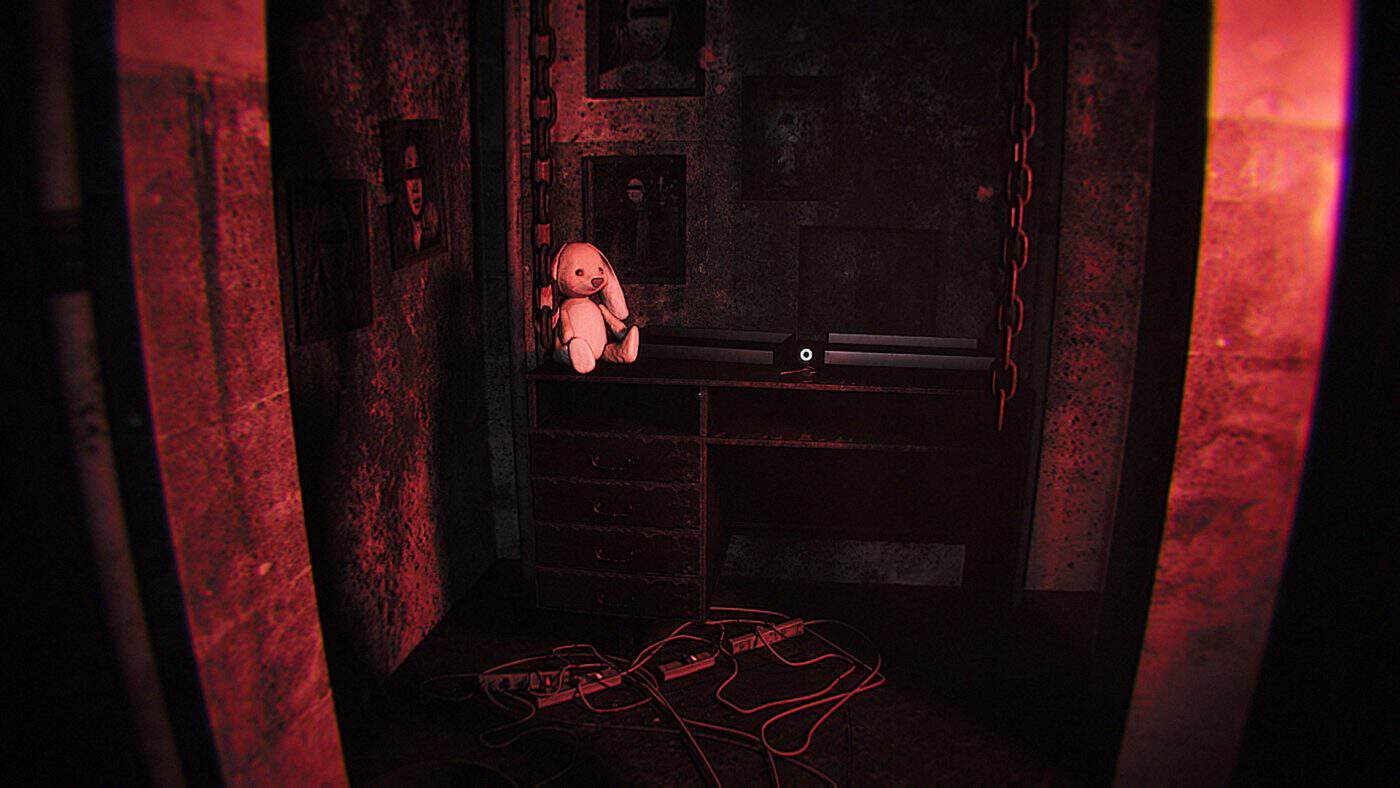
The full game shows further visual refinement compared to the demo, with more detailed environments and lighting that varies significantly between sections: from the near-total darkness of the building’s nighttime corridors to the cold fluorescent light of Anna’s office, to the grey outdoor setting of Felix’s chapter. Each character brings not only a story but a slightly different visual register, and this variation helps sustain attention across perspective shifts.
This variety doesn’t serve purely aesthetic purposes: every environment calibrates itself to produce a specific type of unease. The building’s enclosed, damp spaces work on claustrophobia and altered familiarity; the open or semi-public environments – the office, the outdoors – introduce a different vulnerability, the exposure of someone who has nowhere to hide. The game uses light and space as narrative instruments before it uses them as visual ones.
The sound design remains one of ghostcase’s greatest strengths across their entire output. The rain, the mechanical noises of the building, footsteps in a corridor at an hour when no one should be walking: everything contributes to an atmosphere that rarely relies on direct audio scares and instead builds a continuous undercurrent of perceptual unease. In certain passages, when vision fails or disappears entirely, sound becomes the only navigational tool – a choice that serves first-person immersion far more maturely than a simple amplified jumpscare. The variety across chapters registers here too: the near-absolute silence of certain corridors weighs differently from the sonic tension of the office or the open, indifferent environment of the lake, and ghostcase handles these transitions with real awareness.

A voice in the indie landscape: limits and direction
Dread Neighbor and Dread Flats share the same foundational grammar – domestic spaces that shift, tension that builds through layering, no combat whatsoever – but they are works with different ambitions. The previous title was a more concentrated and claustrophobic experience, entirely built around the pressure of a single space. Dread Neighbor chooses breadth: more characters, more environments, a branching narrative structure. It gains in scope what it concedes in depth, as often happens when a studio decides to expand its range rather than refine what it already masters.
In the current indie horror landscape, ghostcase occupies a recognizable position: part of the current that privileges atmosphere over mechanics, psychological unease over physical shock, environmental storytelling over explicit text. The territory is crowded, but not everyone navigates it with the same awareness. What sets ghostcase apart from much of the comparable output is the precision with which it builds spaces – not visually impressive, but inhabited, credible, capable of communicating a story even when nothing explicit happens. What still eludes them, and what Dread Neighbor doesn’t fully resolve, is the ability to give the player an authentic sense of agency: the difference between living a story and watching it.
Players who will get the most from this title approach horror as a narrative and sensory experience rather than a challenge. Those who expect tension to manage, decisions to make, spaces to interpret freely risk feeling guided where they wanted to explore. This doesn’t amount to an absolute limit – it reflects a deliberate choice. But it helps to know that before starting.

Final thoughts
Dread Neighbor holds no doubts about its own identity, and carries both the strengths and the limitations of something that refuses to compromise. The multi-perspective structure stands as its most original contribution to the genre: telling the same threat through five different lives isn’t just a narrative choice, but a way of giving terror a choral dimension that rarely appears in productions at this scale. The endings system – three possible conclusions, with a true ending that demands attention and resistance – adds a layer of depth that invites returning to the experience with different eyes.
The weaknesses are real but contained. The linearity of the progression weighs in certain passages, and the antagonist – highly effective as a visual presence – loses coherence in the more dynamic sequences, where the title’s realistic register gives way to urgency. These are cracks, not chasms, but they register precisely because the surrounding work is so precise.
What remains after the game ends is the sense of having moved through something built with care and with a recognizable voice. ghostcase knows its territory – inhabited spaces that betray, sound as a weapon, fear that settles instead of exploding – and works it with an awareness that isn’t common. Dread Neighbor isn’t a masterpiece, but an honest work, dense with intention, one that doesn’t exhaust itself with the closing credits.

 7.3/10