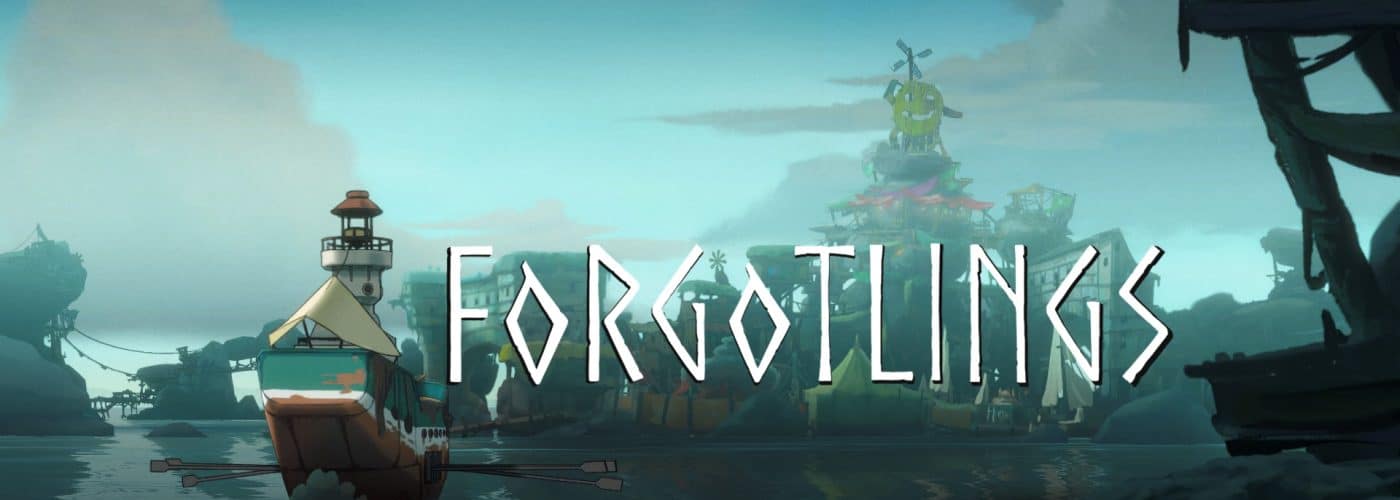
In Forgotlings, being forgotten is not the end. It’s the beginning.

Have you ever truly wondered where the things we forget actually go?
Not in the most obvious, material sense – not in the drawer where we absentmindedly put them, nor on the shelf where they continue to take up space without serving any real purpose. But somewhere else. A place we cannot name precisely. Perhaps in time itself, in that undefined point where something ceases to be part of our lives without ever truly having finished existing. A transition without witnesses. Without sound. Without a clear border to make it recognizable.
Because forgetting is never an immediate act. It draws no firm line, marks no recognizable boundary separating what stays from what vanishes. It is, rather, a slow, continuous, almost imperceptible process that seeps into daily life without ever announcing its arrival.
An object stays where we left it. Still. Consistent with the small order we build around ourselves each day. At first we see it, register it, even in passing. Then our gaze grazes it without pausing. Then, without noticing, avoids it altogether. We do not throw it away; we do not judge it useless. It is still there, unchanged. Yet, little by little, it stops being part of our life. The object does not change – our relationship with it does. We do not move it, do not eliminate it, no longer deem it necessary: we simply stop seeing it.
And this is where the most silent, most radical shift takes place: not the physical disappearance, but the perceptual one. This may be the most human aspect of forgetting: things do not cease to exist when they vanish from our sight, but when our sight stops recognizing them as present.
And so the question changes shape, grows slower, deeper, almost existential: what happens to what exits our gaze? Where does what we no longer see, no longer seek, no longer recognize as part of our world actually go?
It is difficult to accept that the answer might simply be “nothing.” Because intuitively, we sense it is not so. That whatever held meaning, even for a single instant, cannot dissolve entirely. So we imagine an elsewhere. A space that does not belong to our coordinates, but that arises precisely from this fracture: between what we remember and what we let go.

A place that is not entirely real, yet not completely imaginary. And for exactly that reason, necessary. A world built at the margins of memory, among the remnants of what has been forgotten and the traces of what we could not hold onto. It is from this intuition – fragile and extraordinarily powerful – that Forgotlings takes shape, the new work from Danish studio Throughline Games, already the creators of Forgotton Anne. This is a project that does not simply expand the narrative universe of its predecessor but re-reads it from a different emotional distance: more gathered, more intimate, almost exposed in its vulnerability.
The Forgotten Lands, the realm where Forgotlings unfolds, are not merely a backdrop – they are an emotional consequence. A direct reflection of our most daily and most overlooked act: forgetting. Here, objects do not stop. They do not switch off, do not disappear – they persist, transformed, freed from the context that once defined them. Yet they do not become anonymous. On the contrary, they acquire a new identity. They move, organize themselves, build relationships. They seek a meaning that no longer depends on who once owned them, but on what they have become after being left behind. It is a form of existence that resembles, in an almost unsettling way, our own.
Because Forgotlings does not truly speak about objects. It speaks about what remains when we are no longer remembered. It speaks about the fragility of identity, the need for belonging, the fear – deep and often unspoken – of becoming irrelevant. Of existing only as long as someone keeps us in their memory. And of what happens when that gaze moves elsewhere.
All of this unfolds without force, without any attempt to steer the player toward a single emotional response. And for exactly that reason, the experience does not limit itself to being observed. It demands to be traversed. And as one traverses it, something shifts in a subtle way. Not immediately, not obviously. But progressively. One begins to perceive the world not as a collection of separate elements, but as a fragile fabric of presences and absences. One begins to feel the weight of things unsaid, things unseen, things left behind.
This is a sensation difficult to describe, because it does not belong to the game alone. It belongs to something more universal. To our relationship with memory. With time. With what we choose to hold and what we inevitably let go.
It is in transforming an apparently simple question into a deep, persistent, almost intimate emotional experience that Forgotlings finds its most authentic strength.
Because in the end, it is not only about asking where forgotten things go. It is about accepting that, perhaps, they go nowhere. They remain. In a different form. A space we cannot see. A memory that is no longer solely ours.
And it is in this invisible space – fragile and surprisingly human – that the experience truly takes shape. And from here, inevitably, our review begins.


What Remains When You Are Forgotten
More Relationships Than Events
The central theme of Forgotlings – explicitly declared by its creative director – is purpose. Not in the generic sense of “the meaning of life,” but in a far more concrete and material sense: who are you, and what do you do, when the function you existed to fulfill no longer exists? This is a question that Nguyen connects explicitly to contemporary life: in an increasingly connected yet increasingly fragmented world, loneliness proliferates rather than diminishes. And the forgotten objects of the Forgotten Lands – carrying vague memories of the past and a profound desire to reclaim an identity – stand as a precise metaphor for this, far from decorative.
That said, Forgotlings does not preach. It works through diplomatic junctions, through relationships that build or fracture, through choices that quietly redefine positions. The story advances because Fig succeeds – or fails – in shifting relationships between groups. This fundamentally changes how one perceives the narrative: not as a sequence of events, but as a network of constantly shifting balances.
At the center of this network stands Fig, a posing doll – a figure built to assume shapes – who finds herself thrust into a world she does not know, without a defined role, without an articulated past, carrying only a few fragments of memory of what she once was. It is a “new birth,” as the game defines it. And her journey, from this almost tabula rasa starting point to becoming captain of the sentient ship Volare and a point of reference between the tribes, is the story of someone who becomes necessary – in the most functional, least romantic sense of the word.
Fig becomes relevant because the tribes – fragmented, suspicious, unable to speak to one another – discover she carries the capacity to stand in the middle without belonging completely to any side. She is a mediator, and in this sense her narrative arc is, in its own way, radically original by the standards of the genre.
The threat looming over the Forgotten Lands – the Beast, an enigmatic presence prophesied to consume the realm – carries a precise and somewhat unusual narrative function: it acts as a catalyst. It exists to make inevitable what the tribes would prefer to keep postponing – the confrontation between them, the necessity of trust, the difficulty of collaboration. The real conflict in Forgotlings lives within the tribes themselves, in their incompatibilities, in their inability to cooperate. The Beast is simply the pressure that renders that inability unsustainable.
This narrative choice has precise consequences for rhythm and tone. The dialogues aim for no emotional emphasis, seek no memorable line. They build positions. Every conversation carries relational weight; every word chosen through the option wheel – Challenge, Encourage, Empathize, Interrogate – slightly redefines how others perceive Fig, and through her, the entire tribal balance. The choice system does not rest on binary morality of good and evil: it concerns the kind of relationship one aspires to, and the willingness to sustain its consequences over time.
This framework also makes room for lighter writing – at times surreal, almost inevitably so, given that the characters are objects. But that tone never breaks the internal coherence. The quirkiness of the forgotlings is the natural consequence of a world in which a wardrobe with a lamp for a head can hold a philosophically dense conversation, and in which a chess piece can be the most embarrassed and socially awkward member of the crew. Forgotlings manages to be, at the very same moment, strange and credible. That is not a common narrative quality.
The overall result is storytelling that rests on the progressive coherence of relationships. It is an ambitious choice, demanding internal consistency on every level. Forgotlings, through the great majority of its journey, maintains that consistency.


A World Built on the Loss of Function
Here lies the heart of the game. And here, perhaps more than anywhere else, it is worth pausing.
The Forgotten Lands form a system – a cultural, geographic, and metaphysical ecosystem – that descends directly from a single rule, simple and of extraordinary generative power: every being is an object that has lost its original function and must redefine itself. From this rule, everything else follows. The tribes, the conflicts, the architectures, even the aesthetic. Nothing in the design of this world is decorative: everything is consequence.
The basic cosmology centers on Soul – a vital force that accumulates in objects through affection, use, and attachment. The more an object has been loved, the richer its Soul, and the more likely it awakens in the Forgotten Lands as a sentient being. Mass-produced objects, lacking personal history, carry little of it. This is a critique of mass consumerism rendered as narrative system: it does not preach – it is lived through the differences between characters, the implicit hierarchies of the world, and the way certain forgotlings seem more “full” than others.
Four cardinal energies flow through the world, governing its physical laws, traditions, and the sensory character of each area. These energies receive no explicit explanation: one perceives them through color, sound, the visual rhythm of the environments. This is one of the aspects where coherence between design and content becomes most evident – and most refined.
The geography of the world follows the same logic. Areas are physical extensions of cultural conditions. The Pono Market – the first point of contact with the Aufero’s economic system – reads immediately as an intersection space between tribes: chaotic, layered, traversed by tensions running beneath the surface of commercial transactions. The Ancient Park of the Videra holds towers and archives, and its appearance is that of a place built to resist time, to preserve rather than transform. Shelter Island of the Servus carries that defensive, almost insular quality that characterizes spaces built by those who know they are vulnerable. The Waterfalls of the Sonavi speak of continuous exploration, of expansion, of a movement that never pauses long enough to define itself as complete. The Mangroves of the Karus carry the ethereal, suspended quality of places where one retreats to think.


The Agora – the ancient gathering place where the leaders of the five tribes once convened each year to maintain balance – appears in the game in ruins. This is probably the most powerful worldbuilding detail in the entire title: a space whose purpose was dialogue, now inaccessible, stands as the most precise possible materialization of the failure Fig must attempt to correct. You see it, and you understand.
The five tribes form the true axis of the worldbuilding and deserve individual attention, because they represent divergent interpretations of the same crisis: what to do when you lose the purpose you existed to serve.
The Videra – scholars and custodians of knowledge, residing in the Ancient Park – responded to the loss of function with memory. They believe that understanding the past is the key to shaping the future, and they built an entire civilization around archiving, preserving, and transmitting knowledge. Their music, composed by Peter Due, reflects this nature through mathematical structures evoking Bach – logic as a form of care. They stand as the world’s intellectual pole, but also its most fragile one: a culture that lives on what has been risks finding no place for what will be.
The Aufero – innovators and engineers of Serenia – responded with progress. They control the economy, produce the Feros, the dominant currency of the realm, and shape society through commerce and technological innovation, often at the expense of tradition. Forgotlings has the intelligence not to build them as antagonists: they simply represent a response to the problem, with its own coherent internal logic, difficult to reconcile with the others.
The Servus – compassionate and protective, residing on Shelter Island – responded with care. Their purpose is to protect and uplift the most vulnerable, and they do so in a physically isolated space that functions as both refuge and fortress. The game finds them in crisis: the island has fallen under attack from bandits, and the community built to resist the outside world suddenly finds itself exposed. This stands as one of the most effective narrative situations, because it confronts the ideal of care – noble, necessary – with its structural fragility when the world changes.
The Sonavi – adventurous explorers from the Waterfalls – responded with movement. Always expanding, always mapping new corners of the realm, extracting crystals, initiating projects that by their very nature never truly reach completion. Their musical theme moves through many intervals without ever closing completely – mirroring that tendency toward perpetual starting, exploration as end rather than means.
The Karus – mysterious and spiritual, inhabitants of the Mangroves – responded with transcendence. They seek illumination beyond material form, aspiring to merge with the flow of Soul. They stand as the tribe most philosophically distant from the others, and for that very reason the most difficult to approach – and perhaps the most necessary within the overall framework, because they pose the question the others avoid: what if the answer to the loss of function is not finding another one, but transcending the very idea of function?
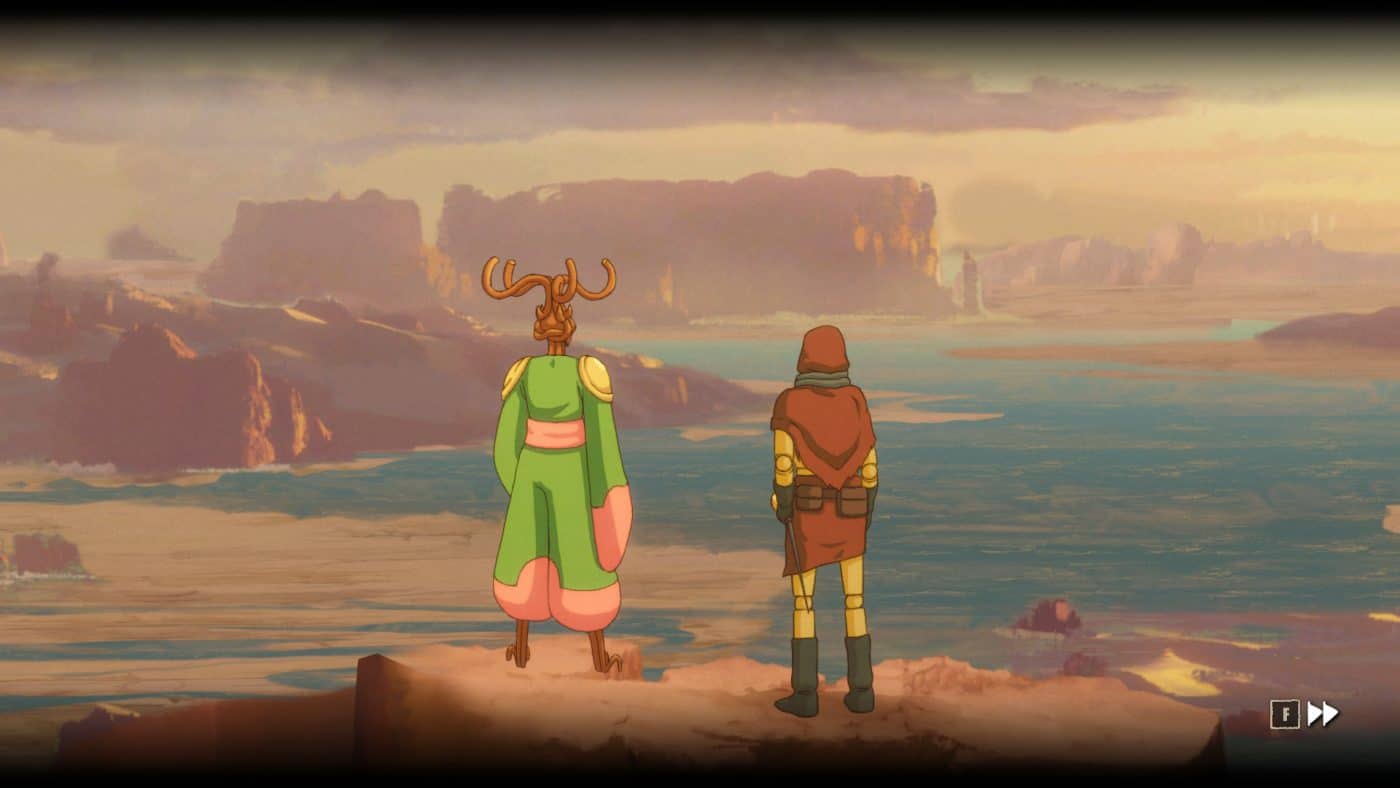
These five responses conflict not because the tribes are unreasonable. They conflict because they are genuinely different, because they arise from coherent internal logics that exclude one another when they meet. Forgotlings has the narrative maturity not to build a tribal antagonist that must be defeated so the others can flourish. The problem is not who is wrong: no one has enough of the right answer to justify ignoring the others.
Into this system enters INA – the board game inspired by chess and Go that permeates the culture of the Forgotten Lands – with a function that extends far beyond that of a simple minigame. INA is a social ritual, a shared language between tribes that otherwise share very little. It can break the ice, establish first contact, create a bond in the absence of other shared tools. It is a shared space that precedes shared values, and that perhaps makes them possible.
Even the bandits and corrupted creatures contribute to the construction of this world. They are the result of a system failure: forgotlings who found no new function, who remain outside every structure, who have become destabilizing forces not out of malice but out of exclusion. The world of Forgotlings is unstable not because it contains evil, but because it offers no guaranteed solutions to anyone.
The aesthetic of the game – the hand-drawn animation, thousands of frames built frame by frame, the tribe-differentiated palettes, the Theatre of Voices soundtrack – renders the system itself perceptible. You can understand a tribe by observing what it is made of, by listening to its music, by reading the architecture of its space. The structure of the world can be read, and this – in a game about memories, identity, and lost functions – is perhaps the most coherent choice the creators could have made.


Characters as Variations on a Condition
The characters of Forgotlings each carry a different response to the same question that runs through the entire game, and that response is inscribed in their body – in the object they were before awakening. This is the very foundation of their design, and understanding its logic allows one to appreciate its effectiveness.
Fig offers the most evident and most paradoxical example. A posing doll exists to assume poses, to embody forms that others impose upon her. Her narrative arc – from new birth without a role to captain of the Volare, from passive object to recognized agent – is the most radical transformation the game could have imagined. She becomes a node: the point through which the tribes can speak to one another, the mediator no one would have thought to seek in a posing doll.
It is interesting, and not without meaning, that critics consider her voice acting slightly flat compared to other characters. There is something coherent in the idea that the mediator is the neutral space onto which other voices project their stories. Fig is a canvas – and a canvas works best when it carries too little of its own voice.

Dilla combines scarf and camera, and this pairing – protection and memory – is not accidental. To wrap means to protect, accompany, create physical continuity. To record means to hold onto experience, to prevent it from dispersing. In gameplay, Dilla offers active support through blitz abilities and enemy blinding. On the narrative level, she lends coherence to the journey, binds experiences together, and prevents Fig’s path from fragmenting as much as the world she seeks to unite.
Blow – a collection of sentient bellows – provides the necessary counterweight. The breathy quality of the voice, always on the edge of breath, stands as the most praised vocal performance in the entire cast. Something is extraordinarily effective in the idea of a character whose very existence ties to the vital breath, who speaks as if always on the verge of exhausting it. Energy and fragility in the same body, in a balance that keeps the system alert and prevents the narrative from flattening onto its own coherence.
The Volare – the sentient ship that serves as operational base and narrative hub – is perhaps the most interesting character of all, precisely because she is not technically a character in the conventional sense. She is a space. A space that functions, and that houses within itself a small society: a microcosm of the Forgotten Lands where radically different figures coexist, each carrying their own variation on the theme. The headless mannequin continually questions Fig’s motivations, embodying the reflection on identity in a body that literally has no place to locate it. The chess piece carries the logic of the game as a relational tool, yet struggles to deploy it outside the codified context of an actual match. The princess hat in the midst of an identity crisis carries within it the entire question of power structures and social expectations inscribed in the object it once was. The broken drill seeks a purpose – perhaps the most explicit among all in representing the central theme of the game.
The Volare is the place where differences coexist – not resolve, but coexist – and this is why the journey it hosts makes sense. It is the silent, daily proof that cohabitation is possible even among profoundly different things.

The secondary characters follow the same logic. The literary clubs – groups of forgotlings born from books and letters – preserve written memory and transform it into communal cultural practice. The wardrobe with a lamp for a head combines archiving and illumination: it illuminates what it stores. The bandits – forgotlings who found no new function – stand as the negative of the system: proof that the Forgotten Lands guarantee solutions to no one, and that exclusion produces instability as surely as open warfare.
And then there is the Beast – the game’s antagonist, or at least what it should be. Its construction is deliberately reticent: scarce characterization, discontinuous presence, no memorable dialogue. This is a choice consistent with the overall narrative framework. The Beast is the form the crisis of the Forgotten Lands assumes when it becomes unsustainable. Fragmentation, distrust, and the inability to cooperate preexist in the world long before it arrives. The Beast is their consequence, their accelerant, the moment when further delay is no longer possible.
Coherence as Narrative Form
Forgotlings brings together narrative, worldbuilding, and characterization as direct expressions of a single conceptual premise, and in this deep coherence – more than structural, almost organic – lies one of its rarest qualities, as well as one of the most delicate to sustain over time. Nothing within the work appears as a mere functional cog or accessory element: every choice, every environment, every presence the player encounters along the way seems to arise naturally from a single common root. It is as though the world itself was not designed “from the outside in,” but “from the inside out,” allowing a single idea to expand until it touches every component.
That idea takes the form of a question as essential as it is destabilizing: what remains of us when what we existed for ceases to make sense? This question runs through the entire experience without ever being made explicit, without ever imposing itself as a mandatory interpretive key. Forgotlings does not state it, does not explain it, does not resolve it. It allows it to emerge, slowly, in the details, in the silences, in the relationships with other forgotten objects. And it is precisely in this choice – apparently subtractive, in reality deeply deliberate – that the game finds one of its most authentic voices.
The answer, if one can call it that, never arrives directly. There is no moment where the game stops to “say” what it thinks. Instead, it seeps through the way the world lets itself be traversed. It lives in the choices made, in the dialogues that never seek the definitive line but build positions; in the relationships that draw closer or fracture almost imperceptibly; in the spaces that tell what they were before telling what they have become. It lives in the characters, above all, where this tension takes form: in their hesitations, in their attempts at self-redefinition, in their search for a new way of existing.


Every tribe develops its own response to that original loss, and does so according to a coherent internal logic, never caricatured, never reduced to mere symbol. In the same way, every crew member of the Volare carries a personal variation, more intimate, more fragile, at times even contradictory. And in this plurality of perspectives, Forgotlings makes its most mature gesture: it refuses the very idea that a right answer exists. There is no privileged direction, no solution the player is steered toward. What the game stages is, rather, the coexistence – complex, unstable, often demanding – of different responses, all legitimate, all incomplete, all profoundly human.
Here the experience changes nature. The difficulty lies not in finding an answer, but in recognizing the value of others’ answers. In sustaining them even when they do not align with one’s own. In attempting, above all, to allow them to coexist without reducing them, without forcing them into an artificial synthesis. This tension never fully resolves, and for exactly that reason it accompanies the player consistently, silently but persistently. Forgotlings does not ask one to “win” this conflict: it asks one to inhabit it.
And so the narrative progressively stops being a sequence of events to follow and becomes a space to traverse. A fabric of relationships, of precarious balances, of small shifts that, accumulating, modify the overall meaning of the experience. Every choice, even the most minimal, does not close a possibility but opens others, imperceptibly redefining the way the world responds to one’s passage.
This is a more complex idea than it might appear on the surface, and for exactly that reason even more significant. Because Forgotlings sustains it with a coherence that is truly rare, without yielding to the temptation of simplifying it, without introducing reassuring solutions that might attenuate its weight. It seeks no shortcuts, does not translate complexity into a more easily digestible message: it preserves it, protects it, entrusts it to the player’s gaze and sensibility.
This is an authorial choice that requires measure, control, and above all, trust. Trust that whoever plays is willing to remain in a space of ambiguity, to confront questions that offer no immediate answers, to find value precisely in what goes unresolved. And it is in this trust – rare, almost countercultural – that Forgotlings finds a fundamental part of its strength.

The Gameplay: The Strongest and Most Fragile Element of the Entire Adventure
At first reading, the title of this section may seem almost an oxymoron, an unstable equilibrium suspended between two poles that seem to repel one another. Yet, in the case of Forgotlings, it is precisely in this silent tension – never truly resolved, never completely recomposed – that one of the most authentic keys to its ludic identity reveals itself. The gameplay here refuses any simplification: it is not simply “strong” or “weak,” it does not reduce itself to a stable category. It is something more nuanced, almost vulnerable. Something surprisingly human.
It is gameplay that does not impose, but exposes itself. It does not seek to dominate the experience, but to traverse it, accepting the risk of not always living up to its own ambition. And it is precisely in this exposure, in this readiness to show itself imperfect, that it finds a rare form of authenticity. Because Forgotlings does not build a system designed to impress, but a language that attempts, with delicacy and stubbornness, to serve as a medium for something greater: a world, a vision, a sensibility.
This quality does not register immediately. It requires time, attention, a certain willingness to listen. Something that emerges slowly, through that progressive sedimentation of sensations that characterizes the most reflective experiences. In the early hours, everything flows naturally: interaction feels organic, actions find a meaning, choices seem to carry real weight. The player moves through the game world with the perception that the ludic and the narrative gesture coincide, that “playing” means, in some way, “understanding.”

But it is precisely when this harmony begins to consolidate that the subtler cracks surface – not obvious breaks, but slight slippages, misalignments, zones of shadow. There, the gameplay reveals itself for what it truly is: a system characterized by a constant tension between intention and result, between what it aspires to be and what it actually manages to express. Rather than hiding this distance, Forgotlings accepts it and transforms it into an integral part of its identity.
To understand this fully, one must shift perspective. Abandon the idea of gameplay as an absolute criterion of judgment and accept it, instead, as one element of a broader equilibrium. In Forgotlings, the game system is not the protagonist: it is a medium. A connective tissue that holds narrative, artistic direction, and emotional experience together. It does not withdraw, but it scales back. And it is precisely in this gesture of subtraction that its strength, paradoxically, reveals itself.
This philosophy takes form in a structure built around three pillars – combat, exploration, and relationships – that coexist in a delicate, never static balance. The Choice Wheel is its most visible manifestation: not a simple functional tool, but a declaration of intent. It does not merely offer options; it proposes attitudes, ways of being in the world. To challenge, encourage, empathize, interrogate: four verbs that define not just actions, but perspectives, sensibilities, possibilities of relationship. Here Forgotlings reaches one of its clearest expressions, translating the complexity of its narrative dimension into ludic form.
Yet it is the moment one enters into detail that this coherence reveals its cracks.
Violence as Last Resort
The combat, in particular, presents itself as a restrained, almost hesitant component. It is not absent, but it is never truly central, never fully developed. The clashes are few, often marginal, built around an essential system – attack, defense, dodge, blitz – that remains readable but rarely evolves into something genuinely deep. Enemy variety is limited, patterns tend inevitably to repeat, and the difficulty level, generally contained, almost never provokes real tension.
But what strikes most is the sense that all of this is, at least in part, intentional. Forgotlings shows no interest in making combat a primary source of satisfaction. On the contrary, it relegates it to a residual choice, almost as if underlining – through gameplay itself – that violence is a possible response, but rarely the right one. This is a coherent, thematically strong position, but one that inevitably leaves the ludic side exposed, creating a distance between intention and engagement.


The Forgotten Lands
If direct conflict represents the most fragile side of the ludic dimension, exploration reveals itself as its broadest breath, its most authentic space. Here Forgotlings finds one of its purest expressions. The world does not impose or direct: it allows itself to be discovered. It invites rather than guides. Every environment takes shape as a place to inhabit, not a challenge to overcome. The Forgotten Lands open slowly, revealing layers of meaning that emerge through sustained presence.
To traverse them means to enter a slower rhythm. It is not so much a matter of “clearing” the space as of listening to it. Imperfections exist here too, of course – moments where the response to controls falls short, or where variety could be greater – but these slide into the background before the quality of the immersion.
INA and the Art of Mutual Understanding
Yet it is in the management of relationships that everything finds a more complete form. Here gameplay definitively stops being a set of rules and becomes human experience. To dialogue is not to select a response – it is to attune oneself. The options the Choice Wheel offers – to challenge, empathize, encourage, interrogate – do not represent simple narrative branches, but genuine emotional stances. Every choice is a positioning. A way of existing within the game world.
And what makes this system so powerful is its capacity to return consequences that are not always immediate, nor always evident. Relationships build over time, transform. They require presence. It is not enough to “choose well”: one must understand. And, at times, accept not having all the answers.
This is where one of the most original and accomplished intuitions of the entire design finds space: INA, the board game that, in the Forgotten Lands, does not represent a simple ludic interlude, but a genuine primary form of communication. An element that transcends the function of “minigame” to transform itself into a shared, layered language, deeply rooted in the very culture of this suspended world.
INA is not a diversion, nor filler between narrative moments. It is, rather, an alternative relational code, a silent grammar through which forgotlings meet, recognize each other, and above all understand one another. A mediated confrontation, but no less authentic for that. To play INA means temporarily abandoning the linearity of action to enter a different mental space, more rarefied, almost meditative. It is an invitation to a suspension of rhythm, to reading the other through patterns, moves, pauses. Every match becomes a small relational ritual, where time expands and tension arises not from speed but from the depth of choices.
In this shift of register – from direct confrontation to ludic mediation – Forgotlings manages to suggest with great sensitivity a concept as simple as it is powerful: a relationship is never a single, immediate gesture, but a process. A fragile equilibrium that builds through different modes, at times even unexpected ones.
And it is precisely in the slowness of INA, in its reflective and almost contemplative nature, that the game finds one of its most significant moments. Because it reminds us that to communicate does not only mean to respond or react, but also to accept silenceas an integral part of dialogue.
This is a profoundly deliberate design choice, one that may leave those seeking more immediate, direct, or “gamey” interaction in the traditional, performative sense feeling puzzled. But it is precisely this renunciation of immediate gratification that gives the work a distinctive voice, a rare internal coherence, and a depth that does not exhaust itself in the moment of play, but continues to settle over time, well beyond a single session.

Art Direction
Animation
The most radical choice Throughline Games makes in Forgotlings is also the most silent: everything is drawn by hand, frame by frame. Thousands of frames, each built one after another, through a methodology that belongs far more to traditional animation than to the contemporary video game industry. The result is a game that, in motion, carries the visual quality of an animated film.
What strikes, however, is not only the quantity of the work, but the direction of its choices. Throughline Games already developed a precise visual philosophy with Forgotton Anne, and Forgotlings advances it with greater ambition and scale. From the development of the first title, Nguyen had chosen not to use the squash and stretch principle – the classic animation technique that deforms bodies to emphasize weight and movement – because it would have compromised the credibility of the world. A sock or a posing doll that deforms like a Disney character immediately stops being an object: it becomes a symbol, a cartoon, a surface onto which preconstituted narrative expectations project themselves. Forgotlings wants something different: it wants its characters to remain recognizable as objects, and at the same time to acquireexpressiveness and personality without betraying that nature.
The solution is elegant: the characteristic properties of each object become its expressive tool. A bellows expands and contracts according to its real mechanics – and that mechanics becomes emotion. A scarf wraps, unfurls, creates postures that need neither arms nor face to communicate something. A posing doll assumes codified poses – and that codification, in a character like Fig, paradoxically becomes the foundation of her narrative arc. The physicality of the objects is not an obstacle to character design: it is its foundation.
This holds for the secondary characters too, where the principle applies with a variety that becomes one of the most genuine pleasures of the experience. Every forgotling encountered during the adventure reads immediately from the object it once was, and that readability carries an implicit story that precedes any dialogue. The wardrobe with a lamp for a head needs no introduction: you see it, and you already know something about it.
Many players and reviewers have evoked Studio Ghibli – and Miyazaki in particular – to describe this quality of the world. The reference is understandable: there is a density of detail in the backgrounds, a care for the secondary corners of environments, and above all that idea of a world inhabited and alive independently of the player’s attention, which recalls that sensibility. And it is an inheritance that Throughline Games has declared as a source of inspiration. Yet the visual style of Forgotlings carries a distinct identity that does not reduce to that label. Where Miyazaki tends toward an organic softness – curves evoking nature, warm palettes, an almost dreamlike fluidity – Forgotlings carries a more material and contrasted aesthetic, with a painterly quality closer to northern European illustration: more weight, less gliding, a certain functional roughness in service of the discourse. A more precise reference, cited by Nguyen himself, is Satoshi Kon – for his capacity to treat the everyday with visual seriousness without abandoning the fantastic dimension, and for that attention to detail that is never decorative but always in service of world construction.


Worldbuilding as Visual System
The most significant difference from Forgotton Anne – which unfolded primarily within a unified urban environment – is the geographic and chromatic variety of the Forgotten Lands. Forgotlings is a fragmented world, and its fragmentation reads first and foremost visually: each area carries its own palette, a distinct atmospheric register, a quality of light that makes it recognizable even before one grasps its cultural logic.
The Videra zones in the Ancient Park carry the dusty, vertical quality of archives – desaturated colors, filtered light, a visual density suggesting layers upon layers of accumulated material. The Sonavi territory at the Waterfalls is brighter, more open, traversed by water and reflections; it is an environment in motion, coherently with a tribe that never stops. Shelter Island of the Servus carries a defensive quality that reads in its architecture – narrow spaces, vegetation as barrier, a sense of refuge that also means isolation. The Karus Mangroves carry the ethereal, almost unreal luminosity of contemplative spaces; light arrives there differently, as if filtering from a direction one cannot quite locate. Serenia of the Aufero bears the colors of commerce and production: metallic, contrasted, with a visual precision that mirrors the tribe’s engineering culture.
This differentiation is not purely aesthetic. The four cardinal energies flowing through the world – not explicitly named in the game, but perceptible through the sensory dimension – manifest visually as variations of tone, saturation, animative rhythm. The player does not identify them as concepts, but feels them as atmospheres. This is the function the visual design serves in Forgotlings: rendering the structure of the world perceptible without making it explicit.
The character design of the tribal leaders and main characters follows the same logic of internal coherence. Fig, as a posing doll, carries the visual quality of an object built for representation – measured movements, postures recalling catalog poses, a sober elegance that contrasts with the urgency of the situations she faces. Dilla, with her dual nature of scarf and camera, carries an animation that suggests both the softness of fabric and the mechanical precision of optics. Blow, made of bellows, moves with a pulsating quality, as if always about to expand or deflate – and that quality already constitutes his entire characterization before he opens his mouth.
The artbook included in the Collector’s Edition – over a hundred pages of concept art, environmental studies, and character sketches – documents a visual development process that sought no shortcuts. The preliminary studies reveal how much work underlies every apparently obvious choice: how does one make a hat expressive? How does one give a chess piece a posture communicating social embarrassment? These are not rhetorical questions, and the answers the team found were not given.


Sound Design and Soundtrack
The soundtrack of Forgotlings comes from Peter Due, the Danish composer who worked with Throughline Games, in collaboration with the Theatre of Voices – the vocal ensemble directed by Paul Hillier, Grammy Award winner and known for significant film collaborations including Denis Villeneuve’s Arrival. This is a choice that says much about the project’s ambitions: bringing into an indie video game an orchestral and choral quality that normally belongs to high-end film production.
The result is a soundtrack that does not merely comment on the action, but builds autonomous layers of meaning. Each tribe carries a musical theme, and those themes take shape to embody the nature of the tribe itself with a precision that goes well beyond simple emotional coloring. The Videra theme deploys mathematical structures evoking Bachian polyphony – logic, rigor, knowledge as a form of order. The Sonavi theme, by contrast, moves through wide intervals without ever resolving completely, mirroring that tendency toward perpetual exploration that never finds a satisfying point of closure. The music does not describe the tribes: it is structurally analogous to them.
This compositional approach – which Due developed by identifying leitmotifs for each significant thematic element, from the tribes to the characters to the prophecies – creates a sonic fabric in which the attentive listener begins to recognize connections not explicitly narrated. A motif that returns transformed, a tribal theme that interweaves with that of a specific character: the music carries narrative information autonomously from text and image.
The contribution of the Theatre of Voices adds a dimension that instrumental soundtracks alone could not have achieved: the human voices, processed and layered, carry an immediate and visceral emotional weight. In certain moments of the adventure, particularly in the denser narrative passages, the choral component grows more present and itself becomes a dramaturgical instrument. It is not background: it is part of the experience.
The soundtrack has received concrete recognition: at the NYX Game Awards 2026, Forgotlings won two gold and three silver awards, with the developers explicitly thanking Peter Due among their first public acknowledgments. That music occupies a central place in the game’s value is a point of consensus across virtually all criticism: even the most lukewarm reviews on the gameplay dimension agree in identifying the sound design as one of the title’s absolute strengths.

Sound as Architecture
Beyond the soundtrack, the overall sound design of Forgotlings operates with the same logic of coherence that characterizes the visual dimension. The ambient sounds of each area build to reinforce the cultural identity of the tribe inhabiting it: Shelter Island of the Servus carries a soundscape including water, wind, and that acoustic quality belonging to spaces open to the sea yet enclosed by a defensive geography. The Videra areas carry a dense silence, broken by sounds of pages turning, of ancient mechanisms, of the kind of quiet that belongs to places where something is being preserved. The Aufero zones ring of metal, of production, of an activity that never interrupts.
This care in ambient sound design contributes to something precise: the player needs no codex to understand where they are. The sensory perception of the place precedes its conceptual comprehension, and this is not a trivial design result.
Voice Acting
Forgotlings features complete voice acting, and the choice of a full vocal cast for an indie title of these dimensions represents a significant production commitment – all the more so because the number of characters the player interacts with is considerable, and each carries a voice designed to be consistent with the object it once was.
The result is uneven, but in an interesting way. The best performances are those where the physical nature of the original object gave the voice actor a precise anchor point. Blow is the most cited case in critical discourse: the breathy voice, always on the edge of breath, stands as the most praised performance in the entire cast, and it works because it arises from a concrete constraint – a bellows breathes, literally, and that mechanics becomes characterization. The result carries an immediate and recognizable personality that stays with you.
Fig, by contrast, some reviewers consider slightly flat compared to other characters. This is a grounded critique, and it merits careful consideration: Fig’s voice at times lacks the emotional force that certain narrative moments would require. That said, as already noted in the characters section, a certain coherence exists in the idea that the mediator carries a more neutral voice – and the choice may have been intentional. It remains a perceptible limitation, but not one that compromises the overall cohesion of the cast.
The other members of the Volare crew and the tribal leaders contribute to building a vocal ensemble that, taken as a whole, works. The socially awkward chess piece carries a rigid, measured diction that suits his nature. The headless mannequin carries an interrogative quality in speech that mirrors his narrative function. The princess hat oscillates between the authoritative and the disoriented – coherently with the identity crisis it embodies.
The overall voice acting does not reach the levels of excellence of certain high-end narrative titles, but carries a consistency of approach that one notices and appreciates: the sound direction clearly worked to ensure that every voice took shape from the object, not as an afterthought. For an indie production of this scale, this is a result that deserves recognition.

Themes and Moral Message
Purpose
Alfred Nguyen has declared explicitly that the central theme of Forgotlings is purpose. And he has done so in terms that connect the game directly to the contemporary condition: in an increasingly connected world, loneliness does not diminish. The fragmented tribes of the Forgotten Lands, unable to speak to one another despite sharing the same existential crisis, stand as a recognizable metaphor.
But Forgotlings is more precise than that. The theme is not simply “finding a purpose”: it is the question of what happens when the purpose you once had no longer exists, and of the different strategies one can adopt to respond. The five tribes embody five of those strategies – memory, progress, care, exploration, transcendence – and none is presented as the right answer. They are all legitimate. They are all partial. And their incompatibility does not arise from anyone’s malice, but from the internal logic of each position carried to its natural consequences.
This is the most mature thematic nucleus of Forgotlings, and the one that distinguishes it from most games with similar ambitions: it does not offer a solution to the problem it poses. Fig does not find the answer. She builds the conditions for different answers to coexist. It is a subtle distinction, but narratively substantial.
The Critique of Consumerism as Structural Premise
Deeper roots of this thematic framework reach into Forgotton Anne, and Nguyen has articulated them with precision in his interviews (you can read ours here). The starting point is a reflection on mass consumerism and its relationship with empathic capacity: when objects get mass-produced and replaced with indifference, a throwaway logic takes hold that ends up applying to people too. One stops perceiving the value of what one has until it is lost.
This is not a new theme in contemporary animation and comics. Gachiakuta – manga and anime series by Nail Fujimoto – explores adjacent territory: a world where not only objects but people considered useless by society get cast into an underground dump. The parallel with the Forgotten Lands is immediate, but the two works traverse it in different directions. Gachiakuta is a story of rage and revenge, built on the conflict between those who have been discarded and those who decided to discard them. Forgotlings shifts the focus: the forgotten objects seek neither revenge nor recognition from those who abandoned them. They seek new meaning within themselves, in the relationships they can build, in the society they have forged. It is a quieter posture, and in certain respects more difficult to sustain narratively – because it requires the question of identity to find a response without an antagonist to confront.

In Forgotlings, this critique of consumerism renders itself structural through the cosmology of the Soul: mass-produced objects, lacking personal history, carry less vital force. They are less “full” forgotlings, less present. The value of affection and use – the fact that someone held something with care, attributed meaning to it – translates literally into quality of existence. This is a system that makes a philosophical position visible and tangible without declaring it.
But this critique is not simplistic. Forgotlings does not present consumerism as pure negativity to be rejected: the Aufero, the tribe embodying economic and productive logic, are complex characters with their own internal rationality. The game recognizes that this logic responds to real needs, that progress and innovation carry value – and that the problem is not production in itself, but the loss of relationship between those who produce, those who use, and what they produce.
Belonging, Division, Collective Responsibility
The third thematic axis – probably the most explicit in Nguyen’s own words – is that of belonging in a divided world. Forgotlings came out in February 2026, and its creative director publicly acknowledged that the themes of the game resonate with the historical moment in ways the team itself had not planned. A story of tribes that have stopped speaking to one another, of an ancient meeting place reduced to ruin, of a protagonist who must rebuild fractured trust: these are images that find easily legible analogies in the contemporary landscape.
The game does not propagandize, and does not seek to resolve the problem it poses through ideological shortcuts. What it offers, instead, is a reflection on the process of reconciliation itself: how difficult it is, how much it demands one to give without guarantee of reciprocity, how much it depends not on grand gestures but on the accumulation of small choices. Fig does not unite the tribes with a speech. She unites them game after game of INA, conversation after conversation, choice after choice. Trust builds incrementally, or it does not build at all.
This is a message the game never states directly. It embodies it in its mechanical structure, in the logic of the dialogue system, in the way relationships shift over time. And this is, probably, the most honest form a message of this kind could take.

 8.3/10