A chilling survival horror where the threat above is just as terrifying as the monsters on the ground.

In an increasingly crowded landscape of independent horror games, establishing a distinct identity is no easy task. With Darker Skies, Steel Arts Software seeks to do precisely that, reimagining the enduring sci-fi imagery of The War of the Worlds through a modern survival horror lens. The result is an experience built on oppressive atmosphere, sustained tension, and an overwhelming sense of human fragility. From the outset, the game makes its intentions clear.
Set in the aftermath of a catastrophic alien invasion, Darker Skies unfolds across a broken world where humanity has been reduced to scattered remnants of its former self. Cities are abandoned, environments feel stripped of life, and even the sky becomes a visual reminder of an ever-present threat. This constant sense of danger quickly defines the game’s identity.
Rather than leaning on spectacle or relentless action, Darker Skies places far greater emphasis on atmosphere and psychological pressure. This is not a survival horror game driven by explosive combat or constant adrenaline, but a slower, more deliberate descent into isolation and fear. Survival depends less on confrontation than on caution, exploration, and the ability to adapt to a hostile world in which vulnerability is central to the experience.
The influence of classic science fiction is unmistakable. Towering alien machines, shattered landscapes, and the overwhelming insignificance of humanity all evoke the legacy of H. G. Wells, yet Darker Skies avoids feeling like a mere homage or straightforward adaptation. Instead, it filters those familiar ideas through a darker, more contemporary sensibility, using them as the foundation for a more intimate survival horror experience. Just as striking is the game’s profound sense of isolation.
The protagonist moves through silent ruins filled with distant mechanical echoes, decaying structures, and the unmistakable aftermath of societal collapse. There is little suggestion of organised resistance, and even less of hope. The world already feels lost, leaving the player as a fragile survivor in an environment that has turned entirely hostile.
Tonally, Darker Skies sits in the uneasy space between sci-fi horror and psychological survival horror. Its fear does not stem solely from alien creatures or monstrous machines, but from a pervasive sense of helplessness that runs through the entire experience. Even the sky itself becomes a source of dread – vast, oppressive, and governed by forces far beyond human comprehension.
The pacing reinforces this atmosphere effectively. Darker Skies begins at a measured, deliberate pace, allowing its world to settle before direct danger is introduced. Tension builds gradually through environmental storytelling, sound design, and exploration, giving the experience a carefully controlled rhythm that favours immersion over spectacle.
Conceptually, Darker Skies draws on many of the pillars of classic survival horror: limited resources, careful movement, and fear of the unknown. Yet its post-apocalyptic sci-fi setting gives those familiar ideas a distinct identity, setting it apart from more conventional horror experiences built around supernatural threats or familiar monster archetypes.
Perhaps most importantly, the alien invasion serves as more than a physical menace. It also stands as a symbol of psychological collapse and social disintegration. Darker Skies presents a world stripped of control and overrun by forces that are both incomprehensible and vastly superior, and that is what gives its horror such a sharp and effective edge.


A Survival Horror with a Strong Authorial Voice
Discussing the team behind Darker Skies means looking at a project that sits within the modern independent games landscape – a space where creative intent, artistic identity, and atmospheric design often outweigh the constraints of budget and scale. In recent years, some of the most distinctive survival horror experiences have emerged from the indie scene, where developers are afforded greater freedom to pursue personal, experimental visions outside the conventions of mainstream blockbuster production.
With Darker Skies, Steel Arts Software shows a clear commitment to atmosphere-driven design, with a particular focus on psychological tension and the depiction of a world in collapse. The project reflects a strong authorial intent: not simply to deliver an action-oriented horror experience, but to build a cohesive sensory and narrative framework built around isolation, vulnerability, and sustained unease. Its influences are equally significant. Drawing from classic science-fiction iconography and post-apocalyptic imagery inevitably evokes comparisons to foundational works such as The War of the Worlds.
However, Darker Skies avoids feeling derivative. Instead, it repurposes these references as structural inspiration for a more contemporary form of survival horror – slower, more restrained, and grounded in psychological rather than purely physical threat.
From a production standpoint, the game reflects the ambitions typical of contemporary indie horror. Lacking the resources of a major AAA studio, it leans instead on environmental storytelling, cohesive world-building, and a strong commitment to atmosphere. In a genre like horror, that approach often carries more weight than technical spectacle alone.
Steel Arts Software also places clear emphasis on establishing a recognisable visual and thematic identity. As many modern horror games converge around familiar structures and aesthetics, Darker Skies aims to set itself apart by blending survival mechanics with alien invasion science fiction, leaning more toward apocalyptic sci-fi than conventional supernatural horror.
Notably, the game adopts a deliberately contained narrative scale. Rather than framing events around global salvation or large-scale resistance, Darker Skies focuses on individual survival within an overwhelming and uncontrollable environment. This perspective reinforces its central thematic focus on human fragility, positioning the player not as a saviour, but as a witness to a world that has already shifted beyond recovery.
At its core, the design philosophy appears to revolve around the perception of threat. The alien presence is not merely an enemy faction, but a transformative force that has reshaped the world itself. Sustaining this pressure demands careful control of pacing and environmental tone, ensuring that oppression remains constant without slipping into repetition or weakening tension.
As with many independent games, certain limitations are also an inherent part of the package. Technical constraints, reduced content scope, or occasional rough edges may surface and affect the overall experience. Even so, horror has repeatedly proven that strong direction, cohesive atmosphere, and a clear artistic vision can outweigh such constraints when executed effectively.
Finally, Darker Skies is clearly aimed at a specific audience: players drawn to slower, more atmospheric, and reflective forms of survival horror. It makes no attempt to compete with action-heavy or cinematic interpretations of the genre. While this inevitably narrows its mainstream appeal, it also reinforces its identity, allowing the experience to remain stylistically focused and tonally consistent throughout.


A Fragile Human Story in an Inhuman World
The narrative of Darker Skies unfolds in the aftermath of a catastrophic alien invasion, blending post-apocalyptic science fiction, survival horror, and sustained psychological tension. Rather than focusing on large-scale conflict or a traditional heroic resistance, the game centres on the fragile, moment-to-moment survival of those left behind in a world reshaped by alien dominance.
The setting is defined by an overriding sense of finality. The invasion is not framed as an ongoing conflict with any meaningful prospect of reversal, but as an event that has already permanently reshaped the world. Cities lie abandoned, infrastructure has collapsed, and once-familiar environments have become alien and unrecognisable. This framing establishes a stark, desolate tone that stands in deliberate contrast to more traditional sci-fi narratives built around organised resistance or eventual victory.
Within this context, protagonist Jack moves through the world with survival as his only objective. This grounded, human-scale perspective is one of the narrative’s key strengths. There is no implication of a chosen hero capable of turning the tide; instead, Jack is positioned as an ordinary individual navigating an incomprehensibly larger and more hostile reality. The result is a narrative that consistently reinforces vulnerability, highlighting the vast imbalance between human fragility and alien superiority. The protagonist is not fighting to win a war, but simply to endure within a world governed by forces beyond understanding.
The influence of The War of the Worlds is deeply embedded in the game’s DNA. Towering alien machinery, threats descending from the skies, and a pervasive sense of human inferiority all recall H. G. Wells’ seminal work. Yet Darker Skies reframes these concepts through a contemporary horror lens, transforming its science-fiction foundations into something far less spectacular – a vessel for dread, isolation, and psychological collapse.
Structurally, the narrative unfolds at a deliberately restrained pace. Rather than front-loading exposition about the invasion or the global situation, the game builds its world gradually through exploration, environmental detail, scattered documents, and brief encounters. This indirect storytelling approach is particularly effective in survival horror, enhancing immersion and allowing the setting to emerge organically rather than being explicitly explained.
A central thematic thread is the fear of the unknown. The alien presence is not simply an opposing force, but an ambiguous and largely incomprehensible phenomenon whose motives and nature remain deliberately obscure. This uncertainty sustains a constant undercurrent of tension and reinforces the game’s oppressive atmosphere.
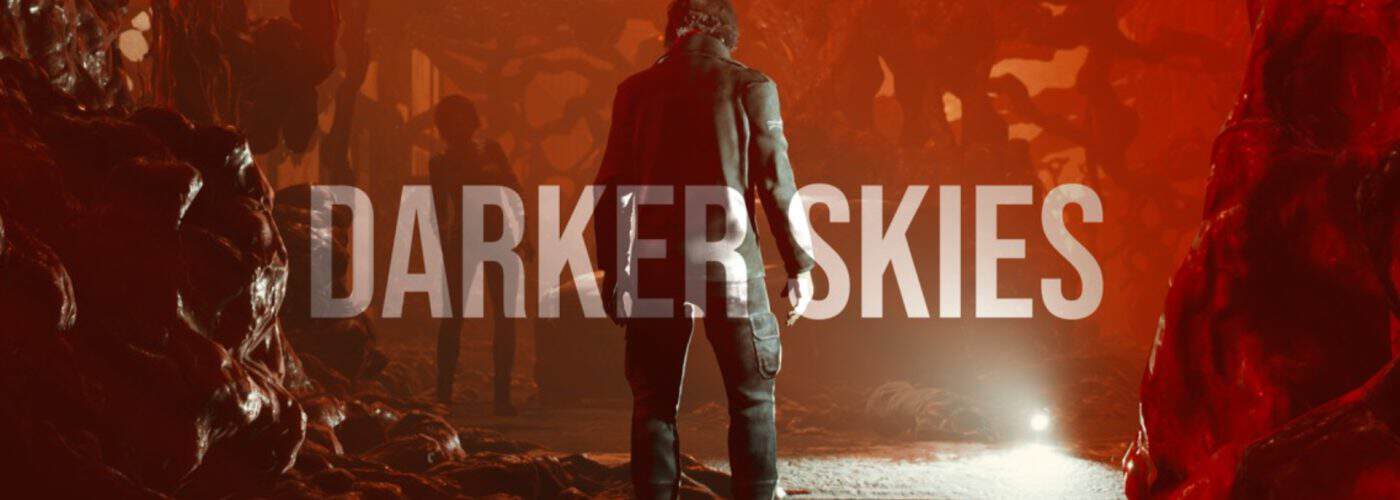
The sky itself becomes a key symbolic element. As the title suggests, Darker Skies redefines it not as a symbol of openness or freedom, but as a permanent source of threat. Alien forces dominate the space above, turning even open environments into zones of exposure and vulnerability, reinforced by a spreading red contamination across the world. It is a stark inversion that strips away any remaining sense of safety or sanctuary.


A Modern Take on a Classic Concept
The narrative of Darker Skies is built around a carefully defined vision of horror – one driven not by sudden shocks or relentless jump scares, but by a slower, more existential sense of dread rooted in humanity’s helplessness when confronted with forces far beyond its understanding. Through its post-apocalyptic setting and the alien invasion that dominates its world, the game uses science fiction not simply as spectacle, but as a vehicle for exploring broader psychological, social, and symbolic themes.
Central to this vision is the fragility of humanity itself. In the world of Darker Skies, mankind no longer occupies a position of control or progress, but exists merely as a scattered remnant struggling to survive beneath overwhelming external forces. This loss of centrality is central to the game’s atmosphere. The protagonist is not attempting to save the world or reverse the invasion, but simply to continue existing within a reality that appears to have abandoned the very notion of safety.
Closely tied to this is the theme of powerlessness. The alien entities and colossal machines dominating the landscape represent a threat so technologically and physically superior that resistance often feels meaningless. The game consistently reinforces humanity’s inferiority, generating tension not through the prospect of victory, but through the constant awareness of vulnerability. Fear emerges less from direct confrontation than from the understanding that survival itself is never guaranteed.
Isolation also plays a defining role in the narrative. The world of Darker Skies feels silent, abandoned, and consumed by absence. Ruined cities, deserted roads, and lifeless environments create a persistent sense of loneliness and emotional exhaustion. Even the occasional traces of other survivors suggest a humanity that has become fractured and psychologically broken by catastrophe. The isolation at the heart of the experience is therefore not only physical, but emotional and existential.
The narrative further explores the collapse of control. Humanity has lost dominion not only over civilisation and infrastructure, but even over the sky itself. This idea proves especially effective because it transforms the entire environment into a source of anxiety. Open spaces no longer suggest freedom or escape, but exposure and vulnerability. The sky – traditionally associated with openness and possibility – becomes oppressive, hostile, and permanently threatening. On a symbolic level, the alien invasion functions as a metaphor for a much broader collapse: the erosion of certainty, social order, and the illusion of security.
Darker Skies is therefore not merely about surviving hostile entities, but about enduring within a world that has lost its balance. Its horror is rooted in disorientation, instability, and the difficulty of finding meaning in the wake of societal breakdown.
Equally important is the game’s reliance on environmental storytelling. Locations are rarely passive backdrops; instead, they function as narrative tools in their own right. Each ruined structure, deserted street, and mark of destruction contributes to conveying the collapse of civilisation long before it is explicitly addressed by the story. This environmental focus strengthens immersion considerably, allowing the world itself to shoulder much of the narrative burden without heavy exposition.
Structurally, the storytelling is intentionally fragmented and atmospheric. Rather than relying on cinematic sequences or direct exposition, the game leans on exploration, scattered documents, environmental detail, and fragmented traces of information. This indirect approach deepens immersion and encourages active engagement, requiring the player to gradually reconstruct both the world’s history and the scale of its collapse.
Perhaps most striking, however, is the deeply pessimistic tone that runs through the entire experience. Darker Skies has little interest in heroism or reassurance. Instead, its world feels irreversibly defeated, with hope reduced to something fragile and increasingly diminished. This bleakness ultimately defines its horror identity, turning survival itself into an act of quiet desperation.


A Visually Striking but Technically Constrained World
One of the defining strengths of Darker Skies lies in its artistic direction, which draws heavily from the visual language of classic science fiction and modern atmospheric horror. In a game so deeply invested in psychological tension and isolation, the visual design serves a purpose far beyond spectacle. Rather than simply creating impressive scenery, the art direction becomes a fundamental storytelling tool, constantly reinforcing vulnerability, unease, and a pervasive sense of oppression.
From the opening moments, Darker Skies establishes a world consumed by collapse. Cities stand abandoned, urban environments appear eroded by time and alien occupation, and even open landscapes feel drained of life. The game’s visual identity is built around the contrast between the familiar and the corrupted, transforming recognisable spaces into environments that feel hostile, unnatural, and deeply unsettling. As a result, the player is not merely traversing generic post-apocalyptic locations, but spaces that still bear the visible scars of catastrophe.
Among the game’s most effective artistic choices is its use of the sky as a constant visual presence. In keeping with the title itself, the sky never feels neutral or reassuring, but oppressive, unstable, and permanently threatening. Dense cloud cover, distorted lighting, and distant alien activity create a lingering sense of danger that hangs over the entire experience. Even open environments lose any traditional sense of freedom, becoming exposed spaces defined by vulnerability and unease.
Technically, Darker Skies prioritises atmosphere over photorealism. This approach is often seen in the strongest independent horror games, where artistic cohesion outweighs raw graphical fidelity. Worn textures, stark environmental lighting, and deep shadow work are used primarily to support tone and immersion rather than visual spectacle. The environments themselves draw heavily on classic post-apocalyptic sci-fi imagery: devastated industrial sites, partially collapsed structures, and abandoned technology create a world frozen in the aftermath of societal collapse. As a result, environmental design becomes a key pillar of world-building, with each location reinforcing the broader story of civilisation’s downfall.
The visual design of the alien machinery and hostile entities is equally effective. Rather than relying on grotesque or overly elaborate creature designs, the game adopts a colder and more impersonal aesthetic. The alien presences appear immense, distant, and emotionally unreadable, reinforcing the player’s sense of insignificance. The influence of The War of the Worlds is unmistakable, though reinterpreted through a darker and more contemporary horror sensibility.
Lighting also plays a critical role in sustaining tension. Interior spaces are often dominated by flickering lights, deep shadows, and cold colour palettes, creating environments that feel claustrophobic and unpredictable. Even larger exterior areas maintain a constant sense of oppression through limited natural light and perpetually darkened skies. The result is an atmosphere in which danger always feels close, even when nothing is immediately visible.
As with many independent productions, certain technical limitations are difficult to ignore. Occasional animation stiffness, inconsistent texture loading, or moments of mechanical rigidity can become apparent, particularly during more dynamic sequences. Yet these shortcomings rarely undermine the overall experience, largely because the game’s atmosphere remains consistently effective in maintaining immersion and tension.
What ultimately gives Darker Skies its strength is the coherence of its visual identity. Every artistic element – from environmental design and atmospheric effects to the alien technology itself – feels firmly rooted in the same carefully built universe. This consistency is essential in survival horror, where immersion depends as much on tonal cohesion as on gameplay mechanics.
Atmospheric effects further reinforce the game’s oppressive tone. Rain, fog, drifting dust, and restricted visibility contribute to a world that feels increasingly hostile and unstable. Limited sightlines in particular become a key source of tension, forcing the player to move cautiously and heightening the constant fear of unseen threats.


Sound Design at the Forefront
The sound design in Darker Skies extends far beyond accompaniment, functioning as a central pillar of atmosphere and psychological tension. In an experience defined by isolation, vulnerability, and fear of the unknown, sound becomes both a narrative and perceptual tool, shaping emotional response and situational awareness in equal measure.
From the very beginning, the game makes its commitment to atmospheric minimalism clear. Rather than relying on prominent orchestral scoring or constant musical cues, Darker Skies leans on restrained soundscapes, environmental ambience, and unsettling sonic textures. This approach is particularly effective in survival horror, allowing tension to emerge organically from the environment itself and from the player’s anticipation, rather than from what is explicitly heard.
Silence, in particular, is deployed with considerable intent. In an alien-occupied world, it rarely feels neutral or comforting; instead, it becomes charged and oppressive, suggesting threat through absence as much as through presence. Long stretches spent moving through abandoned urban spaces, broken infrastructure, and desolate corridors are shaped by distant wind, metallic echoes, and faint electronic interference, all of which contribute to a sustained sense of unease.
The environmental soundscape further reinforces the game’s portrayal of a fractured world. Structural decay, distant alien machinery, and low-frequency atmospheric vibrations create a persistent sense of instability. Each location carries its own distinct sonic identity, strengthening immersion and enriching the overall world-building.
Especially effective is the way the game uses the sky and alien presence within its audio design. The sky becomes a continual source of tension, defined by deep mechanical drones, distant metallic echoes, and unnatural disturbances that imply constant surveillance and looming danger. Even when nothing is visible, sound alone keeps the presence of a hostile force alive overhead.
Spatial audio proves equally effective. Hearing movement behind walls, tracking distant disturbances overhead, and pinpointing unseen threats all heighten situational awareness while sustaining a constant sense of anxiety. This persistent uncertainty keeps the player on edge even during ostensibly quiet moments. Interaction sounds are handled with similar precision. Everyday actions carry considerable weight, capable of heightening tension or inadvertently exposing the player to danger. In a system built around vulnerability, even minor sounds – such as footsteps – contribute meaningfully to the overall sense of pressure.
Beyond its atmospheric role, the audio design also serves a clear narrative function. Fragmented radio transmissions, distorted communications, and isolated voice recordings provide contextual fragments of the world’s collapse, embedding storytelling directly within the soundscape without interrupting gameplay flow.
If there is an inherent structural risk in such a restrained audio philosophy, it lies in the potential for tonal uniformity over extended play sessions. However, Darker Skies largely avoids this through careful modulation of intensity and pacing, ensuring that its sound design remains engaging not only through presence, but also through absence, implication, and suggestion.


Gameplay-Driven World-Building
One of the defining strengths of Darker Skies lies in the close relationship between world-building and gameplay. The game’s world is not simply a narrative backdrop, but an active part of the player experience. Every environment, every ruined structure, and every space the player traverses appears designed not only to convey the collapse of civilisation, but also to shape pacing, tension, and survival mechanics in a direct and meaningful way.
The world itself is set on an Earth devastated by what appears to be an irreversible alien invasion. Cities lie deserted, streets fall silent, and both urban and industrial spaces bear the lingering marks of systemic collapse. Rather than staging spectacle-driven destruction, the game leans into absence and aftermath. The result is a world that feels effectively post-extinction – suspended in decay, defined as much by what is missing as by what remains.
From a gameplay perspective, the design remains firmly rooted in classic survival horror traditions: the protagonist is vulnerable, resources are limited, and movement must remain cautious at all times. The core experience is built around tension management rather than direct confrontation, reinforcing a constant sense of fragility. Exploration sits at the core of this structure. Environments are not conceived as linear corridors, but as deliberately paced spaces that reward careful observation, cautious movement, and attentive resource gathering. In this way, world-building emerges organically: rather than being delivered through dialogue or cutscenes, the narrative is uncovered directly through the spaces the player inhabits and interprets.
Perhaps most effective is the game’s constant sense of threat. Alien presences are not confined to isolated encounters or action sequences; they dominate the player’s entire perception of the world. Even when no enemy is visible, the sky, distant sounds, and the architecture itself continue to reinforce a feeling of danger. This kind of psychological design is central to the most effective survival horror experiences, turning every moment into a potential source of tension.
Resource management also plays a key role. Limited ammunition, scarce survival tools, and the constant need to assess when – or whether – to engage a threat all draw on the genre’s established foundations. Combat is never positioned as the default response, but rather as a deliberate choice that must be weighed carefully against risk and consequence.
From a design perspective, abandoned structures, crumbling buildings, and ruined industrial zones are shaped to exert sustained psychological pressure. Narrow corridors and restricted visibility amplify a sense of vulnerability, forcing careful and deliberate movement. Even open spaces offer no true relief, remaining charged with unease beneath the ever-present threat overhead.
In terms of pacing, Darker Skies avoids drifting into action-horror territory. Slower, more contemplative sections are essential to building immersion and allowing the atmosphere to breathe. This approach is particularly effective for players drawn to more reflective survival horror, though it also requires enough variation to avoid monotony.
Environmental storytelling is used extensively as well. Abandoned objects, destroyed buildings, fragments left behind by survivors, and scattered details all help communicate the collapse of civilisation without constantly interrupting gameplay. This form of narrative design deepens player engagement, turning the player into an active participant in reconstructing events.
The relationship between alien technology and human environments is particularly compelling. Extraterrestrial structures are imposed onto the landscape in an invasive, parasitic way, reinforcing the sense that the human world has been occupied and stripped of control by something entirely alien.
Strengths and Areas for Improvement
Critically assessing Darker Skies reveals a project that understands exactly where its priorities lie. Rather than pursuing spectacle, relentless action, or cinematic excess, the game is built around atmosphere, immersion, and psychological unease. This creative direction ultimately defines both its greatest achievement and its most significant risk. In an era where many horror games gradually drift toward action-oriented design, Darker Skies remains committed to a more traditional survival horror sensibility – one shaped by vulnerability, uncertainty, and the persistent fear of forces beyond human control.
Its greatest strength is undoubtedly the conviction with which it realises its world. The alien invasion is not treated as a convenient premise for explosive encounters or large-scale conflict, but as a civilisation-ending event whose consequences are felt in every environment, every encounter, and every moment of exploration. Humanity is not framed as mounting a heroic resistance; instead, the game depicts a world that already feels defeated. This narrative perspective sustains a strong sense of existential dread, reinforcing the idea that survival itself has become humanity’s final and most desperate objective.
That philosophy carries naturally into the gameplay. Exploration and environmental immersion take precedence over confrontation, encouraging a methodical approach to progression. Resource management, vulnerability, and situational awareness form the backbone of a survival horror experience that understands the value of restraint. Combat is present throughout the journey, but it rarely becomes the defining feature. More often, tension comes from the threat of confrontation rather than confrontation itself, creating an atmosphere in which caution often proves more effective than aggression.
From a narrative perspective, Darker Skies demonstrates a commendable degree of thematic consistency. Its focus on isolation, helplessness, and societal collapse is woven seamlessly into both its storytelling and world design. Particularly effective is its reinterpretation of The War of the Worlds, which abandons the familiar framework of heroic resistance in favour of a far more intimate and human perspective. By focusing on ordinary survival rather than extraordinary heroism, the game achieves a level of emotional credibility that strengthens its broader themes of fragility and insignificance.
The game is not without its shortcomings. Some animations feel unfinished, technical rough edges occasionally show through, and intermittent performance issues can disrupt immersion. Even so, these limitations rarely compromise the experience in any significant way. Strong artistic direction goes a long way toward offsetting the areas where technical execution falls short, allowing atmosphere to remain the defining element throughout. In a genre where mood and tension often matter more than visual fidelity, it is a trade-off that makes sense.
What ultimately defines Darker Skies is the clarity of its vision. It shows little interest in competing with the blockbuster tendencies that increasingly shape modern horror. Instead, it embraces a slower, more deliberate form of fear – one rooted not in shock, but in vulnerability. The horror lies in the unsettling understanding that the world is no longer shaped by human agency, and that survival is no longer about triumph, but endurance.
Equally impressive is the cohesion that holds the entire experience together. The oppressive skies, the devastated environments, the alien presence, and the pervasive silence all contribute to a singular emotional and thematic identity. Nothing feels detached from the game’s central premise; every element works to reinforce the same underlying sense of loss, isolation, and powerlessness. That level of consistency is not easy to achieve, and it stands as one of the production’s most notable strengths.
Ultimately, Darker Skies stands as an atmospheric and thoughtfully realised survival horror experience whose strengths lie in its world-building, artistic direction, and commitment to psychological tension. While occasional technical limitations and moments of mechanical simplicity keep it from reaching the heights of the genre’s very best examples, its distinctive identity and unwavering focus on existential horror make it a compelling and memorable addition to the contemporary indie horror landscape.


 7/10
7/10