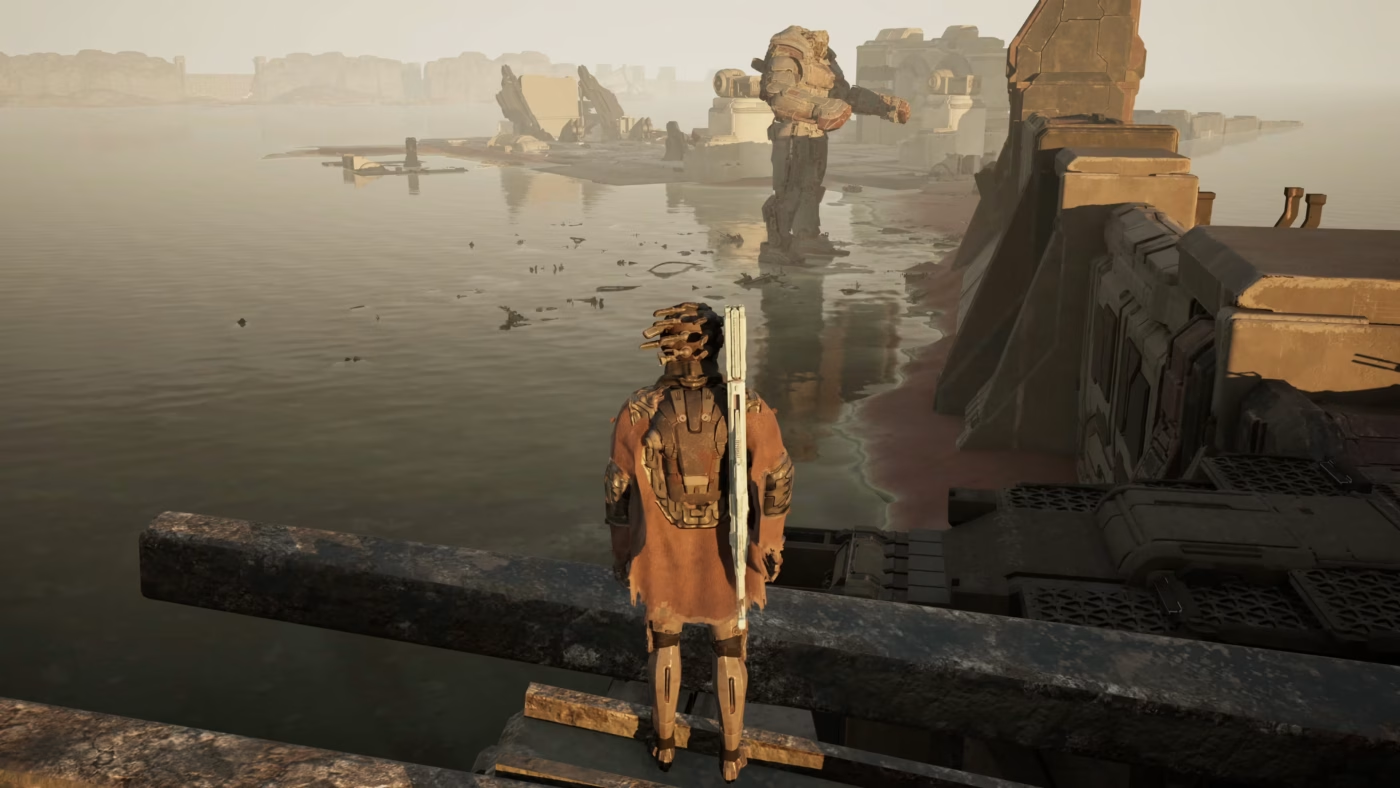

A massive new world, towering mechs, and the unmistakable touch of Fumito Ueda.
Every new project from Fumito Ueda is more than just another game announcement – it is an event for the video game industry. Few creators have done more to redefine games as a form of artistic expression, and each of Ueda’s releases has shaped the medium in ways that continue to resonate today. Across more than two decades, the Japanese director has produced only three major titles, yet each has become a landmark in its own right, helping establish new standards for modern game design.
After years out of the spotlight, Gen Atlas has finally returned with its first gameplay showcase, offering the clearest look yet at genDESIGN‘s ambitious project. While preserving the sense of mystery that has always defined Ueda’s work, the presentation reveals far more of the game’s identity, showcasing its core gameplay systems, approach to exploration, and distinctive artistic vision. What emerges is a project that appears determined to push beyond the scale of anything Ueda has created before.
Gen Atlas retains the hallmarks of his design philosophy – quiet, atmospheric worlds, environmental storytelling, and minimalist design – but expands them through a sprawling open world, colossal mechs to pilot, and a combat system that appears considerably more dynamic than anything seen in his earlier projects.
If the final game lives up to the promise of this first gameplay reveal, Gen Atlas could become more than the long-awaited return of one of gaming’s most celebrated creators. It has the potential to become the most ambitious expression of Ueda’s creative vision to date – and a new benchmark for the action-adventure genre.

A Career Built on Defying Limits: The Road to Gen Atlas
To truly understand the ambition behind Gen Atlas, it is impossible to overlook the career that has defined its creator.
From the release of ICO in 2001, Fumito Ueda established himself as one of the industry’s most distinctive creative voices. At a time when action-focused experiences dominated the market, the Japanese director pursued a radically different philosophy, building an adventure around silence, monumental architecture, and relationships communicated almost entirely through gameplay. It was a bold creative statement that would go on to influence countless developers and help redefine the possibilities of interactive storytelling.
His reputation was firmly established with Shadow of the Colossus, a title that remains widely regarded as one of the greatest video games ever created. Beyond its artistic achievements, the game was an extraordinary technical accomplishment, delivering a vast, uninterrupted world on PlayStation 2 at a scale many believed the hardware simply could not sustain. By pushing Sony’s console to its absolute limits, Team ICO produced what is still considered one of the most remarkable examples of technical optimisation in the industry’s history.
If Shadow of the Colossus tested the limits of PlayStation 2, The Last Guardian became an even greater technological challenge. Originally developed for PlayStation 3, the project revolved around Trico’s sophisticated artificial intelligence, designed to recreate the behaviour of a believable, unpredictable living creature. That ambition ultimately proved too demanding for the original hardware, forcing Sony to move development to PlayStation 4 after years of delays and an unusually complex production cycle.
Even then, Ueda remained unwilling to compromise. Rather than scaling back his vision to accommodate technical limitations, he chose the more difficult path, preserving the creative ambitions that had defined the project from the beginning.
Today, with the creative independence of genDESIGN and access to modern technology unconstrained by the limitations of previous console generations, Ueda appears better positioned than ever to realise the full extent of his vision. If the first gameplay reveal is any indication, Gen Atlas could become the most ambitious work of his career.

The Biggest World Ueda Has Ever Created
The most immediate impression from the first gameplay reveal is the sheer ambition of Gen Atlas’ scale. While Fumito Ueda’s previous works were built around relatively compact environments that were nonetheless incredibly rich in artistic, narrative, and symbolic meaning, his latest project appears determined to make a significant leap forward, presenting what could become the largest and most expansive world he has ever created. The world shown in the trailer feels vast and deliberately mysterious.
Endless desert plains give way to imposing mountain ranges, colossal megalithic structures, abandoned industrial facilities, and towering monuments that dominate the horizon. Every landscape appears to carry the echoes of a civilisation that has long since vanished, transforming the world itself into one of the experience’s most powerful narrative tools.
Despite embracing an open-world structure, Gen Atlas seems to move away from many of the design conventions that have shaped the genre in recent years. The gameplay footage does not suggest a world built around map markers, endless checklists, or artificially placed activities designed to constantly guide the player. Instead, everything appears designed to encourage organic exploration, rewarding curiosity and discovery as the primary drivers of progression.
This philosophy is entirely consistent with Ueda’s creative approach. Once again, the environment itself appears to take centre stage, communicating the story through visual details rather than dialogue or traditional exposition.
Environmental storytelling has always been one of the defining pillars of Ueda’s work, and in Gen Atlas, that philosophy appears to be reaching its most ambitious form yet – transforming the world itself into both the setting and the storyteller of the experience.
Steel, Weight, and Scale: The Colossal Machines at the Heart of Gen Atlas
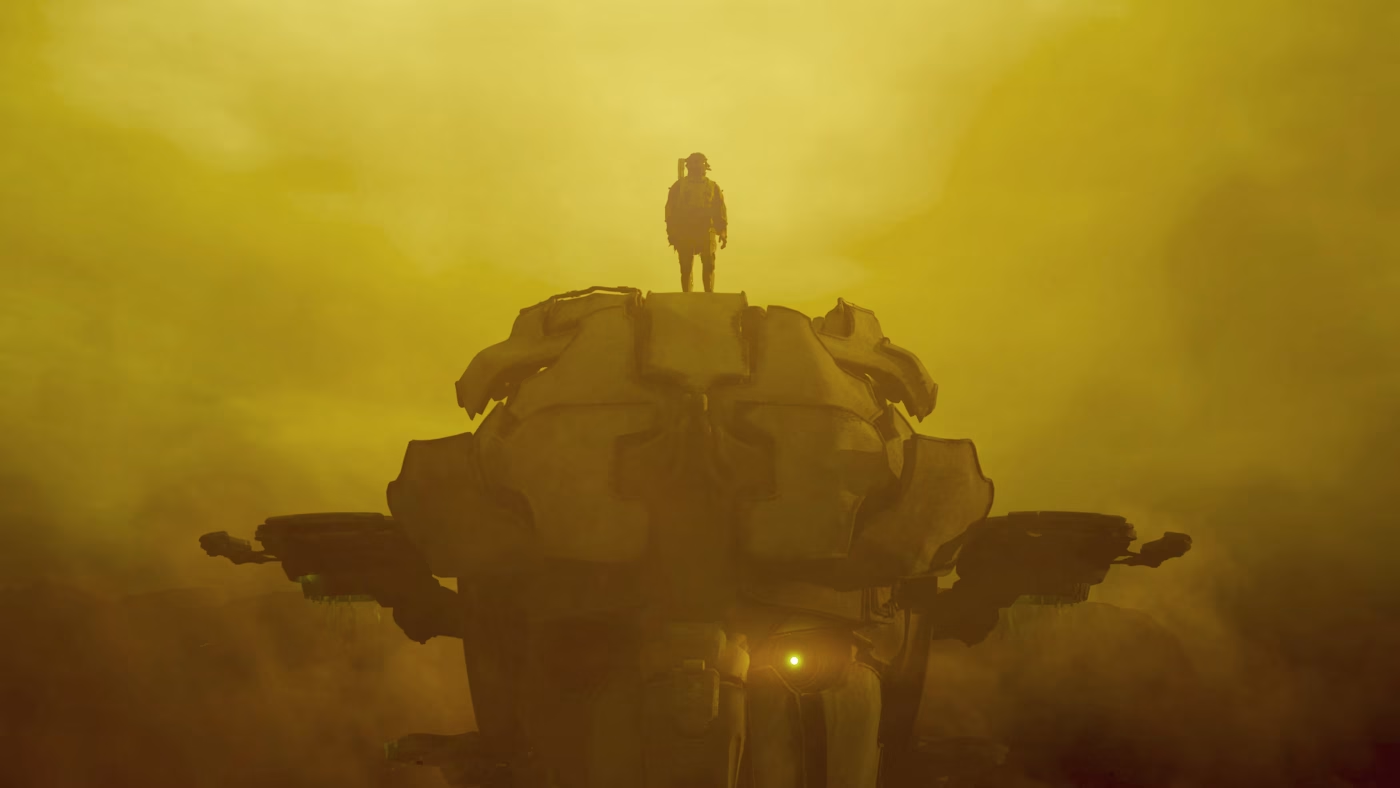
The most significant evolution introduced in Gen Atlas compared to Fumito Ueda’s previous works is undoubtedly the inclusion of colossal mechs. These towering machines scattered throughout the world appear to represent far more than traditional gameplay elements. They are not merely vehicles for traversal, nor are they designed as instruments of destruction; instead, they seem to be deeply woven into the fabric of the experience itself, shaping exploration, combat, and progression in equal measure.
The gameplay reveal suggests that each mech will play a vital role beyond combat, becoming an essential element of both world exploration and the unfolding narrative. This ambition is particularly evident in the combat sequences, where Gen Atlas appears to prioritise a level of physicality and mechanical authenticity rarely seen within the genre.
Every movement conveys the immense weight of steel, the power generated by massive mechanical joints, and the complexity of the machines placed under the player’s control. The sense of impact is especially impressive, with collisions and close-range encounters delivering a feeling of scale and force that few action games manage to achieve.
Rather than functioning as oversized avatars of destruction, these machines appear to possess their own physical presence, with every strike, movement, and reaction reinforcing their enormous weight and power.
Equally impressive is the way Gen Atlas approaches inertia and animation. The mechs avoid the weightless, effortless movement often associated with giant machines in modern productions, instead embracing a slower animation style that convincingly reflects their immense scale, mechanical complexity, and overwhelming physical presence.
The Flying Head and the Philosophy of Discovery Behind Gen Atlas
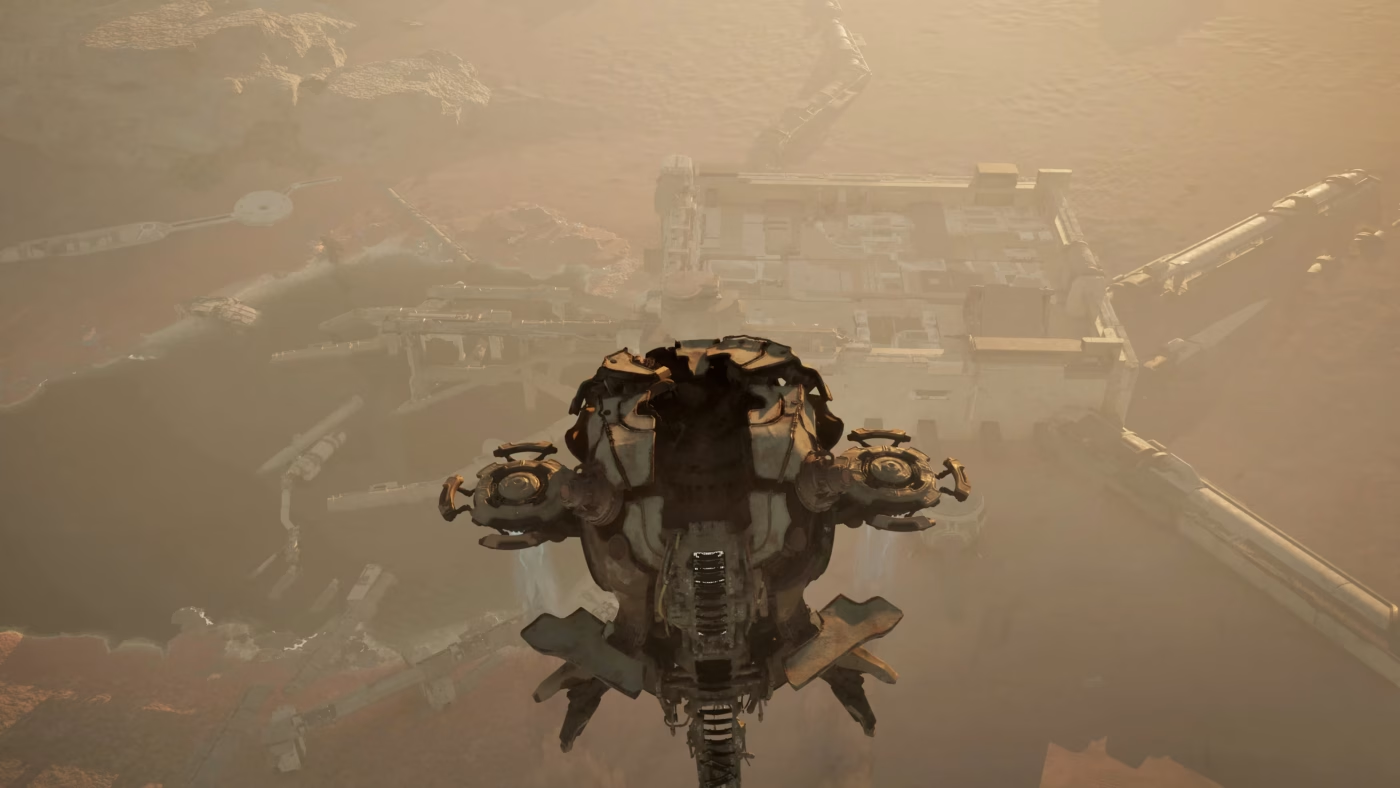
Among the various mechanics revealed in the gameplay showcase, one immediately captured attention for its originality. The protagonist uses the head of a flying mech as their primary means of traversal, allowing them to glide across vast areas of the world, reach seemingly isolated locations, and approach the open world through a stronger sense of vertical exploration.
Yet its role appears to extend far beyond simple transportation. The footage suggests that this device can also be used to interface with and take control of abandoned or disabled mechs scattered throughout the environment. This introduces a fascinating layer of depth to progression, as each forgotten machine could become a potential opportunity, offering different capabilities and expanding the player’s approach to exploration and gameplay.
It is a mechanic that feels perfectly in tune with Ueda’s design philosophy: rewarding curiosity, observation, and experimentation rather than relying on rigidly structured paths or conventional guidance systems. Rather than functioning as a simple traversal tool, the flying head appears to become an extension of the player’s ability to discover and interact with the world, reinforcing the sense of mystery and possibility that has always defined Ueda’s work.
A Different Kind of Action
While exploration remains the foundation of the experience, it is through its gameplay systems that Gen Atlas appears to represent Fumito Ueda’s most significant evolution yet. The project marks a decisive departure from the structure of his previous works, expanding upon his established design philosophy without compromising the creative principles that have defined his career. For the first time, Ueda seems ready to place a far greater emphasis on action, introducing a deeper and more refined combat framework that feels like a natural extension of his vision rather than a departure from it.
The gameplay sequences revealed so far suggest a level of combat depth that goes far beyond anything previously attempted in Ueda’s works. The protagonist appears to have access to a significantly broader range of offensive options, including firearms used against the mysterious biological creatures that inhabit this world. However, it is through encounters with the colossal mechs that Gen Atlas truly begins to showcase some of its most ambitious and intriguing gameplay concepts.
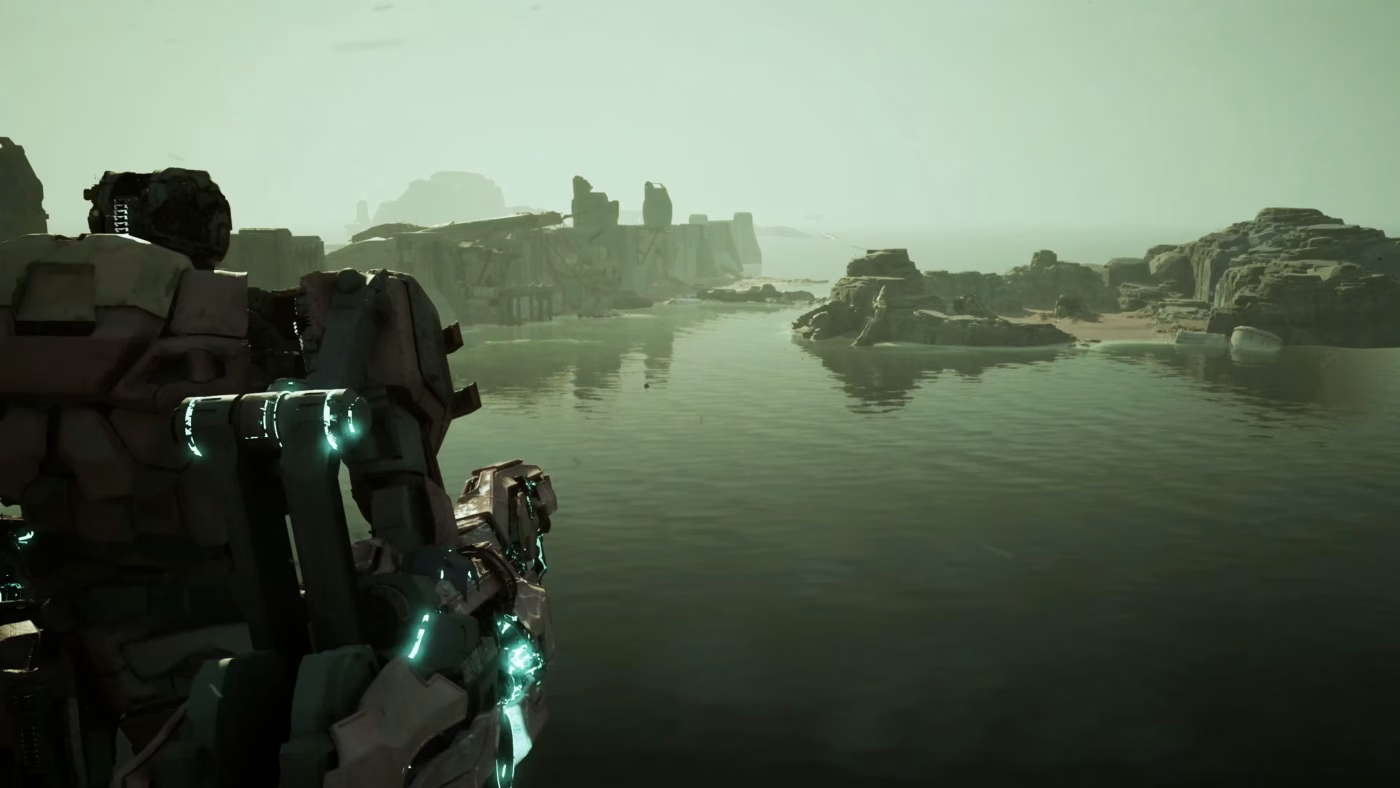
One particularly striking sequence shows the protagonist climbing directly onto the body of an enemy mech to target and disable its vital components. The influence of Shadow of the Colossus is immediately apparent, yet the concept has been significantly reinterpreted through a greater emphasis on verticality, mobility, and a faster, more dynamic approach to large-scale encounters.
Perhaps even more intriguing is the game’s approach to interface design. Rather than relying on traditional markers or artificial indicators, Gen Atlas appears to communicate information through the world itself. The weak points of enemy mechs are revealed through their physical design and the illumination of their internal components, while climbable surfaces are integrated naturally into the machines’ structures through subtle visual cues.
Perhaps even more impressive is Gen Atlas’ approach to interface design. Rather than relying on traditional markers or artificial indicators, the game appears to communicate vital information through the world itself. The weak points of enemy mechs are conveyed organically through their design, exposed components, and carefully placed lighting, while climbable surfaces are seamlessly integrated into the machines’ structures through subtle visual cues rather than intrusive prompts.
This approach reflects one of Ueda’s most enduring creative principles: placing trust in the player’s ability to observe, interpret, and discover rather than relying on intrusive systems or constant guidance. Even as Gen Atlas embraces a more action-oriented direction, it remains deeply rooted in the philosophy that has defined the director’s previous works – an approach built around exploration, curiosity, and the intimate relationship between the player and the world they inhabit.
The Mystery at the Heart of the Journey
As with every work from Fumito Ueda, Gen Atlas appears to build much of its identity around the power of mystery and the player’s ability to interpret the world rather than simply receive its answers.
The newly revealed gameplay trailer deliberately preserves an air of uncertainty, offering only fragments of information while withholding direct explanations about the foundations of the adventure. The identity of the protagonist remains unknown, the origins of the colossal mechs are still unexplained, and the purpose behind the monumental structures scattered across the landscape remains shrouded in ambiguity. Even the nature of the journey itself is left intentionally unclear, following the same philosophy that has defined Ueda’s approach to game design throughout his career.
Once again, the Japanese director appears to move away from conventional forms of storytelling, favouring an experience built around observation and personal interpretation rather than explicit exposition or lengthy narrative sequences. The world of Gen Atlas feels less like a traditional setting and more like an archive of forgotten memories – a landscape where every abandoned structure and environmental detail seems to preserve fragments of a civilisation whose history has yet to be uncovered.
Ultimately, it will be up to the player to uncover the truth behind this enigmatic world – interpreting its symbols, examining its details, and piecing together seemingly disconnected fragments into a coherent whole. The ability to transform mystery and ambiguity into a compelling storytelling language has long been one of Ueda’s greatest strengths, and Gen Atlas appears poised to once again make this philosophy one of the defining pillars of the experience.
When Will Gen Atlas Be Released?
At the time of writing, genDESIGN has yet to announce a release window for Gen Atlas.
However, Fumito Ueda has sought to reassure fans, stating that development is progressing as planned and that the team is committed to avoiding the prolonged production cycle that defined The Last Guardian.
Given the complex and protracted development of The Last Guardian, those remarks carry particular significance. They suggest that Gen Atlas has reached a far more mature and stable stage of production, with Fumito Ueda and genDESIGN seemingly better positioned than ever to bring their ambitious vision to life.