What if the damned broke their chains and rose up against Heaven itself?

Every great game has a moment when it stops being something you analyze and starts becoming something you simply experience. No technical specification, performance graph, or review score can adequately explain that moment. It has little to do with native resolution, frame rate, visual fidelity, or even the sheer amount of content packed into the experience. It isn’t necessarily found in the biggest boss encounter, the rarest piece of loot, or the most shocking narrative twist.
Instead, it arrives quietly. Almost imperceptibly. It’s the point where your critical brain gradually fades into the background. You stop questioning whether the combat system has enough depth, whether the progression is balanced, or whether the gameplay loop will remain satisfying twenty hours from now. For a while, those questions simply stop mattering – not because they aren’t important, but because the game has achieved something far more difficult. It has your complete attention.
Before long, you tell yourself you’ll play one final run. Then another. Then one more after that. Hours disappear almost unnoticed. The clock keeps moving, but your awareness of time doesn’t. If video games still possess a kind of magic that no other medium can quite replicate, it’s this remarkable ability to make time itself quietly slip away.
As critics, we spend countless hours discussing level design, combat mechanics, progression systems, technical performance, and artistic direction. We compare benchmarks, evaluate balance, scrutinize every system, and break games down into dozens of individual components. Yet every review ultimately circles back to the same deceptively simple question: was it fun?
Simple to ask. Remarkably difficult to answer. Because fun isn’t something that can be engineered through a checklist of mechanics. It isn’t a mathematical equation or the inevitable result of combining enough well-designed systems together. It’s an emotional response – one born from countless small moments that somehow come together at exactly the right time.
It’s the complete stranger who abandons their own safety to revive you when the expedition seems doomed. It’s defeating a boss with the last sliver of health remaining. It’s an instinctive dodge executed at precisely the right moment. It’s laughing with friends while absolute chaos unfolds across the battlefield. These moments are fleeting. Most last only a few seconds.
Yet they’re the memories that remain long after the credits roll and the console has been switched off. Weeks later. Sometimes even years later. That’s exactly where I want to begin when talking about 33 Immortals.


Thunder Lotus’ latest project is built around an idea that’s immediately intriguing in its simplicity: what if a roguelike wasn’t about a single hero overcoming impossible odds, but about thirty-three damned souls surviving them together? Rather than casting players as another legendary chosen one destined to save the world, 33 Immortals embraces something far more unusual.
Every player is just one piece of a much larger whole. Success isn’t measured by individual heroics but by collective survival. Every revival, every sacrifice, every perfectly timed cooperative ability contributes to a shared struggle against impossible odds.
It’s an ambitious concept – one that immediately caught my attention. And, if I’m being honest, one that also made me skeptical. Over the past decade, the roguelike genre has become one of the industry’s most crowded spaces. Every year brings another promising co-op experience, another multiplayer game built around procedural progression, another title claiming to reinvent a formula that has already been revisited countless times. Different worlds, different upgrade systems – but far too often, the same familiar design philosophy underneath. That lingering sense of déjà vu has become increasingly difficult to ignore.
It’s exactly the mindset I brought into 33 Immortals. On paper, the premise sounded fantastic: a thirty-three-player action roguelike inspired by The Divine Comedy. But I couldn’t shake the suspicion that the concept itself might ultimately prove more compelling than the game built around it – that once the novelty wore off, the experience would struggle to maintain its momentum.
I couldn’t have been more mistaken. Not because Thunder Lotus has reinvented the roguelike genre. Not because it has delivered the definitive cooperative action game. And certainly not because 33 Immortals is without flaws. I was wrong because I underestimated something that’s becoming increasingly rare in modern game development: a genuine creative identity.
33 Immortals never feels like it’s chasing market trends or attempting to imitate whatever happens to be popular at the moment. It knows exactly what it wants to be, commits wholeheartedly to that vision, and remains surprisingly confident in its own identity throughout. That confidence doesn’t make every design decision successful. Nor does it erase the game’s shortcomings.
But it gives 33 Immortals something many technically stronger games struggle to achieve: personality.
And sometimes, personality is exactly what transforms a good game into one you continue thinking about long after you’ve stopped playing. The question, then, isn’t whether 33 Immortals has a compelling premise. It unquestionably does.
The real question is whether that ambition is enough to sustain the experience once the initial excitement fades – or whether its limitations eventually become impossible to ignore.
Let’s find out.

A World Torn Between Sin and Redemption
Narratively, 33 Immortals takes one of its most interesting risks before the first battle has even begun. Rather than adapting The Divine Comedy outright, Thunder Lotus uses Dante Alighieri’s masterpiece as a thematic foundation, asking a deceptively simple question that immediately reframes the entire experience: what if the damned refused their sentence?
It’s a premise that feels immediately compelling, as it shifts the focus away from punishment and toward resistance. Hell is no longer a place defined solely by suffering or eternal judgment. Instead, it becomes the birthplace of a rebellion, where condemned souls reject the fate imposed upon them and wage war against Heaven itself – not in search of forgiveness, but in pursuit of something far more fundamental: the freedom to determine their own future.
That inversion gives 33 Immortals far more narrative personality than its straightforward premise initially suggests. Beneath its large-scale cooperative battles lies a surprisingly universal theme. This isn’t simply a story about demons storming Heaven; it’s about challenging inevitability. It’s about refusing to let identity, guilt, or judgment become permanent. Whether intentionally or not, Thunder Lotus builds a fantasy world that resonates because its central conflict reflects something deeply human: the desire to push back against labels, expectations, and the feeling that someone else has already decided who we’re allowed to become.
Perhaps the game’s greatest strength is that it rarely feels the need to overexplain these ideas. There are no lengthy philosophical monologues or excessive exposition spelling out its themes. Instead, the narrative trusts its premise to do much of the heavy lifting, allowing players to project their own meaning onto the journey. The march toward Heaven becomes more than a gameplay objective – it becomes a symbolic act of reclaiming agency.

That same restraint extends to its reinterpretation of Dante’s world. Rather than relying on recognizable literary figures as little more than fan service, Thunder Lotus gives them meaningful new roles within its own mythology. Beatrice once again serves as a guide, leading players toward the Crown of Immortality, a relic representing the possibility of escaping eternal damnation.
Dante himself steps away from the spotlight, becoming less of a protagonist and more of a symbolic witness to the rebellion unfolding before him. Even Charon is cleverly reimagined, evolving from ferryman of the dead into one of the game’s central progression hubs, responsible for upgrades, rewards, and long-term character growth.
These reinterpretations succeed because they never attempt to replace or modernize Dante’s original work. Instead, they engage with it. Thunder Lotus clearly understands the source material, borrowing its iconography and themes without becoming constrained by them. It’s a far more thoughtful approach than simply lifting familiar names and imagery, allowing 33 Immortals to establish an identity that feels inspired by The Divine Comedy rather than dependent on it.
Ironically, that’s also where the game’s greatest narrative shortcoming becomes apparent. The premise is considerably more ambitious than its execution. As the campaign progresses, the story gradually retreats into the background, leaving many of its strongest ideas frustratingly underdeveloped. Themes surrounding free will, divine justice, guilt, and redemption are introduced early but rarely explored beyond their initial setup. Dialogue remains sparse, character development is limited, and several key figures function more as quest-givers than fully realized personalities.
It’s difficult not to wonder what 33 Immortals might have become had Thunder Lotus invested as much confidence in its storytelling as it clearly did in its world-building. Because the potential is unmistakable. Every location, every reinterpretation of Dante’s mythology, and every narrative thread hints at a richer story waiting just beneath the surface. Yet the game rarely slows down long enough to explore those ideas in meaningful depth, choosing instead to keep its focus firmly on the cooperative action.
That decision makes perfect sense from a gameplay perspective, but it also leaves behind a lingering sense of missed opportunity. 33 Immortals creates one of the most intriguing narrative foundations we’ve seen in a cooperative roguelike in years. It simply never capitalizes on it as fully as it could have. And that’s perhaps the game’s greatest disappointment – not because the story fails, but because it constantly suggests it was capable of so much more.
Amid the Burning Flames of Hell
If 33 Immortals has a defining strength, it lies in its ability to turn chaos into a deliberate gameplay language. At first glance, the battlefield appears almost incomprehensible. Thirty-three players charge into combat simultaneously as swarms of demonic enemies flood the screen from every direction. Explosions, spells, and projectiles collide in a spectacle that borders on visual overload. Yet beneath the apparent confusion lies a surprising sense of order. Instead of overwhelming the player, 33 Immortals gradually teaches them to read the battlefield, revealing a combat rhythm that feels increasingly intuitive the longer you play.
That design philosophy extends well beyond combat. Thunder Lotus takes the familiar foundations of the action roguelike and expands them into something closer to a large-scale cooperative raid. Each expedition follows a clear, almost ritualistic cadence: players traverse sprawling regions, clear enemy encounters, complete optional objectives, gather resources tied to permanent progression, and eventually regroup for a climactic boss fight before pushing deeper into the next realm.

It’s an immediately compelling framework. Each new region reinforces the feeling of climbing towards an increasingly impossible objective, with every successful expedition bringing players one step closer to challenging the divine order itself. The progression naturally mirrors the game’s narrative premise, creating the impression that the journey is steadily building towards something larger. Unfortunately, that sense of escalation is not matched by the variety of the experience itself.
After the opening hours, 33 Immortals begins to reveal the limits of its content. While different weapons meaningfully alter combat styles and objectives rotate often enough to avoid complete predictability, the overall structure rarely evolves in ways that fundamentally reshape a run. What initially feels dynamic gradually settles into a familiar routine, and for a genre built around replayability, that familiarity arrives surprisingly early. Enemy variety is perhaps the clearest example.
Although Thunder Lotus delivers consistently impressive creature designs, supported by a distinctive artistic direction, the roster itself is relatively limited. Enemy behaviour becomes easy to anticipate after only a handful of expeditions, and once their attack patterns and priorities have been internalised, combat inevitably loses much of its early unpredictability.
The same issue extends to the boss encounters. They are visually spectacular and frequently succeed in creating moments of genuine collective tension. Yet their limited number means that encounters quickly shift from memorable set pieces to familiar routines. The spectacle remains intact, but the sense of discovery inevitably begins to fade. Ironically, repetition itself is not the core issue. Every roguelike is built upon it – failure, mastery, and repeated attempts are fundamental to the genre’s identity.
What defines the best roguelikes is their ability to disguise that repetition through procedural variety, evolving encounters, unexpected combinations of mechanics, or systems that continuously generate new situations.


33 Immortals simply reaches the limits of its possibilities too soon. Eventually, individual runs are differentiated primarily by weapon choice, perk combinations, and permanent progression, while the overall flow remains largely unchanged. The game never stops being entertaining, but it gradually loses its ability to surprise – and for a roguelike, that distinction is crucial.
That makes the lack of variety all the more frustrating because the foundations are genuinely excellent. The core systems feel robust enough to support hundreds of hours of cooperative play, yet the launch version often feels like the opening chapter of a much larger project rather than its complete vision. The progression curve further reinforces that impression. Difficulty ramps up considerably between regions, often encouraging players to pause their advance and spend multiple runs farming resources to strengthen weapons, relics, and permanent upgrades before tackling the next challenge.
That approach is hardly unusual for the genre, nor is it inherently problematic. The issue is one of pacing. Just as the experience begins asking players for a greater investment, it offers relatively few new ideas in return. Instead of rewarding progression with fresh mechanics or dramatically different scenarios, it frequently asks players to revisit familiar content in order to unlock the next step forward. The result is a progression system that occasionally feels more like a requirement than a reward.
Fortunately, many of those shortcomings become far less noticeable once the cooperative systems fully come into their own. The presence of 33 players is far more than a marketing hook. It fundamentally changes the way battles unfold, encouraging constant situational awareness and creating moments where individual performance naturally gives way to collective survival.

Each class is equipped with a unique Cooperative Ability that charges through combat participation rather than simple cooldowns, encouraging players to save these powerful skills for pivotal moments instead of using them indiscriminately. Likewise, the revival system introduces a clever layer of risk management.
Fallen players can be rescued within a limited window, but every revival permanently reduces their maximum health for the remainder of the expedition, ensuring that mistakes retain meaningful consequences without immediately ending a run.
The overall experience, unsurprisingly, depends heavily on who you’re playing alongside. Coordinated groups unlock the game’s full potential, while random matchmaking can occasionally expose the limitations of such large-scale cooperation, particularly when communication breaks down or players scatter across the map.
Even here, however, Thunder Lotus makes a smart design decision. Cooperation is consistently encouraged without ever becoming overly restrictive. Shared buffs, proximity bonuses, and straightforward support mechanics ensure that players can contribute meaningfully even without voice chat or carefully coordinated strategies.
Ultimately, this is where 33 Immortals finds its identity. At its best, it captures the rare feeling of being one part of a much larger whole, where victories belong to the group rather than the individual. It is precisely because that cooperative foundation is so compelling that the game’s shortcomings become impossible to ignore. Once the initial excitement fades, the limited variety of enemies, bosses, and encounter design serves as a reminder that Thunder Lotus has built an exceptional framework – one that still feels as though it is waiting for the breadth of content necessary to fully realise its considerable potential.
Beautiful to Watch, Less Memorable to Hear
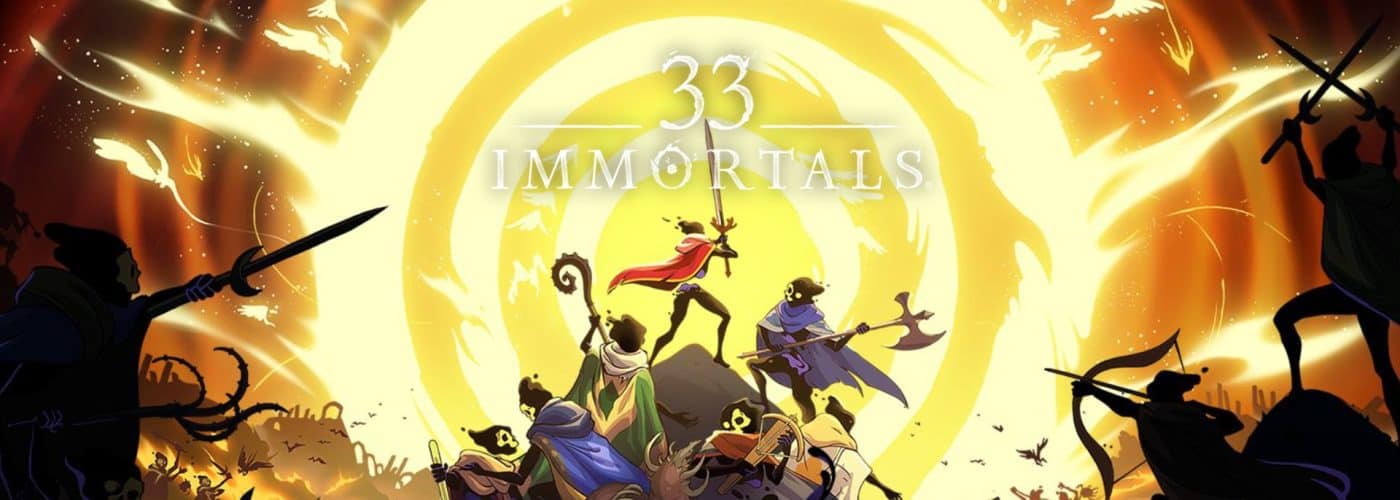
If there’s one aspect of 33 Immortals that impresses from the very first moments, it’s its art direction. Thunder Lotus once again showcases the distinctive artistic identity that has become synonymous with the studio, delivering a world that’s instantly recognizable without ever relying on photorealism or cutting-edge visual technology to make its mark.
Rather than competing on polygon counts or graphical fidelity, the developer doubles down on a cohesive creative vision – one that values atmosphere, composition, and visual identity above technical spectacle. That identity is deeply rooted in The Divine Comedy. Dante’s masterpiece serves as far more than a narrative backdrop; it shapes every corner of the game’s aesthetic. Rather than attempting a literal recreation of the poem’s vision of Hell, Thunder Lotus reinterprets its iconography through a striking hand-painted visual style that blends medieval imagery with bold colours, expressive silhouettes, and rich symbolism. The result is an Inferno that feels both unmistakably inspired by its source material and entirely its own.
Every environment is designed with a strong sense of purpose. Towering citadels suspended above seas of fire, twisted cathedrals consumed by eternal damnation, and grotesque demonic creatures all contribute to a world that feels at once majestic and oppressive. More importantly, these locations communicate through visual storytelling as much as they do through dialogue, allowing architecture, colour palettes, and environmental composition to establish the tone long before the narrative does. It’s world-building that relies on visual language, and it proves remarkably effective throughout the adventure.
That unmistakable visual identity ultimately stands as one of 33 Immortals’ greatest achievements. In a genre where procedurally generated worlds often blur together despite their mechanical differences, Thunder Lotus has crafted an experience with a distinctive artistic voice. Its visual language is so confident that a single screenshot is enough to identify the game instantly.

That said, the presentation isn’t entirely without compromises. When thirty-three players, dozens of enemies, overlapping abilities, environmental hazards, projectiles, and towering bosses all occupy the screen at once, visual readability inevitably suffers. Certain enemy attacks can become difficult to distinguish amidst the effects, while overlapping animations occasionally make the busiest encounters harder to parse than they should be. Given the scale of the action, some degree of visual clutter is perhaps unavoidable, but it remains one of the few areas where the game’s presentation occasionally works against its gameplay.
If the visuals consistently leave a strong impression, the same cannot quite be said of the sound design. While competent throughout, it rarely reaches the same standard as the game’s visual presentation.
The soundtrack succeeds in establishing an appropriately sombre and atmospheric tone, complementing the journey through the Underworld without ever feeling out of place. However, it rarely asserts its own identity beyond that supporting role. The score effectively accompanies exploration and combat, but few tracks possess the melodic strength or emotional impact needed to remain memorable once the adventure is over. There are no defining musical themes capable of becoming synonymous with the experience, which is disappointing given how distinctive the world itself is.
Voice acting quality is similarly uneven. Some performances effectively convey the gravitas of key characters, lending weight and presence to key narrative moments, while others feel less assured, resulting in an overall delivery that lacks consistency. It never reaches a point where it undermines the narrative, but it rarely succeeds in elevating it either.

33 Immortals is now available on PC and Xbox Series X/S (Steam and Epic Games Store), and is included with Xbox Game Pass.
We would like to thank Thunder Lotus for kindly providing a PC code used for the purposes of this review.
 7/10
7/10