Between a young Kratos in Sons of Sparta and Faye’s journey into the Everywhen: charting God of War’s path beyond the Norse saga
Every time I talk about God of War, I can’t help getting personal about it. Everything I write reflects my own opinion, but Kratos always makes me a little more biased.
So this won’t be one of my usual articles that mixes purely informative content with personal judgment. Here I want to do what I did in the other two pieces I’ve already written: share a personal take on the topic.
This time, though, the topic doesn’t concern one specific God of War title.
After God of War: Ragnarök came out in 2022, many of us shared the same question: now what?
A series doesn’t have to go on forever just to please its audience, but one fact got me thinking, at least: if Santa Monica made the leap from Greek mythology to Norse mythology, who knows what comes next?

The curiosity was inevitable. I remember people speculating about, or hoping for, a God of War set in Ancient Egypt. With Kratos as the protagonist, of course.
I wrote about this shortly after Ragnarök came out, arguing that Santa Monica had, in my view, closed Kratos’s story arc for good. They didn’t kill him off – unlike every other “Greek” title, where Kratos always seemed to reach the end of his existence one way or another – but they gave the impression of putting him out to pasture. So the father passes the torch to the son, and Atreus (Loki) made sense as the next possible protagonist.

I remember a heated backlash from fans, since Atreus could never match Kratos for charisma, and I partly agree. Still, I admit I would have loved a title – or more than one – following Atreus into adulthood. I find him a hugely compelling character, especially because of his ambiguity, and he has a real three-dimensionality of his own, maybe even more than Kratos, who initially came across as a man of few pretensions – 2018’s God of War confirmed just how complex he actually is.
But all that talk amounted to nothing, because around that time Santa Monica addressed the question of a possible sequel and said they had no intention of continuing the Norse God of War saga; it would take too long, and they needed, or at least wanted, to do something different.
Personally, I’d resigned myself to the idea that I would never again get to step back into Kratos’s world, especially because I firmly believe that once an author decides a story is over, it’s over, full stop. And that’s fair.
But then two happy surprises – selfishly speaking – showed up on the horizon within a short span of each other: Mega Cat Studios released the metroidvania God of War: Sons of Sparta, developed in collaboration with Santa Monica, and Santa Monica dropped a gameplay video for the next title, which they’ve announced for a possible March 2027 release, called God of War Laufey.
What happens to gods when they go to the afterlife? But more importantly, who is Laufey?
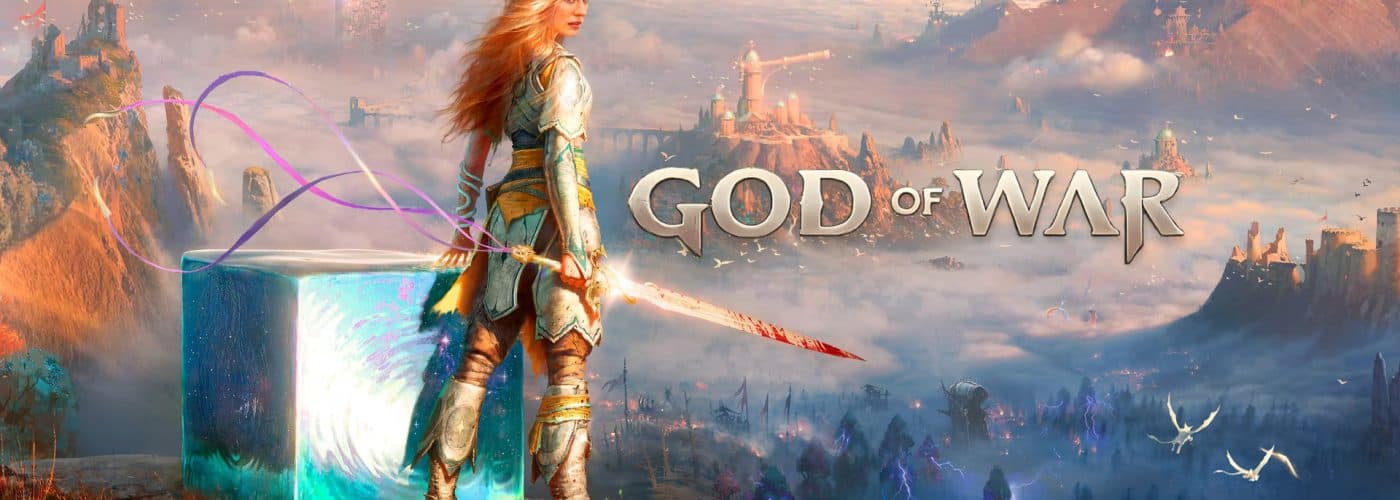
Thanks to the gameplay video Sony released about a month ago, introducing this new project, we found out who the next God of War protagonist will be, and the title actually tells us, even if it’s not obvious at first.

Because Laufey is Faye‘s real name – the character who appears as the protagonist in this first gameplay excerpt.
Faye is Kratos’s mysterious second wife, whom he presumably met in Midgard. Ragnarök showed us a bit more of her, her appearance, for instance, but she remained an almost cryptic figure. We know she was a giant, a warrior, but we still lack so much to really know her, and she looks like a genuinely interesting character; the simple fact that she fell in love with an increasingly embittered, perhaps even resigned, Kratos already says a lot about her and her open-mindedness.


I can’t wait to get to know Faye – she won me over immediately, from the very first minutes of the gameplay video.
Deborah Ann Woll, who plays her, put this feeling into words very well, and she too says she feels excited and happy to get to know Faye as a full, complete person.
“I love how acrobatic Faye is. I think Kratos’s gameplay is fantastic because he’s a powerful fighter, all brute force. Faye is just as strong and just as skilled a warrior, but her gameplay involves spins, whipping strikes, and flips, all in the air. And that lets us show there are many different ways to be a warrior.”

The cast, as we can see from the video above, even includes Jack Quaid, the heroic Hughie Campbell from The Boys, who plays Phranque, a cosmic cube that acts as a protective figure for anyone who runs into trouble in this dimension of constant conflict.


So has Santa Monica decided to go back to the Norse setting?
Not quite.
Faye is indeed a character born within the Norse fabric, but it makes sense to keep this side of God of War alive – by now it carries the same weight as the Greek one.
Either way, that’s not why Santa Monica’s choice makes sense.
Faye is dead – the game opens right as Kratos lights her funeral pyre – so we don’t find her in Midgard, say, or in Sparta, but in the gods’ afterlife, called the Everywhen, where ruthless deities from different mythologies fight over power.

This marks the first time the franchise formally moves beyond Greek and Norse content, with the Everywhen bringing together deities from several mythologies, including Egyptian and Mongolian ones. Structurally, then, it presents itself as something that goes past the Norse perimeter rather than extending it. Above all, it looks like it could tie everything together, giving the whole story a broader, more interesting meaning.
And Kratos? Will he show up?
Raise your hand if you’ve ever wondered: what was Kratos like as a child?
What was his life like before that long string of traumas turned it upside down?
Let’s be honest – I’ve said this before, but I’ll say it again: Kratos is God of War, and vice versa. There’s talk of several gods of war, and Laufey will probably feature even more of them, but the real, one and only, inimitable, iconic God of War remains Kratos for us.
We don’t know what his future holds – or if he even has one – but thanks to Mega Cat Studios we now know what he was like when he still led a normal life, an ordinary Spartan’s life, alongside his brother, the same brother Kratos will end up fighting in God of War: Ghost of Sparta.

Deimos has always stood as an example of one of Kratos’s many traumas – in fact, I’d argue his very first real trauma comes precisely in the moment Ares, together with Athena, arrives in his village and takes his brother away. Deimos, born with a conspicuous birthmark on his body and face, had misled the gods, who had received a dire prophecy: someday a man bearing those marks would destroy Olympus.
Too bad they grabbed the wrong brother, and things didn’t end well at all.
Despite carrying such weight in Kratos’s life and choices – this is the very moment he earns the famous scar over his right eye, for instance – Deimos never got much room of his own, aside from the already-mentioned Ghost of Sparta, which, incidentally, only ever came out for the PSP. So it delighted me to discover that someone had taken him to heart and decided to give him personality and a voice.
When it came out, on February 2nd of this year (2026), I read and heard various complaints going around. The usual kind, in a sense: whenever someone touches a sacred product like God of War – sometimes even the original creators themselves – there’s always the fear that it could cheapen or discredit it.
In my view, Mega Cat did a really clean job, working alongside Santa Monica itself, as I mentioned, presumably with its blessing, and Sony published it; the game gives room to a fairly minor slice of Kratos’s life, in a format that, almost by necessity, still made the experience enjoyable.
People love the metroidvania genre for plenty of reasons, and when someone builds it well, adding original elements that give it its own identity – think Prince of Persia, Hollow Knight, Blasphemous… – fans love it even more.
Sons of Sparta isn’t just a well-made, thoroughly enjoyable metroidvania with a classic but genuinely entertaining structure – it’s also a small tribute to a character who’s been far too overlooked.


The game portrays Deimos with real precision: he balances out a young Kratos who’s a bit too rigid and fanatical – basically, Kratos was a pain even as a kid: grumpy and strict.
Deimos, on the other hand, is his opposite: lively, curious, rebellious, and he genuinely cares about others and their fate. He’s still young but already thinks about love – he has a crush on Amara, a girl from the village.
She’s actually the driving force behind the whole adventure. The trigger is finding Vasilis, a missing companion, but after much insisting, the real reason Deimos manages to convince Kratos to help him search is to impress her.
Mega Cat describes him this way:
“Even in the shadow of a legend, Deimos shines with his own fire. Bold, daring, and unyielding, he faces every challenge head-on, proving that bravery isn’t only measured by duty, but by the courage to follow your own path.”
During this search, in a world that stays suspended, as always, between reality, myth, and fantasy, the bond between the brothers comes through, even if it takes a back seat to the gameplay and the adventure. Still, it gave me enough to understand what their personalities were like before the tragedy.
I found Kratos exquisitely in character, even though he’s quite different from his adult self: rigid, as I said, aggressive, but also wise. His pragmatism sets him apart in everything he does, from finding solutions to obstacles to trying to dodge punishment. At the same time, his strong sense of dignity always pushes him to take responsibility for his choices, no matter what.

Deimos plays the little devil on his shoulder, his own Lampwick, egging him into disobedience. But Kratos gives in for a reason, even if he’d rather not: he trusts his brother and his instincts. He trusts his principles and, deep down, shares them, even though his sense of obedience almost always wins out.
All of this, and much more, manages to surface, despite the game’s – fair – choice to give more room to gameplay than to storytelling.
So what will become of Kratos?
In recent months, starting in February, God of War has stirred up public interest again, and, as often happens, opinion has split roughly down the middle; with Laufey too, people have dragged the “woke ideology” debate back into the spotlight, something that crops up almost every time a female character leads a video game.
Many heroines, like Senua, have largely escaped this media pillorying, but Aloy from Horizon comes to mind, or Abby from The Last of Us Part II, who, for different reasons, faced plenty of hatred.
Personally, I find the choice of a female protagonist, Faye/Laufey specifically, both interesting and almost necessary at this point. Not necessary to give women representation in a video game, but necessary to get to know this important character in Kratos’s life better – exactly the way Sons of Sparta let us get to know Deimos – since she serves as the perfect gateway into whatever will, in the end, tie the whole God of War universe together.
All we can do now is wait, on the edge of our seats.