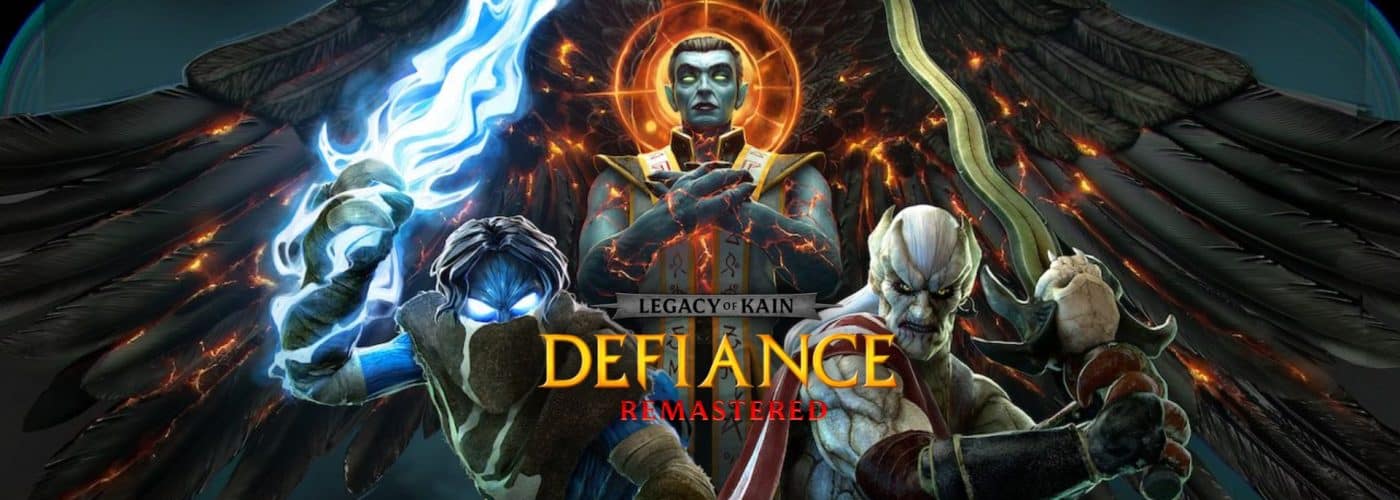
Some legends never truly fade.

There are video games remembered for their commercial success, others for redefining entire genres or introducing mechanics that go on to shape generations of developers. And then there are rarer works – those that leave a lasting mark not only on the history of the medium, but on the memory of those who experienced them firsthand. Works that continue to be revisited, discussed, and celebrated decades later not for their commercial milestones, but for the emotional depth, ambition, and narrative strength they achieved. Legacy of Kain firmly belongs to this latter category.
Revisiting the saga of Kain and Raziel today means stepping back into a singular – and difficult to replicate – moment in video game history, when the medium was still actively defining its narrative language and expanding the boundaries of interactive storytelling. Amid the rush toward technological innovation and fully realised 3D environments, Legacy of Kain chose a different path: one rooted in disciplined writing, cohesive world-building, and long-form character development.
At a time when most productions were driven by immediacy and spectacle, Crystal Dynamics chose instead to build an expansive dark fantasy tragedy rooted in prophecy, temporal paradoxes, ancient conflicts, and deeply fractured characters navigating a deliberately ambiguous moral landscape – an approach that still feels strikingly impressive even by contemporary standards.
More than twenty years after Defiance, Nosgoth still carries remarkable narrative weight. Its decaying cathedrals, fallen empires, and myth-soaked history remain unforgettable, but it is above all its characters that continue to resonate.
Not because Legacy of Kain was a commercial juggernaut, but because it accomplished something far more difficult: building a narrative world that still feels alive in memory long after its original release. Kain and Raziel are not simply iconic protagonists, but enduring tragic figures—beings bound within an endless cycle of fate, sacrifice, and defiance. Their intertwined arcs helped shape one of the most ambitious, layered, and philosophically rich narratives ever created in the medium.
It is this that gives the return of Legacy of Kain: Defiance a significance that extends well beyond nostalgia. It is not merely an opportunity to revisit a cult classic, but to re-engage with a work that proved how video games could engage with existential and metaphysical themes at a level comparable to major works of fantasy literature.
Questions of fate, free will, faith, and existence are not merely present, but woven into the very structure of its narrative – qualities that still place it among the medium’s most accomplished storytelling achievements.
This remaster, ultimately, is not just a return to the final chapter of Kain and Raziel’s story. It is a chance to step once more into a legend that never truly stopped resonating.
Kain: The Sovereign Who Defied Fate
From its earliest hours of, it becomes evident that the Kain-focused sections form the true backbone of the experience.
The ancient vampire stands as one of video games’ most distinctive narrative figures: neither a conventional hero nor a traditional anti-hero, but a sovereign driven by an uncompromising will to defy fate itself in order to impose his own vision upon the world.
His narrative arc is defined by the consequences of a single decision that irrevocably altered the fate of Nosgoth – the refusal to sacrifice himself to restore the Pillars of Balance. A choice that condemned the world to a slow, inevitable decay, while also opening profound questions about free will, causality, and moral responsibility.
Through time travel, ancient prophecies, and long-buried truths, Kain’s journey extends beyond personal ambition, becoming a broader confrontation with the very meaning of Nosgoth’s existence and its underlying determinism.
Particularly well executed is his character progression, as the vampire gradually reclaims his powers over time. Each newly acquired ability serves not simply as a gameplay enhancement, but as a narrative marker within his evolving arc. Encounters with Moebius, the schemes of the Sarafan Order, and the lingering mystery of the Soul Reaver collectively shape one of the series’ most intricate and compelling storylines.

Raziel: The Tragic Heart of Legacy of Kain
If Kain embodies power and defiance in the face of destiny, Raziel is the tragic heart of Legacy of Kain. His journey is one of the most powerful character arcs ever written in video games: a long and often painful pursuit of truth that cuts across the lines between life and death, body and spirit, fate and free will. Even after more than twenty years, the sections centred on Raziel still carry extraordinary narrative weight, delivering some of the most memorable and emotionally powerful moments in the series.
His flight from the Elder God, the gradual restoration of the Soul Reaver’s various forms, and his relentless search for identity lead players through some of the most evocative and symbolically charged locations in Nosgoth. Yet the true strength of Raziel’s narrative lies not in the events themselves, but in the extraordinary psychological depth with which they are explored.
What makes Raziel such a remarkable protagonist is his constant evolution. He is not merely driven by revenge or survival, but by an increasingly desperate need to understand the truth of his own existence. As his journey progresses, every certainty is systematically dismantled. Each revelation raises new questions, every answer uncovers a deeper deception, and every step toward his apparent destiny seems only to carry him further from the freedom he seeks.
This perpetual tension between fate and self-determination lies at the very core of Raziel’s tragedy. He is a character trapped between conflicting truths, forced to confront the possibility that his life, his choices, and even his identity are all part of a design far larger than himself. The result is a narrative arc that remains as intellectually compelling as it is emotionally devastating. Perhaps most impressively, the writing still feels remarkably sophisticated by modern standards.
The quality of the dialogue, the thematic depth of the storytelling, and the complexity of Raziel’s characterisation remain outstanding examples of narrative craftsmanship. Even after more than twenty years, his journey stands as one of the most ambitious, nuanced, and emotionally resonant in video games.

A Storytelling Standard That Few Have Reached
One of the defining qualities that continues to set Legacy of Kain apart from many of its peers is the exceptional strength of its writing. Even today, few game narratives exhibit the same degree of ambition, sophistication, and thematic coherence. Defiance serves as the culmination of a story developed across five interconnected chapters, bringing together temporal paradoxes, ancient wars, philosophical conflicts, and deeply personal tragedies within a narrative of extraordinary scope and complexity.
What elevates the series beyond the vast majority of fantasy epics, however, is not merely the intricacy of its story, but the intelligence and confidence with which it engages its central themes. Throughout the story, players are asked questions that remain as resonant today as they were at the time of the game’s original release.
Is destiny truly fixed, or can it be challenged through individual choice? Does free will really exist, or are all actions merely steps along a predetermined path? And to what extent can the present be sacrificed in pursuit of a better future? These questions run through every layer of the narrative. They are not confined to exposition, codex entries, or background lore, but emerge organically through character relationships, moral dilemmas, and dialogue of exceptional quality.
A Sharper and More Responsive Experience
One of the most significant improvements in Defiance Remastered lies in the refinement of its core gameplay systems. Chief among these is the new over-the-shoulder camera, a change that reshapes how the game is experienced and played.
Far from being a purely cosmetic adjustment, this revised perspective meaningfully enhances spatial awareness and environmental readability. Exploration feels more intuitive, platforming sections are easier to interpret, and the game’s environments gain a stronger sense of depth and dimensionality. Movement, in turn, benefits from improved precision, with jumps and traversal feeling notably more controlled compared to the original release.
Combat also benefits from a welcome increase in responsiveness. Refined controls give encounters a sharper sense of immediacy, resulting in a more fluid and readable action system overall. Kain’s heavier, more destructive combat style carries greater clarity and impact, while Raziel’s faster, more agile approach feels tighter and more responsive moment to moment. Crucially, these refinements enhance the gameplay without altering its core identity, preserving the structure and intent of the original design while addressing long-standing issues of rigidity and pacing.
The end result is a remaster that strikes a careful balance between preservation and refinement. It retains the distinct character and atmosphere of the original Defiance, while making it significantly more accessible and satisfying to play by modern standards – an approach that enhances, rather than replaces, the foundation of the original work.


A True Time Capsule for Series Fans
The remaster goes beyond a simple re-release of the base game. Instead, the developers have framed this edition as a broader celebration of Legacy of Kain’s legacy, with its additional content standing out as one of the package’s most valuable strengths. The inclusion of lost levels opens access to previously unreleased material, offering rare and meaningful insight into the creative process behind the original game.
The standout addition, however, is the playable demo of Legacy of Kain: Dark Prophecy, the cancelled direct sequel to Defiance. Even in the form of a brief vertical slice, it carries considerable documentary weight. Combat appears faster and more aggressive, the pacing more streamlined, and the overall structure notably more action-oriented, suggesting a potential evolution of the franchise that ultimately went unrealised. The only real drawback is that content of such significance has been locked behind premium editions, restricting access to a crucial fragment of the series’ history.
A Strong Technical Foundation
From a technical standpoint, Legacy of Kain: Defiance Remastered delivers a strong and largely consistent performance. The updated graphical engine enhances environments, character models, and lighting without compromising the visual identity of the original release. On PC, performance remains stable throughout, ensuring a smooth and responsive gameplay experience.
Improvements to textures and visual effects further enhance immersion, making Nosgoth feel more tangible and cohesive while preserving the series’ signature dark aesthetic. Although this is not a full remake, the level of care invested in the remastering process brings it perceptibly closer to the feel of a modern reinterpretation.

A Worthy Return to Nosgoth
Legacy of Kain: Defiance Remastered is more than the return of a beloved classic; it marks the long-awaited revival of one of gaming’s most ambitious, mature, and narratively accomplished franchises.
More than two decades after its original release, Defiance remains a striking reminder of what set Legacy of Kain apart from many of its contemporaries. Its intricate narrative, richly realised cast, and uniquely oppressive vision of Nosgoth continue to resonate, while the improvements introduced in this remaster make the experience significantly more accessible to modern audiences. The revised camera system, refined controls, enhanced presentation, and wealth of archival material collectively strengthen the package, without compromising the identity of the original work.
Not every aspect has aged gracefully. The absence of modern navigational aids can, at times, make progression feel unnecessarily opaque, while parts of the archival bonus content remain locked behind premium editions. These shortcomings, however, are ultimately minor when weighed against the significance of what has been preserved here.
More than twenty years later, the story of Kain and Raziel remains one of the most compelling and thematically ambitious narratives the medium has produced. Legacy of Kain: Defiance Remastered does more than revisit a classic; it reaffirms its place among gaming’s most important storytelling achievements. Above all, it serves as a timely reminder that few fantasy worlds have ever felt as rich, as distinctive, or as enduring as Nosgoth.
 8/10
8/10