
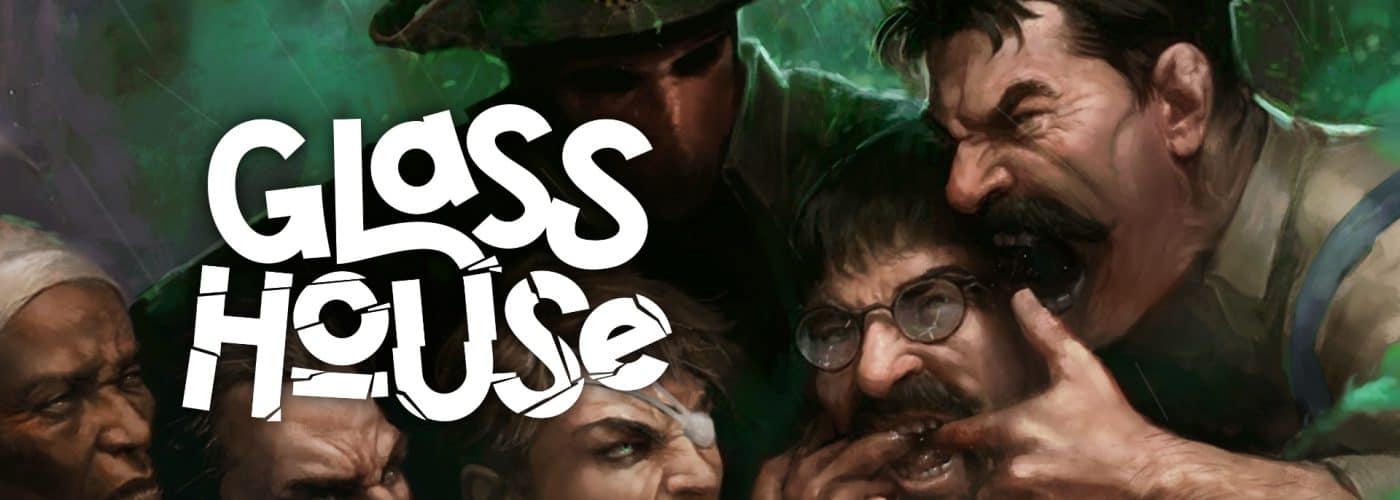
A turn-based feudalpunk CRPG that redefines what “political” in games actually means.

Some games are designed to overwhelm. They chase awe through sheer scale – sprawling open worlds, cinematic warfare, towering skylines, and protagonists crafted to feel untouchable. And there is absolutely nothing wrong with that. Video games have always excelled at escapism. Few mediums are capable of transporting us so completely beyond the ordinary, immersing us in realities larger, louder, and more exhilarating than our own. For a few fleeting hours, they allow us to become heroes.
Then a project like Glasshouse appears, and suddenly the focus shifts elsewhere entirely.
Not toward what erupts outwardly, but toward what quietly decays beneath the surface. Not toward spectacle, but toward people. Because from the very beginning, Glasshouse feels far less interested in heroism than in humanity itself.
Its fragility. Its tensions. The invisible emotional weight that builds when too many lives are forced into the same confined space for too long. The resentment born of proximity. The exhaustion of coming home after a punishing day, closing the apartment door behind you, and wanting nothing more than silence – a moment of peace before the outside world begins pressing inward again.
Because there are few places stranger than an apartment building. It is a uniquely unnatural form of intimacy: shared walls, narrow corridors, unfamiliar smells drifting through ventilation shafts, muffled arguments leaking through ceilings, footsteps echoing long after midnight. Over time, these fragments stop feeling incidental. They become familiar.

The exhausted footsteps in the hallway after midnight. The television left running late into the night. Sudden laughter breaking the silence at impossible hours. A door slammed in anger. The neighbour’s dog barking at precisely the same time every evening. Water moving through old pipes while the rest of the building feels eerily still.
Individually, these details are insignificant. Yet gradually they evolve into something else entirely: presence. Routine. Almost intimacy. And perhaps that is the precise emotional space Glasshouse seeks to explore. For despite this constant physical proximity, people remain fundamentally unknowable to one another. We rarely understand who truly lives on the other side of the wall – what fears, frustrations, compulsions, or compromises they carry once the door closes behind them.
What we perceive are only fragments: moods, sounds, absences, brief emotional fractures.
And eventually, that forced coexistence gives way to something far more ambiguous. Familiarity curdles into irritation. Curiosity hardens into paranoia. Empathy yields to suspicion. Sometimes, even to fear.
This is where Glasshouse begins. Not with a hero destined to save the world, but with a deteriorating residential complex inhabited by people bound together more by necessity than trust. A community worn down by isolation, trapped inside an endless quarantine while, beyond its windows, the threat of global conflict draws ever closer.
Perhaps the most compelling aspect of FLAT28’s project is the way it transforms an outwardly surreal premise into something deeply recognisable. Beneath its feudalpunk aesthetic, its suffocating political atmosphere, and the mystery surrounding Dormitory 73B, Glasshouse feels less concerned with dystopian worldbuilding for its own sake than with the anxieties of contemporary life itself. The desperate need to be acknowledged. The fear of losing control.
The anger that emerges when people feel crushed beneath systems too vast and indifferent to notice them. Above all, the deeply human fear of becoming invisible – of fading into little more than background noise in the lives of others.


What immediately defines Glasshouse is the sense that it is not merely trying to tell a story. It seeks instead to immerse players in a psychological atmosphere – dense, claustrophobic, oppressive, and almost physically tangible.
The world feels as though it has its own texture, its own smell, its own emotional gravity. Every room suggests that something happened moments before your arrival. Every character seems to be holding back grief, dishonesty, resentment, or a fragile instability just beneath the surface. Conversations rarely feel safe. Instead, they carry the constant tension of exchanges that could, at any moment, collapse into confession, manipulation, emotional violence, or outright breakdown.
Yet despite the heaviness of its themes, Glasshouse never feels sterile or self-consciously intellectual. Quite the opposite. One of the project’s strongest qualities is the sheer personality radiating from every corner of the experience. There is dark humour here. Cruel irony. A grotesque theatricality that makes the world feel uglier, stranger, and somehow more human at the same time.
It is the kind of game that seems to actively enjoy making players uncomfortable without ever losing its magnetic pull – the desire to open one more door, overhear one more conversation, remain inside the building just long enough to discover how far the tension can stretch before something finally breaks. And in a genre where countless RPGs increasingly blur together, Glasshouse immediately feels determined to become something else entirely.
It is not striving for sterile perfection. Instead, it wants to leave something behind: discomfort, friction, unease. The unsettling feeling of a world observing the player as intimately as the player observes it. Because every image, every line of dialogue, every fragment of its universe points toward the same unmistakable conclusion: Glasshouse has something genuine to say.
Perhaps not always elegantly. Perhaps not always with perfect clarity. Perhaps with a degree of madness that will inevitably alienate some players. But unmistakably, it has a voice.
And that, more than anything else, is why Glasshouse leaves such a lasting impression long before it is played. It does not feel like another dystopian RPG assembled from familiar genre conventions. Instead, it feels like a distorted reflection of contemporary life itself – a warped yet unsettlingly lucid lens through which to observe isolation, anxiety, ideological dependence, emotional fatigue, and the increasingly fragile ties that bind individuals to the world around them.
And perhaps that is precisely what makes Glasshouse so difficult to look away from.
Because once it pulls you into its world, leaving again may prove far more difficult than expected.

The Hands, Minds, and Voices Behind Dormitory 73B
There comes a moment, when looking more closely at Glasshouse – even before engaging with its gameplay mechanics – where the project quietly stops feeling like “just” a video game. Not through any dramatic revelation or carefully staged twist, but gradually, almost subconsciously, as the images, atmospheres, and fragments of life inside Dormitory 73B begin to accumulate emotional weight, psychological depth, and an unsettling sense of familiarity that lingers just beneath the surface.
At first, the attention naturally settles on the surface. The world’s grimy, deteriorating aesthetic, the exhausted faces of its inhabitants, the rooms that seem to trap stale air alongside years of unresolved tension. Then comes the constant undercurrent of irony, social unease, and political anxiety – elements that never merely frame the experience, but instead seep into every corridor, every silence, every detail. Nothing in Glasshouse feels designed simply to be observed. Its world asks to be emotionally inhabited, as though its oppressive weight extends even beyond the screen, reaching those who only stand at its threshold.
But gradually, almost imperceptibly, the perspective begins to shift. Attention drifts away from Glasshouse as a finished product and turns instead toward the people shaping it – the individuals imagining it, writing it, illustrating it, assembling it piece by piece. The sensibilities embedded in every visual choice, every fragment of dialogue, every trace of humanity running beneath the project like an underground current become increasingly difficult to ignore.
And it is precisely here that Glasshouse begins to reveal what truly makes it stand out.

Because the closer one looks, the more the project feels driven not simply by creative ambition, but by something closer to necessity. Not the industrial imperative to “make a game,” but a far more personal need: to give form to emotions that are difficult to articulate and even harder to contain. The exhaustion of contemporary life, the constant friction between individuals, the longing for belonging intertwined with the quiet fatigue of merely sharing space with others.
At that point, Dormitory 73B begins to shift in meaning. It no longer feels like a dystopian setting defined by its visual identity, but something far more human – a psychological space before it is a narrative one. A place shaped by invisible tensions, private fragilities, unresolved ideologies, and isolated lives pressed into proximity without ever truly achieving emotional connection. An exaggerated form of coexistence that nonetheless feels uncomfortably, even disturbingly, recognisable.
And it is here that FLAT28’s project begins to gain its real weight. Because beneath Glasshouse’s grimy, theatrical, deliberately abrasive feudalpunk surface – beneath its political hostility, ideological strain, and air of suffocating social pressure – there is a remarkably precise creative intention: to speak about people. Not as symbols or narrative functions, but in their most fragile, contradictory, and recognisably human form. Their fears. Their emotional fractures. Their quiet wounds. Their growing inability to find common ground in a world increasingly shaped by alienation and fragmentation.
In an industry increasingly shaped by familiarity, immediate readability, and the constant repetition of proven formulas, Glasshouse stands in quiet but deliberate opposition. It is not pursuing polish as an end in itself, nor comfort as a guiding design principle. Instead, it pursues identity – even when that identity becomes uncomfortable, or difficult to categorise.
What emerges from the project is a quality that feels increasingly rare in contemporary game development: the sense that expression is not simply a by-product of production, but the foundation upon which the entire project is built. And that sensibility does not end with the game itself. It extends directly into the identity and creative DNA of the young team at FLAT28.


FLAT28 is an international multidisciplinary collective made up of more than twenty creatives across Italy, the UK, and the United States, bringing together experience from video games, cinema, CGI, music, comics, illustration, writing, and digital art.
What ultimately defines the collective, however, is not simply the breadth of disciplines involved, but the constant exchange – and, at times, deliberate creative friction – between them. It is an ongoing process in which distinct artistic languages do not merely coexist, but actively intersect, challenge, and reshape one another.
Rather than functioning as a conventional studio, FLAT28 feels more akin to a creative ecosystem: a shared environment in which ideas, aesthetics, and perspectives exist in a constant state of dialogue, evolving through both collaboration and creative tension. Glasshouse is not defined by a single voice, but by a constant exchange between distinct creative sensibilities – sometimes in harmony, sometimes deliberately at odds. That very tension is reflected in the game’s own identity.
Glasshouse appears to thrive on the same tensions that define the collective behind it: coexistence across difference, friction between perspectives, and the difficulty – and necessity – of sharing the same space without erasing individual identity. Dormitory 73B gradually feels less like a setting than a metaphor for the creative process itself: a structure filled with overlapping voices that collide, influence one another, and coexist without ever fully merging. It becomes a distorted yet familiar reflection of how relationships, communities, and ideas are shaped in contemporary life.

And it is precisely here that Glasshouse begins to forge such a distinctive identity long before it is ever played. Because behind every image, every fragment of dialogue, and every aesthetic decision lies a voice that never feels neutral or impersonal. It is shaped by experience, sensitivity, irony, contradiction, and emotional fatigue – but above all by a clear intent to communicate. Not to simplify, not to provide easy answers, but to express a distinct way of seeing the world.
Perhaps that is ultimately FLAT28’s most distinctive achievement: shaping Glasshouse into something that leaves an impression long before it is ever played. An emotional and psychological space before it is an interactive one, where worldbuilding feels inseparable from the creative sensibilities, lived experiences, and collective identity of those who built it. And the closer one looks at Glasshouse, the harder it becomes to draw any meaningful line between the work and its creators. It is within this blurred boundary – between artistic creation and lived experience – that Glasshouse seems to find its most authentic identity.
Ideology, Investigation, and Survival: The Core Pillars of Glasshouse
If you have made it this far, one question is likely to have surfaced with increasing urgency: what exactly is Glasshouse? What kind of experience is it trying to deliver – and, more importantly, what will players actually find once they step inside Dormitory 73B? The most immediate answer would be to describe it as a narrative-driven, turn-based CRPG.
Yet even that description feels reductive. Because Glasshouse belongs to a rarer strain of role-playing game – one less interested in storytelling as a conventional narrative framework than in immersing players within a volatile, psychologically charged social ecosystem. A world where every interaction, every decision, and even every silence feeds – almost imperceptibly – into a constant undercurrent of tension. This is not a game built around empowerment, heroism, or conquest. It is concerned instead with something far more intimate, fragile, and uncomfortably human.
You are not the chosen one. You are not the saviour of the world. You are Wealdmaer of Godwyne, deputy superintendent of a crumbling proletarian housing complex, slowly collapsing under the weight of its own contradictions. And it is here that Glasshouse most clearly diverges rom the contemporary RPG landscape. Rather than empowering the player through dominance or control, it confines them within a fragile system of enforced coexistence – sustained by an emotional and social balance that feels permanently on the brink of collapse. Beyond the walls of Dormitory 73B, the world is drifting toward another global war.

Inside, however, a lockdown following an atomic disaster has turned the building into something far more oppressive than a residential structure: a sealed social pressure chamber. Fear, isolation, frustration, and ideological tension accumulate day after day, seeping into every interaction, every corridor, every fragile human bond. It is within this exhausted, saturated environment that the narrative begins in earnest: a crime scene, three corpses, and a community inching toward implosion.
This is where Glasshouse truly begins: with an investigation, with a crime scene from which there is no escape, and with a community forced into continued proximity as hunger, suspicion, ideology, and fear quietly erode every relationship within it.
What makes FLAT28’s project so compelling is the extent to which every system appears to be shaped by this constant psychological pressure. Gameplay does not sit apart from the narrative; it grows directly out of it. Every mechanic seems designed to reinforce the emotional weight of coexistence, consequence, language, and vulnerability.
At its core, Glasshouse revolves around three interconnected pillars: investigation, ideology, and survival.
Crucially, these are never treated as isolated systems. They constantly overlap until they become inseparable parts of the same experience. Investigation, for example, is not simply about gathering clues. It is about observing behavioural patterns, reading between the lines of conversations, and learning to treat silence with the same importance as spoken words.


More importantly, it means learning to recognise the fractures hidden beneath the surface: who lies out of necessity, who is slowly deteriorating psychologically, and who is exploiting instability as a means of control. Glasshouse consistently evokes the sense of inhabiting a diseased social organism, in which every resident is simultaneously victim, suspect, and potential threat.
All of this unfolds within what is arguably one of the project’s most striking elements: its worldbuilding. Despite clear Victorian and industrial undertones, Glasshouse is set in an alternate 2028 shaped by the “Fragmentation” – a historical collapse that erased the nation-state and replaced it with a fractured lattice of feudal political and economic domains.
This is the foundation of its feudalpunk identity: a post-capitalist, deglobalised world trapped in stagnation, where progress has not so much evolved as decayed into something unstable, distorted, and deeply unsettling.
Importantly, this setting is never reduced to background texture. It actively shapes every layer of the experience, shaping gameplay mechanics as much as the ways characters interact, judge one another, and ultimately spiral into conflict.
One of Glasshouse’s most intriguing features is the Political Compass: a role-playing framework built entirely around ideology. Players invest “Points of View” into competing doctrines, gradually shaping Wealdmaer’s moral and political identity. Yet the system resists the logic of traditional alignment mechanics. It is not a moral grid, but a fluid, contextual language of belief.
Every NPC, meanwhile, possesses their own hidden ideological compass, revealed only through sustained interaction. Conversations therefore become acts of interpretation as much as dialogue – spaces where trust can be built or dismantled, persuasion can fracture belief, and ideological tension can quietly escalate. Even combat follows this same philosophy.

Glasshouse employs a turn-based combat system inspired by classic JRPGs, but conflict is never framed purely around physical violence. During encounters, players can negotiate, manipulate, psychologically destabilise, or force opponents into surrender through the Threat Bar system – a mechanic measuring emotional and ideological dominance over an adversary.
Perhaps most strikingly, Glasshouse appears to do away with conventional “mobs” altogether. Every encounter functions as a boss fight, because every opponent is first and foremost a person – shaped by fear, desire, and contradiction. Violence is never abstract or celebratory. It is messy, reactive, and often bleakly inevitable – less a victory than the collapse of every other option.
Alongside this, exploration and survival play a central role. Dormitory 73B is not merely a backdrop, but a system to be navigated – a space of routines, secrets, and pressure points. Players can enter apartments, scavenge resources, consult books, craft improvised tools at the Workbench, and unlock narrative possibilities through Acumen, which reshapes dialogue options depending on the items they carry. Yet even these mechanics resist a purely functional reading.
Everything is designed to heighten perception, sustain tension, and sharpen interpretation. At its core, Glasshouse is interested in detail as testimony. A book left half-open. A disordered room that reveals more than it conceals. A locked cupboard. A sentence broken precisely where meaning gives way to omission. These are not decorative elements; they are residues of lived experience, fragments of identity, traces of people trying to endure while the world outside slowly collapses.
And it is perhaps here that FLAT28’s project finds its strongest identity. Not simply through aesthetics, atmosphere, or political themes, but through its ability to turn all of those elements into something unmistakably human. Glasshouse is not designed simply to be played; it is designed to be endured, observed, and interpreted. It places players in a constant state of emotional and ideological tension, forcing them to share space with people they can never fully understand or control, and confronting them with situations that resist easy, comfortable, or morally straightforward resolution.


In a genre increasingly shaped by familiar structures and reassuring formulas, Glasshouse moves in the opposite direction: toward discomfort, contradiction, and deliberate risk. Accessibility does not appear to be its guiding principle.
Instead, it leans into the very qualities most likely to divide opinion: political charge, emotional heft, and, at times, an almost suffocating atmosphere. Yet it is precisely this refusal to smooth over its rough edges that gives the project its full identity.
Because beneath its oppressive atmosphere and vast creative ambition lies something increasingly rare in contemporary RPG design: a project with a distinctly recognisable voice – uncompromising, singular, and unwilling to bend to safer expectations.
A game that will likely divide audiences. But perhaps, for that very reason, one that will be difficult to forget.
When Will Dormitory 73B Open Its Doors?
As we reach the end of this first, fascinating journey into the world of Glasshouse, one question naturally lingers: when will players finally be able to experience it, and on which platforms? At the time of writing, FLAT28 has not yet announced an official release date or launch window. The game is currently planned for PC via Steam, while a potential console release remains unconfirmed and will ultimately depend on the project’s continued development and future publishing decisions.
To stay up to date on Glasshouse, follow the official channels of FLAT28 – including X, the official website, and YouTube channel – where the team regularly shares news, development insights, behind-the-scenes content, and developer devlogs.
For now, that’s all. Stay tuned for further updates on Glasshouse. Until next time.