
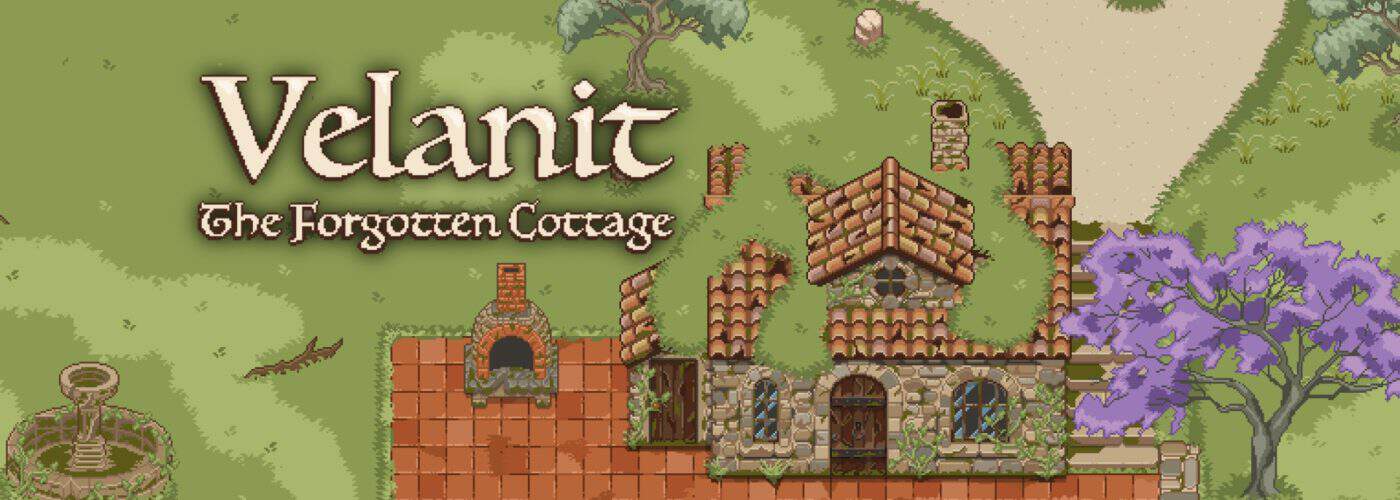
A relaxing cottage renovation game with far too many secrets buried within its walls.

Let’s be honest for a moment – without filters, without that reflexive cynicism we’ve learned to adopt whenever a new game appears on screen. We no longer really observe. We scroll, we skim, we categorize. It has become almost automatic: a consequence of how video games are now announced, marketed, and consumed. An era of constant reveals, trailers compressed into seconds, social feeds that reduce entire worlds into fleeting impressions before moving on to the next.
And so, almost without realizing it, we’ve grown used to instant judgment – to the increasingly automatic belief that we understand something long before we’ve actually taken the time to engage with it. A warm palette. A familiar aesthetic. A recognizable art direction.. A glimpse of crafting systems, decoration, slow routines, gentle rhythms. And that is often enough for the mind to conclude: “I get it.” It is instinctive. Efficient. And, in many ways, human.
But in that efficiency, something essential gets lost. Because contemporary game culture rarely allows space for slowness of perception. We are pushed toward recognition rather than understanding, toward categorization rather than attention. Complex works are quickly folded into familiar labels before they have time to fully express themselves.
And this is precisely where Velanit: The Forgotten Cottage risks being misread. Not because it hides what it is, but because its surface feels immediately familiar. At first glance, it reads as another cozy experience – another quiet game of restoration, crafting, and slow progression, another warm pixel-art world built on care and reconstruction.

It would be easy to file it away as such. And it would also be premature. Because a slightly longer look reveals something else entirely. Something more fragile. More deliberate. More personal. There is a quiet sensitivity at work here – one that does not announce itself, but accumulates gradually, almost imperceptibly.
And perhaps that is Velanit’s most distinctive quality: its refusal to fully speak the dominant language of modern visibility. It does not raise its voice. It does not compete for attention. Instead, it asks for something increasingly rare today: time. Time to be seen properly. Time to be understood. Time to exist before it is defined.
In a culture that rewards immediacy, this feels almost like a quiet act of resistance. To understand why that matters, we need to recognize something broader: cozy gaming is no longer just a genre. It has become a cultural language – an emotional framework built on slowness, comfort, and care, born as a response to an increasingly accelerated world.
And it has flourished precisely because of that promise. Yet the more recognizable this language becomes, the more it risks hardening into formula. And formulas, over time, inevitably dilute the emotional power that once made them resonate. Today, the grammar of cozy games is immediately recognizable: gentle loops, resource cycles, soft progression systems, decoration mechanics, day-night rhythms. These elements still work. They still comfort. But they also start to blur into a more uniform shape.
And this is where Velanit quietly begins to diverge. Not by rejecting the cozy framework, and not by dismantling it, but by subtly reframing it — infusing it with something else. Something more melancholic. More ambiguous. More human.
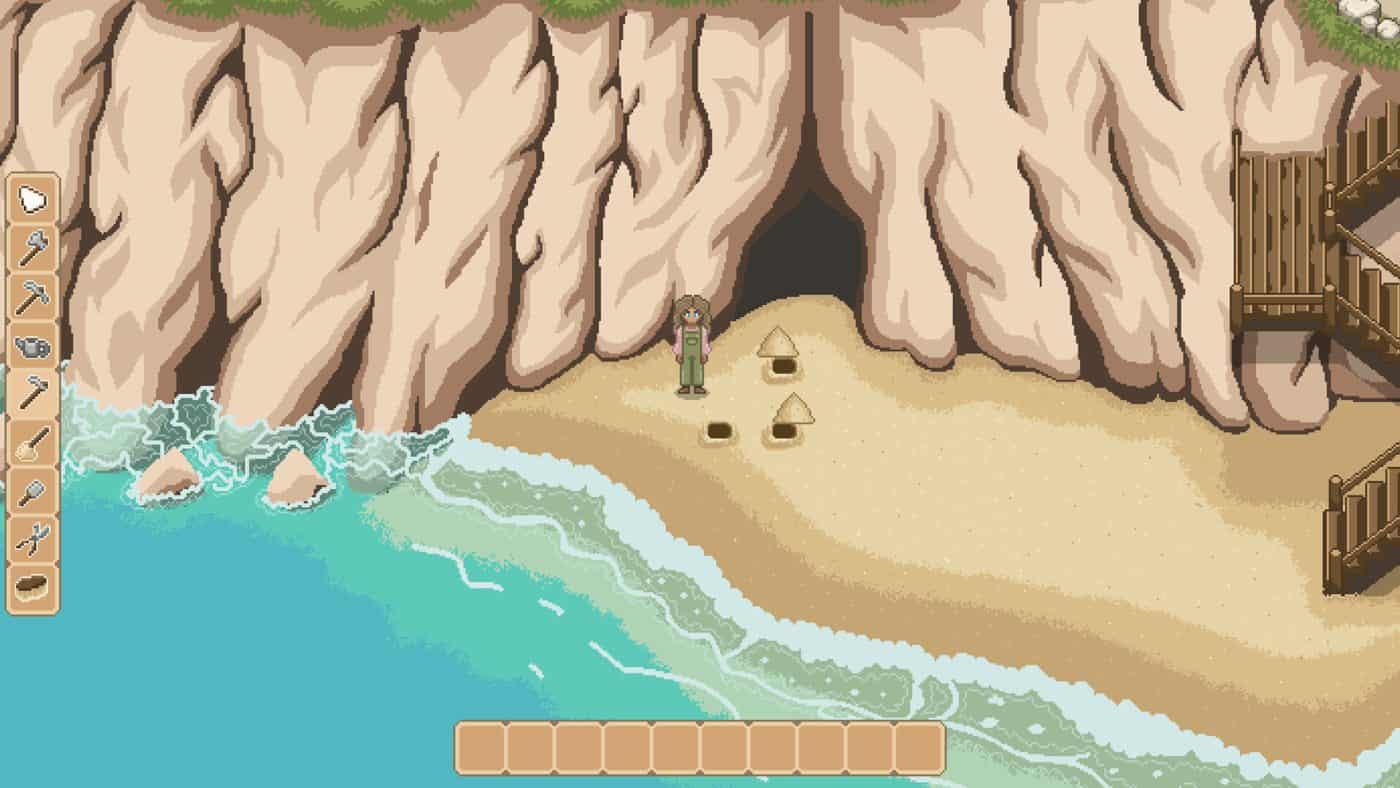

At its core, Velanit does not appear to be about comfort alone. It is about what lingers beneath it. About the emotional residue of what has been left behind. The cottage overlooking the Mediterranean is not framed as an empty space waiting to be shaped.
It feels marked by absence. Shaped by time, silence, and traces of lives that existed before ours. Here, restoration is not merely progression. It is interpretation. An act of listening to what a place once was – and what it still quietly remembers.
And gradually, a second tone emerges beneath the surface – more elusive, more unsettled. A quiet sense that something is slightly out of place. Never enough to break the atmosphere, but enough to complicate it. Like light suspended in dust. Like a room left untouched for years. Like a memory resurfacing without ever fully resolving. It is in that ambiguity that Velanit finds its emotional core. It invites comfort, but resists simplification. It offers calm, but encourages curiosity.
What happened here? What remains hidden? What refuses to fade? It is here that the project begins to move beyond the boundaries of a conventional cozy experience. Comfort becomes not the destination, but the threshold – an entry point into something deeper. A meditation on memory. On absence. On reconstruction. On the fragile dialogue between what was and what still lingers. What makes this even more striking is the sense that nothing here feels accidental. Everything appears shaped by intent rather than convention. And behind it all, unmistakably, is the voice of its creator – singular, focused, personal.
Because Velanit communicates something increasingly rare in contemporary development: authorship. It does not feel assembled. It does not feel optimized. It feels necessary – as though it exists not to follow a trend, but because it needed to exist. And perhaps that is why it resonates even now, before we have fully experienced it ourselves.

Because beneath its warmth lies sincerity. Beneath its softness, vulnerability. And beneath its calm surface, a personal way of seeing the world – which may be one of the most valuable things a game can still offer today.
So perhaps the best way to approach Velanit: The Forgotten Cottage is simple: slow down. Resist the urge to define it too quickly. Give it the space to speak on its own terms. Because every now and then, in an industry that rarely pauses, a project emerges that reminds us what games can become when they are not merely products, but expressions.
And Velanit, with its Mediterranean light, its quiet silences, and its subtle undercurrent of melancholy, feels very much like one of those rare cases: a work that does not simply ask to be played, but to be felt.
Ana: The Mind, Heart, and Soul Behind Velanit: The Forgotten Cottage
Leaving a stable job. Walking away from a life carefully built over time, piece by piece. Giving up a sense of security that, for better or worse, slowly becomes a comfort zone – one that grows harder to leave the longer you stay inside it.
And then choosing to leave anyway. Choosing, with clarity and conviction, to question everything in pursuit of something more uncertain: a creative path, a personal vision, a dream. Accepting risk, instability, and the possibility of failure in order to take a leap that many consider, but few ever truly commit to. At the heart of Velanit: The Forgotten Cottage lies exactly that decision.
A deeply human story shaped by hesitation, ambition, doubt, and resolve. A story about fragility – but also about a quieter kind of courage: the moment someone stops asking whether a dream is realistic and instead decides to pursue it regardless.

Those familiar with our work will know we rarely stop at the surface of a game. We look beyond trailers, beyond mechanics, beyond the language of features and marketing shorthand that, in today’s media cycle, so often compresses complex works into quick labels and familiar comparisons. Because in the independent space especially, a game is rarely the product of systems alone. It emerges from lived experience, from personal unease, from emotions accumulated over time — and, more often than not, from a need to express something that words alone cannot fully contain.
That is precisely the impression Velanit: The Forgotten Cottage leaves. Behind the cottage waiting to be restored, behind the Mediterranean melancholy that runs through its environments, behind the constant sense of memory and rediscovery, there is something unmistakably personal. Almost intimate. That presence has a name: Ana.
Ana is the founder of Ivasan Games. More importantly, she is the creator of Velanit: The Forgotten Cottage – its designer, writer, and artistic and narrative voice. Working alone from a small apartment in Barcelona, she is not merely making a game, but giving form to a life choice that feels deeply human and entirely her own. And perhaps that is where the real story begins.

To understand what makes Velanit feel so intimate, so grounded, and so emotionally resonant, we have to begin with its creator – with the path that led her here, the doubts she had to confront, the sacrifices she made, and the gradual realisation that a life which looks coherent on paper is not always one that feels coherent to live. Before this shift, Ana worked as a software engineer — a profession that, from the outside, embodies a familiar idea of success: stability, financial security, clear progression, and a reassuring sense of certainty about the future. The kind of career often seen as an endpoint. And yet, as is so often the case, what appears rational and desirable from the outside does not always align with what feels right on the inside.
Over time, a quieter tension began to take shape: the sense of a life that worked in practice, but no longer reflected who she was becoming. A professional environment that rewarded technical skill and productivity, but left little room for creative expression.
The desire to make games was never sudden. It had been there for years, stretching back to adolescence – a quiet, persistent ambition grounded in a deep love for the medium, but also shaped by external expectations. The familiar pressure that suggests, explicitly or implicitly, that certain dreams are too uncertain, too fragile, too impractical to pursue seriously.
So we adapt. We defer. We choose what feels safe. And for a long time, Ana did exactly that. Until a breaking point came: the layoff. A sudden rupture in what had once felt stable, followed by a simple but disorienting question – what now?
In that uncertainty, something shifted. As Ana has described it, there was suddenly no external frame defining what was realistic or not. No expectations to meet. No voice to scale things down. Only a decision to make. And slowly, the idea of trying stopped feeling impossible. That is how Ivasan Games was born. Not as a studio in the traditional sense, but as the direct extension of a personal decision. One person. A desk. A small apartment. Long hours. Constant doubt. Real sacrifice. And a vision pursued with quiet persistence, even in moments when uncertainty becomes overwhelming.

Because changing your life in this way is never the romantic gesture it is often made out to be. It means living with instability, accepting the possibility of failure, and confronting the fear of not being enough. It means constantly questioning whether talent, discipline, and passion will be enough to carry the weight of the decision you have made.
But it also offers something rare: the possibility of being truly aligned with oneself. That emotional honesty runs through every fragment of Velanit – in the way it approaches forgotten spaces, in the almost tactile care of its restoration systems, and in its recurring focus on memory, absence, and recovery, which shapes the entire world.
At its heart, Velanit is also about what we leave behind. About the parts of ourselves we stop listening to, and the possibility of returning to them before they fade completely. It is one of the reasons independent games continue to resonate so deeply.
Because behind works like this, there are not just systems or design decisions. There are people. There are lived experiences. There are difficult choices and acts of conviction. And when a game emerges from that kind of necessity, writing about it stops being just analysis. It becomes something closer to witnessing. And sometimes, even a responsibility.
A Cozy Game with a Sharp Investigative Edge
At this point, many readers are likely asking the question that matters most whenever an ambitious indie project appears on the horizon: where exactly does Velanit: The Forgotten Cottage come from?
More importantly, what is it that truly sets it apart? What allows it to stand out in an increasingly crowded cozy landscape – one filled with visually appealing projects that often struggle to establish a voice of their own? Because the challenge facing the genre today is hard to ignore. A polished pixel-art aesthetic, a warm colour palette, a handful of farming mechanics, some light crafting systems, and a cottage nestled in an idyllic natural setting are often enough to define a contemporary cozy experience. The formula is instantly recognizable – and when handled with care, it can still be highly effective.
But familiarity alone rarely creates something that lasts. Leaving a real impression requires something more difficult to achieve: vision. A creative sensibility that does not merely embrace the conventions of the genre, but reinterprets them through a perspective that feels personal, deliberate, and unmistakably authored. And this is where Velanit begins to set itself apart.
To understand why, however, it helps to go back to the beginning. Long before Velanit existed as a concept or development project, it existed as an instinct – one rooted not in market trends or design theory, but in lived experience.


As creator Ana has explained, her relationship with construction and restoration dates back to childhood, when she spent time helping build and shape her family’s holiday homes. It was an early, hands-on encounter with the process of creation itself: raw materials waiting to become something, empty spaces gradually transformed through imagination and care.
Those experiences left a lasting impression. They instilled an understanding that building is more than assembly. It is transformation. An act of giving form to possibility. Ana has often described herself during those years as fascinated – almost obsessed – by the idea of renovating and building. Over time, that fascination evolved into creative language.
If restoration sits at the heart of Velanit today, it is not because it makes for satisfying progression systems. It is there because it reflects something deeply personal. That autobiographical foundation is matched by another defining influence: the Mediterranean. Ana’s move to Spain played a major role in shaping the project’s atmosphere and visual identity.
Anyone familiar with the region understands its particular emotional texture: late-afternoon sunlight washing over stone walls, the scent of salt and rosemary carried through the air, the quiet beauty of spaces shaped by time rather than perfection. Velanit does not simply use the Mediterranean as aesthetic dressing. It treats it as identity.
That same attention to specificity extends to the game’s historical setting. Rather than defaulting to a vague fantasy past, Velanit is set in 1540, at the height of the Renaissance – a fascinating period suspended between scientific curiosity and superstition, where reason and mystery often occupied the same intellectual space. It is a striking choice, and one that fits neatly with the game’s central tension. That tension is further reflected in the project’s clearest influences.
The restorative rhythms and pixel-art warmth of Stardew Valley are immediately recognizable, as is the quieter investigative DNA of Nancy Drew, particularly in the game’s approach to puzzles, observation, and slow-burn discovery. It is at the intersection of those influences that Velanit finds its most compelling identity.

Its ambition is not simply to belong to the cozy genre, but to gently push its boundaries. At first glance, the game appears to offer many of the genre’s familiar comforts: a neglected cottage to restore, resources to gather, decorative freedom, a charming rural setting, and a small town to become part of. Look closer, however, and a far more layered experience begins to emerge.
Players step into the role of a fully customizable protagonist who purchases an abandoned cottage overlooking the Mediterranean coast. What initially appears to be an idyllic fresh start quickly becomes something stranger. The house has stood empty for eighteen years. Its former owner remains a source of speculation among the town’s residents – remembered as eccentric, brilliant, and perhaps consumed by something few fully understood.
As restoration progresses, unsettling traces begin to surface. Hidden letters, unexplained mechanisms. Secret passages. Puzzles embedded within the architecture itself. Here, Velanit reveals one of its most interesting design ideas. Restoration is not merely a mechanical system. It is a narrative tool – the primary means of discovery. Every repaired wall, every recovered object, every restored corner has the potential to reveal another fragment of the mystery.
What would normally be a familiar loop of rebuilding instead becomes a process of excavation – both physical and emotional. The world beyond the cottage follows the same logic. The surrounding Mediterranean countryside has been built with notable care, filled with regionally grounded flora and materials that deepen its sense of place.
Crafting systems also draw from historical building practices. Producing mortar, for example, requires creating lime and combining it with water and sand in a deliberate, step-by-step process. Nothing is instantaneous. Progress is material, tactile, measured. Even resource design reflects this philosophy. Recovered materials are reused rather than discarded. Weathered timber, worn terracotta, broken roof tiles – all are given a second life. It is a small detail, but a telling one.

In Velanit, restoration is not replacement. It is continuity. The same principle defines its approach to decoration. Players are given extensive freedom to shape interiors and exteriors through Mediterranean furnishings, Renaissance-inspired objects, local vegetation, terraces, fountains, and gardens. Yet the intention is not surface-level customization. It is environmental storytelling.
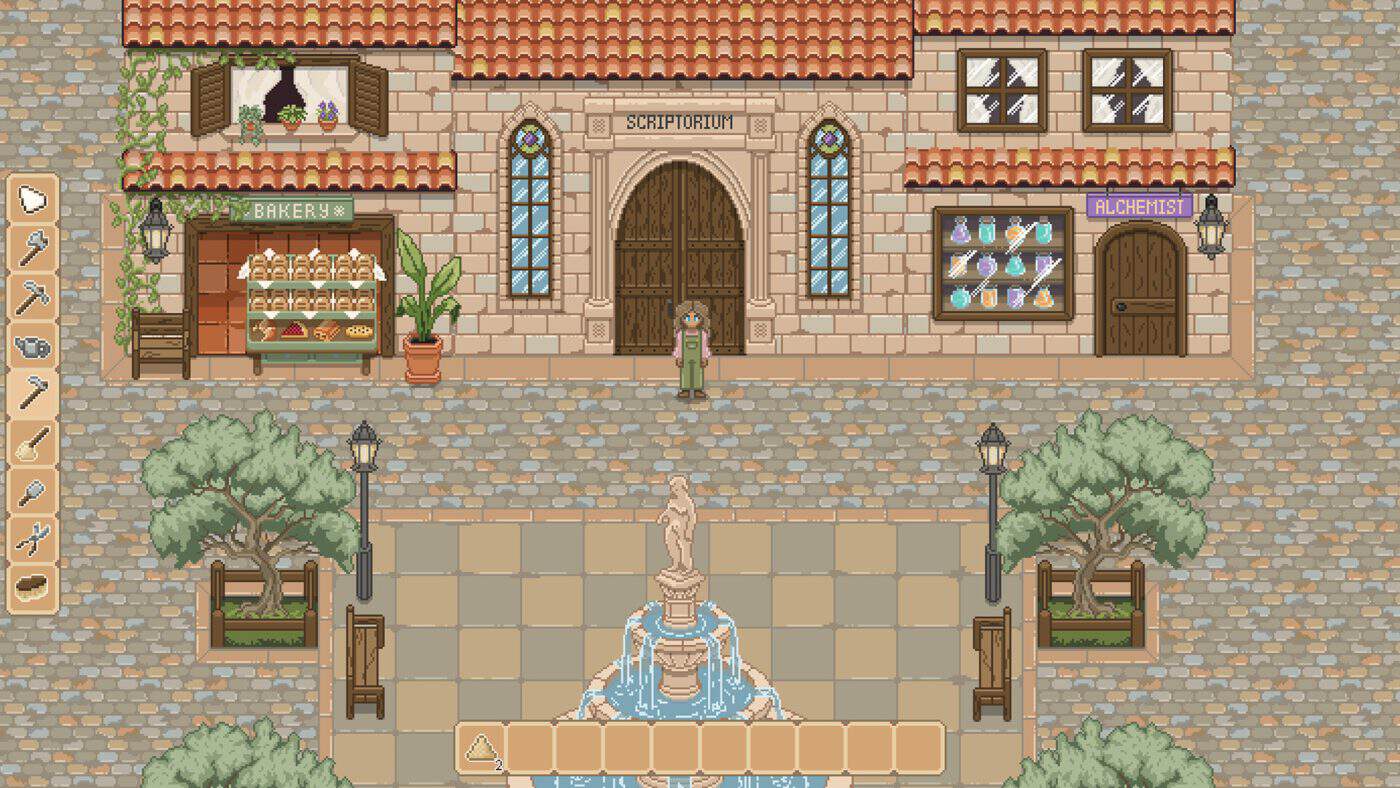
The creation of spaces that feel inhabited, coherent, and marked by memory. This sense of lived-in authenticity extends to the town itself. It is not a functional hub built around quests and menus. It is a community shaped by rhythm. Work slows during siesta. Evenings unfold across taverns and plazas. Life moves with an intentionally unhurried cadence.
Even the day-night cycle reflects this philosophy. There are no arbitrary restrictions or punitive systems. Instead, it exists to shape atmosphere rather than enforce structure. Night, in Ana’s vision, is not a boundary. It is a space to inhabit.
And perhaps this is what ultimately defines Velanit. It shows little interest in the acceleration-driven logic of much contemporary game design – the constant optimization, the pressure to progress, the compulsion toward efficiency. Instead, it chooses restraint. It slows down. It observes. It creates space – for attention, for curiosity, for reflection.
That quiet confidence, paired with the mystery running beneath its surface, makes Velanit one of the most compelling cozy projects currently in development. And if it fulfils even part of what it now promises, it may achieve something increasingly uncommon: a reminder that comfort in games is not born only of tranquillity.
Sometimes, it is found in mystery, in memory, in the quiet pull of something waiting to be uncovered.
When Will Velanit: The Forgottem Cottage Be Released and on Which Platforms?
If you are wondering when it will finally be possible to step into the world of Velanit: The Forgotten Cottage, there is still no exact answer. The project remains in a delicate phase of development, and it will take time before players can explore the evocative, weathered interiors of its Mediterranean cottage. Still, the outlook is promising: development is progressing steadily and, barring unforeseen setbacks, the current target is a PC release between Q2 and Q3 2027, with a potential console launch to follow.
After learning more about Ana, her journey, and the intent behind Velanit, it becomes increasingly difficult to view the project in purely conventional terms. This is not simply another cozy pixel-art game in an overcrowded, increasingly formulaic genre. It is a work built on lived experience – on uncertainty, memory ambition, and personal conviction – translated into interactive form. And it is precisely this human layer that sets it apart within today’s indie landscape.
For that reason, the recommendation is straightforward: keep Velanit on your radar. Follow Ana’s development journey through updates, devlogs, and behind-the-scenes insights shared across the game’s official channels – including X, Threads, Instagram, and YouTube. And if what you’ve read so far has sparked even a trace of curiosity, it may be worth adding the game to your Steam wishlist. A playable demo is already available, offering an early glimpse of the experience to come.
Between May 5th and June 5th, Ana also launched a crowdfunding campaign for Velanit, which has already surpassed 50% of its funding goal — a meaningful milestone that reflects the growing momentum behind the project. At the time of writing, 19 days remain before the campaign concludes. And, honestly, one can only hope she sees it through.
Because projects like Velanit serve as a reminder of something often overlooked: behind videogames are not just systems, mechanics, or design choices. There are people. There are ideas pursued in spite of uncertainty. And it is often this human dimension that gives them their true weight – and makes them impossible to ignore.
Thank you for reading. We’ll see you soon, among the forgotten walls of Velanit.