A gritty FPS with a short fuse and a hair-trigger edge, with no room for compromise.

Mouseburg, late at night. The city doesn’t sleep, it holds its breath.
Neon signs flicker in the dark as rain reflects fractured light across empty streets. Shadows stretch along the walls with an almost unnatural presence. The air is still, heavy, and charged with tension. Then, a phone rings. A few clipped words break the silence: a name, a disappearance, a case. In that moment, Mouseburg shows its true face. A city suspended in night – apparently still, but never at rest – where an investigation begins that soon moves beyond surface appearances.
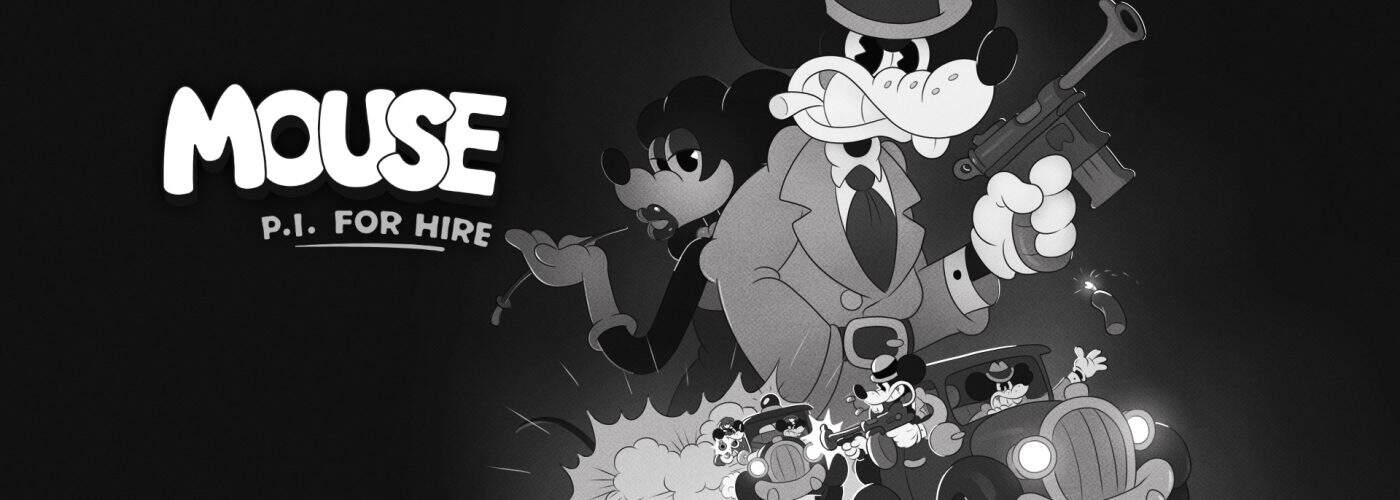
This is where MOUSE: P.I. for Hire, the debut title from Fumi Games and published by PlaySide, begins.
What follows is an investigation that moves through damp alleyways, smoke-filled interiors, and forgotten corners of the city, where every detail seems to conceal a fragment of truth – and every truth feels uncertain, fragile, and open to reinterpretation. Drawing heavily from classic noir, the game avoids straightforward imitation, instead reworking its conventions into a modern, cohesive, and clearly authored vision.
Rather than simply telling a story, MOUSE: P.I. for Hire builds an experience. The player is not just an observer but an active participant in meaning-making. The investigation unfolds through intuition, misdirection, and gradual discovery, paced with deliberate restraint. It never rushes, allowing space for observation, doubt, and interpretation. In that measured pacing lies one of its defining strengths: a slow accumulation of detail that gradually builds weight and impact.
Because in Mouseburg, nothing is ever quite what it seems. And every answer leads to more questions.
Mouseburg: A City That Feels Like It’s Always One Step Behind You
The true protagonist of MOUSE: P.I. for Hire is not detective Jack Pepper, nor any single case, but Mouseburg itself. From the outset, the city emerges as the game’s driving force, evolving beyond mere backdrop into a living, layered system in constant motion. The environment does not simply frame the story; it actively shapes it. Mouseburg influences events, reflects them, and at times distorts them entirely. It remains a constant presence – one that appears to watch the player just as closely as it is watched.
Each area contributes to a dense, cohesive urban fabric. Run-down districts, narrow alleys, abandoned industrial zones, and underground spaces form a narrative map in which nothing feels incidental. Decay is never explicitly stated; instead, it emerges through space itself – embedded in worn surfaces, fractured architecture, and the gradual erosion of environmental life, suggesting a world being consumed from within. Social stratification is clearly expressed through the physical and symbolic separation of areas, reinforcing a rigid, hierarchical urban order.
Beneath this structure lies a persistent sense of control: a corrupt framework that is never fully revealed, yet appears to permeate every layer of the city. This quiet, pervasive force defines Mouseburg not merely as a setting, but as a narrative system in its own right, where architecture itself becomes a vessel for meaning and tension.
From sewers to swamps, and from decaying film studios to hidden laboratories, Mouseburg unfolds as a cohesive, interconnected ecosystem. Each environment follows its own internal logic, constructing a world through accumulation, implication, and environmental storytelling rather than direct exposition.
At the centre of it all is the art direction, arguably the game’s defining pillar. The 1930s animation aesthetic is not used as nostalgia, but as a fully functional visual language. Black-and-white imagery, rubber hose animation, and exaggerated forms build a world that feels visually light, yet thematically heavy and unsettling. This tension between form and content becomes one of the game’s most powerful tools: a distinctive visual identity that carries an atmosphere far from reassuring. It is here that Mouseburg fully asserts itself, evolving from a mere setting into the true narrative and emotional core of the experience.


Three Cases, One Hidden Narrative Thread
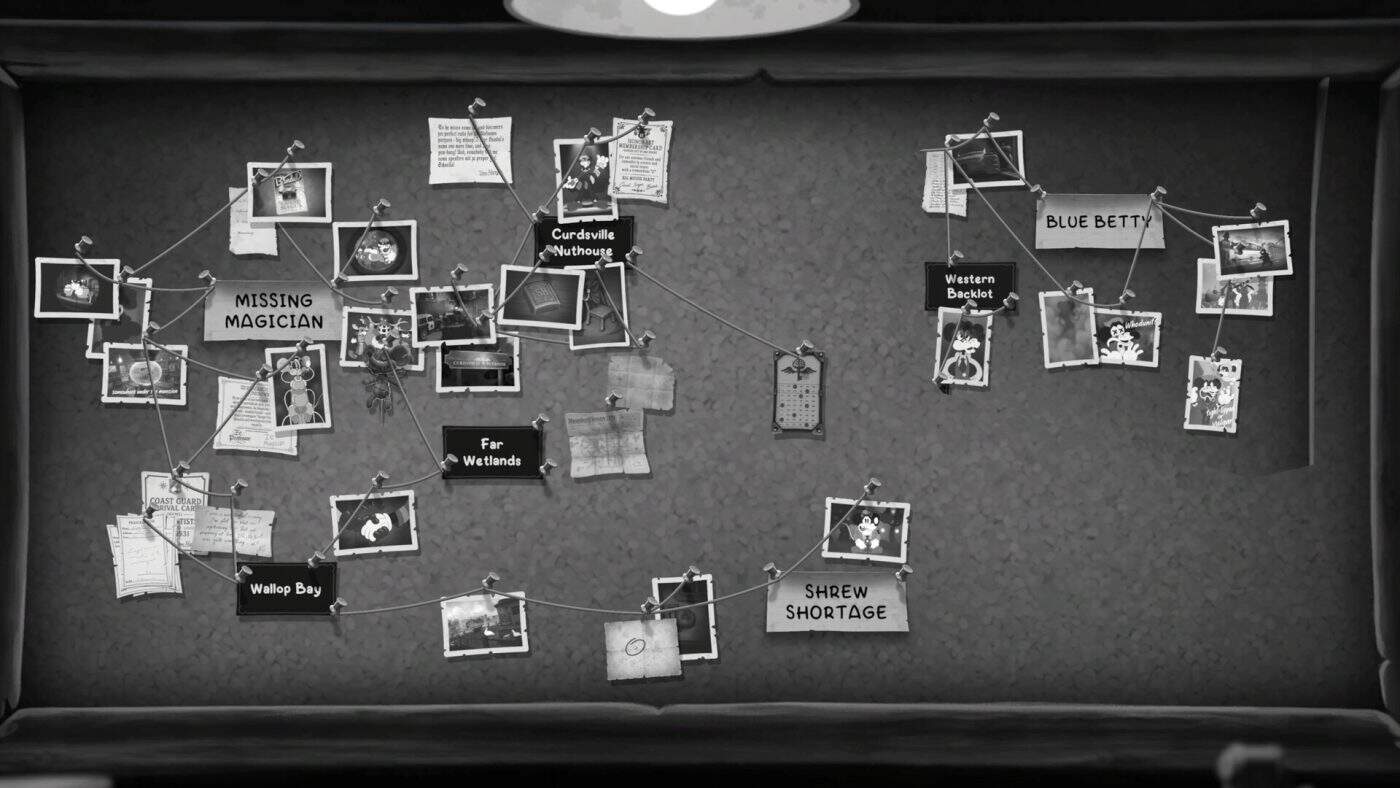
The narrative of MOUSE: P.I. for Hire unfolds through a tripartite structure built around three distinct cases that initially appear as separate episodes – largely self-contained and only loosely connected.
The opening follows a deliberately classical structure: an unexpected phone call, the disappearance of a magician, a personal link to the protagonist, and the arrival of an ambiguous femme fatale figure. It strongly recalls traditional noir tropes, yet quickly reveals a narrative framework that is more layered and self-aware than it first seems.
What may initially seem, to a less attentive eye, like a stylistic exercise or straightforward genre reinterpretation gradually develops into a far more intricate narrative system. MOUSE does not use noir as surface aesthetics, but as the structural foundation of its storytelling. Each case is not an isolated episode, but part of a broader, unified design.
- The first case unfolds within a world of pseudo-science and forbidden experimentation, drawing on visual and thematic references to early science fiction cinema and twentieth-century scientific obsessions.
- The second adopts a more explicitly political and social register, using the persecution of shrews to expose systems of control, institutional manipulation, and manufactured consent.
- The third case, centred on Betty Linch, stands as the narrative’s most symbolically dense and metafictional layer. The investigation unfolds into a reflective space that engages directly with the language of animation, leading the player into a film studio that gradually turns into a site of deconstruction and medium analysis.
The result is a narrative structure that does not simply sequence its episodes, but weaves them into a cohesive, layered system with strong internal continuity. The pacing remains measured and controlled, avoiding fragmentation while maintaining a clear and consistent narrative direction throughout.

Jack Pepper: Voice, Memory, and Disillusion
At the heart of the experience is Jack Pepper, a private investigator defined by the familiar conventions of the noir tradition: cynicism, restrained irony, emotional detachment, and a persistent undercurrent of disillusionment with the world around him. What initially appears as a clear-cut archetype is gradually expanded into something more nuanced and carefully considered, with the character gaining further depth as the experience unfolds.
The writing adopts a restrained, subtractive approach, deliberately moving away from noir cliché in favour of implication, nuance, and character-driven development. As a result, Pepper emerges as a more human and ambiguous figure, with his contradictions intentionally left intact rather than resolved. This is further reinforced by a confident vocal performance, which lends weight and credibility to his internal tensions without ever becoming overstated.
Troy Baker’s performance grounds Jack Pepper firmly within the noir tradition while avoiding any sense of simplification. He is clearly defined, yet never fixed – shaped by the lingering weight of an unresolved past, while maintaining a steady, almost stubborn commitment to uncovering the truth, even when that truth proves morally ambiguous or difficult to pin down.
Supporting him is a notably well-realised ensemble that extends beyond conventional narrative roles. Characters such as John, Tammy, and Stilton are not merely auxiliary presences; they actively shape the world’s texture, bringing distinct perspectives that enhance both its narrative depth and sense of place.


Antagonists and Encounters: The Mise-en-Scène of Combat
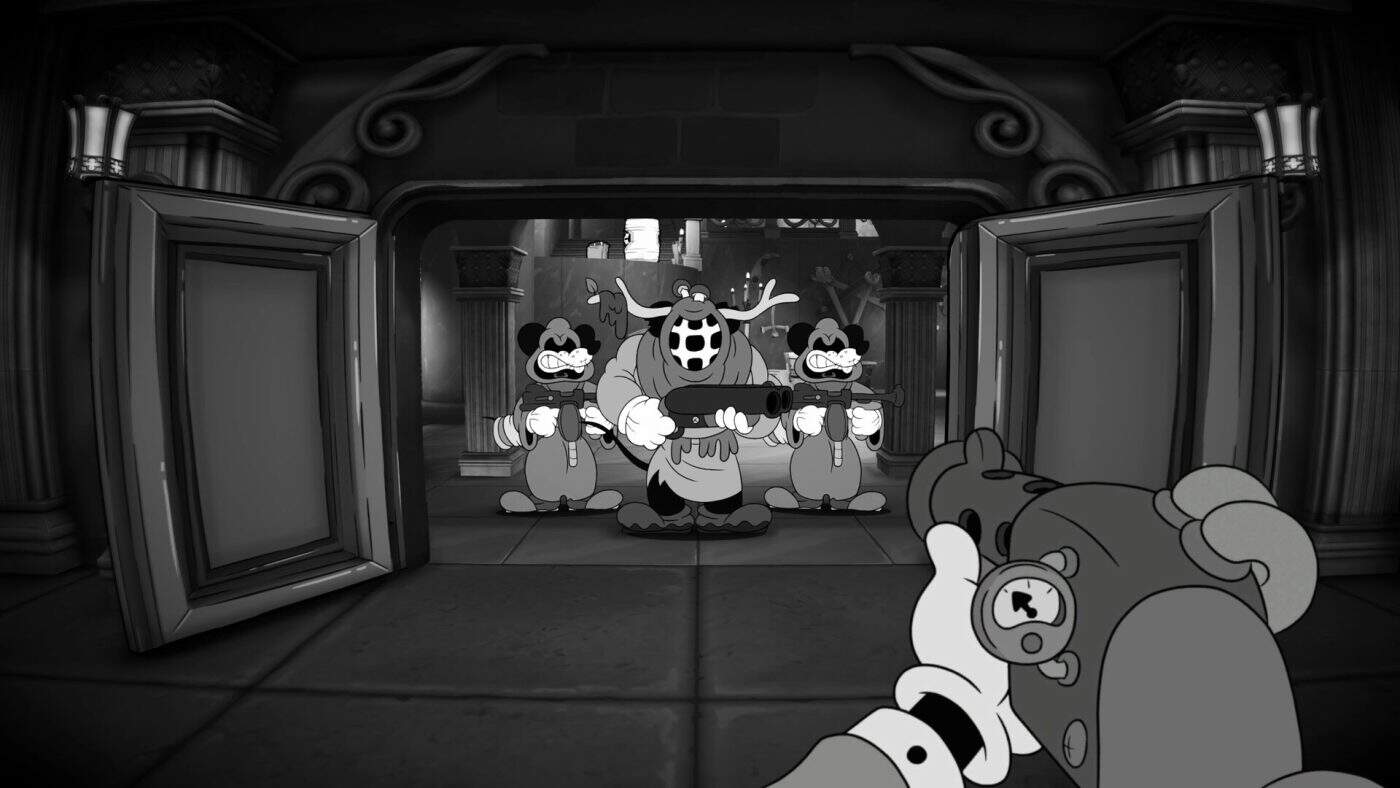
One of the game’s strongest aspects lies in its antagonist design. In MOUSE, enemies are never framed as mere gameplay obstacles, but as direct extensions of the narrative fabric—each defined by a distinct identity deeply embedded within the world they inhabit and actively shape. Characters such as the Professor or Vic Gatore emerge from familiar archetypal roots, yet are reinterpreted through the game’s stylised animation language and embedded across aesthetic, narrative, and thematic layers. The result is a design approach that avoids arbitrariness, instead reinforcing a cohesive and recognisable visual identity.
Boss encounters follow the same design philosophy, extending well beyond their mechanical function. Their direction reflects a clear sense of staging, with careful attention to rhythm, visual framing, and the progressive escalation of each confrontation. Rather than serving as isolated skill checks, these sequences are structured as authored set-pieces, designed to carry narrative weight and reinforce the game’s overall pacing and tonal consistency.


Combat: A System Built on Timing and Control
If the narrative is the heart of the experience, the gameplay acts as its backbone. MOUSE: P.I. for Hire features a combat system defined by a strong sense of identity, internal coherence, and clear stylistic intent, establishing a gameplay language that is both distinctive and immediately readable. Weapon handling is crisp, responsive, and consistently rewarding.
Each tool is designed not only for functional efficiency, but with a clear aesthetic and narrative purpose. The arsenal – from the Tomi Gun to the Devarnisher – is never neutral or purely utilitarian; instead, it reflects the game’s deliberately exaggerated visual identity, becoming an integral and immediately recognisable extension of its world.
The system’s defining strength, however, lies in the approach it demands from the player. MOUSE moves away from the conventions of the traditional shooter, embracing a more dynamic, almost cartoon-like logic built around rhythm, responsiveness, and continuous spatial awareness. Combat is never reduced to a purely mechanical exchange; it requires constant adaptation and a fluid, situational understanding that develops organically over time.
The difficulty curve, initially demanding, gradually settles into a more accessible balance without sacrificing depth or complexity. The result is a system that rewards sustained player learning, fostering a clear sense of progression and delivering, over time, an increasingly tangible sense of mastery over its mechanics.


Lockpicking and Platforming: More Than Add-Ons
One of the game’s most notable strengths lies in the attention devoted to its secondary mechanics, which are often treated as peripheral in comparable productions but here are fully integrated into the core experience. Lockpicking, traditionally reduced to a brief functional interlude, is reimagined as an intuitive and engaging minigame. What initially appears to be a simple system is carefully engineered to align with the game’s rhythm, sustaining flow without ever feeling intrusive or mechanically redundant.
Platforming makes effective use of the protagonist’s mobility, introducing dynamic sequences that are tightly woven into the game’s pacing and overall progression. While occasional spikes in difficulty do occur, the balance between challenge and control remains carefully calibrated, supported by a learning curve that is measured and never tips into frustration.

 9/10
9/10