
After closely following the project’s evolution, from its first demo to its current Early Access phase, Realm of Ink is proving to be one of the most interesting action roguelite titles on the market.
Developed by Leap Studio, Realm of Ink clearly draws inspiration from titles such as Hades. However, it intelligently builds upon those foundations, establishing its own stylistic identity while introducing several original ideas.
Since our first article published in February 2024 and the second one in September of the same year, the developers have shown a remarkable commitment to refining the game. They have worked on gameplay, balance, visual presentation, and content. The improvements are evident and help bring Realm of Ink to its definitive version.
Now that version 1.0 has arrived, let’s take a look at what has been refined and what has been added.
As far as its core structure is concerned, Realm of Ink takes most of its inspiration from the original Hades, maintaining a certain simplicity in both its story and combat. The latter, despite featuring aggressive and varied enemies, can sometimes be overcome through extremely overpowered builds.
We’ll talk more about that later. For now, let’s focus on the story.
Story: Trapped Inside a Book
The story, already discussed in our previous articles, takes place in the mysterious Realm of Ink, a fantasy world whose inhabitants are unaware that they are merely creations of a higher entity. Guided by the Spirit of the Book, they unknowingly live within a predetermined cycle, following a destiny that has already been written.
The protagonist, Red, accompanied by the ancient Scriptbound Fox and empowered by the immortal Fox Blood, embarks on a journey to collect the Ink Gems and uncover the truth behind her world.
The game’s visual style is one of the elements that truly sets Realm of Ink apart. Its entire universe appears to have been painted with brush strokes. Every creature and inhabitant of this realm originates from the Spirit of the Book and is therefore made of ink. This artistic direction accompanies players throughout all four stages, referred to as chapters to further reinforce the narrative setting.
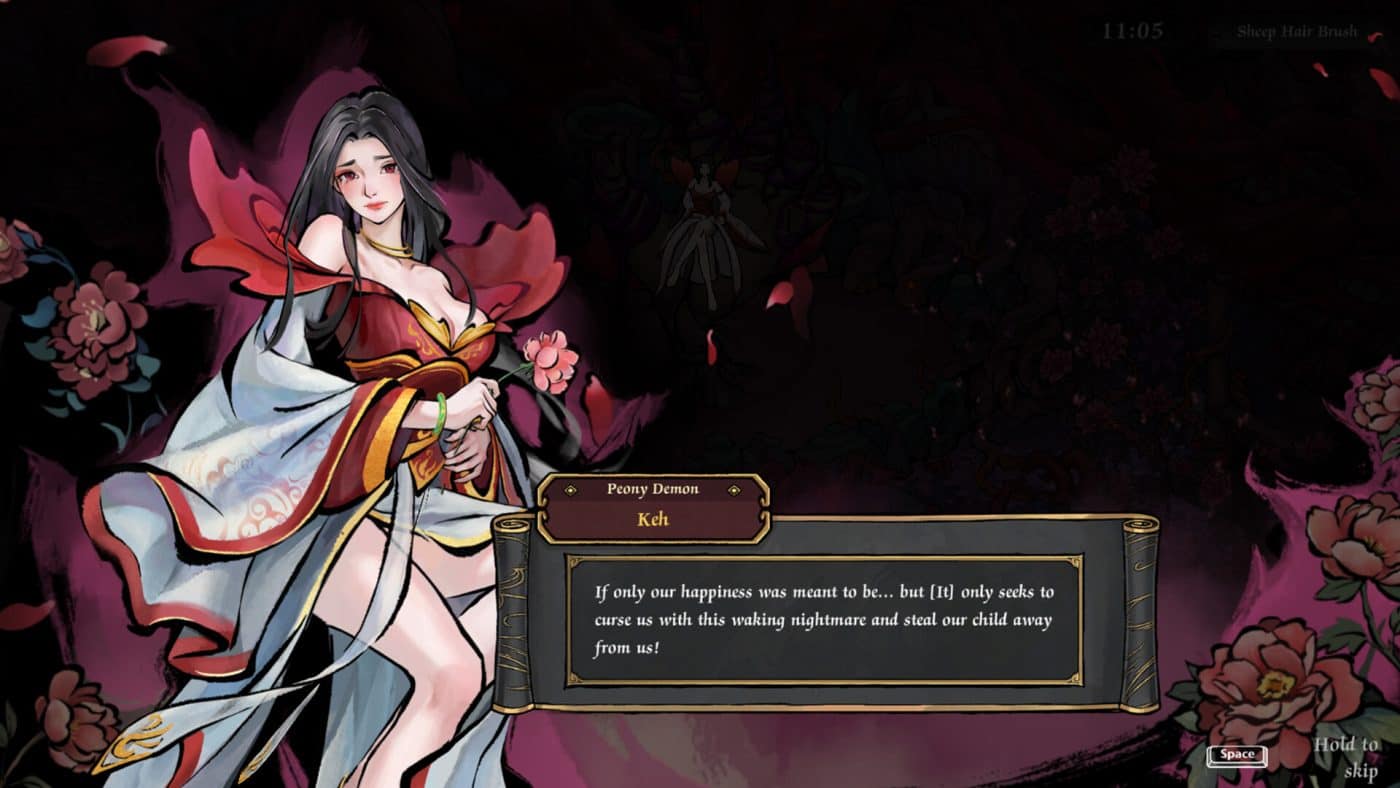
The narrative is intentionally simple. I found it particularly interesting to encounter certain hub NPCs at the end of a room, where they offer various deals. Some are beneficial, while others provide extremely powerful advantages at a significant cost. As a result, players should carefully consider their choices.
I also discovered that, in some cases, an NPC in the hub may appear with a heart-shaped speech bubble. Accepting the invitation triggers a short interaction sequence with that character. Honestly, I’m not sure whether these events occur randomly or under specific conditions. Completing multiple runs, exhausting dialogue options, or spending currency could all be valid triggers. Regardless, it’s a welcome addition that adds some charm to the hub.

A Well-Structured Central Hub
The central hub serves as the core of the game’s progression. While it felt somewhat basic in earlier versions, it now appears much more refined both visually and functionally.
The hub is divided into two floors, allowing players to interact with various NPCs who act as archives for collectibles, statistics, and information gathered during runs. There is also a resting area for Momo, our pet companion. Here, players can feed her drops obtained from major bosses. Doing so allows Momo to level up and unlock new forms. Additional upgrades grant her new abilities that prove valuable during combat.
The second floor houses several permanent progression systems. Among them is the Talent Stele, which consists of three separate branches focused on offense, defense, and reward quality. By investing the Fox Blood earned during runs, players can unlock permanent upgrades and useful passive abilities.
There is also a special brush that increases the game’s difficulty in exchange for better rewards, providing an additional challenge for experienced players. However, balance still shows some weaknesses. It’s possible to melt a mini-boss in two seconds (I’m not exaggerating) while others feel like massive damage sponges.
Combat System: Weapons, Pets, and Ink Gems
Gameplay is undoubtedly the strongest aspect of the entire production.
The game doesn’t try to do too much, and that restraint helps it avoid major mistakes. There are still some rough edges and minor issues, which is understandable given that this is Leap Studio’s debut title. Even so, Realm of Ink offers a wide range of options for character customization.
Ink Gems remain one of the cornerstones of build creation. They come in multiple variations, some of which are particularly powerful. They can also be upgraded in areas located before mini-bosses and bosses. These gems accumulate energy over time and unleash devastating attacks once fully charged, often turning the tide of battle.
Each character possesses a unique weapon built around distinct mechanics that force players to constantly adapt their approach. Some weapons focus on rapid combos, while others revolve around charged attacks or more technical interactions.
The nine available weapons feel surprisingly diverse and original, avoiding the impression of being mere cosmetic variations.
Unlocking a weapon effectively unlocks a new playable character, each offering a completely different way to experience the game. Despite this, Red remains the protagonist from a narrative standpoint. There are eleven characters in total, all unlocked through Jade Ink, unique drops obtained from major bosses.
Momo also plays a more significant role in combat. Through Ink Gems, she changes both her appearance and abilities, inheriting effects from the equipped gems. Depending on the synergies created, she can even unlock a special finishing attack whose usefulness varies according to her current form.


Progression
Dismantling Ink Gems provides materials used to upgrade them. In addition to active abilities, Gems grant passive bonuses that improve both primary and secondary character attributes. Upgrading them therefore strengthens the entire build.
Players can also obtain Curios, some of the game’s most valuable upgrades, which are divided into different rarity tiers. However, choosing carefully is essential, as even a high-rarity Curio can end up being useless. Characters possess both primary attributes (such as strength, damage, bonus damage, damage percentage, speed, and more) and secondary attributes. The latter include status effects, curses, and area-based effects. Consequently, even a legendary Curio may be ineffective if it boosts a secondary stat that your build does not utilize. There are also Corrupted Curios, which offer tremendous power at an equally significant cost.
On top of that, Elixirs provide percentage-based stat increases.
Don’t hesitate to destroy the surrounding environment. Doing so may reward you with orbs that function similarly to Elixirs.
The weapon evolution system is also noteworthy. After defeating a stage’s main boss, players can obtain upgrades that dramatically alter a weapon’s combat style, further expanding customization options.


Bosses and Combat System
One of Realm of Ink’s most noticeable improvements lies in its visual presentation and level design.
The combat system has also received significant refinements. The developers have worked on improving encounter readability, reducing visual clutter, and making effects, damage-over-time mechanics, and synergies between Ink Gems and Perks easier to understand. The result is a cleaner and more satisfying gameplay experience. Unfortunately, during the most chaotic encounters, player-generated area effects can still obscure enemy attack indicators. While clearly telegraphing enemy attacks is certainly beneficial, situations involving large numbers of aggressive enemies can still feel overwhelming.
The environments have been completely reworked and enriched with additional details, new animations, and cutscenes that help give the world greater personality.
The bosses are particularly successful. Beyond their impressive visual design, they feature well-crafted and generally readable attack patterns. Some encounters even include dynamic dialogue that expands the game’s lore during battle, demonstrating the care the developers have invested in world-building.
Endgame
Realm of Ink’s endgame is not particularly complex, but it remains functional.
Beyond the challenge of completing the game with all eleven characters, players can tackle multiple difficulty levels. However, as difficulty increases, those without a highly optimized build may find themselves struggling against bosses with enormous health pools. Furthermore, certain weapons and builds perform poorly against specific encounters, though this is not necessarily a flaw. Each weapon carries its own level of challenge and requires a distinct approach.
Fox Blood, which is primarily used to unlock upgrades at the Talent Stele, gains an additional purpose once all abilities have been unlocked. At the start of each run, players can spend it to purchase one of the Curios they have previously unlocked, as well as an Ink Gem.
After completing a run, players can speak with the NPC responsible for tracking run history to access an endless mode. This arena gradually pushes the difficulty to extreme levels, providing a meaningful challenge for dedicated players.
The synergies between weapons, Ink Gems, and Curios are extensive and encourage long-term experimentation. Discovering a devastatingly powerful build is satisfying, but so is testing new strategies and combinations.


My Two Cents
Realm of Ink is a game that demonstrates tremendous potential. Its inspirations are evident, but the team has managed to create something that goes beyond simple imitation, introducing interesting mechanics, a distinctive artistic identity, and a highly engaging progression system.
Of course, not everything is perfect. In the later stages of the game, especially during the final chapters, the sheer number of visual effects and enemies on screen can still impact combat readability. Some area-of-effect attacks can be difficult to read, and the final boss features particularly aggressive phases that may occasionally lead to frustrating situations.
Despite these shortcomings, Realm of Ink already rests on an extremely solid foundation. The gameplay is satisfying, build variety is impressive, and the progression system remains rewarding without becoming excessively demanding.
If you’re a fan of action roguelites and are looking for an alternative to Hades II, Realm of Ink is definitely a title worth checking out.
 8/10
8/10