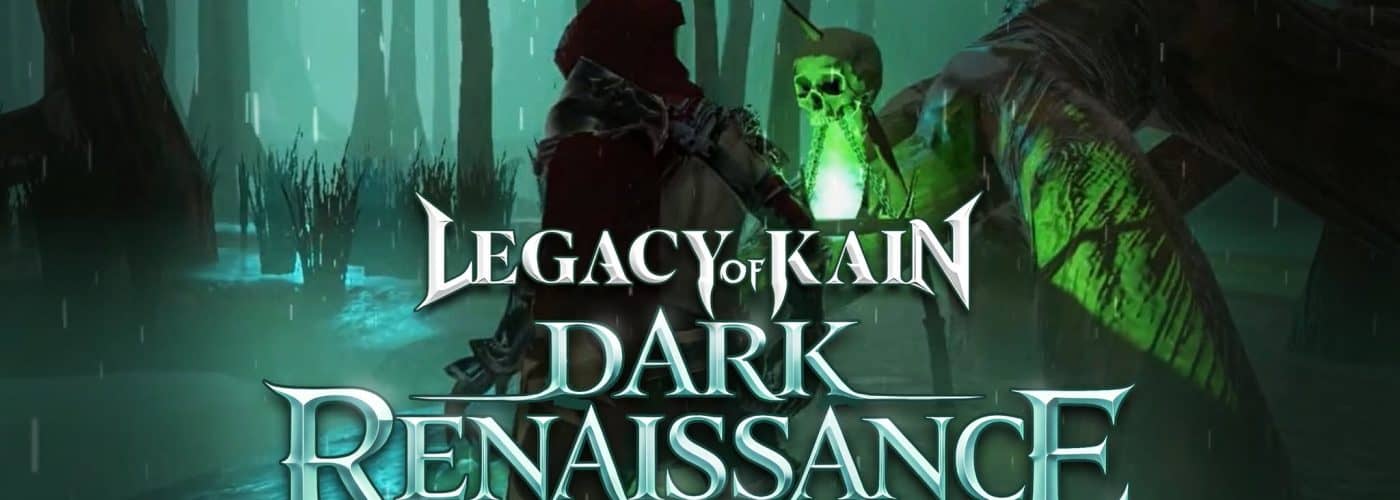
A narrative-driven fan project revisits the forgotten era of Nosgoth, with Raziel leading Kain’s armies before his fall.

More than twenty years after the release of Legacy of Kain: Soul Reaver, few narrative universes still hold the same fascination as the work Crystal Dynamics created and Amy Hennig‘s writing immortalized. Nosgoth’s complex mythology, built through time travel, paradoxes, and memorable characters, has remained one of the definitive references in video game storytelling for years, fueling one of the most passionate and active communities in the gaming landscape today.
In recent months, the series’ return through the Soul Reaver remasters has driven a marked resurgence of interest in the franchise. Meanwhile, some independent developers have decided to pick up that legacy, attempting to explore events that the official episodes only hinted at.
Among these projects, Legacy of Kain: Dark Renaissance probably stands as the most ambitious. Built by the small independent team Spiral Summit, the title presents itself as an original fan game aiming to tell one of the most important and, at the same time, least explored phases in the entire Legacy of Kain chronology: the long period in which Kain consolidated his dominion over Nosgoth, giving rise to the vampire hierarchy destined to change the world’s fate forever.
Rather than simply reviving iconic characters or nostalgic settings, Dark Renaissance attempts a decidedly more complex operation: building a genuine narrative prequel dedicated to the years of conquest, with Raziel as the absolute protagonist, long before the events told in Soul Reaver.
The Forgotten Era of Nosgoth
One of the project’s most interesting aspects concerns the choice of historical period.
The Legacy of Kain universe carries an extremely intricate chronology, spanning several millennia and dotted with events that have continually reshaped the course of history. Despite this vast narrative wealth, one of the saga’s most important phases has remained surprisingly in the shadows.
After the events of Blood Omen conclude, Kain begins building his vampire empire, gradually conquers Nosgoth, and transforms six powerful lieutenants destined to become the protagonists of Soul Reaver.
Yet players have never witnessed these events directly. The birth of the empire, the wars of conquest, the rise of the vampire generals, the evolution of Kain and Raziel’s relationship, and the transformation of vampire society are elements the official episodes have conveyed almost exclusively through dialogue, brief references, or indirect reconstructions.
Even Blood Omen 2, set during one of the saga’s most controversial timeline alterations, only brushed against this period without ever truly exploring it. This is exactly the enormous narrative gap that Dark Renaissance sets out to fill.
Naturally, this is not an official work, and the project will not join the series’ canonical chronology. Still, the intent to tell one of the most significant periods in the Nosgoth universe makes for an extremely compelling choice, especially for a community that has spent over twenty years wondering about the years of Kain’s conquest.

The Years of the First Lieutenant’s Absolute Power
If the choice of time period stands as one of the project’s main strengths, the decision to put Raziel at the center of the experience is probably its most fascinating element.
The saga has always told this character’s story at the moment of his fall. Players have known Raziel as a wraith, consumed by a desire for revenge and dragged into a cycle of manipulation that involved Nosgoth’s very fate. The Raziel that Dark Renaissance imagines looks very different. Here the protagonist should stand at the peak of his existence as a vampire, back when he was still Kain’s First Lieutenant and the most powerful of all his children.
This shift in perspective opens up particularly interesting narrative possibilities. For the first time, players could observe the relationship between Raziel and the other lieutenants before their physical degeneration, understand the vampire empire’s military structure, and witness the conquest campaigns that let Kain establish himself as Nosgoth’s absolute ruler. If the writing manages to honor the tone that has always defined Legacy of Kain, Dark Renaissance could offer one of the most interesting deep dives ever dedicated to the series’ historical characters.

A Completely Rethought Gameplay
On the gameplay side, Dark Renaissance chooses not to chase a simple imitation of the original chapters. The sequences shown so far reveal a fairly radical reinterpretation of the game’s structure. The action-adventure framework typical of Soul Reaver gives way to a system much closer to early-2000s Western RPGs.
The camera moves completely freely, positioned behind the protagonist, while the interface clearly recalls productions like Gothic, Rune, and other role-playing games of that era, with a traditional inventory, item management, stats, and progression that appears more pronounced than in the original series. It’s an extremely bold choice.
Rather than simply replicating mechanics that now belong to another gaming era, Spiral Summit seems to want to reinterpret Legacy of Kain through a more modern structure, while keeping the slow, atmospheric, and heavily exploratory approach that has always defined Nosgoth.
The impression is one of a project searching for its own identity, avoiding the risk of becoming a simple nostalgic clone.

Atmosphere Seems to Be the Project’s Real Strength
The early published materials make the developers’ goal clear. Even before gameplay, Dark Renaissance seems intent on rebuilding Legacy of Kain‘s artistic identity. The settings show decaying castles, gothic cathedrals, fog-shrouded fortresses, and dark landscapes that immediately evoke the series’ imagery.
The color palette also seems to draw directly from the original chapters’ historic CGI cutscenes, recovering the cold, metallic, dark tones that helped define the visual identity of the universe Crystal Dynamics created.
Even the three-dimensional models seem to deliberately pursue that particular “rough” style typical of early-2000s productions, an artistic choice that further reinforces the sense of continuity with the original work.

Combat Remains the Biggest Unknown
The project has already shown decidedly promising elements from an artistic standpoint, but the combat system remains the main question mark. The developers have shared only brief sequences, and it’s still not possible to gauge the real depth of the offensive mechanics.
The question carries particular weight given the chosen protagonist. During this period of the chronology, Raziel represents the most powerful warrior in the entire vampire army. The risk lies in building an overly dominant character, depriving the player of genuine progression.
Avoiding this problem will require developing a credible growth system, one capable of progressively introducing new abilities, vampiric powers, and offensive capabilities without compromising overall balance. It will also be interesting to see how the team integrates any RPG components, equipment management, and skill development, elements that could further differentiate the experience from the original titles.
The Challenges of Independent Development, Between Ambition, Sustainability, and Copyright
On the production side, Dark Renaissance faces an even more complex challenge. Making a fan game of this scale demands years of development, advanced technical skills, and considerable resources.
Maintaining steady development already poses a particularly difficult goal for a small independent studio; when the project also rests on intellectual property that belongs to a third party, the difficulties increase significantly.
Beyond the economic and organizational aspects, there’s also the delicate question of rights. Over the years, the industry has shown very different approaches toward fan games. Some publishers have chosen to shut down any unofficial project immediately, while others have preferred to tolerate their development as long as they carry no commercial purpose. Dark Renaissance‘s future will inevitably depend on this factor too.
Legacy of Kain remains an intellectual property of great historical value, and the series’ return to the market could make managing community-made productions even more delicate. For this reason, tracking the project’s evolution in the coming months and understanding the position current rights holders will take will prove essential.
A Project to Follow Closely
Spiral Summit has not yet announced a launch window for Legacy of Kain: Dark Renaissance, a sign that development still sits at a relatively early stage. Naturally, it’s still too soon to say whether Dark Renaissance will truly become a complete experience, but one thing already stands clear: few independent projects have tackled one of video game history’s most complex and beloved stories with this much determination.
If the team manages to maintain the quality shown so far and overcome the inevitable production and legal difficulties, Legacy of Kain: Dark Renaissance could become much more than a simple nostalgic tribute. It could reconstruct one of the saga’s most important chapters, one never told before, giving fans the chance to finally live through the years of Nosgoth’s conquest through the eyes of Raziel before his fall: the powerful First Lieutenant of Kain whom the official series has recounted in his most dramatic moments, but never shown directly during his age of greatest splendor.