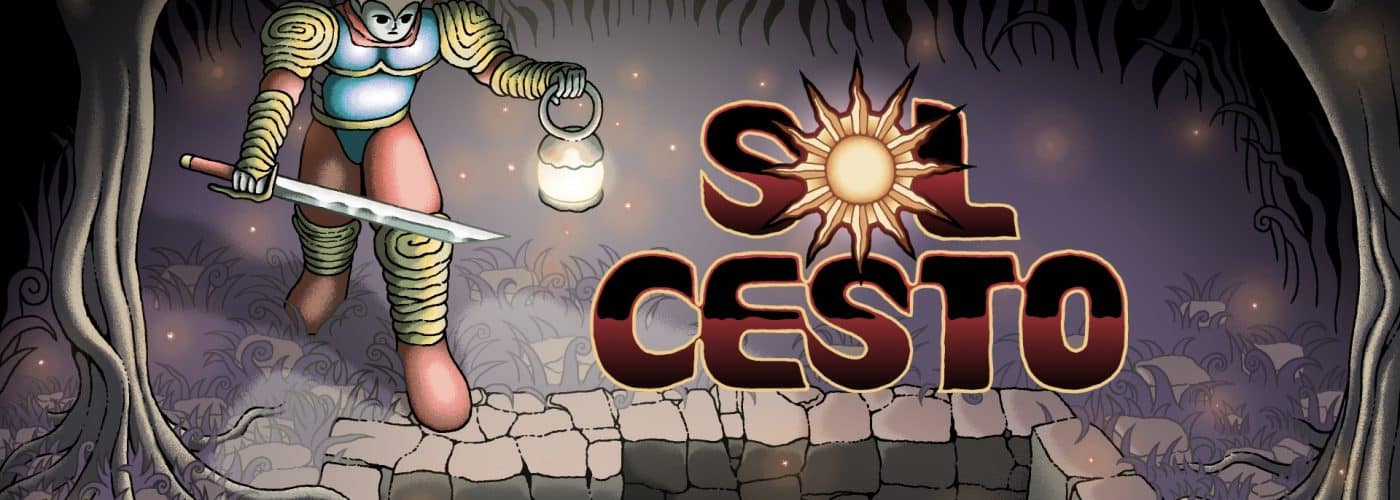
Chariospirale’s linework and Géraud Zucchini’s design shape a roguelite where every turn runs through probability.
Somewhere, at the bottom of a world that no longer sees the light, someone has stolen the sun. Sol Cesto hands the player a single task: climb down and take it back. The tone stays playful; the structure underneath does not. Every turn is a bet, and the player never picks the outcome, but how much to risk.
Behind the project stands Tambouille, a label that unites Géraud Zucchini – winner of Best Student Game at the 2017 IGF with Un Pas Fragile – and comic artist Chariospirale, whose linework stands out at a glance in a genre crowded with interchangeable pixel art. Almost two years of full-time work separate the Early Access launch, on May 27, 2025, from the 1.0 version that Goblinz Publishing released on April 10, 2026. In between: sales past 70,000 copies, almost 170,000 wishlists, a Pégases 2026 nomination for Best Indie Game and Best Game Design, and Steam ratings among the highest any roguelite has posted in the past year.

The gameplay loop
Each floor is a grid of four rows by four columns. The player chooses the row; chance decides the destination cell among the four available, which may hold a monster, a chest, a trap, or a strawberry that heals. The door to the next floor opens only after at least five clicks; from then on, descending becomes optional, and the player can stay and clear the grid for as long as the loot justifies the risk.
The heart of the system lies in the probabilities, which the game displays in plain view and which never sit still. Every visited cell drops out of the count: a row that starts at 25% per cell climbs to 33%, then 50%, up to 100% on the last free cell. Reading the board means redoing the math every turn. A lethal row at the start of a floor can turn into the safest pick three clicks later, simply because the range of outcomes has narrowed.
Combat resolves as a blunt numbers check, split between Strength and Magic: if the character’s value matches or exceeds the monster’s, the enemy falls without retaliation; otherwise the player takes damage equal to the difference between the two numbers. Attack therefore doubles as defense, because every extra point of Strength automatically reduces the damage physical enemies deal. Traps follow a different logic: they always hit, whatever the stats, and in the depths they apply a poison that stacks. The third stack kills, and the counter resets only when the player changes floors. In a game where every other threat fades as the numbers grow, the trap remains the one price the player never stops paying.


The magic teeth system
The base probabilities don’t stay untouchable for long. Every two or three floors, statues scattered through the dungeon offer stone teeth that alter the pull of the cells: more chests but more traps, or more healing at the cost of one point of maximum health. Each tooth shifts the distribution without erasing the uncertainty – a uniform 25% turns into lopsided configurations like 32/28/20/20 – and the player has to weigh every choice against the current build, because a strawberry bonus means little to someone who built everything around avoiding them. Metal teeth work on consequences instead, with curses and more aggressive synergies: chests that weaken adjacent monsters, opening moves that sap an entire column, strawberries that drain strength from nearby enemies. Here the game states its ambition: turning chance into a material to work with.


Powers, items and dungeon dwellers
Each character has a power that charges by visiting cells or killing monsters, and that in some cases breaks the fundamental movement rule: the knight moves vertically, the mage links two cells and summons a reflection of himself, with the option of banishing other mages without even fighting them. The further the run goes, the more the center of gravity shifts from chance toward control. Items round out the arsenal: bombs that wipe an entire row, dice that reshuffle the grid, mirrors that reveal monster abilities, arrows that remove a threat from a distance.
Then there’s the merchant, who deserves a paragraph of his own. Pulling his nose stuns him and makes him close his eyes, leaving the field clear to steal an item from the shelf; the second attempt only irritates him, since he remembers the offense. Shooting him is technically possible, and the game takes note: the merchant vanishes from the run, shelves included. Sol Cesto brims with hidden rules of this kind, little experiments that reward curiosity or punish it, from fake endings that invite the player back to the surface, cutting short runs in perfect health, to the hooded wanderer who sells half-truths about the depths for a coin, with the tone of a fairy tale gone sour.


Bosses and bestiary
The bosses amount to more than a stat check. The Leviathan occupies the grid and crawls across it for whole turns: ending up in its mouth means instant death, and bringing it down takes several hits spread over several turns, dodging the wrong cell every time. The 1.0 adds a new final boss and a hidden zone deeper down, and it also revises some fights already present in Early Access. The common bestiary works in the same direction and complicates the reading of the grid: creatures that change shape from one turn to the next, mimics disguised as coins, chicks whose death empowers an adjacent monster, enemies that spawn reinforcements on empty cells or turn the strawberries in their row toxic. Every floor asks the player to reread cells they thought they had already read.


Characters and progression
The playable characters number seven, each with their own stats and powers: the knight starts with two Strength and vertical movement, the warrior offsets her zero in Magic with a generous pool of health. The 1.0 adds a dedicated ending for each of them and a specific progression branch for the farmer, historically the weakest of the group and now the target of a focused fix: equip him with a sling or a seed and he gains a growth path he never had before.
Progression between runs goes through the well, which works like an extraction point: the player deposits collected coins during the descent, and only deposited coins make it back to the surface. Whatever stays in your pockets at the moment of death vanishes. Coins buy stars in a firmament of constellations to complete – new characters, extra teeth for the statues, items that enter the shop rotation. The costs run far from symbolic, with major unlocks at 1,500 coins: a long progression that takes several runs to complete even partially. The move to the definitive version wiped all saves; the developers offer a small compensation in coins and, in the same message, advise the player to refuse it and start from scratch.


Art, sound and technical side
This is the ground where Sol Cesto wins without argument. Chariospirale’s linework brings into the dungeon the hand of someone who works in comics for a living: sharp figures on dark backgrounds, monsters the line renders almost comical without costing them any of their menace. The opening cinematic that arrives with 1.0 justifies launching the game on its own, and gives narrative weight to a premise that stays deliberately light on paper.
The score by Antoine Druaux – with over ten years of collaboration with Zucchini behind him – accompanies the descent without drowning it out.
On the technical side, the game aims for lightness: it plays entirely with the mouse, one click at a time, and runs without a stutter on any configuration. A mobile port looks like the project’s natural destination, and the single-input design would make it painless. The choice fits an architecture that concentrates all the complexity in the rule system rather than in the staging.


Limits
The main risk lives in the mechanism that defines the game. A system that rests on probability management holds up as long as the player perceives a real margin of control; when the choice between rows slides toward a dice roll in disguise, the structure shows its seams. And chance, in Sol Cesto, bites for real: promising builds die to the wrong percentage at the wrong moment, and no reading of the board protects against a hostile streak. Add to this a grinding component in the early hours, when alternative characters and sharper items sit behind thresholds of hundreds of coins, and some doubt about long-term staying power: the real variety comes from classes and unlocks, and whoever stops at the first characters risks runs that look too much alike.
Verdict
Sol Cesto reaches 1.0 with a fully formed visual identity and a content package that testifies to eleven months of Early Access well spent: new boss, secret area, per-character endings, revised interface. The system, once you take it apart piece by piece, proves more elaborate than the «pick a row and hope» formula suggests – dynamic probabilities in plain view, teeth that shift the distributions, powers that break the movement rules, a bestiary that forces constant recalculation. The overall feeling is that of a strategy that grows inside randomness, with randomness occasionally taking everything back.
Who is it for, then? Players willing to hand chance a good share of the control, as long as the rules of the chaos stay readable. Whoever prefers execution-driven mechanics or a narrative component denser than the fairy-tale frame on offer will find little to hold on to: the game declares its nature from the first click, and anyone who dislikes betting should take it at its word.

 7.5/10