
In short
Spirit of the North offers a memorable journey through a beautifully realised world, where environmental storytelling, evocative landscapes, and a delicate soundtrack take centre stage. Its contemplative atmosphere is among its greatest achievements, but repetitive puzzles, imprecise controls, and a somewhat elusive narrative prevent the adventure from fulfilling its ambitions. A distinctive experience that leaves a stronger impression through what it shows than through what it asks players to do.
Trading combat and dialogue for environmental storytelling and atmospheric exploration, Infuse Studio’s adventure offers a distinctive experience that is not always as polished or engaging as its world suggests.

Spirit of the North is a third-person adventure built around exploration, atmosphere, and environmental storytelling. Set against a series of striking Nordic-inspired landscapes, the game follows a red fox on a journey through ancient ruins, abandoned settlements, dense forests, and snow-covered wilderness.
Rather than relying on dialogue or conventional narrative exposition, Infuse Studio entrusts the story to the world itself, using visual storytelling, environmental details, and sound to gradually reveal the events that have shaped it. This approach establishes the foundations of a deliberately understated adventure, one that prioritises discovery and atmosphere over action and spectacle.
The journey begins with the fox encountering a mysterious spiritual presence connected to the Northern Lights. Drawn into an unfamiliar world, it ventures across environments inspired by Iceland’s natural landscapes and Nordic folklore, from frozen mountain ranges and glaciers to waterways and the remains of a forgotten civilisation. The setting is more than a backdrop to the adventure: its ruins, landmarks, and natural features gradually become fragments of a larger story. With little explicit guidance, players are encouraged to observe their surroundings and make sense of the world through exploration, allowing the narrative to emerge at its own pace.
Gameplay follows a similarly restrained philosophy. Spirit of the North brings together exploration, platforming, and environmental puzzles within a largely linear structure, with progression depending on the player’s ability to navigate the terrain, interpret environmental clues, and find solutions to the obstacles ahead. There are no combat encounters or elaborate action systems.
Instead, the experience centres on interacting with the environment and using the abilities the fox acquires throughout its journey. The mechanics are straightforward by design, keeping the emphasis on traversal and puzzle-solving rather than mechanical complexity.
This minimalist approach is also reflected in the game’s storytelling, with silence serving as one of its most important narrative tools. Dialogue and spoken exposition are entirely absent, leaving the environment, visual imagery, and soundtrack to convey the story.
As players uncover traces of the past, the adventure gradually takes shape as a contemplative journey through a world marked by mystery, loss, and spirituality. Its artistic direction and atmospheric presentation give the experience much of its character, while the simplicity of its mechanics ultimately represents both a defining strength and a source of some of its shortcomings.


Less Action, More Atmosphere: The Philosophy Behind Spirit of the North
Created by Infuse Studio, Spirit of the North began development in April 2017, with the ambition of crafting an adventure that would distinguish itself through its visual identity, understated mechanics, and unconventional approach to storytelling. Rather than drawing on the familiar conventions of the genre, the independent studio envisioned a more restrained form of adventure, one in which exploration, atmosphere, and visual composition would carry much of the narrative weight. This creative direction became the foundation of the project, shaping everything from its minimalist gameplay to the way its world communicates with the player.
At the heart of this vision is a particular understanding of environmental storytelling. In Spirit of the North, the world is not merely somewhere to explore, but the primary means through which its story is told. Ancient ruins, abandoned structures, and subtle changes across the landscape offer glimpses into the history of a civilisation long since lost, leaving players to connect the fragments and interpret what remains. This places considerable importance on the composition of each location, the visual language of its surroundings, and the relationship between exploration and progression. The absence of dialogue is an equally deliberate choice. Rather than interrupting the journey with exposition, Infuse Studio gives the imagery, musical score, and environmental details room to convey the narrative on their own terms.
Following its original release on PlayStation 4 in November 2019, Spirit of the North gradually made its way to additional platforms. Merge Games was instrumental in extending the game’s distribution, with the PC and Nintendo Switch versions arriving in May 2020. A PlayStation 5 Enhanced Edition followed in November of the same year, before the adventure reached Xbox Series X|S in June 2021. Silver Lining Interactive is also credited as the publisher of the Steam version. Although these subsequent releases brought the game to a wider audience, they preserved the essential character of the original, keeping its underlying creative vision intact.
What makes Spirit of the North particularly interesting from a development perspective is the consistency of its creative direction. Infuse Studio builds its identity around a clearly defined vision of what an adventure can be, demonstrating that a distinctive experience need not depend on intricate systems, extensive dialogue, or a constant succession of set pieces.
Its strengths instead emerge from the relationship between art direction, environmental storytelling, and player exploration. This design philosophy is not without its limitations, particularly when it comes to mechanical variety and depth, but its intentions remain clear throughout. Spirit of the North is ultimately a game that finds its purpose in the act of discovery, placing the quiet progression of a journey above the conventions of spectacle-driven adventure.

The Last Echoes of an Ancient World
Spirit of the North begins in a seemingly pristine wilderness, following a red fox as it makes its way through rugged terrain, dense vegetation, and winding waterways. Its solitary journey takes an unexpected turn when it encounters a mysterious spirit fox, a supernatural entity connected to the Northern Lights that soon becomes its guide. The encounter sets in motion an adventure that leads the protagonist far beyond its familiar surroundings, into a desolate landscape marked by ancient ruins, abandoned structures, and the remnants of a forgotten civilisation.
Accompanied by its spectral counterpart and drawn onwards by a mysterious trail of light, the fox ventures deeper into this unfamiliar world. The journey gradually shifts between natural landscapes and the remains of a once-thriving civilisation, whose history can now be glimpsed only through scattered remnants and traces of its former inhabitants.
Progress is frequently interrupted by environmental obstacles, blocked passages, and ancient mechanisms that must be overcome to continue. Doing so requires players to engage with their surroundings, activate forgotten symbols, and make use of the supernatural abilities the fox gradually acquires through its connection with its companion. The adventure unfolds across a succession of interconnected locations, following a predominantly linear route through forests, secluded valleys, mountain ranges, frozen landscapes, and abandoned architectural complexes.
Each new area expands the picture of a world whose past remains largely obscured, with ancient structures, visual depictions, and environmental details offering fragments of its history. Rather than relying on dialogue or explicit exposition, Spirit of the North leaves players to interpret these discoveries and gradually piece together what became of the civilisation that once inhabited these lands. At the same time, the journey gives greater significance to the relationship between the two foxes, whose connection develops through the challenges and discoveries they share.
As the journey unfolds, the fox encounters further supernatural presences and increasingly intricate environmental puzzles. Progress often depends on restoring energy to dormant structures, awakening ancient forces, or reactivating mechanisms left behind by the civilisation that once inhabited these lands. The abilities acquired along the way play an increasingly important role in overcoming these obstacles, allowing players to reach previously inaccessible areas and uncover new routes through the world. While the fundamental gameplay loop remains largely unchanged, the introduction of these abilities adds variety to the puzzles and gives the adventure a greater sense of progression.
The final stages bring the journey back to the central mysteries surrounding this forgotten world, as the surviving traces of its civilisation assume an increasingly important role in understanding the events that preceded the fox’s arrival. Still accompanied by its supernatural guide, the protagonist presses towards the conclusion of an adventure whose narrative has been unfolding largely through implication rather than direct explanation. True to its wordless storytelling, the game avoids conventional dialogue-driven revelations and cinematic exposition, allowing its visual sequences and environmental imagery to bring the journey to a close. The result leaves players with the task of connecting the remaining pieces and interpreting the significance of what they have witnessed.


A World of Silence, Spirits, and Forgotten Memories
Storytelling is one of Spirit of the North‘s most distinctive features, but also one of its most divisive. Infuse Studio takes an intentionally minimalist approach, doing away with dialogue, voice-over narration, and conventional exposition in favour of environmental storytelling. The history of the world is instead conveyed through ancient ruins, visual depictions, and details embedded in the landscape, leaving players to interpret what they discover along the way. Rather than presenting a clearly defined narrative, the game reveals its story through fragments, inviting players to connect the dots and draw their own conclusions. It is an approach that gives exploration a narrative purpose, although it also means that much of the context surrounding the events remains implicit.
Thematically, the adventure is rooted in the relationship between nature and spirituality. Its Nordic wilderness is far more than an elaborate backdrop: it bears the marks of a mysterious calamity and preserves the remnants of a civilisation that has all but vanished. Forests, mountain ranges, and frozen expanses establish a pervasive sense of isolation, while the ruins scattered throughout the landscape offer glimpses of the society that once inhabited these lands. The contrast between the endurance of nature and the impermanence of human creations gives the setting much of its significance. This is a world in which nature has outlasted its inhabitants, leaving behind only fragments of their existence for the player to discover and interpret.
The supernatural fox also draws on a specific strand of Nordic folklore, particularly the Finnish legend of the revontulet, or fox fires, traditionally associated with the Northern Lights. According to the legend, a mythical fox running across snowy landscapes strikes the snow with its tail, sending sparks into the sky and creating the aurora. Spirit of the North takes inspiration from this imagery, using it to establish a connection between the natural world and the supernatural forces that shape the adventure. The spirit fox becomes both a guide and a companion to the protagonist, with their relationship providing the story with much of its emotional substance. Trust and companionship are conveyed through their shared journey rather than through dialogue or conventional character interactions, reinforcing the game’s preference for visual and environmental storytelling.
Another important theme is the restoration of a world corrupted by an unknown force. The spreading blight, visible in distorted organic growths and areas stripped of their natural vitality, represents a disruption of the environment’s original balance. As the fox progresses, its actions gradually help cleanse these locations, giving the journey an underlying sense of renewal. This recurring process lends the adventure a symbolic dimension, suggesting that even a world seemingly beyond repair can recover. However, the game offers little insight into the origins of the corruption or the precise circumstances behind the civilisation’s disappearance. While this lack of explanation preserves the mystery surrounding its world, it also limits the narrative’s ability to develop some of its more interesting ideas.
The decision to tell the story through silence ultimately proves to be both the game’s greatest strength and one of its most significant weaknesses. By placing its trust in imagery, music, and environmental details, Spirit of the North creates an atmosphere that conventional exposition might otherwise undermine. It also gives players the freedom to engage with the narrative at their own pace, finding meaning in details that might have gone unnoticed in a more explicit form of storytelling. Yet this restraint comes at a cost. The limited narrative context occasionally makes the story difficult to follow, while the lack of substantial character development can prevent its central relationship from reaching the emotional depth it seems to promise. What remains is an evocative but often elusive narrative, one that succeeds in creating a distinct atmosphere and suggesting larger themes, even when it struggles to give them a fully realised form.


A Fox Beneath a Sky of Northern Lights
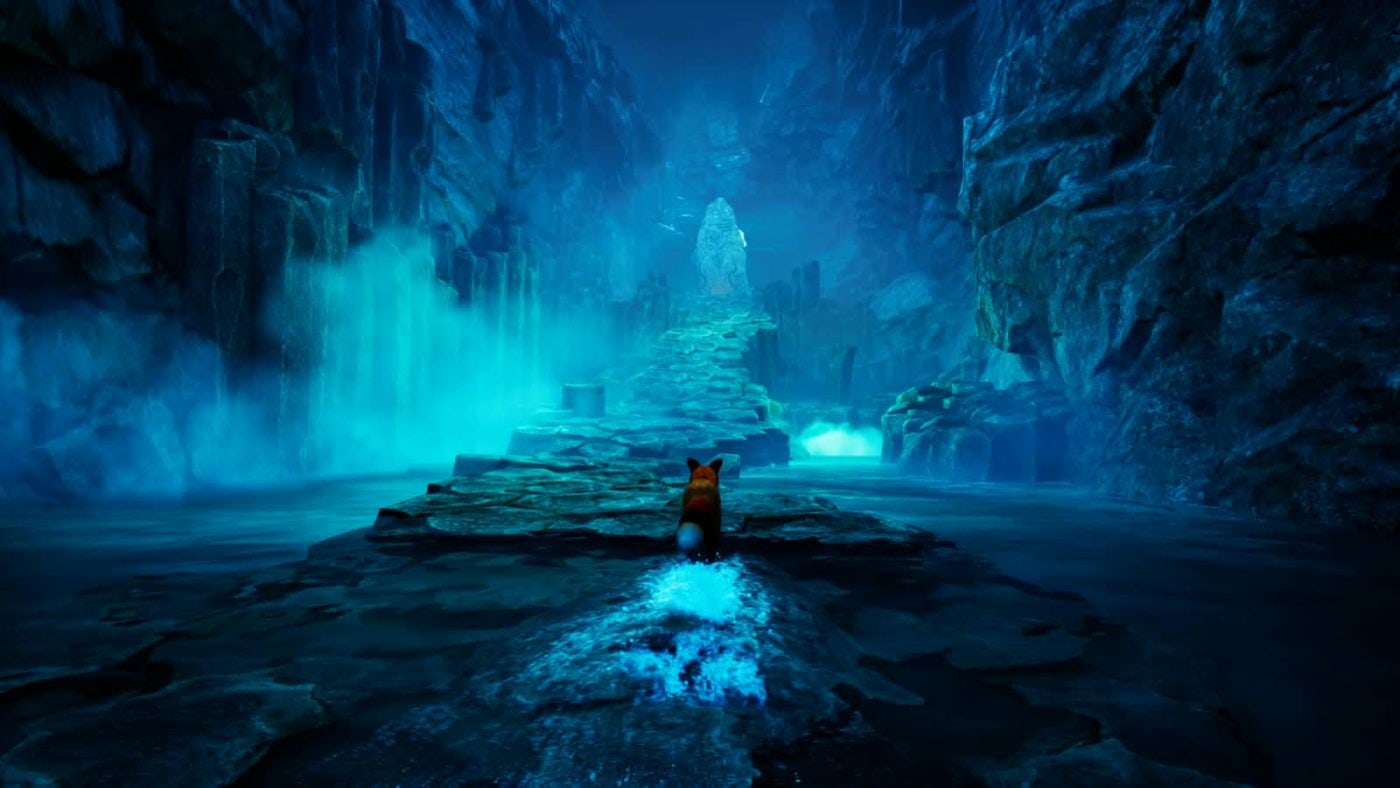
Much of Spirit of the North‘s visual appeal stems from an art direction that places the natural world at the heart of its identity, drawing on the atmosphere and landscapes of the Nordic wilderness to create a setting that is both striking and cohesive.
Developed in Unreal Engine 4, the game takes players across a succession of expansive environments, from dense forests and mountain valleys to frozen lakes and snow-covered plains. Its presentation does not seek to replicate reality in every detail. Instead, Infuse Studio favours a stylised yet convincing depiction of nature, relying on colour, lighting, and environmental composition to establish a distinct sense of place. The result is a world whose appeal rests less on technical spectacle than on the way its different elements come together.
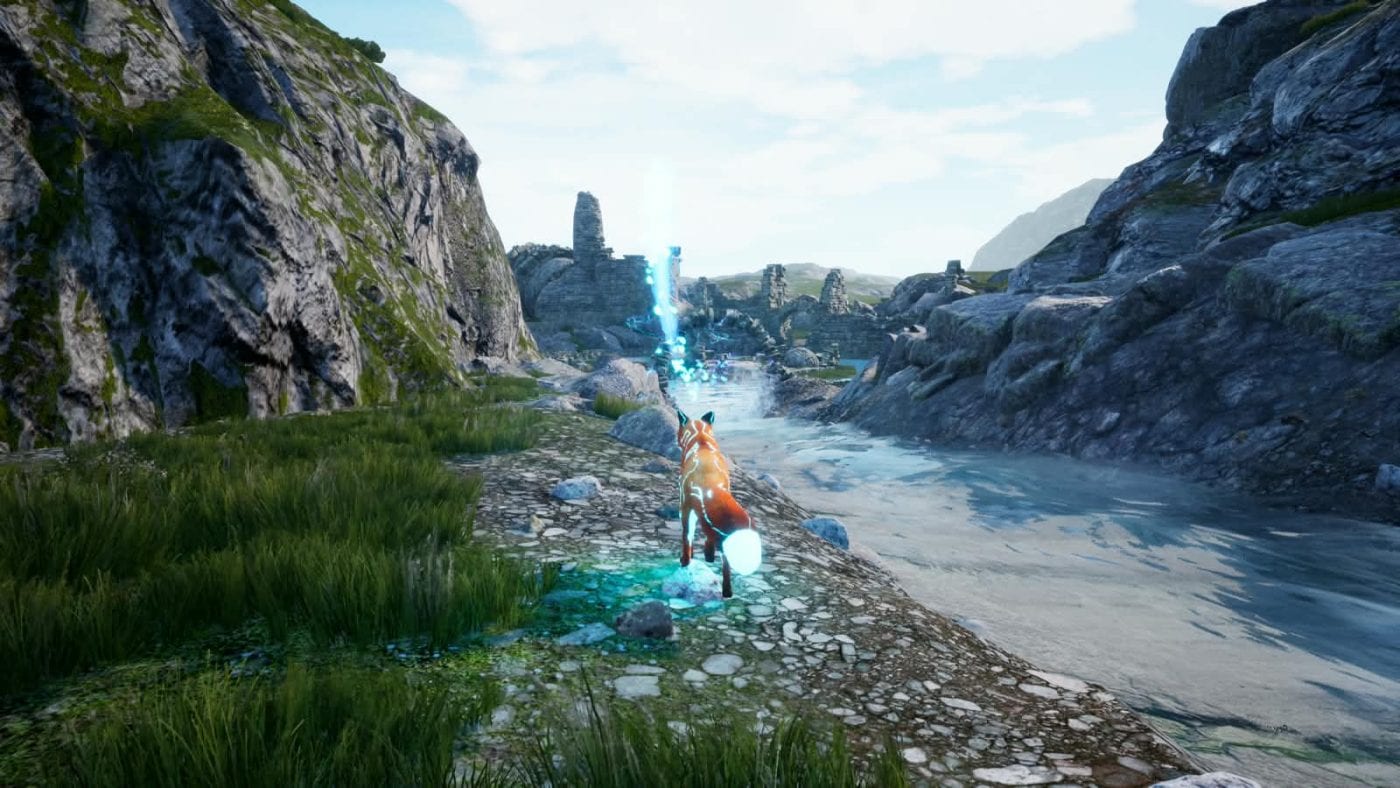
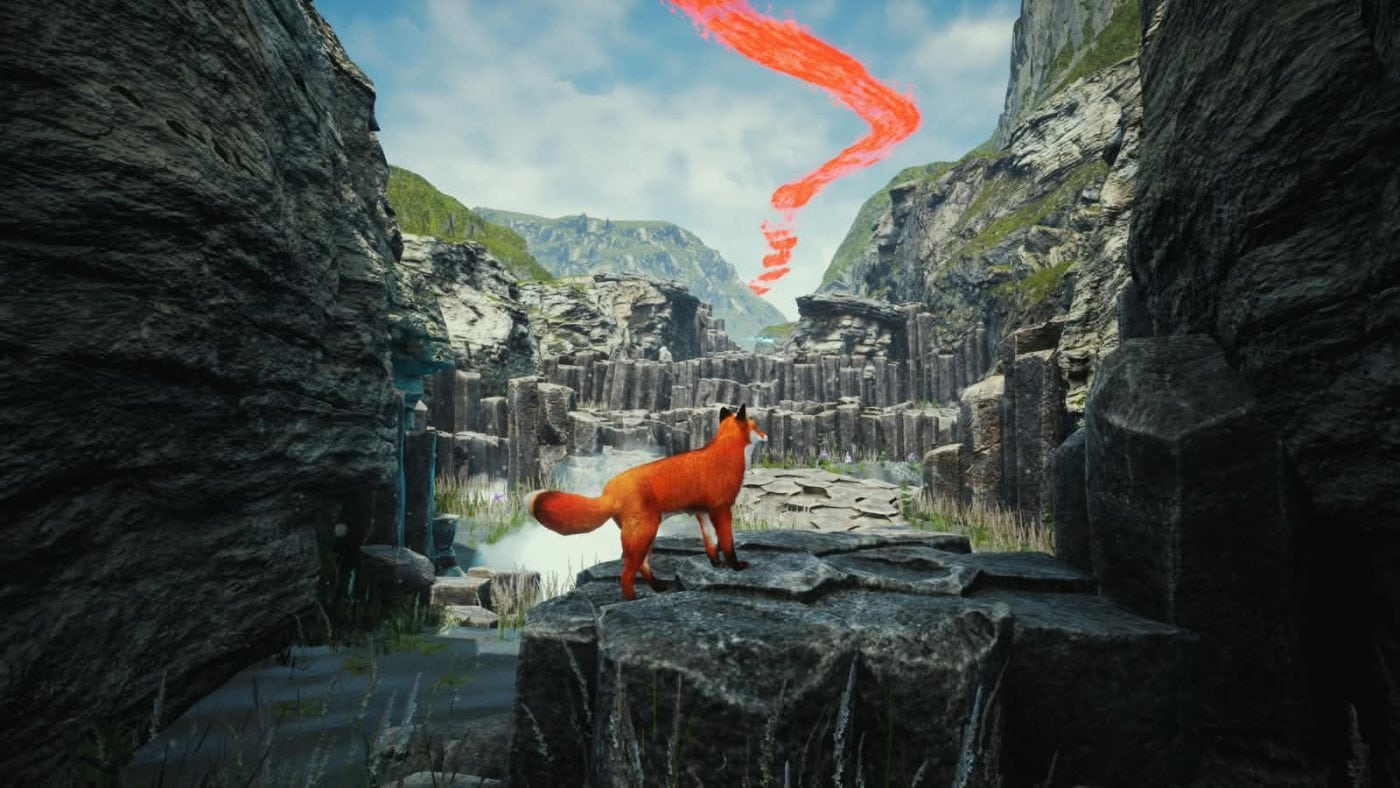
This approach is particularly evident in the design of the environments, which stand among the game’s strongest assets. The landscapes are varied enough to sustain a sense of discovery throughout the journey, with vegetation, rock formations, waterways, and imposing mountain ranges giving each area its own character. The interplay between the untouched wilderness and the encroaching corruption is especially effective. The former is defined by open spaces and more natural, often brighter tones; the latter introduces darker palettes, twisted organic growths, and unsettling details that break with the surrounding scenery. Abandoned buildings and the remains of ancient structures add another layer to this contrast, their presence hinting at a civilisation that has disappeared while nature continues to reclaim the land.
Lighting is central to the effectiveness of this visual approach. It lends depth to the environments, accentuates the contours of the terrain, and brings out the changing qualities of surfaces, from flowing water to ice and snow. It is also instrumental in giving the supernatural elements their impact. The Northern Lights, ethereal illuminations, and particle effects are among the most memorable features of the game’s visual presentation, introducing moments of wonder that distinguish the journey from a more conventional wilderness adventure.
These phenomena do more than embellish the scenery: they reinforce the presence of a spiritual dimension within the natural world. The shifts in colour and atmosphere also help communicate the effects of corruption, making the contrast between the different regions immediately apparent.
The fox, meanwhile, is well suited to the world around it. Its 3D model is sufficiently detailed, and its animations generally capture the animal’s movements, from the rhythm of its stride to the way it jumps and navigates the terrain. The same degree of refinement is not always evident in the underlying mechanics. Movement can feel imprecise at times, particularly during platforming sections, while some animations lack fluidity and certain interactions with the environment are less consistent than they should be. These shortcomings become more noticeable when the game demands accurate movement or precise positioning, occasionally disrupting the otherwise measured pace of exploration. Technical performance and presentation can also vary between platforms and editions, making it important to distinguish between the qualities of the game’s overall art direction and those of a particular release.
Ultimately, the visual identity of Spirit of the North is considerably more accomplished than its technical execution. Unreal Engine 4 provides the tools to bring its environments to life, but it is Infuse Studio’s artistic direction that makes them memorable. The considered use of colour and lighting, the composition of its landscapes, and the contrast between natural beauty and supernatural corruption give the adventure a recognisable aesthetic that remains consistent throughout. Its shortcomings in animation, movement, and environmental interactions prevent the experience from feeling entirely polished, but they do not overshadow the achievement of its strongest visual elements. Spirit of the North may not push the technical boundaries of its genre, yet it demonstrates how a coherent artistic vision can give even a relatively modest adventure a world worth exploring.


The Sound of a World That Has Lost Its Voice
The audio design is a fundamental part of what gives Spirit of the North its atmosphere and emotional identity. In a game that deliberately eschews dialogue and voice-over narration, the soundtrack and environmental audio take on much of the expressive work that would ordinarily fall to words. The original score, built around delicate orchestral arrangements, places particular emphasis on piano and strings, creating a subdued, melancholic sound that complements the solitude and mystery at the heart of the adventure. Rather than relying on dramatic musical flourishes, it establishes a more restrained tone, allowing the experience to unfold at its own pace.
The compositions are characterised by gentle melodies, understated arrangements, and a recurring sense of tranquillity, isolation, and quiet wonder. Music rarely competes with the environment for the player’s attention; instead, it blends into the surrounding soundscape, accompanying the fox’s passage through forests, valleys, and snow-covered landscapes. Certain sequences introduce more expressive arrangements, building in intensity to emphasise the scale of a location or the significance of a particular discovery. This approach works particularly well within the context of the game, where the pacing leaves considerable room for observation and reflection. The score knows when to take a more prominent role and, just as importantly, when to recede into the background.
Its contribution becomes even more apparent in the way the music reflects the changing character of the world. The quieter passages suit the openness and serenity of the natural landscapes, while shifts in tone and intensity help establish the more unsettling atmosphere of corrupted areas and supernatural encounters. These musical transitions give the journey a degree of emotional progression, reinforcing the contrast between the familiar and the otherworldly without relying on explicit narrative cues. In an adventure where so much is left for the player to interpret, this is particularly valuable: the soundtrack helps communicate what the story deliberately leaves unsaid, giving the experience an emotional thread that runs alongside its environmental storytelling.
The sound design complements this approach by giving the environments a more tangible presence. The fox’s footsteps, the movement of water, and the sounds associated with traversing and interacting with the landscape provide a sense of physicality that grounds the more fantastical elements. These naturalistic details are contrasted with the distinctive audio effects accompanying the fox’s spiritual abilities and the supernatural phenomena encountered throughout the journey. Their more ethereal qualities help distinguish them from the sounds of the wilderness, reinforcing the boundary between the physical world and the forces that exist beyond it. The protagonist’s own vocalisations also contribute to its characterisation, lending the fox a recognisable presence without compromising the game’s wordless approach.
The main weakness lies in the limited musical variety, which makes some of the recurring compositions increasingly noticeable over time. Although the score is consistently well suited to the game’s tone, its effectiveness can diminish during extended sessions, particularly when progress slows and players spend longer periods exploring the same area or working through a puzzle. Greater variation in the arrangements, together with more responsive transitions between musical cues, could have made the soundtrack feel less repetitive and better attuned to the changing pace of the adventure.
Nevertheless, the audio remains one of Spirit of the North‘s most accomplished aspects. Its strength lies not in the complexity or sheer variety of its compositions, but in how naturally music and sound complement the game’s artistic and narrative direction. The orchestral score, environmental audio, and supernatural effects work together to establish a coherent atmosphere, giving emotional weight to a journey that communicates largely through images and sounds.


A Journey Worth Taking, but Not Always Challenging to Play
At its core, Spirit of the North is an exploration-led adventure built around platforming and environmental puzzles. Its world is divided into a succession of interconnected areas, taking players through open wilderness, narrow passages, and the remains of ancient settlements. Progression follows a largely linear route, although occasional branches offer the opportunity to explore beyond the immediate path and uncover optional discoveries. This structure gives the journey a clear sense of direction without entirely sacrificing the pleasure of finding things for oneself.
The scope of the environments, however, can be somewhat misleading. Although many areas appear expansive, the spaces in which players are expected to interact with their surroundings and complete objectives are often considerably more confined. The result is a world that can feel larger than the experience it actually offers, with stretches of traversal occasionally separating points of interest without adding much to the journey. This measured approach is consistent with the game’s contemplative ambitions, but its pacing does not always benefit from the distances involved.
The environment also serves as the game’s principal source of world-building. Murals, statues, stone structures, and the remains of ancient settlements offer fragments of information about the civilisation that once inhabited the region. Rather than filling the world with characters or relying on dialogue to explain its history, Infuse Studio allows these details to speak for themselves, leaving players to interpret what they encounter. It is an approach that gives exploration a purpose beyond simply reaching the next objective, tying the act of discovery to the gradual reconstruction of the world’s past. Nevertheless, the recurrence of similar architectural features and landscape compositions can make certain areas feel interchangeable, particularly as the adventure progresses. The setting is at its most compelling when it brings together the natural beauty of the wilderness and the remnants of a civilisation gradually reclaimed by it.
The gameplay gradually develops through the introduction of new spiritual abilities, which expand the fox’s initially modest repertoire of actions. Running, jumping, and interacting with objects form the basis of movement, while additional powers introduce new ways to traverse the environment and overcome obstacles. Several abilities consume a shared energy resource, replenished by collecting luminous flowers scattered throughout the levels.
This energy can be used to activate ancient stone structures, clear corrupted growths obstructing the path, and perform special actions, including a spiritual dash and the temporary separation of the fox’s spirit from its physical body. These additions provide a gradual sense of progression, although their value lies primarily in the new environmental interactions they make possible rather than in any substantial increase in mechanical complexity.
Puzzle-solving is where these abilities find their main purpose. Challenges range from activating statues, aligning symbols, and powering mechanisms to navigating platforming sections that require players to combine their powers with a more careful reading of the environment. The better puzzles make effective use of their surroundings, encouraging observation and experimentation rather than relying on elaborate solutions. However, the overall quality of these encounters is uneven. Many are relatively simple and offer little resistance once their underlying logic becomes apparent, while others can be unnecessarily obscure because the game provides too few clues about the intended solution. Platforming is similarly inconsistent. Although most sequences are straightforward, sections that demand more precise jumps or positioning expose some shortcomings in the controls, with the fox occasionally responding less reliably than the situation requires.
There are also optional collectibles to discover away from the main route. Among these are ritual staffs that can be returned to the remains of ancient shamans, allowing their spirits to be released. These encounters add a little more context to the world and reward players willing to investigate their surroundings, providing an additional incentive to explore beyond the immediate objectives. Their impact on the overall experience remains relatively modest, however, and they do not substantially expand the range of activities available.
Ultimately, Spirit of the North‘s gameplay is guided by a clear creative direction, but the simplicity of its design is not always matched by sufficient variety in its execution. Exploration remains the strongest incentive to keep moving forward, supported by an evocative setting and the gradual introduction of abilities that give the fox new ways to interact with the world. Yet the puzzles rarely develop beyond their initial ideas, optional discoveries have limited influence on progression, and imprecise controls occasionally undermine the platforming.
The result is an adventure whose world is considerably more engaging than the mechanics used to explore it. Greater variety in puzzle design, more rewarding optional activities, and tighter controls would have given the gameplay a stronger foundation, bringing it closer to the standard set by the game’s artistic direction and environmental storytelling.


A Promising Adventure That Never Fully Finds Its Footing
Spirit of the North is an adventure with a distinctive creative vision, but one whose execution does not always do justice to its underlying ideas. Infuse Studio succeeds in establishing a compelling sense of place through its evocative environments, considered art direction, and understated orchestral score. Its decision to build the narrative around environmental storytelling also gives the experience a character of its own, allowing the world to communicate through imagery, architecture, and the traces of a civilisation long since lost. It is an appealing foundation, and one that sets the game apart from more conventional adventures. Yet while its artistic direction remains consistently engaging, the gameplay built around it is considerably less assured.
The most significant shortcomings stem from the limited variety and refinement of the core mechanics. Exploration and environmental puzzles provide the framework for progression, but neither develops enough to sustain the same level of engagement throughout. Many of the challenges rely on familiar solutions, while some of the larger environments offer relatively little to discover beyond the route leading to the next objective.
The resulting stretches of traversal can feel disproportionate to the activities they contain, occasionally disrupting the otherwise measured pace. Navigation also lacks consistency: certain environmental clues are too ambiguous to make the intended route immediately apparent, turning moments of discovery into unnecessary trial and error. Platforming presents further problems, with movement and jumping not always responding with the precision required by more demanding sections. These issues rarely define the entire experience, but their recurrence exposes the limitations of a gameplay formula that could have benefited from more considered design.
Where Spirit of the North proves considerably more convincing is in its audiovisual presentation. Its Nordic-inspired landscapes are among its greatest assets, combining natural beauty, ancient architecture, and supernatural imagery into a cohesive and recognisable visual identity.
The fox is an effective protagonist for this setting, while the spiritual elements woven into the environment lend the journey an additional sense of mystery. The soundtrack reinforces these qualities through delicate orchestral compositions that complement the game’s contemplative atmosphere and help convey emotions that the narrative deliberately leaves unspoken.
Although the limited variety of the music becomes more apparent over longer sessions, the overall presentation remains remarkably consistent. It is here, rather than in the complexity of its mechanics, that the game’s creative vision comes closest to being fully realised.
The narrative is more difficult to assess. Its reliance on environmental details and visual symbolism is a natural extension of the game’s design philosophy, and the absence of dialogue gives players considerable freedom to interpret what they encounter. However, the distinction between deliberate ambiguity and insufficient narrative development is not always clear.
The limited contextual information can make certain events difficult to follow, while the central story and its characters receive relatively little development. The result is an evocative premise that does not always translate into a particularly compelling narrative, especially when the environmental clues leave more questions than meaningful discoveries.
The game’s broader critical reception reflects this uneven balance. Its atmosphere, visual presentation, and soundtrack have attracted praise, while the simplicity of its puzzles, occasional control issues, and limitations in exploration have also been points of criticism. Assessments have varied across platforms and editions, further illustrating how differently its strengths and weaknesses can affect the overall experience. Ultimately, Spirit of the North is neither a wholly successful adventure nor one whose shortcomings negate its artistic achievements. Its appeal rests on a particular combination of atmosphere, exploration, and visual storytelling, and its effectiveness depends largely on how much importance players place on those qualities.
For players who value atmosphere and environmental storytelling over mechanical complexity, Spirit of the North remains an appealing journey. Those looking for intricate puzzles, consistently satisfying platforming, or a more fully developed narrative may find less to appreciate.
The game creates a world that is often captivating to explore, but does not always give players enough meaningful reasons to engage with it. Its artistic identity is clear, its atmosphere frequently memorable, and its intentions admirable; what holds it back is the gap between the quality of its presentation and the depth of the experience built around it. With more varied challenges, tighter controls, and a stronger narrative foundation, Infuse Studio could have turned a distinctive concept into a considerably more accomplished adventure.

 7/10