
Sol Brothers’ 3D metroidvania takes the genre off the plane: an interconnected labyrinth, inspired by Moebius, built almost entirely by one person.
The metroidvania has lived in two dimensions for forty years. Maps that open up as abilities grow, locked doors that become promises, the pleasure of returning with fresh eyes: all this was born on the plane, and on the plane it stayed. Anyone who tried to carry it into space almost always had to change its skin. Metroid Prime, the most famous example, solved the problem by turning into a first-person shooter. Since then, 3D metroidvania has remained a territory more evoked than practiced.
Maseylia: Echoes of the Past walks in with its head held high, aiming to create a new 3D action/metroidvania. It also tries to offer a fresh perspective through the abilities players acquire as the adventure progresses. The game keeps the third-person view and builds a single interconnected, vertical labyrinth that reveals itself one ability at a time: double jump, 360° air dash, grappling hook, underwater traversal. Verticality and platforming especially stand out as the game’s strength, a quality that surprised us. Each power, in the developer’s intentions, rewrites how players move and reopens already-visited zones, eventually allowing sequence breaking for those who know their digital body well enough. The declared inspirations: Metroid Prime, Pseudoregalia.
The project comes from a Kickstarter campaign and reached Steam – Windows and Linux, Steam Deck included – on June 19, 2026; developers have announced versions for Nintendo Switch 2, PlayStation 5, and Xbox Series X/S for the following months.

Archaeology as Storytelling
Maseylia entrusts its story to the environment. No cutscenes framing events, no direct exposition: players must reconstruct the planet’s story – a tragic story, as the developer calls it – through what remains of it. Ancient ruins, buried cities, forgotten caves, alien forests, structures where the organic and the technological have merged to the point of blurring the boundary. The title itself already states the method: only echoes remain of the past, and listening to them falls to whoever explores.
The reference model recalls Hollow Knight‘s “mysterious” approach: a lore that players must dig up, characters and vestiges that allude without explaining, a world that treats the player as an archaeologist. It’s a precise pact that demands patience, rewards attention, and accepts the risk that part of the audience will walk through everything without understanding anything – and that part of that audience will be perfectly fine with that.
Then there’s the destination the game itself poses as a question: the Heart of Maseylia, the labyrinth’s ultimate secret. The game carefully avoids revealing what it is in advance, and rightly so here too. The risk in this design is well known: the thin line between suggestion and vagueness, where a world that alludes can come across as dense or simply reticent, and only playing through it can tell the difference.
True Brothers
Sol Brothers is one of those studio names that literally describe who’s inside. Victor Abresol, an independent French developer, leads the project and handles nearly every aspect of Maseylia himself: programming, game design, world-building, game systems, art direction, integration. Around him, a minimal core – his two brothers and Zach Fitzgerald, a longtime collaborator. A small team carried an interconnected 3D metroidvania, complete with large-scale bosses and mid-production ambitions, across the finish line.
When such an ambitious project shows rough edges, are those edges deliberate choices, or the mark of limited time and resources outpacing the ideas?

Moebius’s Horizon
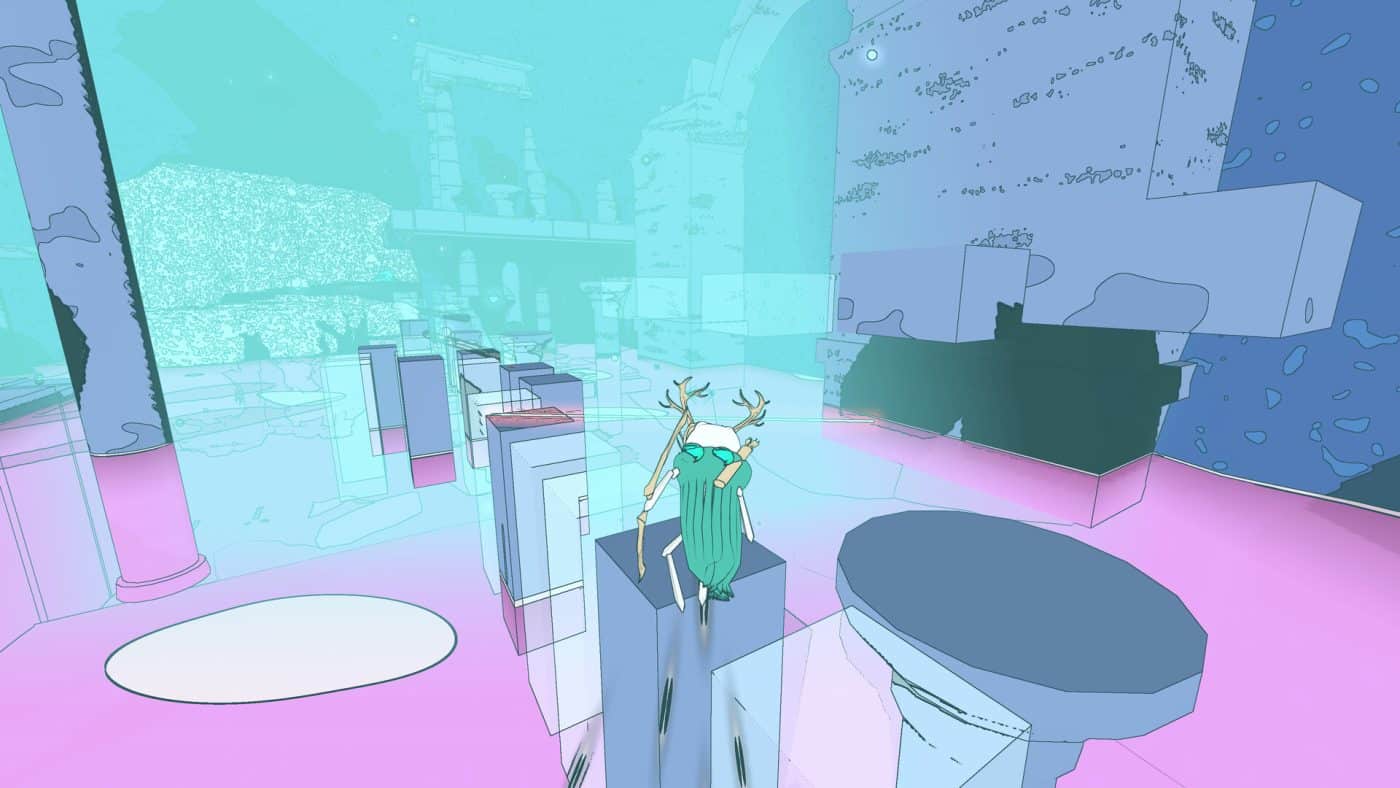
The visual statement of intent is precise and demanding: Moebius. Sol Brothers openly cites Jean Giraud as their art-direction reference, and anyone who knows the pages of Arzach or The Airtight Garage knows what evoking them means: clean lines, flat colors, boundless horizons, monumental architecture that seems to have always existed without ever having had a builder. An imaginary world where silence is part of the drawing.
Carrying that mark from a page to a real-time 3D engine poses a formal problem before a technical one. Giraud’s page stays still, controlled down to the millimeter; an explorable world needs lighting from every angle, and clean line art doesn’t forgive. The bet pays off mostly at scale: vast, vertical landscapes, ruins fading into the mist, the protagonist’s small body dwarfed by architecture that ignores it. The techno-organic structures mark the point where the reference bears the most fruit, fusing stone, metal, and plant life into forms that belong to none of the three kingdoms.


The palette works by zone: each region carries a clear dominant tone, and moving from one to another reshapes the exploration’s mood. This choice also aids orientation – in a 3D labyrinth, color works as signage – and ties function to suggestion with an economy of means that fits the project’s nature. International critics converge on pointing to the art direction as the game’s strongest element, and the visual material backs them up: if Maseylia leaves an echo behind, it will be for how it looks above all.
All of this translates, within the game’s economy, into an execution that falls short of excellent. As much as the color palette and visual impact sometimes leave players stunned, glitches and geodata issues aren’t rare. Especially in corners and the map’s more “delicate” areas, all the problems stemming from the title’s overall lack of “polish” surface.
The Price of Ambition
Maseylia: Echoes of the Past is clearly a low-budget product, created by two developers. The game itself isn’t “broken,” but it definitely carries some structural problems and rough edges that a review can’t overlook. Problems obviously aren’t everything: interesting and clever ideas run through it too. Classic genre formulas get reinterpreted with real intelligence; others follow the book by rote.
Before diving into this analysis, let’s start with a concept we’ll repeat as a leitmotif throughout the following paragraphs: Maseylia: Echoes of the Past is a product with rough edges, unpolished in several respects. Does this make it an insufficient product? No, but it sometimes undercuts the good ideas it shows.
Let’s go in order and talk about the map and its structure.
Map, Design, and Secret Placement
Maseylia: Echoes of the Past isn’t as large as its metroidvania competitors, but it packs 6 biomes. Among these, 4 hold the keys players need to progress, plus the starting biome and the final one.
The developers chose vertical complexity over horizontal, a choice I personally appreciated. While the horizontal structure stays simple, every fork and detour leads to a reward, an upgrade, or a shortcut. During exploration we meet several characters, more or less hidden, essential to our progression. Interacting with them means spending collected gold for trinkets, extra health points, or simply revealing the surrounding area’s map. The vertical structure differs and shows its best in complex platforming sections that sometimes turn confusing.
Gold matters because it activates the banners needed for upgrades, and especially for teleportation, the only fast travel in the game. The checkpoint and fast-travel placement works well, but a few problems spoil it. For example, when players reach the end of a path to acquire an upgrade, the game auto-saves and forces them, after an often demanding stretch, to backtrack through a route that turns tough. In my view, this choice partly undermines the philosophy of rewarding the player, because even with the upgrade in hand, the messy mechanics make the backtrack frustrating.
Signs and Beacons abound, telling the lore of this now-decayed place. Some secrets stand out too, including memories of the past and a legendary weapon I found during my run. I can assure you it helped me quite a bit in fights.


Combat System, Development, and Gameplay
Maseylia: Echoes of the Past pours nearly all its gameplay into demanding, articulated platforming. Players can see this in how the upgrades they gradually acquire focus on mobility and on the chance to reset the double-jump-dash loop.
As a counterpart, these sections show messy handling, likely from limited pre-launch testing and the product’s already-mentioned general “roughness.” Camera management and its distance from the character add to this. In the more complex, vertical moments, players risk losing their orientation and can’t tell if they’re landing in the right spot.
Combat remains a sore point: poorly articulated and not developed to its full potential. We only get two options: melee weapon and ranged.
Enemy lock-on risks shifting or staying fixed even after defeating them, blocking the player’s view with consequences you can imagine. Enemy AI itself runs weak, and their attacks often feel repetitive, especially projectile throws. Hit feedback (dealt and received) needs work and often leaves players confused.
Unfortunately, boss fights, which should be this genre’s crown jewel, suffer from these same problems too. As visually fascinating as some are, players can solve them by spamming the bow. One in particular only required me to stand on a platform where I could hit the boss without getting hit myself.
Progression instead borrows from genre classics: health points and mana points, with the latter letting us heal from enemy hits. Character progression relies on pins that occupy specific inventory slots. We can equip them once we’ve unlocked the banners adjacent to the checkpoint. I don’t think I found them all, but the ones I found show real interest and offer real freedom in building a loadout.


Final Thoughts
Maseylia: Echoes of the Past is undoubtedly an ambitious project. Tackling a 3D metroidvania as a debut work isn’t common and definitely poses a challenge. The developers proved they know the genre and managed to reinterpret it without overreaching or piling on too much. In fact, they even thought up interesting solutions for character mobility.
The music reaches a high level and stays evocative, pairing well with the proposed settings. The aesthetic itself captures players, immersing them in this alien, poetic world.
Unfortunately, the same can’t be said for the technical side and overall execution. In fact, ambitious as it is, Maseylia: Echoes of the Past looks like an immature, sometimes incomplete project. Every department (except the audio one) carries some grime that often makes the experience falter. As mentioned in previous paragraphs, spending time with the game exposes its weaknesses. The game isn’t “broken,” but it still feels too raw, especially on the combat side. In theory, Maseylia: Echoes of the Past shows very smart design, but unfortunately some aspects of its execution and an intrinsic roughness keep it from earning a good score. A shame, because the title also challenges players, and once they clear a zone, it rewards them.
That said, Maseylia: Echoes of the Past doesn’t deserve rejection, but encouragement despite its undeniable flaws. With that in mind, we recommend this title to fans or anyone who feels nostalgic for this genre. Anyone approaching the game should keep what we’ve told you in mind and accept the title’s general lack of polish throughout the adventure.
Developers provided the review key.
 6.9/10