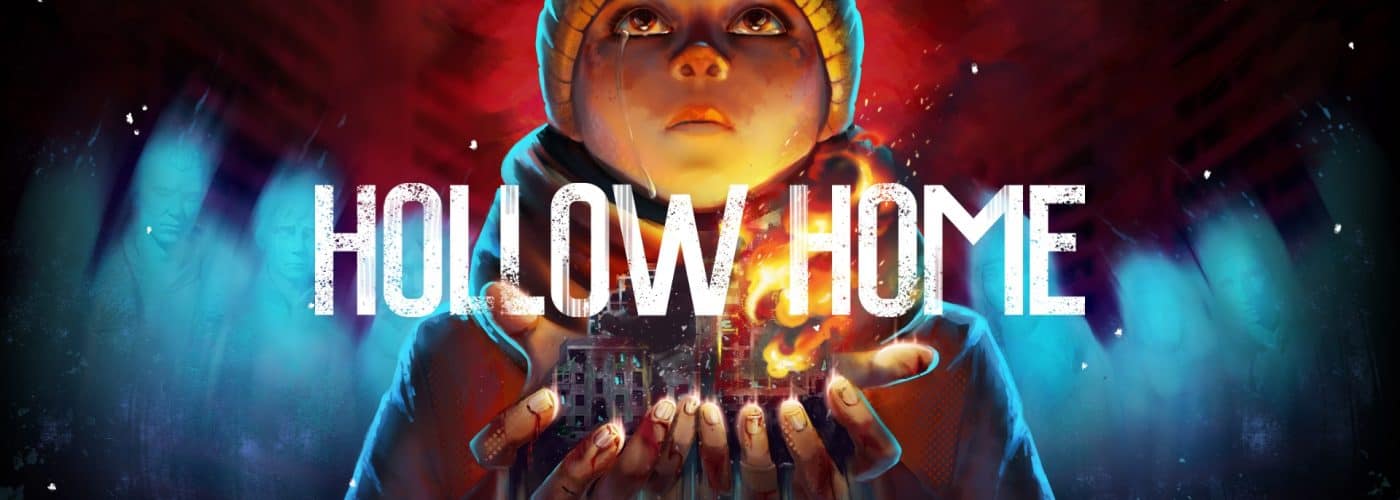
We played the demo of the narrative survival RPG from Kyiv studio Twigames: the last normal days of Maksym, fourteen years old, before the war enters his home.
An alarm rings. Maksym rolls over in bed, mounts a pathetic defense against the phone’s chime and, after five minutes of struggle, concedes defeat. He is fourteen, his parents have been out of town for a week, and the idea of skipping school crosses his mind with the ease of someone who knows the consequences will be future him’s problem. He has forgotten to do something – the dishes? his homework? the call to Mom? – and on his way down the stairs he greets Grandma Tania from the floor below, stops by Uncle Kostia’s garage, lingers at the playground where Vika saved his number as “C3PO” after a disastrous performance on the dance machine.
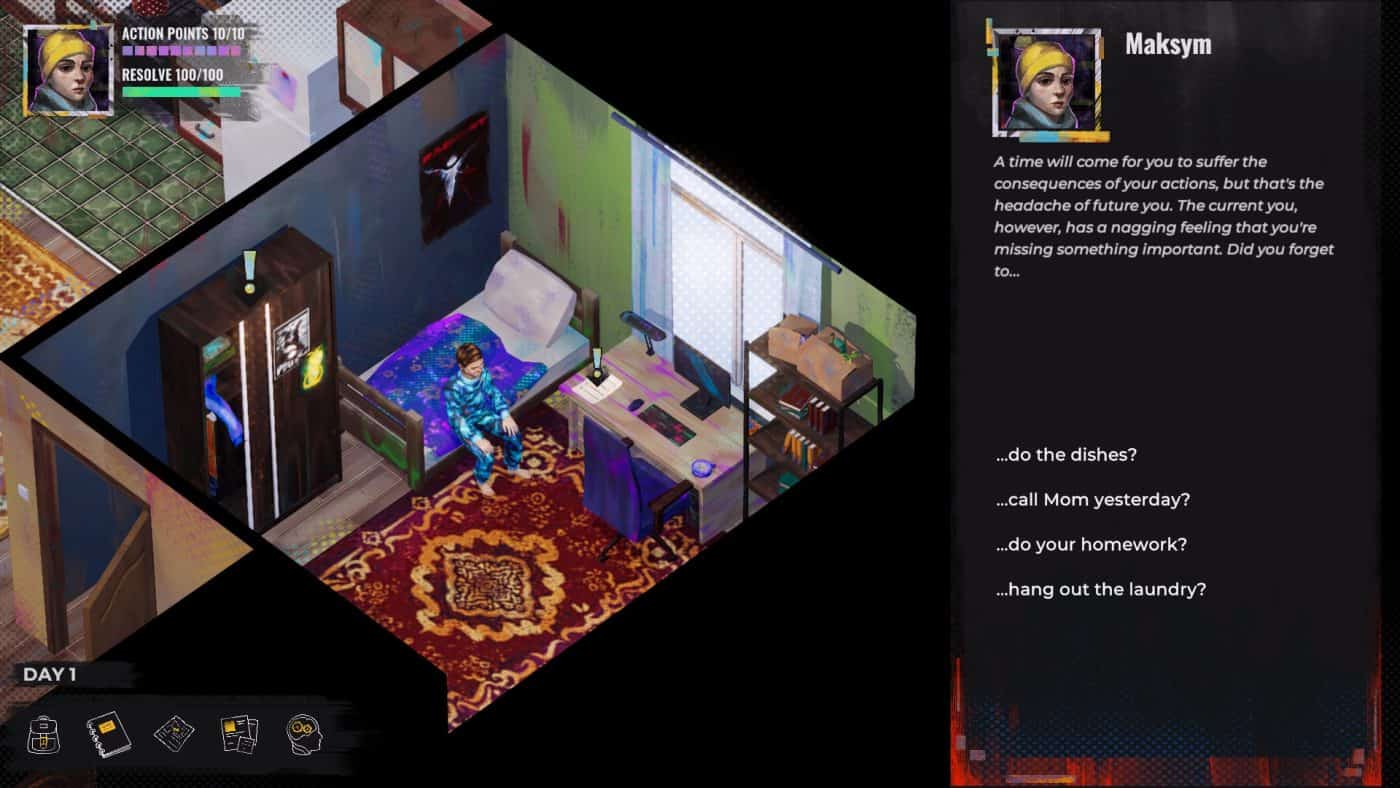
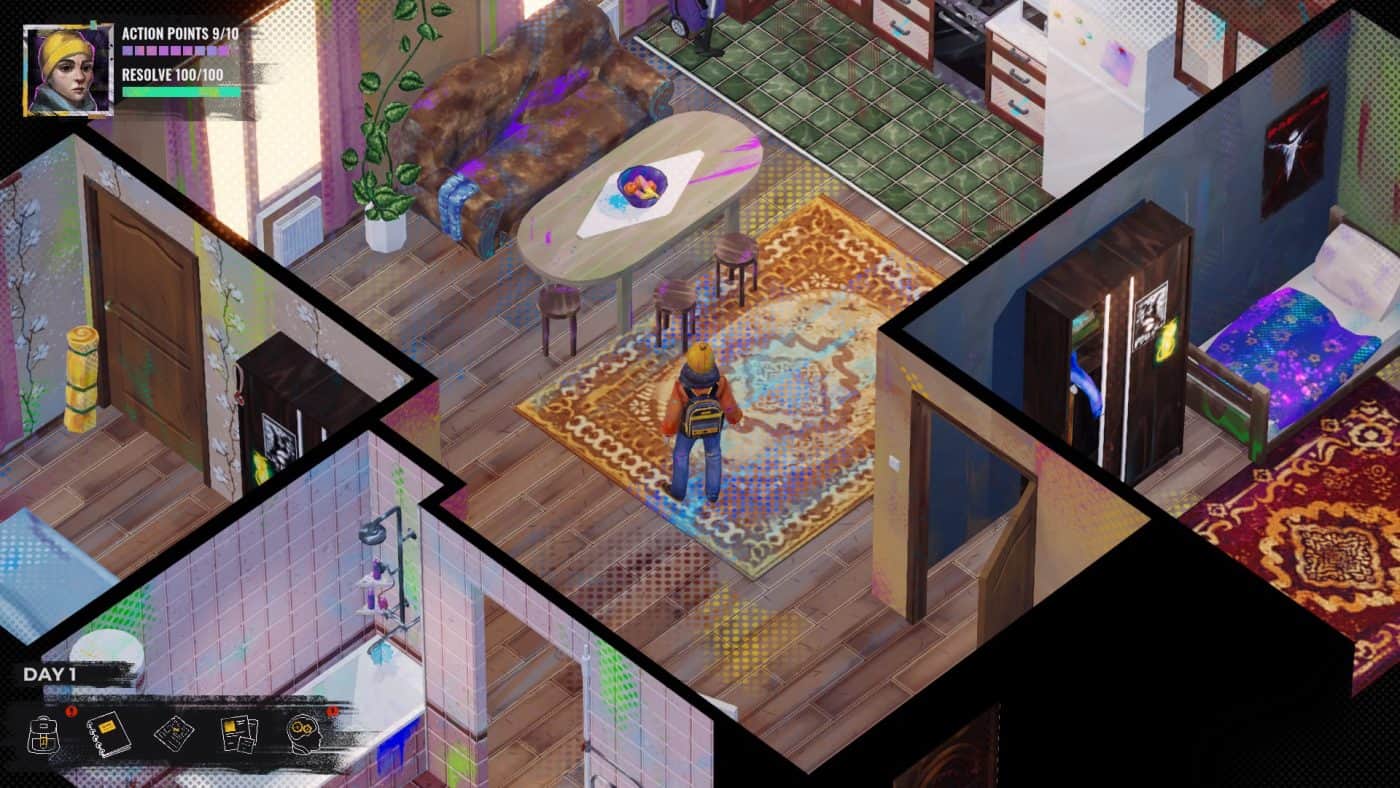
It reads like the opening of a coming-of-age novel, and the literary nod arrives through Uncle Lyosha, the neighbor who recommends Mark Twain: “You have many things in common with some of his characters. Resourceful, restless and independent.” I openly admit a weakness for Twain’s boys, turbulent and enormous-hearted, and Maksym worked his way into my heart before the story had truly begun. The game scatters the vocabulary of adventurous childhood everywhere: the make-believe “wars” with the neighborhood kids, the hiding place on the broken basement staircase, the door that always stays shut.
Then the screen fades to black and a date appears: February 23, 2022.

Home, Hollowed
The player knows what that date means. Maksym doesn’t. Into this gap Hollow Home sinks its first blade: the next morning, the boy wakes to the sound of the radio, the meaning of the words reaching his brain slowly, until something inside him breaks open. His father serves on the Donbas front line. His mother is unreachable. The full-scale invasion has begun, and he is alone, in a frontline city.
At that point the title stops being a label and reveals its full weight. “Home” carries the warmest sense of the word: the place you inhabit and love, as distinct from the cold “house” of mere walls. “Hollow” describes what is empty, carved out from within. A home that has lost everything that made it home: two words that contain the entire game before you even launch it.


That emptiness has a genealogy, and the characters embody it one by one: Grandma Tania, born during the Second World War, lost her father to that conflict, her husband to Afghanistan, her son and daughter-in-law to the events of 2014 – she never talks about any of it; Vika fled the war in 2014 with her parents, and lost them along the way; Maksym himself reflects that the war has lasted eight years and that he has taken part in it, unwillingly, from the very start, simply because he was born where he was born. The demo gently dismantles the Western perception of February 24 as a bolt from the blue: for these characters the war was already memory and mourning, a guest returning to claim its room.


Surviving Without Weapons
Hollow Home is a narrative survival RPG from Twigames, a studio from Kyiv, with Berlin’s Crunchy Leaf Games publishing. I played the demo that landed on Steam during the latest Next Fest, and I must lay my cards on the table: this is the first RPG of my life. The genre never attracted me. I came for the story, and the story nailed me to my chair. The characters achieve a three-dimensionality that few productions, even big-budget ones, ever reach: a handful of dialogue lines suffices for each of them to reveal an entire life behind them.


The game structure is clear and coherent with its theme. No weapons, no combat. Each day grants a limited number of action points: being everywhere is impossible, and so is helping everyone. You learn survival skills – cooking, crafting, scavenging, first aid – from people, through conversations and quests, and what you choose to learn today might save someone three days from now. The city, which spans three districts, changes with every dawn: cut-off streets, shelled buildings, people you met on day one who may no longer be there on day three. The developers themselves draw the Disco Elysium comparison, and it is an ambitious one; for theme and moral weight, the closest kinship I see is with This War of Mine. The true strength of Hollow Home lies in its writing, which comes through the demo clear and ironic when it needs to be, merciless when it must.


The Third Day
Then the third day arrives. You step out of the house and the courtyard sits in an unnatural silence. Where the swings stood – the ones a part of you still wants to ride – a black crater now gapes. The neighbors form a circle around something on the ground, something they wish they didn’t have to see. And a woman, whose name Maksym cannot even recall, repeats with a cracking voice: “They promised they’d only target military sites. This is a residential neighborhood. Our neighborhood.”
The demo stops here, on the threshold of the third day, at the exact moment when the horror stops being a news bulletin on the radio and takes concrete shape in the courtyard of your home. A precise, courageous cut, one that leaves the player exactly where it leaves Maksym: facing something impossible to ignore any longer.
Hollow Home hurts terribly, and it hasn’t even begun. It hurts because it counts for nothing which side of the barricade you stand on. If bombs fall on the place where you live, where you love and hope, everyone feels the same things. That fear, that sense of injustice, binds us all – as human beings and, before that, as living beings.


Toward Autumn
Twigames knows this firsthand. The studio developed the game during the war, drawing on the real events of 2022 and the siege of Mariupol. The characters are fiction; the city and what happens to it are not. The developers state their intent explicitly: to show the nightmare of war through the story of a boy surviving in an occupied city, and to let players feel the horror and despair of ordinary people. One detail says a great deal about the perspective behind all this: the word “russian” appears with a lowercase initial. An orthographic choice that has spread through Ukraine since 2022, and a fully deliberate one here.
Hollow Home arrives on PC via Steam by the end of 2026. The demo remains freely available on the game’s Steam page, while the Kickstarter campaign that will support the production of the full version has yet to go live. The game has already gathered significant recognition, including Best Conference Game at Games Gathering 2024, the Nordic Game 2024 Pitch Battle and the Most Promising Game award at Indie Cup Ukraine 2023.

I await autumn with my heart already bruised. Which is exactly what this game wants.
If you want to try the Demo: