
In short
With Voivod, Chaosmonger Studio turns the universe of the Canadian metal band of the same name into a side-scrolling action metroidvania, with run ‘n’ gun combat, mutations that unlock exploration and a pixel art aesthetic inspired by ’90s action platformers. The preview covers the early demo, playable ahead of the October Steam Next Fest, with boss fights, secrets and environmental lore, and the band directly involved in development: from Michel Langevin’s illustrations to Daniel Mongrain’s music supervision and Denis Bélanger’s voice. A positive first impression, with some room for improvement on AI and balancing.
With Voivod, Chaosmonger Studio brings the imagery of the Canadian band into an action metroidvania that turns the band’s long-standing narrative universe into a video game.
I had the chance to play the early demo of Voivod in preview and share my first impressions with you. A metroidvania developed by Chaosmonger Studio in collaboration with the historic Canadian metal band of the same name. You too will be able to download and play a demo available in October for the STEAM Next Fest.
Some titles are born when music and video games meet, and the relationship between the two media is certainly nothing new. Over the years we have seen artists and bands become protagonists, appear within stories, or become an integral part of a title’s identity. There are, however, cases where the bond goes well beyond a simple soundtrack.
It is precisely in this category that Voivod fits.
The project does not seem to want to simply use the band’s name to accompany an ordinary action game. The goal is far more ambitious: to transform the Voivod imagery into a fully-fledged game world. The result is a game that leans heavily on action and exploration, but above all on a visual identity that is hard to mistake for anything else. A journey through a reality now completely distorted, where our protagonist will have to face biomechanical creatures, traverse ever-changing landscapes, and try to piece together the fragments of a memory that has been lost.
A bit of history
Before talking about the game, though, let’s take a step back into the past. Several video games have tried to turn a band’s imagery into an interactive experience. From Michael Jackson’s Moonwalker to KISS: Psycho Circus, and Queen: The eYe, and these are only a small sample of the titles that have entered the video game medium.
Some projects, however, have had a particularly close bond with the artists who inspired them. I will only mention those that share with Voivod the same creative idea and the particular mindset.
Let’s start with Iron Maiden: Legacy of the Beast, where Eddie, the settings, the enemies and even part of the game’s structure draw directly from the long history of the British band. The project was also developed in close collaboration with Iron Maiden and their management.
Another example is Motörhead: Through the Ages. Born as an expansion for Victor Vran, the project brings Motörhead’s imagery into the game through new worlds, weapons, abilities and bosses inspired by the band, accompanied by tracks rearranged specifically for the video game experience. In this case too, the band’s involvement was direct, with Lemmy Kilmister taking part in the project alongside the other members.
We finish with Brütal Legend, which approaches the question from a yet different perspective. Here there is no single band as protagonist; instead, the entire imagery of heavy metal becomes part of the game world. The title builds its setting around metal, also involving musicians such as Ozzy Osbourne, Lemmy Kilmister and Rob Halford.
Lore and narrative
In Voivod we take on the role of the Voivod himself, a warrior who finds himself lost in a land devastated by war and nuclear radiation. The problem is that, in this world, it is not only the environment that has changed.
The protagonist’s body is subject to constant mutations and, in the course of this process, his mind has been lost. Guiding him will be Nothingface, a disembodied consciousness that accompanies him through this strange world in search of the fragments of his memory.
The goal, then, is fairly simple: recover what has been lost and look for a way out of this nightmare. The way the story is told, however, seems to want to leave ample room for the setting, turning every area into another piece of a reality that becomes increasingly hard to comprehend.


A metal metroid
Voivod seems to want to rely on a fairly classic formula, but with some interesting ideas. The heart of the experience will in fact be a run ‘n’ gun combat system, in which we can shoot and strike enemies. This is exactly what I want to focus on: our firearm can also be used in close combat, delivering slashes, and can even deflect enemy projectiles.
With the firearm, beyond the classic run ‘n’ gun, we can shoot while standing still or crouching. The aiming is good and fairly precise, as is the aggressiveness of the enemies. Although at times their AI is easy to circumvent, you should not underestimate the damage enemies inflict, or you may come to a bad end. Watch out for verticality, because in Voivod fall damage exists too.
The title offers a Story mode and a Combat Trial. The first is the pure metroidvania experience with story progression. The second is for those who want to focus on combat and try out the abilities the game grants in the preview.


Map and early demo experience
The map of Voivod follows the classic metroidvania structure. New weapons and abilities (mutations) will allow access to previously unreachable areas and the discovery of hidden paths. Without spoiling anything at this stage, I found one mutation that is genuinely curious and original. Use it with curiosity if you are the kind of player who loves discovering secrets and lore in the game environment.
As is the genre’s tradition, secrets, hidden passages and some sections to uncover will not fail to surprise and delight you. The early demo experience consists of a central map and one biome including a boss fight. Once the player completes the boss fight, the demo does not end, but allows the player to keep exploring and discover new portions of the map.
Obviously, some portions of the map will be impassable, but we can still derive quite a few satisfactions.


90s pixel art and metal
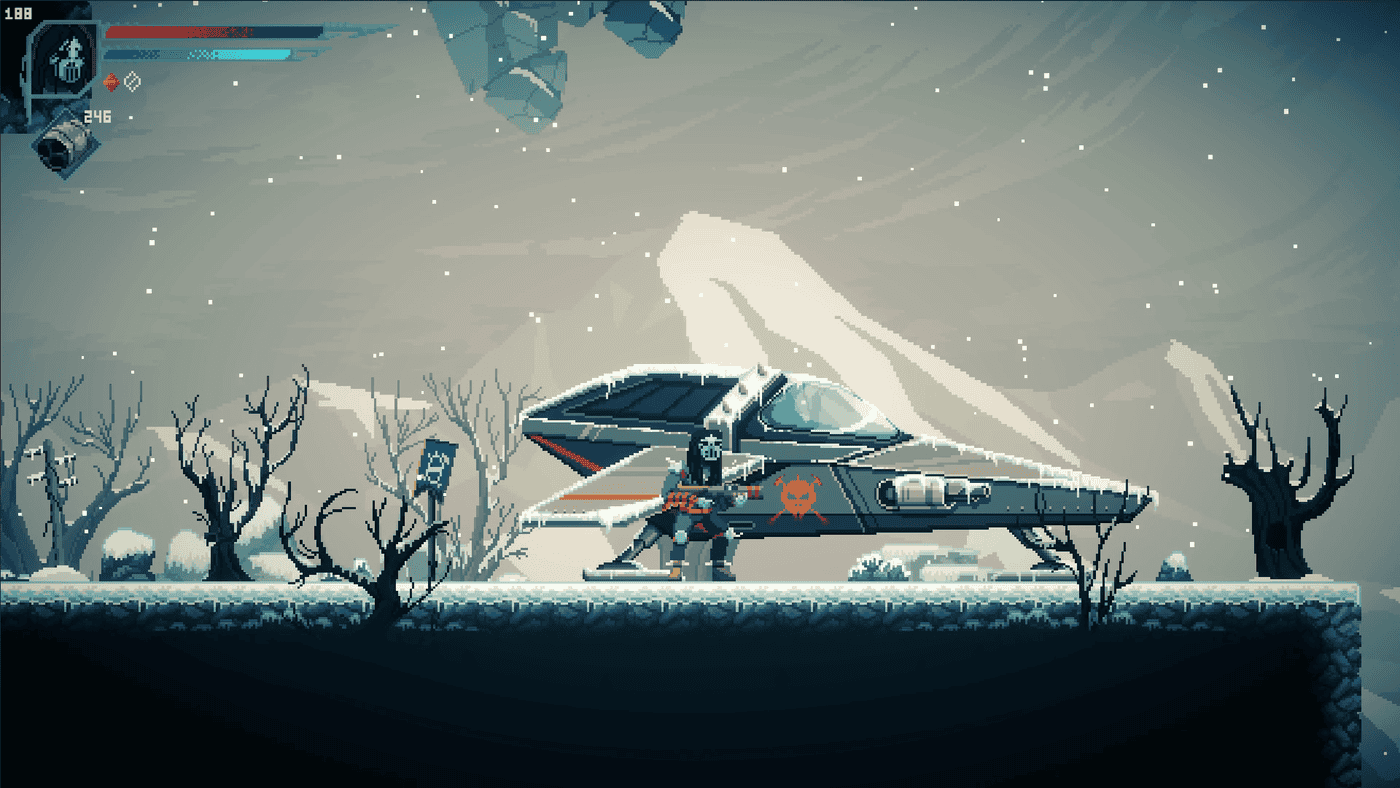
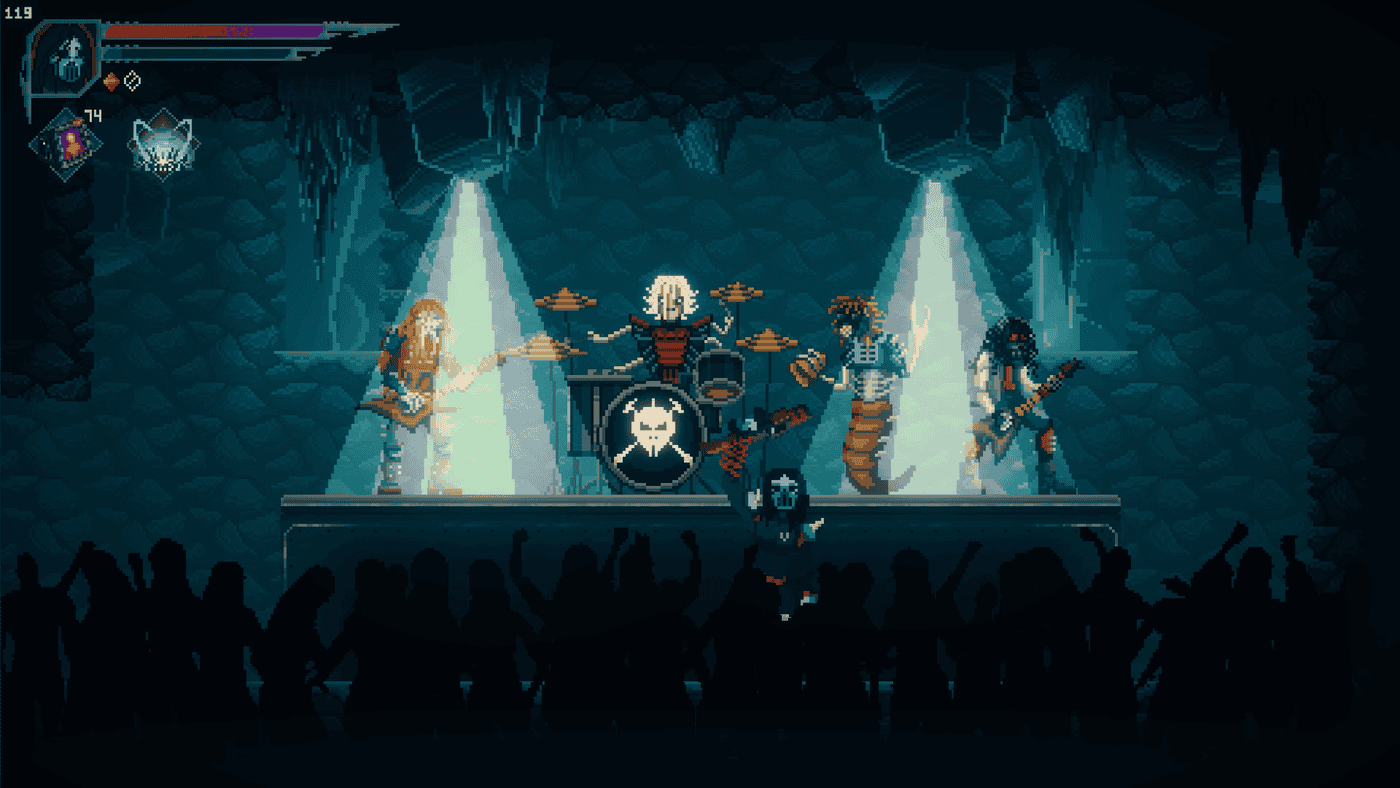
Aesthetically, Voivod does not seem to have any intention of hiding its influences. It openly draws on the 90s action platformers, with a dirty, rough look that fits the game’s post-apocalyptic atmosphere very well.
It is a choice I find particularly consistent with the project. The Voivod universe is indeed one of those that Chaosmonger Studio can turn very well into a video game with a rétro aesthetic, especially for the way it combines science fiction, technology and decidedly bizarre creatures.
The music also seems to play an important role. The soundtrack will not simply use the band’s musical identity, but will offer rearranged versions of some Voivod tracks, adapting them to a vintage video game aesthetic.

Voivod, more than just inspiration
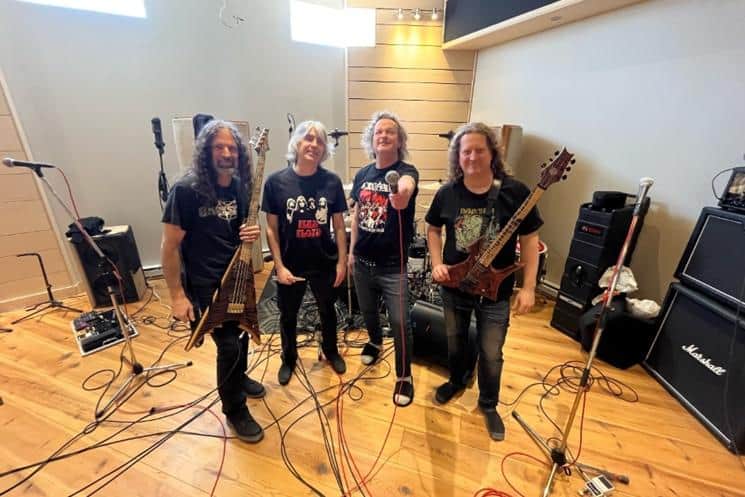
Voivod does not seem to be the classic operation in which a band simply lends its name to make a video game. The band in fact takes a direct part in development.
Michel Langevin (Away) contributes to the visual side and the illustrations.
Daniel Mongrain (Chewy) supervises the music adaptation work.
Denis Bélanger (Snake) provides the voice of the protagonist.
Dominic Laroche (Rocky) takes part in playtesting and gives his feedback on the gameplay.
When a video game decides to build its identity around a band’s universe, the risk of being nothing more than a simple commercial operation is always present. In this case, at least judging by the premises, there instead seems to be a desire to build something that genuinely starts from the Voivod imagery.

My Two Cents
Voivod is one of those projects that manage to spark curiosity from their premise alone. Not so much because the idea of an action metroidvania is anything new, but for the way it tries to bring together two worlds that, at least on paper, seem to have quite a few points in common.
The rétro aesthetic, the pixel art, the run ‘n’ gun combat and the metroidvania exploration make for a fairly recognizable and solid foundation.
The run ‘n’ gun system is fast and responsive, and the idea of being able to use the same weapon in close combat as well, on top of deflecting projectiles, adds some interesting elements to the formula. The title seems, for the moment, to handle its metroidvania spirit well and with plenty of secrets, considering the length of the demo.
On the gameplay side, apart from a few small hitches or technical blemishes (it is an early demo, after all), the title is fairly solid. Voivod shows only a small part of what it has to offer and the experience lasts a little over an hour. Some aspects, such as the enemies’ artificial intelligence and the balancing of damage output, both dealt and received, still seem to have room for improvement.
For now, then, Voivod has left me with a good first impression. We are not yet looking at a finished product, and I will need to evaluate several elements more closely with the upcoming builds, but the foundations seem to be there. Indeed, Voivod does not give the impression of being simply a metroidvania with a skin dedicated to a metal band, but a product with an already clear identity.