In short
Our impressions of the Talaka demo, the 2D action roguelite by Potato Kid published by Acclaim that draws on Brazilian folklore and the Orisha: remarkable art direction and a well-built imagery are not yet enough to make up for an unripe gameplay, with issues in balancing, weapon handling and enemy positioning, in a demo that nonetheless shows openness to community feedback.
We played the Talaka demo and found ourselves facing a roguelite with a strong artistic identity, but one that still leaves a few doubts on the gameplay and balancing front.
The Talaka demo is yet another demonstration of how much richer the Brazilian indie scene is than one might assume. The title joins other productions we have reviewed on these pages, such as Bloodless and Hell Clock. After all, the roguelite genre’s ability to blend with other genres has pushed small developers to create genuinely original works. Talaka, by Potato Kid, a small Brazilian independent studio, tries to stand out through a combination of dynamic combat, progression typical of the genre, and an imaginary rooted in Brazilian folklore. Published by Acclaim, the project, according to the developers, looks to titles like Dead Cells and Hades for its combat system and run structure, respectively. All of this, however, while reworking those inspirations through a very specific artistic and cultural sensibility.
Curious to explore this particular offering, we had the opportunity to try the demo in advance, so as to get a clearer picture of Potato Kid‘s vision.
Will the demo manage to strike a balance between an action formula that developers have already extensively explored and a cultural universe that the medium still underrepresents? Will the strength of the artistic identity and the variety of the mechanics translate into an experience that is equally solid on the gameplay front?
To find out, I put the Talaka demo to the test.


A Game Inside a Painting
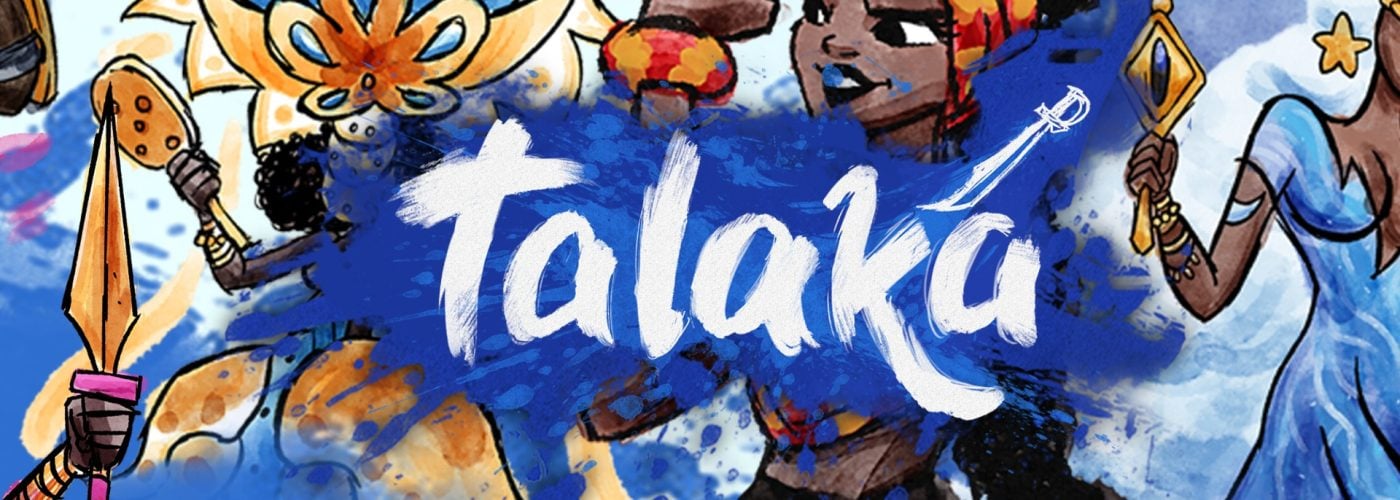
The title’s crowning achievement is its art direction. Precise, and with an identity of its own. Many productions draw inspiration from fantasy settings aimed at evoking a sense of exoticism in the player. Talaka, on the other hand, does not simply use an unusual setting as a backdrop: it seeks to celebrate a very specific cultural heritage, highlighting a wealth of legends, deities, and creatures that still find little space in the gaming landscape.
This element does not end with the characterization of characters and enemies: Potato Kid also reflects it in the art direction and the narrative. Potato Kid ties the world of Talaka to the theme of forgotten legends and their corruption, an element that finds visual representation in the creatures we fight and in the environments we traverse during our runs. An interesting choice, because it allows Potato Kid to integrate the folklore into the experience rather than relegate it to a merely decorative role.
This artistic vision also influences the gameplay. Just think of the brushstrokes of color that appear on screen every time we jump or land a hit. Enemies likewise disappear as ink stains. These solutions help reinforce the project’s visual identity and guide the player through the action.
We should not overlook the audio component either: Potato Kid created it in collaboration with Afro-Brazilian musicians. Songs, percussion, and melodies tied to this cultural universe help build an atmosphere consistent with the setting and with the role of the Orisha.
The Fight Against the Loss of One’s Roots
The opening of Talaka also makes clear what Potato Kid wants to communicate with this title. In the introduction, a narrator, whom we will later come to know, tells us the story of our heroine.
The protagonist, a young woman gifted with the spark of art, begins to travel the world thanks to her gift. She decides to return home, however, after discovering the mysterious disappearance of her grandmother. This event leads her to confront a world very different from the one she knows, populated by legendary creatures, deities, and ancient spiritual forces. Since childhood, in fact, Talaka grew up listening to tales tied to Brazilian folklore and to the Orisha, figures that always fueled her imagination.
During the journey, the protagonist finds herself immersed in a fantastical universe that seems to come to life from the drawings and paintings she made during her childhood. Here she meets Eshu, the narrator who seems to want to help the young woman and to whom she recounts what is happening. She also discovers that the ancient legends are slowly disappearing and that some of the creatures populating this world have been corrupted by a mysterious force. The Orisha, the deities who safeguard the balance of these lands, will also be involved in the events.


Talaka’s task, then, will be to cross territories inspired by Brazilian landscapes, confront the creatures that inhabit them, and try to understand the origins of this corruption. A journey that goes beyond the search for her grandmother and progressively takes on a broader dimension. It is not only about saving a person, but about preserving a heritage of stories and traditions at risk of being forgotten.
Gameplay and Level Structure
On the gameplay front, Talaka offers frenetic combat, an arsenal of weapons and abilities to combine, and a structure based on successive runs, during which to experiment with different approaches and face increasingly challenging enemies. The progression follows the classic patterns of 2D action roguelites, without introducing any particular revolutions to the formula. Let’s be honest: the gameplay of Talaka is not yet really on par with its artistic and narrative side. Unfortunately, at least in this version, it does not entirely convince and still feels rather rough in some of its components, such as weapon handling, damage balancing, enemy positioning, and certain dynamics that end up undermining the team’s good ideas.
The Basics and Movement Actions
The control system offers a double jump and a dodge with a cooldown. A choice designed to convey a good sense of mobility from the very start of combat. Added to these actions is the ability to grab onto higher platforms by pressing the dedicated button.
The protagonist can also attack both in melee and at range, using different weapons that influence how the various situations are handled. Particularly effective is the downward attack, which allows you to strike creatures below by exploiting the jump. While the controls feel responsive during the tutorial, performing certain actions becomes more difficult as the adventure progresses, mainly due to the verticality of the level design, which often ends up hiding both enemies and traps.
An original idea is the Brush of Kumbu, a secondary weapon that allows you to paint both the past and the future. In gameplay terms, it lets us, among other things, remove the Glitch Shield that protects certain enemies, making them vulnerable to our attacks. A particular mechanic that further helps differentiate the combat system.


In-Game Upgrades and the Central Hub
As runs progress, it also becomes possible to obtain additional jumps and upgrades that further expand movement options. As for the management of the central Hub and character progression during runs, Talaka does not stray particularly far from its peers, but introduces some interesting possibilities. During a run we can make various choices spanning blessings dedicated to attack, movement, and resource gathering. All of this then feeds into alternative paths, with portals that allow you to continue the story or take on mini-bosses and bosses.
The central Hub also develops according to a progression now well established in the genre. As we advance through the runs, the different spaces are occupied by the Orisha, who help us improve the character. Each deity has its own area of expertise, on which the available upgrades depend: from upgrades for the protagonist to those for abilities, up to the shop and the other customization options.
The structure of the Hub is also interesting, characterized by a certain verticality and by the need to use the platforming mechanics to reach the deities you want. A solution that makes this space something more than a simple menu through which to manage progression.


Balancing, Weapons, and Level Design
It is above all in this area that the Talaka demo shows its weak side. Although the game tries to adapt to the player by adjusting the difficulty level based on the results achieved during the tutorial, some choices do not entirely convince. Naturally, the difficulty can be changed later on.
The level design of the areas and the placement of enemies tend to create more problems than necessary. Given the aggressiveness of the opponents and the ability of some to send their projectiles through obstacles, there is a real risk of taking practically unavoidable damage. Added to this is contact damage, which sits poorly with the presence of narrow platforms and the movements required of the protagonist.
The weapons, for all their originality and interest, are in some cases hard to control and, as a result, less effective than they should be. A problem that once again collides with the aggressiveness and positioning of the enemies. It is mainly the ranged weapons that suffer from these issues, sometimes making it difficult to handle encounters with the necessary precision.
In the end, the management of damage taken and dealt, together with weapon behavior and enemy placement, ends up in some instances compromising the rhythm and fluidity of the experience.
Interesting, on the other hand, is the choice to hide collectibles and special rewards in the areas we traverse, encouraging closer attention during exploration.


The Desire to Improve
Beyond the issues highlighted, it is fair to remember that we are looking at a demo, not a full version of the game. Something that Potato Kid itself seems aware of, since during play it directly asks players to share their opinion on certain mechanics.
Over the course of the run, we are in fact asked whether we liked the weapon we used, and we can also provide further feedback on the experience. An attention that bodes well for the team’s willingness to gather the community’s impressions and address the various issues. How much of this input will translate into concrete changes remains to be seen, but the openness to dialogue is certainly a positive sign.


My Two Cents
The Talaka demo left me with mixed feelings. On the one hand, we have a project that manages to stand out thanks to a genuinely distinctive art direction and a very specific cultural imaginary. Potato Kid’s work on Brazilian folklore, the Orisha, and the visual component demonstrates a clear intention to give the project an identity of its own, rather than simply rehashing familiar formulas. On the other hand, the gameplay cannot yet fully sustain these ambitions.
The issues encountered during play are not few, and they concern aspects far from secondary, such as the balancing of combat, weapon handling, and enemy placement. At certain moments, one gets the feeling that the difficulty stems less from the need to learn the opponents’ patterns than from poorly readable situations or damage that is hard to avoid. These are aspects that, in an action roguelite where precision and reactivity are fundamental, inevitably weigh on the experience.
That said, I do not want to be particularly harsh on a project that is still a demo. The developers’ own willingness to collect feedback suggests there is still room to intervene on the mechanics and smooth out the various rough edges. It would therefore be premature to pass definitive judgment, especially considering that the project’s potential is evident.
At the moment, Talaka strikes me as a title that has already found its identity on the artistic and narrative front, but that still has work to do to achieve the same result on the gameplay front. My curiosity about the project remains, as does the hope that Potato Kid can make the most of the good ideas that emerged from the demo. Because, beyond the issues, it would be a shame to see such an interesting imaginary not matched by an equally convincing game system.