In short
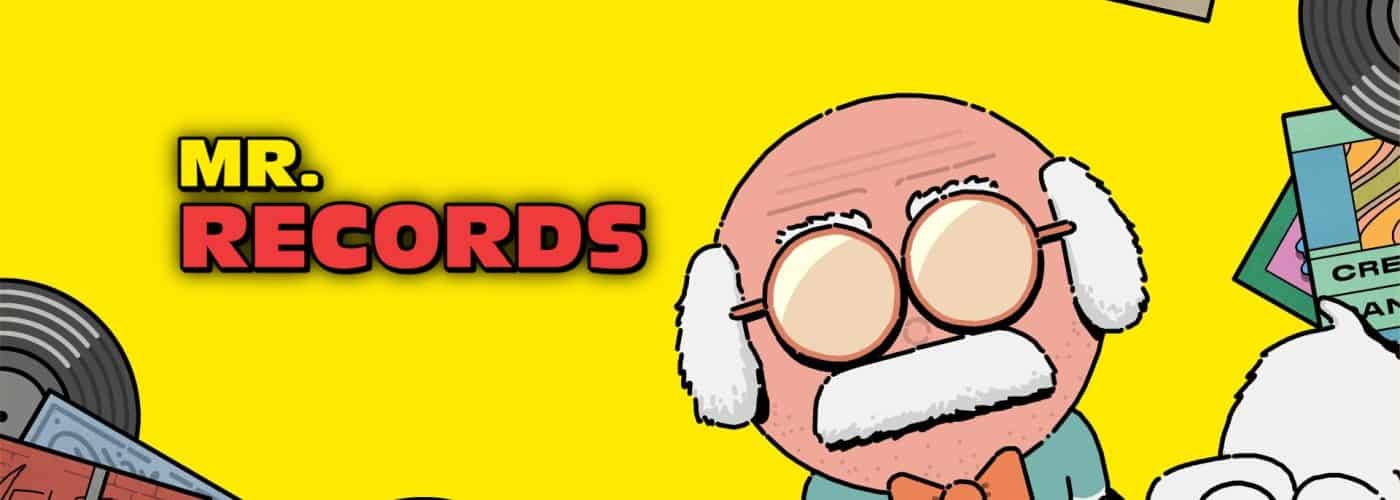
MR. RECORDS is a charming musical adventure that combines rhythm gameplay, record shop management, original music, and storytelling in a colorful and approachable package. By day, players manage George’s shop and help customers find the right records; by night, those records become gateways to surreal worlds shaped by music and imagination.
A game about what music leaves behind: memories, feelings, people, and pieces of our lives that can suddenly come rushing back with the sound of a familiar song.

There is something music can do better than almost any other art form: take us back. It does not matter how much time has passed. It does not matter how much has changed, how many people have crossed our paths, or how many places we have left behind. Sometimes, all it takes is a song.
A few notes can be enough. Just enough to recognise a melody, and suddenly we are somewhere else. Back in a room that no longer feels quite the same. On a road we have driven a hundred times. Somewhere on a trip we had almost forgotten. Next to someone who is now far away. Back in a time of our lives that we cannot return to. There is something almost magical about it.
Music does not warn us. It does not ask for permission. It does not give us time to put our guard up. It simply starts playing, and before we have fully realised what is happening, something inside us has already moved. Perhaps that is why certain songs become so important to us. We do not simply remember what we listened to. We remember who we were when we listened to it. Strangely enough, it was a video game, not a song, that reminded me of that.
When I first launched MR. RECORDS, I expected a short hands-on session with an intriguing indie project. What I did not expect was for a roughly thirty-minute demo to turn into an experience that felt surprisingly personal, touching something I had not felt resonate in quite some time.
On paper, it had all the ingredients of a game worth keeping an eye on: a distinctive visual identity, a record shop at the heart of the experience, and music woven into the very fabric of the game. Leading the way is George, with Buzz, his loyal four-legged companion, never far from his side.
I knew what kind of game I was about to play. I had seen the screenshots and had a clear idea of the experience Glee-Cheese Studio was aiming to create. But there is a world of difference between understanding what a game is on paper and discovering what it actually feels like to play.
And somewhere between the game I thought MR. RECORDS would be and the one I found once I had the controller in my hands, something clicked.


A few days ago, I had the opportunity to play the MR. RECORDS demo ahead of its appearance during Steam Next Fest, thanks to Glee-Cheese Studio and Wired Productions.
I went in with the usual mindset of a first hands-on session. I wanted to understand how it played, see how its ideas came together, pay attention to the details and, naturally, listen. I had no idea whether I would come away thinking I had played a charming little project, an intriguing concept with room to grow, or something that would stay with me long after I put it down.
The answer came sooner than I expected. I started playing, and somewhere along the way, I stopped checking the time. The demo was suppoes to last around thirty minutes. Instead, I kept going. A little longer became another run, which became another replay. I listened to another track, went back to revisit a section I had missed, and then found myself starting over once again.
Before I knew it, those thirty minutes had become almost five hours. I actually laughed when I noticed. Then came the inevitable question: “Wait. How long has it been?” That might sound like a small thing, but I think it is one of the clearest signs that a game has managed to get under your skin. Not when it tells you that you have reached an important moment. Not when it throws a spectacular set piece or a carefully crafted twist at you. But when you forget to look at the clock.
At that point, you are no longer playing because you need to understand the game. You are playing because you genuinely want to find out what comes next. That was MR. RECORDS‘s first real surprise for me. Calling it a bolt from the blue might sound excessive when we are talking about a demo that lasts around thirty minutes. But perhaps that is what made it so effective. A game does not necessarily need enormous scope, a sprawling world or a massive production behind it to leave an impression. Sometimes, a good idea is enough, provided it knows how to make you care.

Thirty minutes is not much time. It is enough to learn the basics, hear a few tracks, meet some of the characters and understand the general direction of the project. It is rarely enough to form a genuine connection with a game. Yet that is exactly what happened here.
By the time the demo ended, my main thought was surprisingly simple: Thirty minutes was not enough. Not because it had failed to show me what I needed to see. Quite the opposite. I simply did not want it to end. So I kept playing. I replayed sections. I listened to certain tracks again. I looked more closely at my surroundings and went back for details I had missed during my first run.
And, somewhere along the way, something happened that carries a particular weight when you write about video games: I stopped playing as a journalist and started playing as a player again.
It is a subtle distinction, but an important one. When you play a game for review, you inevitably start looking at it differently. You think about how its systems work, whether its mechanics are effective, how its world is built, where its ideas succeed and where its limitations begin to show. That is part of the job. But before games become something we analyse, they are something we experience.
There should still be room for that moment when you stop dissecting what is happening and simply let yourself be there. MR. RECORDS gave me that moment surprisingly early.
And perhaps that is one of the most valuable things a game can do. It does not necessarily have to be huge. It does not necessarily have to be ambitious. It does not even need to overwhelm us with content. Sometimes, what matters most is something far simpler: making us want to stay.
When we are children, that feeling comes easily. We do not care how long a game is, how many modes it has, how deep its systems are or how many hours it will take to finish. We just want to play. We want to be curious. We want something that makes us say: “One more time.”
Growing older changes that. Not because we stop loving games. If anything, we understand them better. We recognise their conventions and the systems designed to keep us engaged. We learn to see the machinery behind the experience. And sometimes, that makes us harder to surprise. Which is why there is something particularly refreshing about a game that manages to catch us off guard through something as simple as a feeling. MR. RECORDS did exactly that.

I found myself smiling at the screen. Laughing at certain moments. Thinking about sections I wanted to replay before I had even finished them. And then, a few hours after closing the game, I found myself thinking about one of its songs. That was when the experience changed. Until that point, MR. RECORDS had won me over simply as a game. From there, however, it began to speak to something beyond what was happening on screen: music Not music as background. Not music as a mechanic. But music as memory, as identity, as a part of who we are.
It is a simple idea, until you stop to think about how deeply music is tied to the moments we remember. A song is rarely just a song. It can become the memory of a person. The soundtrack to a summer. It can take us back to a place we thought we had left behind. It can make us smile. It can hurt. It can make us miss someone we had not expected to think about that day.
And sometimes, it does not even take an entire song. Just a single lyric, a familiar bassline, or the opening notes of a chorus can be enough. Suddenly, we are there again. That is the almost inexplicable power of music: its ability to make the past feel within reach. For a few seconds, time seems to fold in on itself, and a memory we thought was far behind us feels remarkably close again.
And MR. RECORDS seems to understand that instinctively. This is not simply a game about songs. It is a game about the people who listen to them: the memories they attach to them, the meaning they give them and the moments that become inseparable from a particular melody. That is where the game surprised me most. Watching George move around his shop, choose a record, put it on and let the music carry him somewhere else, I began to recognise something familiar: the feeling. That deeply personal relationship many of us develop with certain songs over the years.

A vinyl record stops being just an object. It becomes a fragment of memory. A small vessel for emotions, capable of holding onto people, places and moments we thought were long gone.
That, to me, is where MR. RECORDS becomes truly fascinating. Beneath its bright colours, eccentric characters, and surreal world lies a much more personal idea – and perhaps that is precisely what gives it such a universal quality: music does not simply tell stories; it becomes part of our own.
That is what makes music feel so deeply personal. And it may also explain why Glee-Cheese Studio’s game feels surprisingly empathetic. As we follow George and step further into his world, the music changes the way we experience what is happening on screen. And, almost inevitably, it sends us back to memories of our own. In that sense, George’s record shop becomes more than a setting.
It becomes a place where memories live. A place where a song can open a door we thought we had already closed. George’s dream of finally opening the record shop he has always wanted also introduces another idea I found particularly compelling: all the things we keep putting off.
Life is full of “somedays”. Someday I’ll do it. Someday I’ll try. Someday I’ll find the time. Sometimes, that day really does come. Sometimes, it keeps moving further away.
There is something deeply human about watching someone finally make room for a passion and turn a long-held dream into something real. Not because the idea itself is extraordinary, but because it is something we can recognise in ourselves. And that is another reason MR. RECORDS resonated with me. At least in this demo, it feels like more than a game about music. It is also a story about time. About the past. About possibilities. About the things we leave behind.
And perhaps, sometimes, about the possibility of going back for them. That is where Buzz also comes in, George’s inseparable four-legged companion. Details like this give the game a warmth that sits comfortably beneath its surreal exterior, reinforcing the human side of George’s journey.

It is a difficult balance to strike. Nostalgia can easily become heavy-handed, and joy can lose its meaning when it is pushed too far. At least in this demo, MR. RECORDS manages to walk that line remarkably well. Perhaps that is also why those five hours felt so different from an ordinary hands-on session. At some point, I no longer felt like I was evaluating a game. I felt attached to a place. That is difficult to describe without sounding overly sentimental, but the feeling was real.
When the demo ended, I did not simply feel the satisfaction of having finished what I had started. I felt that small, almost childlike frustration that comes when something you are enjoying ends precisely when you want it to continue. It was over. And I simply was not ready to leave.
I wanted another song. Another level. Another few minutes in George’s shop. It is perhaps the simplest thing I could ask from a game. And yet, it became one of the hardest feelings to ignore.
Because when an experience makes you want to return after you have closed it, something has already happened. It has given you a reason to keep thinking about it. Not because it is perfect. Not because it has already shown everything it has to offer. Simply because there is still something beyond it that you want to see. And MR. RECORDS gave me that reason through something we have all known for as long as we can remember: a song.
It is funny to think that, after so many years of playing and writing about games, the simplest things can still surprise us more than the biggest ones. A vast open world can leave us speechless. A massive production can impress us with its scale, technology and sheer abundance. A complex system can keep us coming back because there is always something new to master.
And yet, every so often, a small indie game takes the opposite approach. It leads us into a record shop. It puts a needle on a vinyl record. It lets a song begin. And, almost without making a sound, it takes us somewhere we thought we had left behind. That is the kind of surprise I value most.
Not the one that comes from scale, spectacle or sheer volume, but the one that comes from something seemingly small finding a place inside us and becoming, almost without us noticing, far bigger than we expected. That is how MR. RECORDS found its way into my experience.
It was not the game I expected to find. It was not even the game I knew I was looking for. It simply arrived. And perhaps because of that, it surprised me all the more. It was the game I did not know I wanted until I realised how much I wanted to keep playing it.

Now, we can finally step inside George’s shop and take a closer look at everything else MR. RECORDS has to offer. But before we do, I want to ask you one thing. Think of your song.
The one you would only need to hear once to travel back in time. The one capable of bringing a face, a voice, a place, a journey – or perhaps a version of yourself that no longer exists – to the surface.
Because, ultimately, that is what MR. RECORDS is about: how a song can become a memory, how a memory can become a journey, and how a video game can sometimes bring something we thought we had forgotten back into the light.
Four Minds on the Same Wavelength
Before we step into the MR. RECORDS demo, there is one more part of the story worth telling. For a moment, I want to look beyond the game itself, not to delay our journey into its mechanics, but to consider the people who made that journey possible. It is an easy part of games to overlook.
As players, we encounter the finished product: we press Play, pick up a controller and enter a world that has already been imagined, designed and built for us. We see the characters, hear the music, learn the mechanics and move from one level to the next. What we rarely see is everything that had to happen before any of it reached our screens. Every game starts with an idea.
Turning that idea into something playable can take months or years of writing, drawing, programming, composing, testing, revising and, more often than not, starting over. By the time we experience the finished result, most of that work has disappeared behind the curtain.
MR. RECORDS is particularly interesting in that regard because its identity is so closely tied to the people who made it. To understand the game, it helps to understand the creative philosophy that shaped Glee-Cheese Studio long before George’s record shop came to life.
At its core is a straightforward idea, but one that is considerably harder to realise: music should not simply accompany a game. It should help define it. That means treating music as more than atmosphere or background. It can shape rhythm, influence the visual language, support the narrative and, ultimately, become part of the way a player experiences the world.
So, before we enter George’s shop, let’s rewind. Our story takes us back to 2017, when Glee-Cheese was founded in France by Charles Bardin, Valentin Ducloux, Olivier Fouques and Alexandre Rey.

Four people, four different areas of expertise, and a shared passion that would become the defining thread of their work: music. From the outset, the studio set out to create innovative music-driven games with a strong artistic identity and a language of their own.
That ambition becomes clearer when looking at the projects that followed. In 2022, Glee-Cheese released A Musical Story, an introspective journey inspired by the sounds of the 1970s. Here, music was far more than a backdrop: it was woven into the storytelling itself, carrying the experience through images, emotions, and memories. The studio then took that musical sensibility in a completely different direction with Headbangers Rhythm Royale, a multiplayer battle royale for up to thirty players, where rhythm became the foundation for competition, movement, and comedy.
The two games could hardly feel more different. A Musical Story is intimate and contemplative; Headbangers Rhythm Royale is frantic, playful, and unapologetically absurd. Despite their differences, both projects are built around the same creative principle: music is never incidental.
It is the thread that runs through Glee-Cheese Studio’s work, adapting to each project while remaining central to the way the team approaches game design.


Seen in that context, MR. RECORDS feels less like a departure and more like the natural evolution of an idea Glee-Cheese Studio has been developing for years. What makes this project different is how personal that idea feels this time – one that is closely tied to the studio itself
Glee-Cheese Studio is a team of four. There is no sprawling production structure behind the game, with hundreds of people working within separate departments. Instead, its projects are shaped by a small group whose disciplines overlap and inform one another. That is particularly significant when music is at the heart of the experience. Here, composition, sound design, game design, programming and art are not isolated pieces of production. They intersect throughout development, allowing music to influence the experience rather than simply decorate it once the rest of the game is complete. That philosophy is reflected directly in MR. RECORDS.

The studio is composing and producing the game’s music internally, making the soundtrack an integral part of its creative identity. The full game is set to feature 49 tracks, covering a broad mix of genres, eras and influences: funk, progressive rock, hip-hop, electronic music, world music, 1980s and 1990s pop, alongside more contemporary sounds. Forty-nine tracks is a substantial soundtrack for an indie game. But the more interesting question is not how many songs there are.
It is what those songs are meant to do. Each track has to find its place within the experience. It has to establish an atmosphere and work alongside the player’s actions without ever feeling detached from them. That is where the distinction between music and game music becomes important. A soundtrack can make a game sound better. But when music begins to influence how we perceive a space, a character or a moment, it becomes part of the game’s vocabulary.
That is the territory MR. RECORDS is interested in. Because underneath its colourful presentation and surreal world is an idea that most of us already understand on an instinctive level: music carries memories. We all have songs connected to people, places and moments in our lives. Sometimes it is the song we remember. Sometimes it is everything that surrounded it.
A melody can take us back to a summer. A familiar rhythm can bring back a journey. A few seconds of a chorus can suddenly make a moment from years ago feel close again. MR. RECORDS builds its identity around that relationship. George’s records are not simply collectibles. They represent something more personal: a connection between music, memory and experience.
And that is what gives the game’s premise a surprising amount of depth. Beneath the bright colours and surreal environments is a game interested in what music means to the people who listen to it.


That makes those 49 original tracks more significant than a simple soundtrack listing might suggest. They are part of the game’s identity. They help establish its atmosphere, but they also give the world another way to communicate with the player. A feeling can become a melody. A memory can become a rhythm. Something abstract can become something we experience directly.
For a four-person studio, that is an ambitious creative undertaking. And it is worth keeping in mind before we talk about the demo. It would be easy to reduce MR. RECORDS to its most immediately visible elements: a rhythm-driven adventure, colourful environments, eccentric characters and a series of sequences in which George moves to the beat. But that would only tell half the story.
Behind the game is a team that has spent years exploring a much more fundamental question: What happens when music is no longer simply part of a game, but becomes one of the foundations on which the game is built? MR. RECORDS feels like Glee-Cheese’s most personal answer to that question yet. And suddenly, those 49 tracks take on a different meaning. They are not there to fill the silence between one sequence and the next. They are part of the world itself.
Now that we know where that idea comes from, it is time to see what happens when Glee-Cheese Studio puts it into practice. Because there is only so much a history, a concept or a soundtrack can tell us. Eventually, there is only one thing left to do. Step into George’s shop. Press Play. And listen.

Shopkeeper by Day, Dreamer by Night
It is time to leave the story behind MR. RECORDS at the door and see what happens once we step inside. After looking at Glee-Cheese Studio’s history, its close relationship with music, and the ideas that have shaped the project, there is only one part of the equation left to consider: the game itself.
So I picked up the controller, followed George and Buzz into their little corner of the world, and let the demo make its own case. The first thing that became clear is that calling MR. RECORDS a rhythm game alone does not quite capture what it is doing. Rhythm is fundamental, of course. It is the backbone of the experience and the language through which much of the game communicates.
But Glee-Cheese Studio is interested in what can happen when music becomes more than something we listen to or play along with, when it becomes a way of moving through a world.
That idea runs through much of MR. RECORDS, which constantly shifts between everyday reality and imagination. George is trying to build a life around the record shop he has always dreamed of owning, but music pulls him beyond its walls and into stranger, more surreal places. The shop gives shape to his ambitions; the worlds he discovers through music give him the freedom to dream.
During the day, George is a shopkeeper. He has customers to deal with, records to find and sell, and a business to build. Away from those responsibilities, however, music takes him somewhere else. It becomes an escape from the routine and a means of reconnecting with the part of himself that has never stopped dreaming. That contrast is one of the demo’s most interesting ideas.
Reality and fantasy are not separate experiences in MR. RECORDS; they are two sides of the same life. The shop is the tangible expression of George’s dream, where he serves customers, builds his business, and searches for new records. Music, meanwhile, carries him beyond the routines of everyday life and into strange, surreal worlds where rhythm, memory, and imagination begin to blur together. And between these two sides of his life is George’s home.
It is a quieter, more intimate space where he can step away from the shop, spend time with Buzz, and simply be himself. It may seem like a small detail, but it helps give the experience a sense of everyday life: something that exists beyond the moments designed specifically for the player.
That is perhaps what the game does most effectively in its opening hours. Rather than simply placing us in George’s shoes, it begins to give us a sense of what it means to live his life. The distinction is subtle, but important: we are not only moving through his story; we are gradually becoming familiar with the world around him. And that is where the demo begins to come together.

Lost in the Music
The demo’s main focus is undoubtedly the Musical Journeys, the sequences in which George is swept into the music and each record opens into a world of its own. This is where MR. RECORDS most clearly reveals what makes it different. It begins with something wonderfully simple.
You put a record on. The needle drops, the music starts, and an ordinary piece of vinyl sitting on a shop shelf becomes a gateway to somewhere else. The surroundings shift, George is pulled into the track, and the record itself becomes the world you are about to play through.
I found that transition effective because it turns an essentially internal experience into something physical. Music has always had the ability to transport us without requiring us to go anywhere. A familiar song can bring back a place, a person or a moment with remarkable immediacy. MR. RECORDS takes that relationship between music and memory and gives it a playable form. Music is not simply the soundtrack to the adventure. It is what the adventure is built around.
The Musical Journeys featured in the demo unfold as side-scrolling rhythm sequences, taking George through environments that can shift dramatically in both visual style and musical identity from one record to the next. The mechanics are deliberately familiar – jumping, attacking, sliding, changing direction, avoiding obstacles and anticipating enemy movements – but every input has to fall in step with the rhythm of the track. That is the key distinction. In MR. RECORDS, recognising the right action is only part of the equation. You also have to find the right moment to perform it.
Once a level becomes familiar, the music starts to feel less like something playing in the background and more like another layer of the game’s language. The beat sets the pace, the structure of the track shapes the rhythm of the level, and individual inputs gradually stop feeling like separate commands and start connecting into one continuous flow.
A jump is no longer simply a jump. A slide is not just a way of clearing an obstacle. Each movement has to land where the music expects it to, turning otherwise straightforward platforming into an exercise in timing, precision and attentive listening. The interesting part is how quickly that relationship can become intuitive. Once you begin to recognise the patterns, your movements naturally start falling into step with the track. What initially requires conscious attention becomes increasingly instinctive, with the controller, the animation and the music seeming to move as one.
The game also does a good job of communicating its rules without getting in the way. Its visual language is clear, its objectives are easy to read, and the demo gives you enough room to learn through play rather than relying on lengthy tutorials or explanations. I understood what MR. RECORDS wanted from me within a relatively short time. That did not mean I had mastered it. There is an important difference between understanding a rhythm and consistently executing it. And that distinction is what kept bringing me back to certain levels, determined to give them another run.


The Better You Play, the More There Is to Earn
Each level gives you eight lives, and MR. RECORDS gives you plenty of ways to lose them. A fall into the void, contact with an enemy, a mistimed action, or even overusing the attack button can cost you a life. That makes simply rushing towards the finish line a poor strategy. The game expects you to listen to the track, read the level and anticipate what is coming next before making your move. Precision is not just rewarded; it is central to how MR. RECORDS wants to be played.
That philosophy carries directly into the results screen. Every Musical Journey ends with a one-to-five-star rating, turning each completed level into an opportunity rather than a full stop. A run can be successful without being particularly clean, and that distinction is precisely where the game’s replayability begins to emerge. For me, it became one of the demo’s most compelling hooks.
There is a big difference between finishing a level and feeling that you have finished it properly. Three stars might be enough to move on, but once you know that the same run could become four – or perhaps five – it becomes surprisingly difficult to leave it alone. You know the feeling. You restart because you missed one jump. Then because you took one unnecessary hit. Then because the rhythm finally clicked and you want to see how far you can carry that momentum. MR. RECORDS taps into that familiar “one more run” instinct without ever needing to force it.


The possibility of improvement is enough. And the game gives that pursuit a purpose beyond the satisfaction of a better score. Completing a standard version of a level unlocks its Hard variant, raising the difficulty and asking you to demonstrate that you have genuinely internalised the patterns and timing of the original. More importantly, the Musical Journeys feed directly into the other side of George’s life: the record shop. Every completed journey can add another record to George’s catalogue, which can then be brought into the shop and sold to customers. It is a neat piece of connective tissue between the game’s two halves. The music drives the levels; the levels expand the collection; the collection, in turn, gives the shop a reason to exist.
Hard mode takes that relationship a step further by increasing the rarity of the records and, consequently, their selling value. It is a simple progression system, but one that gives the act of replaying a level a purpose beyond chasing a number on a results screen. You are not simply trying to play better—you are building something for George. There is, however, one area where I would have liked the reward structure to go a little further. In the demo, the record’s selling value does not appear to vary substantially according to the star rating achieved. Considering how effectively MR. RECORDS encourages you to refine a performance, a more pronounced distinction between an average clear and a near-perfect run could have made that loop even more satisfying.
There is, however, a necessary caveat: the demo gives us only five levels to work with. With the full game set to feature 49 tracks, there is clearly much more variety, and potentially much more depth, to come than this preview can reveal. Even within that limited sample, though, MR. RECORDS already demonstrates a strong understanding of what makes a rhythm game rewarding: completing a level is only the beginning. The real satisfaction comes from learning its rhythm, refining your timing, and returning to see just how much better you can play it.
Every Record Has Its Own Identity
Musical variety was one of the things that stood out to me most during the demo. Not because MR. RECORDS radically changes its gameplay from one level to the next, but because it understands how to use each track to give its world a distinct identity. Every record has a character of its own, every song establishes a different mood, and every world feels deliberately shaped around the music rather than simply having a track laid over the action. The result is a much closer relationship between what you hear and what you see on screen—one in which the music feels like part of the world itself, rather than something layered on top of it.
That is where Glee-Cheese Studio’s decision to compose and produce the soundtrack in-house really pays off. The music and the level design feel inseparable. The tracks do not simply accompany the levels; they seem to have been part of their creation from the outset.
The environments, obstacle placement, enemy patterns and George’s movements all respond to the rhythm, creating a constant dialogue between what you hear and what you do. It is an approach that gives the demo a welcome sense of cohesion. The rhythm keeps each sequence moving, the visual design gives every world its own personality, and the controls remain responsive without ever losing sight of the game’s central idea: music is driving the experience, not decorating it.
There is one area, however, where I would like to see MR. RECORDS push further: the variety of gameplay situations within individual levels. Some obstacle types and patterns begin to recur, and the longer a particular sequence goes on, the more noticeable those repetitions can become. With only five levels available in the demo, it is a relatively contained concern.
The full game, however, will have to prove that its gameplay can keep pace with its musical ambition, particularly across the 49 tracks planned for the complete experience. And yet, just as that question started to linger in my mind, MR. RECORDS had one more trick up its sleeve.
The final stretch of the demo contains two small moments that genuinely surprised me. I am deliberately leaving them out here. They are the kind of discoveries that lose something the moment someone tells you they are coming, and the demo is much better experienced without that knowledge. If you have already played it, you know exactly what I mean.
If you have not, keep going until the end. You will be glad you did.


The Other Side of the Record
After racing through surreal worlds, moving to the beat and letting George’s imagination carry you somewhere else, MR. RECORDS eventually brings you back to the shop. The music fades, the dream gives way to reality, and George is back behind the counter. The focus shifts with it: there are no obstacles to dodge or rhythm patterns to master now. There is a customer waiting to be heard.
The shop is the part of the demo we get the least time to see, but its relatively limited presence should not be taken as a sign that it is secondary. If the Musical Journeys are George’s escape from everyday life, the store is where that dream has to take shape in the real world. Customers come through the door, records have to be found and sold, and George has to keep the business running.
More interestingly, the store gives the records themselves a purpose beyond the levels in which we discover them. The music we collect during our journeys becomes part of George’s catalogue, ready to find its way into the hands of someone who is looking for something specific. What happens in George’s imagination therefore has consequences in his everyday life.
Finding the right record is not always as straightforward as it might seem. Customers do not necessarily walk into the shop and tell you exactly what they are looking for. Instead, they talk about themselves – what they have been through, what they enjoy, how they are feeling – and leave you to read between the lines. Their words become a series of clues, and it is up to you to listen carefully, understand what they are really asking for and find the record that might fit.
It is a simple premise, but one that feels closely aligned with what MR. RECORDS is trying to say about music. A song can become tied to a memory, a person, a place or a specific moment in our lives, giving it a meaning that goes far beyond the music itself.

Selling a record becomes more than a transaction. It becomes an act of recognition: finding something in the music that speaks to the person standing in front of you. That sense of empathy is what makes the shop more interesting than its relatively simple mechanics might initially suggest.
The game is not asking you to memorise a catalogue and simply match records to customers. Instead, it encourages you to listen to what people tell you, pick up on the details they leave behind and connect their stories with the music in George’s collection.
The demo remains fairly restrained in how far it takes this idea. The musical puzzles we encounter are relatively easy to work through, and the customers themselves are generally quite forgiving. There is not yet much pressure on the player, nor much room for the system to become particularly demanding. For an early glimpse, however, the more important point is that the foundation is there.
The shop also gives George opportunities to share trivia, tell customers about a record’s history and discuss how it was made, adding context that goes beyond the basic information attached to each vinyl. These moments are brief, but they give the catalogue a sense of history and make the records feel like more than objects waiting to be sold.
That distinction gradually becomes difficult to ignore. The more you learn about the records, the less they feel like collectibles and the more they begin to resemble a collection of stories.
There is still plenty we have yet to see, and the full game will ultimately determine how deeply this side of MR. RECORDS can develop. But the demo already establishes an intriguing idea: sometimes, finding the right record starts with understanding the person asking for it.
Even Dreams Need a Place to Rest
When the shop closes, the shutters come down, the lights go out and the noise of the day gradually gives way to silence. What remains is George. Not the shopkeeper. Not the dreamer who disappears into surreal worlds through music. Just George. His bedroom offers a quieter, more intimate space away from both the shop and the Musical Journeys. Here, we can check our progress, answer phone calls, change George’s clothes, interact with his surroundings, take care of a few personal activities and spend time with Buzz. None of these actions is particularly elaborate on its own, but together they make George feel like more than the sum of the systems built around him.
That is something MR. RECORDS handles with a surprising degree of restraint. It does not feel compelled to turn every moment into another objective, mechanic or challenge. Sometimes, it simply gives you somewhere to slow down. There is no score to improve, no obstacle to overcome and no immediate task waiting to be completed. You can take a breath, look around and spend a little time in George’s world without being asked to accomplish anything.
In a game so closely tied to rhythm, that slower pace feels especially appropriate. Music is defined as much by the spaces between its notes as by the notes themselves. The same is true of George. If every moment were spent running through Musical Journeys or managing the shop, he could easily feel like little more than the character through which we experience those systems.
These quieter sections provide that space. The activities themselves are deliberately ordinary, almost uneventful, but that is precisely what makes them work. For once, George has nowhere he needs to be. He is not chasing a better score, serving a customer or being carried away by another song. He can simply spend time in his own life, without every action needing to lead somewhere.
The demo only gives us a brief glimpse of this side of MR. RECORDS, yet I found it more significant than its limited scope might suggest. These quieter interactions add a sense of humanity to George that the game’s more structured systems cannot convey, giving us a glimpse of his life when there is no customer at the counter and no record waiting to pull him into another world.
And that distinction feels important. MR. RECORDS may be built around records, rhythm and imagination, but none of those things exists in isolation. Behind the shop, behind the dream and behind every song is George himself: a person with memories, routines, relationships and an everyday life that continues even when the music stops.

The Difference Is in the Details
It was during these quieter stretches, when MR. RECORDS gives you room to slow down and take in your surroundings, that I began to notice just how much thought has gone into everything you hear beyond the soundtrack. The music is, naturally, the first thing that draws your attention.
But spend a little longer listening and a much richer soundscape begins to emerge: the soft crackle of vinyl as you move through the menus, the subtle cues attached to individual interactions, and even the mechanical rattle of the shop shutters opening and closing. None of it is particularly conspicuous, yet together these details do a great deal to shape how the game feels.
These are easy details to miss when you are simply playing, and MR. RECORDS never pushes them to the foreground. Instead, they sit comfortably within the broader soundscape, doing their job almost unnoticed. That restraint matters. A world feels convincing not only because of its big ideas, but because its smallest interactions have been given enough attention to feel deliberate.
It also reinforces something that runs through MR. RECORDS as a whole. This is not simply a game about music; music is part of the way the game communicates. It shapes the atmosphere and gives even otherwise ordinary interactions a distinct character. The result is an experience in which sound rarely feels like something added after the fact. It feels considered from the ground up.
The demo is, of course, only a brief glimpse of what MR. RECORDS has in store for the full game. Still, even within that limited sample, the care given to its audio detail is hard to miss.
A distinctive musical identity cannot rest on the soundtrack alone; it is built through the countless smaller choices that shape how a world sounds and, in turn, how it feels to inhabit. In MR. RECORDS, some of the most effective touches are the ones you might barely notice at all.

So… Who’s Ready for the Full Record?
The demo we played ahead of release is now available for free on PC via Steam. The full game, however, does not yet have a confirmed release date or launch window, with Glee-Cheese Studio yet to announce when MR. RECORDS will arrive. The game is currently planned for PC, via Steam, GOG and the Epic Games Store, as well as PlayStation 5, Xbox Series X|S and Nintendo Switch 2.
For those wishing to follow MR. RECORDS as development progresses, the developers’ official Discord server provides regular updates and announcements directly from the team.
For now, our time with MR. RECORDS comes to an end. The needle lifts, the record slowly stops spinning, and George and Buzz return to their little world, waiting patiently for us to come back. Yet if the demo has shown us anything, it is that this is only the first side of a much larger story.
Until the next spin.