
A black-and-white puzzle-adventure that blends ever-evolving skill combinations with a narrative that provides the perfect frame.
The two previous articles already made this promise: Helix: Descent N Ascent would deliver hours of pure entertainment, and even the half-hour demo hinted at this Belgian title’s ludic potential, which launched on July 23, 2026. I took the time to fully enjoy it, and after nearly seventeen hours of play I came away more than satisfied – so much so that I had to decree the suspension of the experience myself in order to write this review, otherwise I would still be playing.
Badass Mongoose‘s natural ending arrived, and I reached it before continuing, completing a second part that I’ll discuss in depth without revealing too much, so as not to spoil the experience. Helix will certainly reach a definitive conclusion, but that conclusion isn’t immediate at all, and plenty remains for players who want to push further.
The narrative premises the demo hinted at were intriguing and mysterious, yet the story doesn’t take first place in the gameplay experience. It certainly builds a frame with its own logic and appeal, without overshadowing this title’s truly winning aspect: the gameplay.
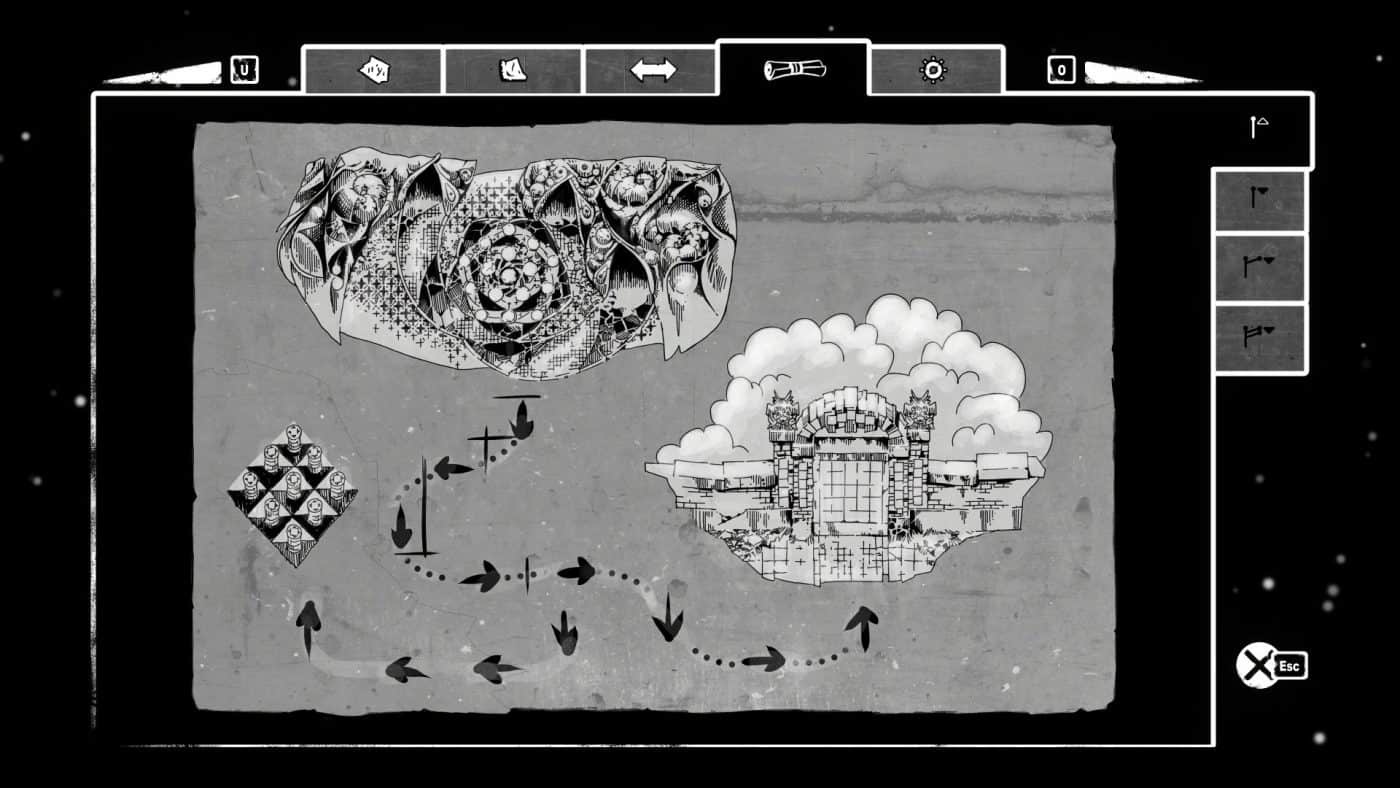
Everything you collect in corners or hidden – sometimes secret – spots consists of crumpled notes that, once you open them, yield maps, story fragments, and puzzle clues, without ever affecting the game’s core path. This aspect intrigued me from the start, and precisely because I imposed a temporary limit on myself, I didn’t manage to complete every collectible.
What I gathered in this second phase – 54% in my case – still suffices to grasp the narrative device that drives the story: a civilization that once practiced an ancient rite to embody the power of eight primordial creatures fell in the clash with the largest and most powerful among them. You, the last of your kind, repeat that rite alone, one form at a time, until you discover what shattered the world and what you can still inherit from it.
Some panels reveal clues about this lost civilization’s cosmogonic myth – material I tried to analyze without letting it pull me in beyond what this review needs.

The Ancient Lost Civilization
The carved panels you uncover while exploring assemble, piece by piece, a small illustrated treatise: a wheel of eight primordial creatures arranged in a circle, each one a source of a different power, or else more narrative and didactic scenes where we see the same civilization in two sizes, one small and one large, the latter disguised as a fish, a bird of prey, a crustacean – in the act of temporarily embodying each of those forms to draw strength from it. A transformation rite, celebrated with objects that bear the same symbols as the abilities you use in-game.
One of the eight forms, however, seems to carry a different register from the other seven. It’s the largest, the oldest, the one the panels first show in full action and then asleep amid the rubble – and the leap between the two images suggests that something, at that point in the myth, broke forever. The codex doesn’t explain it openly. It lets you glimpse it, one fragment at a time, with that same narrative reticence that defines the whole game.
One visual detail finally ties myth and title together in a single gesture: a tree, in one of the panels, has branches knotted into a tight spiral – the same shape as the ritual dagger that recurs throughout the game’s most intimate scenes. Helix, you might think, isn’t just the name chosen for the adventure. It’s woven into this world’s very botany, as if the vanished civilization’s entire cosmogony revolved around the idea of a circle closing on itself – something that carries the promise of a return.


The Double
Readers of our demo preview will remember the open questions about the doppelganger accompanying the protagonist from the very first steps: an enemy? A reflection? An ally? Helix guards that question for the entire adventure.
The path toward that answer crosses some of the most intense moments in the whole experience. An enormous, scaled creature emerges to fill the screen entirely, and the ensuing battle carries a different specific weight than any encounter you’ve faced up to that point – less a level-design obstacle, more a trial the game chose to reserve for a precise moment in its internal architecture. A curved dagger recurs throughout this phase, always isolated, framed by a glow that treats it as an icon in its own right, an object the game chooses to show with the same care reserved for a symbol. Shortly after comes a moment of absolute stillness: an altar, a circle of candles, a contemplation that carries the same emotional intensity as the battle just fought.
The direct confrontation with the double closes this sequence: the two silhouettes, the light one and the dark one, touch and shatter together, in an explosion of shards reminiscent of a breaking mirror. This shatters the separation between the protagonist and his double, who has guided you to this point, opening paths and showing you how to use your abilities.


The Gameplay: Five Abilities and Their Combinatorics
The five basic abilities are Block, Drone, Hook, Cage, and Hourglass, and each one, on its own, solves elementary problems: Block creates a solid platform or a weight on a mechanism, Drone reaches otherwise unreachable spots, Hook grabs surfaces at a distance, Cage traps or moves environmental elements, Hourglass alters the time flow of an object or sequence. The demo had already shown three of these five, and the full game doesn’t change the underlying logic: each ability keeps doing exactly what it promises, without surprises in its isolated function.


The real body of the gameplay comes from the combinatorics. The five abilities first combine in pairs – twenty-five possible combinations – and each pair produces a behavior that isn’t simply the sum of the two individual functions: Hook combined with Block, for example, doesn’t just grab something, it drags the block itself along the trajectory, opening solutions neither ability would reach alone. Helix builds every room around this logic, and after the first few hours, the feeling becomes that of handling a small mechanical alphabet that the game keeps conjugating in different ways without ever repeating itself identically.
The base game closes once you complete every two-ability combination. From there the second half opens, the one with three-ability combinations happening simultaneously, noticeably harder to manage. Here the game stops being accessible and becomes a real challenge, aimed at players who have already internalized the whole system and want to see it pushed to its limit.


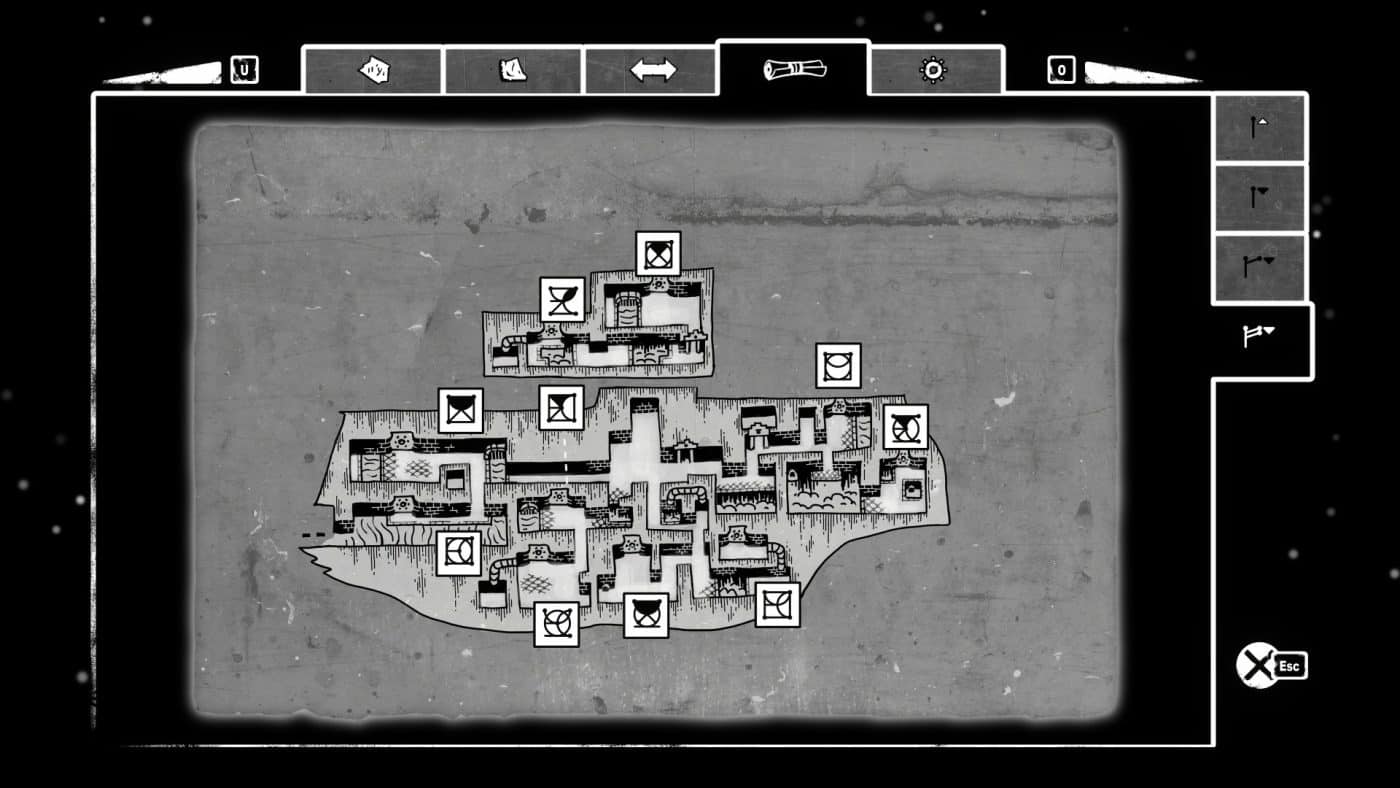
A world built on this many combinations could easily disorient players, and Helix guards against that with one of the clearest map systems I’ve seen in a recent puzzle-adventure. Every area has its own consultable map, dotted with icons that correspond to the symbols of the combinations each door or blocked passage requires: a visual checklist of what still awaits unlocking and with which pair (or triplet) of abilities. Checking the map before heading into an area, spotting which symbols are still missing, and returning with the right combination once you’ve learned it becomes a small ritual of progression, and it’s one of the elements that makes completionism – even the three-ability kind, the most punishing – sustainable without relying on an outside guide.
There’s also an element the game introduces without announcing it with any fanfare, and that’s precisely why it’s worth flagging: some passages open through arcade cabinets containing small 1980s-style platform minigames that wink directly at Donkey Kong. For the duration of those minutes, Helix literally sheds its own visual identity – the hand-drawn comic art, the halftone textures, the rarefied black and white – and becomes an arcade screen, with its own blocky graphics and self-contained arcade aesthetic.
Finally, there’s a code-entry system I encountered several times without ever fully grasping its function – I suspect it ties into unlocking the final door or one of its variants, but I don’t yet have the hours needed, at the time of writing, to confirm that with certainty. I flag it here mostly as a reminder of how much Helix still leaves to discover, even for someone like me who has already invested a good seventeen hours in its world.


The Circle Closes
In the demo article I wrote that every element of Helix – the visual design, the music, the gameplay, the narrative silence – spoke the same language, and that thirty minutes sufficed to grasp it. Seventeen hours later, that language hasn’t wavered once. Helix: Descent N Ascent is one of those rare cases where the initial promise not only holds but deepens as the game progresses: the ability combinatorics keeps producing new solutions well past the point where, in other puzzle-adventures, the formula starts repeating; the black-and-white art achieves an expressive and legible visual impact at once; Jim Guthrie’s music accompanies every area with the same power to create a suspended territory already evident in the demo, without ever slipping into monotony.

The base game closes with full satisfaction, and anyone who stops there takes home a complete experience, with a narrative arc that – however much it relies almost entirely on imagery – still reaches its own conclusion. One point deserves clarifying: keeping the narrative secondary to the gameplay doesn’t equate to a lacking narrative. Players who dedicate themselves to fully collecting the fragments scattered across the world – the codex panels, the hidden notes – find, once the adventure ends, additional narrative material that closes some of the threads left open along the way, delivered with the same visual care reserved for every other moment in the game. Helix’s narrative device, however minimal in form, proves thorough in substance, and it serves exactly the purpose the game wants it to.

Completing the three-ability combinations mechanically follows a different logic: it remains a challenge for its own sake, the most demanding the title offers, designed for players who want to see the combo system pushed all the way rather than for those seeking further narrative answers. The two paths – narrative collection and mechanical mastery – don’t overlap but complement each other: the first rewards the explorer’s curiosity, the second rewards the puzzle-solver’s patience.
Helix: Descent N Ascent is a quiet adventure, built with a visual care rare in the indie landscape, and it remains one of the most accomplished experiences released this year – proof that a small studio, with a clear idea and the discipline to see it through, can still surprise more than productions ten times its size.

Thanks to Badass Mongoose for providing a Steam code for this review
 8.5/10