
The Sinking City 2 proves that a sequel does not need to go bigger to go deeper, trading the scale of its predecessor for a more focused and compelling descent into horror.

Returning to The Sinking City means stepping back into a world that never quite fulfilled its potential. Frogwares’ original was an ambitious attempt to bring Lovecraftian horror and detective fiction together, built around the intriguing idea that uncovering a mystery could be every bit as unsettling as confronting whatever lay behind it. Yet the game often struggled to turn that ambition into a consistently cohesive experience. Its open world could feel too expansive for the systems supporting it, its investigative mechanics did not always live up to the strength of the premise, and beneath it all was the sense that something far more compelling was buried within its foundations.
The Sinking City 2 approaches that legacy with a very different mindset. Rather than simply expanding upon the original, Frogwares has taken a step back and reconsidered what the series actually needs. What was worth preserving? What needed to change? And what was better left behind? Those questions underpin much of the sequel’s design, and the answers become apparent in almost every aspect of the experience. The most significant change is also the most obvious.
Frogwares has moved away from the original’s sprawling open-world structure in favour of a more focused open-map approach, allowing the studio to build spaces that are more carefully authored and purposeful. Investigation remains central, but it no longer has to carry the weight of an entire open world. Combat has been given a far greater role, while exploration now revolves around environments in which level design and storytelling are much more closely intertwined.
It is a change that reflects a far clearer understanding of what The Sinking City 2 is trying to achieve. This is no longer a detective game with survival-horror mechanics woven into its formula; it is a survival-horror experience in which investigation remains fundamental to how we understand and navigate the world. The two sides no longer feel like competing identities.
Instead, they complement one another, with investigation feeding directly into exploration and discovery while the horror gives those moments a much greater sense of consequence.
That evolution is striking given the circumstances surrounding the game’s development. Frogwares has had to navigate one of the most difficult periods in its history, with the ongoing consequences of war and the mobilisation of members of its development team inevitably affecting the studio’s resources and working conditions. Bringing a project of this scale to completion under such circumstances would have been demanding enough. Reworking the foundations of an established series at the same time makes the studio’s approach all the more remarkable.
Perhaps that is why The Sinking City 2 feels less concerned with becoming bigger than its predecessor than with becoming more focused and more confident in what it wants to be.
You can see that philosophy throughout the game. The sense of sprawl that defined much of the original has given way to greater concentration; breadth has been traded for density; and investigation has been integrated into a structure that embraces the language of modern survival horror much more openly. The influence of recent Resident Evil games is difficult to miss in its resource management, interconnected environments, exploration, and progression, but The Sinking City 2 never loses sight of the element that gives the series its identity. Investigation is not simply a mechanic here. It is the means through which the horror reveals itself.
That is also where Frogwares’ interpretation of Lovecraft feels most effective. The game does not treat cosmic horror as a visual vocabulary of grotesque creatures, forbidden cults, ancient rituals, and unsettling imagery. Those elements are certainly present, but they serve a larger idea: the fear of discovering that reality is far stranger, and far less comprehensible, than we ever imagined.
Knowledge therefore becomes a double-edged weapon. It is what allows us to make sense of the world, but it is also what gradually strips that world of its familiar logic. Every answer risks revealing another mystery. Every discovery can make things less certain rather than more. And the closer the protagonist gets to the truth, the harder it becomes to believe that the truth is something humanity was ever meant to understand.
From the streets of Arkham to the frozen expanses of Antarctica, The Sinking City 2 brings together two sides of Frogwares’ identity: the investigative tradition inherited from the original and a more focused survival-horror framework that now sits firmly at the centre of the experience. It does not attempt to erase the past, nor does it blindly preserve it. It learns from both the strengths and shortcomings of what came before.
And that may ultimately be the sequel’s most important achievement. Frogwares has recognised that preserving the identity of The Sinking City does not mean preserving its original formula. Sometimes, the best way to save what worked is to have the courage to change everything around it.

Quality Over Quantity
The original The Sinking City was built around an ambitious premise: an open-world detective adventure where exploration, investigation, storytelling, and horror could coexist within the same space. On paper, it was a natural fit for Frogwares, a studio with a long-standing affinity for detective fiction and Lovecraftian horror. In practice, however, the sheer scale of its world often exposed the limitations of the experience constructed around it.
The map was expansive, but not always sufficiently dense to justify its size, and the long stretches between meaningful discoveries could make exploration feel aimless rather than rewarding. Repetition occasionally disrupted the rhythm, while the freedom afforded by the open-world structure could come at the expense of tension, pacing, and narrative momentum.
The Sinking City 2 addresses those shortcomings with a decision that initially sounds almost counterintuitive: make the world smaller, and make every part of it matter more.

Frogwares has moved away from the sprawling open-world structure of its predecessor in favour of a more controlled open-map design. The change is more substantial than the terminology might suggest. This is still an experience that encourages us to stray from the critical path, investigate optional locations, pursue side activities, and uncover fragments of the story that might otherwise remain hidden. What has changed is the relationship between freedom and space. Rather than dispersing points of interest across a vast landscape, the sequel concentrates them within environments that are more deliberately constructed and considerably richer in purpose.
That shift gives Frogwares something the original could not always maintain: far greater control over the player’s attention. Individual locations are built around a tighter relationship between exploration, investigation, environmental storytelling, combat, and progression. There is less empty territory separating one significant moment from the next, but more importantly, the spaces themselves now feel like active parts of the experience rather than containers for it.
The improvement is especially evident in the pacing. In the original, travelling from one objective to another could feel like moving through the connective tissue between the moments that actually mattered. Here, those gaps have been substantially reduced. The journey between discoveries is shorter, but the discoveries themselves carry considerably more weight. An optional room, a hidden route, an environmental detail, or an apparently insignificant detour can feel like a piece of a larger whole rather than little more than a reward for wandering off the beaten path.
Exploration takes on a more meaningful role. It is no longer simply a way of demonstrating the size of the world Frogwares has created. It is part of how the world tells its story and sustains its atmosphere. Environments establish context, conceal clues, reinforce the sense of unease, and occasionally provide the resources needed to survive what lies ahead. Freedom is still important, but it now exists in service of the experience rather than as an end in itself.
This is the clearest indication that Frogwares has learned from the ambitions of the first game without allowing them to dictate the sequel’s design. The Sinking City 2 is not trying to surpass its predecessor by giving players more ground to cover. Instead, it embraces a more fundamental question: what value does a larger world have if there is not enough within it to justify the journey?
The answer is apparent in the sequel’s environments. By eliminating much of the dead space, Frogwares has been able to devote greater attention to what remains: the layout of each area, its atmosphere, secrets, and narrative purpose. The result is a world that feels more compact without ever feeling diminished. There is a stronger rhythm to moving through it, and a clearer connection between where we are, what we are doing, and what the game wants us to notice.
That focus is especially important for a series leaning further into survival horror. Horror thrives on anticipation and the careful control of what the player knows, suspects, and does not yet understand. A sprawling world can work against those qualities when too much time is spent simply moving between points of interest. The Sinking City 2 understands that tension is not a product of distance, but of how effectively an environment controls the player’s experience within it.
What might initially look like a reduction in ambition therefore becomes one of the sequel’s most intelligent design choices. Frogwares has traded scale for substance, breadth for density, and open-world sprawl for deliberate design. The world may no longer be as vast, but it is far more effective at making each location, detour, and discovery feel purposeful.
And that restraint proves to be anything but a limitation. It gives The Sinking City 2 the space to become the game its predecessor was always reaching towards: more focused, more cohesive, and far more confident in how it wants its horror to be experienced.

Not Every Shot Is Worth Taking
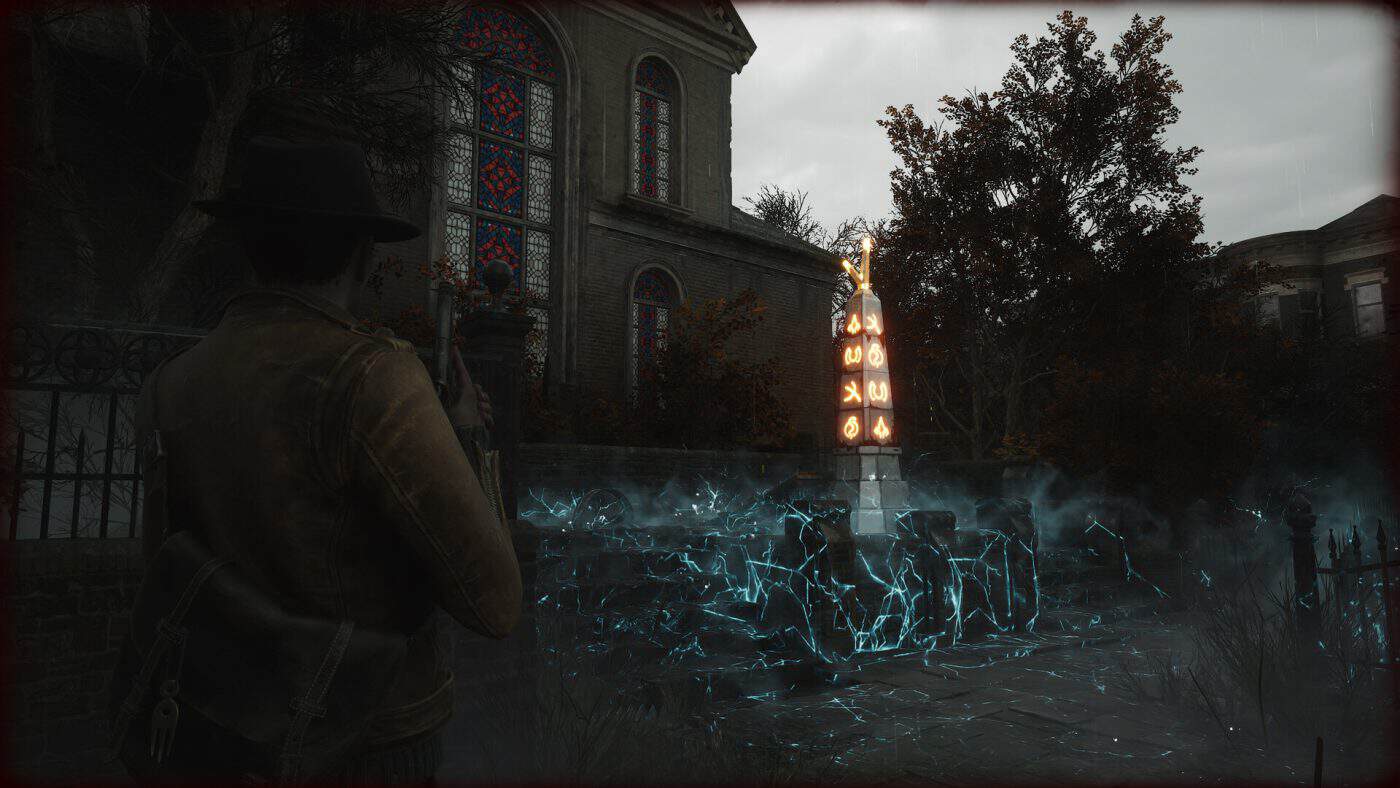
The shift in The Sinking City 2‘s design becomes apparent almost immediately, and nowhere more clearly than in combat. Encounters now occupy a far more significant place in the experience, reflecting a much clearer understanding of what combat should contribute to a horror game built around survival. Frogwares understands that a fight should not simply interrupt exploration; it should make exploration feel more dangerous. Every encounter has the potential to disrupt our plans, drain valuable resources, and force us to reassess the situation around us.
Combat is therefore no longer just something that happens between investigative sequences. It has become part of the tension that holds the entire experience together.
The arsenal remains relatively conventional. The pistol, shotgun, and Thompson make up the core of the weapon selection, with each firearm possessing its own handling and proving better suited to certain situations than others. There is little here that feels revolutionary, and the game never tries to turn its gunplay into an elaborate showcase of mechanical depth.
Instead, its strength lies in how clearly each weapon communicates impact. Shots feel appropriately forceful, enemies react convincingly to incoming fire, and the feedback is immediate enough to make the outcome of each attack easy to read.
That responsiveness becomes considerably more important when ammunition is limited. In a game where resources need to be managed carefully, the relationship between weapon, target, and impact cannot be left ambiguous. The Sinking City 2 generally gets this right. We can tell when a shot has connected, when an enemy has been staggered, and when sustained fire is actually beginning to turn an encounter in our favour. The result is a gunplay loop that feels dependable even when the underlying mechanics remain relatively straightforward.
The system becomes more interesting when weak points enter the equation. Enemies are not simply health bars waiting to be emptied; certain parts of their bodies can be identified and targeted with greater precision, allowing well-placed shots to inflict substantially more damage and, in some cases, bring an encounter to an end far more quickly.
It is a modest mechanic, but one that changes the way we approach a fight. When several creatures are closing in, simply emptying a magazine into the nearest target is rarely the most sensible option, particularly when ammunition cannot be taken for granted. Instead, we are encouraged to read the enemy, judge the distance, identify its vulnerabilities, and decide where our next shot will have the greatest effect. Accuracy matters more than sheer aggression, and even relatively straightforward encounters can consequently demand a degree of attention and judgement.
The restraint of the system is also part of its appeal. The Sinking City 2 does not attempt to turn combat into a sprawling collection of mechanics, nor does it need an elaborate progression system to make each encounter meaningful. Its individual systems are modest, but they reinforce one another. Weak points naturally tie into ammunition management: the more accurately we shoot, the fewer rounds we spend, and the better equipped we remain for whatever comes next.
That connection gives combat a purpose beyond simply putting enemies in our way. Ammunition becomes a resource to protect, precision becomes a form of survival, and every encounter carries a cost. Missing a shot means more than losing a bullet; it can mean entering the next confrontation with one fewer option available. Likewise, an engagement handled poorly can leave us depleted long after the immediate threat has disappeared.
This is ultimately where Frogwares finds the right balance. The Sinking City 2‘s combat is not complex enough to redefine the genre, but it is not trying to. What matters is that it now understands exactly what role combat needs to play within the broader experience. Frogwares has given encounters greater weight without allowing them to overwhelm the investigation and exploration that remain central to the series. The guns are there not to make us feel powerful, but to make every decision about when, where, and how we fight carry a little more weight.
And that distinction matters. The tension does not come from having enough firepower to kill everything in our path. It comes from knowing that we may not have enough to do so carelessly.

No Room for Error
If regular encounters establish the strengths of The Sinking City 2’s combat, its boss fights are where the system is put under genuine scrutiny. These encounters demand a level of composure that ordinary enemies rarely require. Patterns need to be learned, attack windows carefully read, distances constantly reassessed, and every opening weighed against the risk of overcommitting.
The result is a noticeable shift in rhythm: aggression alone is rarely enough, and surviving often comes down to understanding the fight before attempting to overcome it.
That becomes particularly evident at higher difficulty levels, where Frogwares avoids the most obvious ways of making a game harder. Enemies do not simply become bloated damage sponges, nor does every encounter devolve into a test of how much punishment we can absorb. Instead, the challenge comes from demanding a more complete understanding of enemy behaviour and a greater willingness to adapt. Choosing when to attack, when to create distance, which weapon to rely on, and where to place a shot becomes increasingly important, especially when exploiting a vulnerability can dramatically shorten an encounter and preserve resources for what lies ahead.
It is in these encounters that The Sinking City 2 most clearly embraces the logic of modern survival horror. The threat posed by a boss is not measured solely by its damage output or health pool, but by the pressure it places on the resources we have accumulated up to that point.
Every mistake has the potential to linger long after the fight is over. Wasted ammunition, a missed opportunity, or a poorly judged attack can leave us entering the next section with fewer options and considerably less room for error. The strongest encounters understand this balance, creating genuine pressure without ever wresting control from the player.
There is nothing particularly revolutionary about the underlying mechanics, and Frogwares never pretends otherwise. Aiming, resource management, enemy patterns, and vulnerable points are all familiar elements of the genre. What matters is how effectively they are brought together.
The system works because each mechanic reinforces the others, giving combat consequences beyond the immediate encounter. The result is a deliberately accessible combat model that nevertheless acquires considerably more weight when the stakes are raised.
That is ultimately what makes the better boss fights work. They do not represent a dramatic reinvention of The Sinking City 2’s combat; they represent its clearest expression. They turn everything the game has taught us about precision, restraint, resource management, and enemy behaviour into a test of judgement. And when those elements come together, the tension feels earned rather than manufactured, exactly where a survival-horror boss fight should be.

A World Worth Exploring
If combat is the most immediately noticeable change in The Sinking City 2, exploration is arguably the more important one. Frogwares’ decision to move away from the sprawling open world of its predecessor and embrace a more contained open-map structure changes the way the game is paced and the way its environments are meant to be experienced. The difference is not simply measured in square miles. It is felt in how much attention each space demands from us.
The original game often struggled with the gap between the scale of its world and the density of what it offered within it. The Sinking City 2 takes the opposite approach. By narrowing the scope of its environments, Frogwares has created spaces with considerably more room for detail, secrets, optional encounters, resources, and narrative fragments to breathe. Exploration is no longer about covering ground; it is about having a reason to stop and look.
That shift suits the horror framework particularly well. Curiosity has always been one of the genre’s most effective tools, and The Sinking City 2 makes considerably better use of it. A locked door is not merely an obstacle waiting for a key. An abandoned room can contain a document or environmental detail that seems insignificant in isolation, only to acquire greater meaning once viewed alongside everything we have already uncovered. The game understands that the possibility of discovery can be more compelling than the discovery itself. Its environments consequently feel more authored.
Occult libraries, university buildings, ancient temples, and snow-covered landscapes are not simply different backdrops for the same set of objectives; they have distinct identities and rhythms of their own. More importantly, they feel built around a specific atmospheric and narrative purpose. Their layouts, architecture, environmental details, and points of interest work together to suggest a larger story unfolding beyond what we can immediately see. That sense of purpose extends to the way optional content is positioned throughout the world. Rather than filling spaces with distractions simply to reward thoroughness, Frogwares gives us reasons to follow our instincts.
A detour might lead to ammunition, a hidden encounter, a piece of lore, or nothing more tangible than a detail that changes how we interpret what came before. The game does not insist that we explore every corner; it makes us curious about the corners we might otherwise ignore.
This is where the new structure proves particularly effective. The environments are and considerably easier to read, yet they rarely feel stripped down. Secondary routes, locked areas, environmental storytelling, and concealed resources create layers within relatively contained spaces, giving them a sense of depth that no longer depends on physical scale. There is a stronger relationship between where we are, what we find there, and why that discovery matters.
For a game built around both investigation and horror, that is a substantial improvement. Large worlds can create a convincing sense of freedom, but they can also dilute tension when too much time is spent simply travelling between meaningful moments. The Sinking City 2 understands that horror benefits from proximity. When something unsettling can be just around the next corner, exploration itself becomes part of the tension rather than the period between encounters.
That is ultimately what Frogwares gains by scaling back. The world may be smaller, but the act of exploring it has become more deliberate. Every corridor feels like it might lead somewhere, every locked door carries the promise of a future discovery, and every optional path has the potential to reveal something the main route would never show us. The Sinking City 2 does not make exploration compelling by giving us more of it. It makes us care more about where we are.
And for a survival-horror game built on mystery, atmosphere, and the fear of what might be waiting just out of sight, that is a far more valuable achievement than simply having a bigger map.

Making Investigation Matter
Frogwares has also reworked the role of puzzles within its investigations, and the change is almost as significant as the reduction in scale elsewhere. Considering how closely the series has always been associated with detective work, giving puzzles less prominence might seem like an odd decision. Yet it makes sense within the sequel’s broader approach.
The Sinking City 2 is less interested in stopping an investigation so that we can solve a puzzle than in making the investigation itself the act of solving. The familiar foundations remain. We search environments for evidence, examine objects, read documents, and connect seemingly unrelated details through the investigation board, which remains one of the series’ defining mechanics.
It gives us a framework for organising what we have found and reconstructing the logic behind each case, but the process feels considerably less compartmentalised than before.
Rather than functioning as a separate layer of gameplay, deduction is increasingly woven into the rhythm of exploration and discovery. The result is a system that understands an important distinction: a simpler puzzle does not necessarily make for a simpler investigation.
A report tucked away among other documents, an overlooked detail in a room, or an object that appears meaningless can become crucial once it is placed alongside the right pieces of evidence. Information is allowed to accumulate, acquire context, and occasionally challenge assumptions we thought we had already settled. That is where the sequel’s investigative design is at its strongest.
Frogwares does not seem particularly interested in proving how clever its puzzles can be. Instead, it puts greater emphasis on whether we are paying attention to the world and capable of drawing our own conclusions from what we find. The puzzle is no longer something placed in front of us; it is the connection between the clues themselves.
This also makes the process feel more natural. An investigation can unfold through a document discovered in an abandoned room, a detail noticed while exploring, or a piece of evidence that gives new meaning to something encountered several minutes earlier.
The game rarely needs to announce that we have solved something. Often, the satisfaction comes from recognising the connection ourselves, from the moment when a collection of disparate details stops feeling disparate at all. It is a subtle change, but an important one.
The original The Sinking City could occasionally make its investigative mechanics feel like systems we had to work through before the story could continue. The sequel is more confident in allowing deduction to emerge from the experience itself. It trusts the player to observe first and solve second, rather than constantly placing an artificial obstacle between the two.
That philosophy ultimately strengthens one of the series’ most distinctive qualities. The Sinking City 2 does not abandon the detective at its core; it simply understands that being an investigator should involve more than solving increasingly elaborate puzzles. It should mean noticing the detail everyone else missed, questioning the evidence in front of us, and gradually assembling a version of the truth that may be far more disturbing than the one we expected.
The best investigations here are therefore not the ones with the hardest puzzles, but the ones that make us feel as though we uncovered the answer ourselves. And in a game where knowledge is so closely tied to horror, that distinction carries more weight than any traditional brainteaser could.
A Truth Better Left Unknown
It is, however, in the writing that Frogwares shows the greatest sense of purpose. The Sinking City 2 does not treat Lovecraft merely as a visual language of grotesque creatures, forbidden cults, and ancient gods. His influence runs through the structure of the narrative itself, particularly in the way the game treats knowledge as both a means of discovery and a source of dread. The more Calvin learns about the world around him, the less certain that world becomes.
His story begins with a simple, deeply personal objective: finding Faith, his partner, who disappeared after a ritual ended in tragedy. It is an effective starting point precisely because it is so human. Before the story becomes concerned with cosmic forces and incomprehensible entities, Calvin has a reason to keep moving that requires no elaborate mythology to understand.
Frogwares gradually turns that intimate search into something far more unsettling. Following Faith’s disappearance draws Calvin into a much wider conflict involving the Slither, creatures connected to the cosmic forces governing this world, and entities whose existence erodes his understanding of reality. What begins as a search for one missing person becomes an investigation into forces that are considerably older, stranger, and more powerful than anything Calvin could have anticipated.
The narrative is at its best when it allows that mystery to unfold on its own terms. Rather than front-loading the story with explanations, Frogwares builds its lore through fragments: evidence, conversations, documents, environmental details, and revelations whose significance often becomes apparent only much later. The player is given enough information to form theories, but rarely enough to feel completely certain about them.
That distinction is crucial. A new discovery may confirm an assumption we have been building towards, only for the next revelation to undermine it. A seemingly minor detail can acquire an entirely different significance once viewed in the context of everything that follows. The story treats truth as something that has to be reconstructed rather than simply delivered. Understanding is a process, and every new piece of knowledge has the potential to change what came before.
This is also where The Sinking City 2 comes closest to the heart of Lovecraftian horror. The fear is not simply that monsters exist or that humanity is surrounded by forces beyond its comprehension. It comes from the far more unsettling possibility that our understanding of reality was fundamentally incomplete to begin with.
For Calvin, knowledge consequently offers no guarantee of safety. Quite the opposite. The further he progresses, the more the boundaries of what he believed to be possible begin to collapse. Every revelation gives him a clearer picture of the truth while simultaneously making that truth more difficult to accept. What he learns does not necessarily give him control over the situation; it often serves as a reminder of how little control he ever had.
That idea gives the investigation considerably more narrative weight. Finding evidence and connecting clues are not simply steps towards solving a mystery. They are the means through which Calvin is gradually exposed to something he may have been better off never understanding. The investigation itself becomes a descent into the unknown.
And this is perhaps where Frogwares makes its most effective use of the Lovecraftian tradition. The Sinking City 2 is not at its strongest when it simply shows us something grotesque or inexplicable. It is at its strongest when it makes us understand just enough to realise how little we actually know. The horror lies not in discovering that there is something in the darkness, but in discovering what that something means.
By turning knowledge into a source of uncertainty rather than reassurance, Frogwares gives the sequel’s narrative a much stronger thematic foundation. The mystery is not merely something Calvin has to solve. It is something that changes him as he gets closer to the truth, and makes the truth itself increasingly terrifying.


The World Beyond Arkham
The story gradually pushes The Sinking City 2 far beyond the confines of Arkham, taking Calvin through increasingly remote and hostile environments before eventually bringing him to the frozen wilderness of Antarctica. It is an expansion in geography, certainly, but more importantly, it allows Frogwares to broaden the very language of its horror. Arkham remains the emotional and investigative heart of the experience: a dense, deeply human environment of streets, archives, cults, and secrets concealed beneath the familiar rhythms of everyday life.
Its horror is intimate because it exists within a world we can still recognise. A familiar building can conceal something monstrous; an apparently mundane investigation can lead somewhere profoundly unnatural. The city remains dangerous precisely because it still feels inhabited, understood, and human. Antarctica operates on an entirely different register.
Here, there is little left of that familiarity. The vastness of the landscape, the isolation, and the hostility of the environment create a different kind of unease, one rooted not simply in what might be hiding beyond the next ridge, but in the feeling that human beings were never meant to be here in the first place. That makes the connection to At the Mountains of Madness particularly appropriate. Frogwares draws on one of Lovecraft’s most iconic settings not merely as a visual reference, but as an extension of the game’s broader ideas about cosmic horror.
In Antarctica, the environment itself becomes oppressive. The ice, the silence, and the sheer scale of the wilderness diminish the human presence within it, creating a sense of vulnerability that no creature needs to manufacture. The contrast with Arkham is what makes the transition work.
In the city, Calvin can still approach the unknown through familiar means. He can search for evidence, consult records, examine objects, follow leads, and attempt to impose a degree of rationality on events that initially seem inexplicable. Antarctica offers no such reassurance. There is nothing familiar enough to provide a stable frame of reference, and the deeper Calvin ventures into the wilderness, the less convincing those assumptions become.
The result is a meaningful escalation rather than a simple change of scenery. In Arkham, horror can still be contained: behind a door, beneath a floor, within a ritual, or somewhere in the city’s labyrinth of secrets. In Antarctica, that sense of containment begins to disappear. The unknown is no longer confined to a place; it becomes the place itself.
That shift also feeds directly into the game’s central preoccupation with knowledge. Calvin travels further in search of answers, only to find himself increasingly removed from anything that can be explained through familiar human logic. The investigation grows with the journey, but so does the sense that the truth may exist beyond the limits of what he is capable of understanding. The closer he gets to the answers, the smaller humanity begins to feel.
The campaign occasionally steps away from this more traditional investigative rhythm as well, most notably during the mermaid rescue, a sequence that expands the game’s lore while offering another perspective on Calvin’s relationship with the world he is trying to understand. These detours are valuable because they prevent the story from becoming too narrowly focused, allowing more personal episodes to coexist with developments of increasingly cosmic proportions.
Ultimately, the journey from Arkham to Antarctica is one of the clearest examples of how The Sinking City 2 uses setting as more than backdrop. The further Calvin moves from civilisation, the further the game moves from the familiar.
Arkham is a world that can still be searched, investigated, and partially understood. Antarctica is a world that makes those assumptions feel increasingly fragile, and in a story built around the pursuit of forbidden knowledge, that may be the most unsettling destination of all.

No Easy Answers
For most of its runtime, The Sinking City 2 maintains a confident narrative pace, pushing its central mystery forward without losing sight of its broader direction. Not every thread receives the same degree of attention, and some of the ideas surrounding the cosmic forces driving the story could have been explored in greater depth. Even so, the campaign remains cohesive, balancing major revelations with quieter character moments as it gradually broadens the scope of its central conflict.
That sense of narrative control is perhaps most evident in the final act. Frogwares resists the temptation to resolve every mystery or offer a definitive explanation for everything Calvin encounters, instead allowing certain questions to remain deliberately unanswered. It is a particularly fitting choice for a story rooted in cosmic horror, where the unknown is often more powerful than anything that can be fully explained. The moment the incomprehensible is reduced to something that can be neatly defined and understood, much of its menace begins to fade.
The Sinking City 2 is at its most effective when it recognises that distinction. Some truths emerge only in fragments, while others are left deliberately unresolved. More importantly, several of the game’s revelations do not close the questions surrounding them so much as open entirely new ones. The story trusts uncertainty to do some of the work that exposition otherwise would, allowing its mythology to remain elusive rather than reducing it to a collection of neatly defined answers.
That approach gives the conclusion a lingering quality. The final revelations provide enough context to give the journey meaning, but never enough to make the world feel completely decipherable. There is closure to Calvin’s immediate journey without complete closure to the mystery itself, preserving the uncomfortable sense that the forces he has encountered extend far beyond what he has been able to uncover. It is a particularly fitting way to conclude a story so preoccupied with the limits of human understanding. The Sinking City 2 understands that cosmic horror is often at its most effective when it leaves something just beyond reach. The unanswered questions are not a failure to finish the story; they are part of what the story is trying to say.
Frogwares ultimately resists the temptation to turn its mysteries into explanations and its unknowns into certainties. The result is an ending that stays with us precisely because it refuses to settle everything. The story ends, but the mystery does not.
And for The Sinking City 2, that lingering uncertainty proves considerably more unsettling, and considerably more appropriate, than a clean resolution ever could.
Accessibility on Your Terms
On the accessibility front, The Sinking City 2 takes a relatively restrained approach, but the options it provides are practical rather than superficial. Frogwares has focused on areas that can otherwise create unnecessary barriers, particularly for players more interested in its narrative and atmosphere. Investigations can be simplified, while interactive objects can be made easier to identify, reducing the need to painstakingly search each environment for the details required to progress.
The implementation is deliberately unobtrusive. Rather than restructuring the game, these settings allow players to ease some of its more demanding systems without stripping them of their purpose. Simplifying an investigation, for example, reduces the amount of deduction required while preserving its narrative function, while clearer indicators for interactive objects make exploration more approachable without turning every environment into a trail of obvious prompts.
Difficulty offers considerably greater flexibility. The Sinking City 2 allows players to adjust the challenge across a broad range, including an option that makes Calvin completely invulnerable. That setting will naturally hold little appeal for anyone looking for the tension, resource management, and vulnerability that define survival horror, but it serves a clear purpose for those approaching the game primarily as a narrative experience. It allows the story, atmosphere, investigation, and Lovecraftian world to remain the focus without demanding mastery of its combat.
That distinction is important because The Sinking City 2 derives much of its identity from more than its mechanical challenge. Its atmosphere, investigative systems, environments, and storytelling are equally central to what makes the game work, and Frogwares acknowledges that not every player will want to engage with all of those elements at the same level of difficulty.
Accessibility here is therefore less about making the game easier than about removing barriers to the parts of it that matter most to each player. Those seeking the full survival-horror challenge can leave its systems untouched; those more invested in the narrative and world can reduce the mechanical demands without fundamentally compromising either.
It is not an exhaustive suite of accessibility features, but it is a sensible implementation. The Sinking City 2 recognises that its appeal extends beyond the act of surviving its encounters, and gives players enough flexibility to decide where they want the emphasis to lie: on the challenge, the investigation, or simply the atmosphere of Frogwares’ Lovecraftian nightmare.

A Few Technical Rough Edges
The one area where The Sinking City 2 falls short of the confidence displayed elsewhere is technical performance. Frogwares has created a visually impressive game, combining richly detailed environments with a strong command of atmosphere, but the quality of its visual presentation is not always matched by the consistency of its performance. A reasonably powerful PC is therefore required to get the most out of what the game has to offer.
On mid-range hardware, performance is generally acceptable, but frame-rate drops remain a recurring concern, becoming noticeable in more demanding areas and during combat. That is where the issue matters most. The Sinking City 2 places considerable emphasis on timing, precision, and responsiveness, and when performance falters during an encounter, the consequences extend beyond visual smoothness. A sudden dip in frame rate can affect the immediacy of combat, making otherwise deliberate encounters feel less responsive and, at times, less fair.
Shader compilation is another notable weakness. It can introduce lengthy waits and loading interruptions that disrupt the flow of the experience, particularly when transitioning between exploration, investigation, and combat. In a game that relies so heavily on atmosphere and sustained tension, these breaks in momentum can be especially distracting, undermining the sense of continuity Frogwares otherwise works hard to maintain. None of this comes close to undermining The Sinking City 2 as a whole, and its strongest visual moments remain genuinely impressive. Even so, the technical side is noticeably less polished than the rest of the package.
A Sequel That Knows What to Leave Behind
The Sinking City 2 ultimately makes a strong case for an approach that is easy to overlook in an industry increasingly obsessed with scale: sometimes, the best way to move a series forward is to decide what no longer belongs in it. Frogwares could have responded to the original by making its world larger, adding more activities, and doubling down on its open-world ambitions. Instead, it has deliberately narrowed its focus, concentrating its resources on the spaces, systems, and ideas that make the experience more effective.
That decision pays off. The Sinking City 2 is a more focused and confident survival-horror game in which each component has a clearer role to play. Exploration benefits from denser, more deliberate environments; investigation is integrated more naturally into the campaign; and combat, while hardly revolutionary, has enough weight to feel like a genuine pillar of the experience rather than an occasional distraction. Boss encounters provide welcome escalation, while the revised map structure gives Frogwares far greater control over pacing, atmosphere, and the relationship between a location and the story unfolding within it.
Crucially, the sequel never needs to reinvent survival horror to justify its existence. Its strengths come from recognising established ideas, adapting them to the identity of The Sinking City, and making them work together more effectively. It is a quieter form of evolution, but a more convincing one. Rather than pursuing novelty for its own sake, Frogwares has focused on cohesion, on ensuring that the systems surrounding investigation, exploration, combat, and horror are working towards the same goal.
The game is not without its weaknesses. PC optimisation still requires attention, with occasional performance drops capable of affecting the responsiveness of combat, while ammunition management is not always as finely tuned as the rest of the survival-horror formula.
The puzzles are also more accessible than before, but that accessibility sometimes comes at the expense of complexity, leaving some ideas feeling less developed than they might have been. These shortcomings prevent The Sinking City 2 from reaching the highest tier of the genre, but they never obscure the much stronger foundation Frogwares has built around them.
More importantly, the sequel demonstrates that Frogwares now has a far clearer understanding of what The Sinking City should be. It is no longer an investigative adventure attempting to accommodate survival-horror mechanics, nor an open-world game whose scale works against its horror. Investigation and survival horror now exist in a much more productive relationship: the former gives the latter context, while the latter gives every discovery greater weight.
That relationship is ultimately what defines the sequel. Exploration is no longer simply about reaching the next objective, finding another resource, or clearing another encounter. It is about uncovering something you may have been better off never finding.
And that is the feeling The Sinking City 2 leaves behind. Not simply the anticipation of what might be waiting beyond the next door, but the far more unsettling possibility that opening it may reveal something humanity was never meant to understand.
 8/10
8/10