

In short
Fading Echo is an action RPG that finds its strongest footing in exploration, pairing clever level design with inventive environmental puzzles and elemental mechanics that reward curiosity and experimentation. While Emeteria’s debut establishes a distinctive identity and delivers some genuinely satisfying moments, repetitive combat, uneven environmental variety, and an underdeveloped narrative keep the experience from reaching its full potential. A promising adventure whose best ideas shine brightest when the game gives them room to breathe.
An adventure at its most inventive when it lets us explore and experiment, but one that struggles to carry that creativity into its combat and progression.

Some games make an immediate impression. Others take time to reveal their strengths, gradually drawing us into their worlds and systems. And then there are those that stay with us long after we have stopped playing, their ideas lingering in our minds and prompting us to reconsider what we experienced. What sets these games apart is not necessarily a groundbreaking mechanic, a beautifully realised world, or the satisfaction of overcoming a formidable challenge.
Sometimes, it is simply the feeling that there is more to discover: another possibility to consider, another approach to try, or another question waiting to be answered.
This is one of the things I find most compelling about video games. At their best, they turn curiosity into participation, experimentation into discovery, and a passing interest into a genuine investment in the experience. Playing is not merely a matter of following a story or learning how to use the tools at our disposal. It is about testing assumptions, adapting to unfamiliar situations, and discovering possibilities that may not have been immediately apparent. It requires us to give a game the time and attention it needs to reveal what lies beneath the surface.
That process becomes particularly interesting when a game makes a promising first impression without revealing the full extent of its potential. An intriguing mechanic or a distinctive design choice can suggest a wealth of possibilities, but only time can show whether those ideas have the depth and flexibility to sustain an entire adventure. The initial spark is important; what matters more is what follows. That was the question I carried away from my first hands-on experience with Fading Echo, the action RPG developed by Emeteria and published by New Tales.
On 12 July, I put the game aside with a distinctly positive impression, intrigued by what I had seen but aware that some of its most interesting ideas still needed to prove themselves.
The demo offered an encouraging introduction to a project with a clear sense of direction. More than its individual mechanics, what caught my attention was the possibility of a gameplay experience built around experimentation, player agency, and the freedom to approach challenges in different ways. Rather than simply presenting obstacles and prescribing how they should be overcome, Fading Echo appeared willing to let players discover their own solutions.
Its water-manipulation mechanics and elemental interactions were particularly promising in this respect. They suggested a system in which abilities could serve purposes beyond their most immediate applications, encouraging players to understand how different elements worked together and how that knowledge might be used to their advantage. The appeal lay not simply in acquiring new tools, but in discovering what those tools could make possible.

There is an important distinction between a game that gives players a set of abilities and one that encourages them to think creatively about how to use them. In the former, success often depends on recognising the intended solution. In the latter, the process of finding that solution becomes part of the experience itself. The satisfaction comes not only from overcoming a challenge, but from understanding why a particular approach works and discovering that it was yours to find.
This is a quality I value in games that make experimentation an integral part of their design. The most engaging systems strike a careful balance: they provide enough structure to make progress meaningful while leaving sufficient room for players to develop their own strategies. They invite us to participate in the design of our own experience, rather than simply follow a sequence of predetermined steps. Achieving that balance does not require a game to reinvent its genre.
Familiar mechanics can still produce engaging results when they are combined thoughtfully and given room to interact in interesting ways. In Fading Echo, I had glimpsed the possibility of precisely that kind of experience: one that drew on established action RPG conventions while allowing its elemental systems to introduce a more personal approach to problem-solving.
Promising ideas, however, are only the beginning. The real test comes when the excitement of discovery gives way to familiarity and a game’s systems must demonstrate their lasting value. During the opening hours, even relatively simple mechanics can feel compelling because everything is new. As we become more proficient, we begin to recognise patterns and understand the limits of the tools available to us. What initially felt full of possibility must then find new ways to remain engaging. This was where my first encounter with Fading Echo left me with questions.
My impressions were positive, but the demo could only provide a partial picture of the experience Emeteria had set out to create. I wanted to know whether the freedom that had initially caught my attention would continue to shape the adventure, whether the elemental mechanics would develop beyond their introductory applications, and whether the game could build on its strongest ideas without allowing them to become repetitive.
These questions are hardly exclusive to Fading Echo. They are part of what makes a complete playthrough so important to a review. A demo can introduce a game’s central ideas and establish its creative direction, but it cannot always show how those ideas will evolve or how effectively the different systems will work together over time. A mechanic must do more than impress on first use; it must remain relevant. A promise of freedom must translate into meaningful choices. And an intriguing concept must ultimately demonstrate that it can support the wider experience.
The distance between a promising idea and a successful game lies in its execution. What matters is not simply whether an individual mechanic works, but whether it contributes to a cohesive experience that continues to reward the player’s time and attention.
Returning to Fading Echo for this full review gave me the opportunity to examine that distinction properly. Rather than relying on the enthusiasm of my first encounter, I wanted to see how the game’s defining ideas held up over the course of the adventure, how its systems interacted, and whether the potential I had identified in July translated into something more substantial.

For me, reviewing a game means going beyond a description of its mechanics or a straightforward list of strengths and weaknesses. It means examining the relationship between what a game sets out to achieve and what it ultimately delivers, identifying the decisions that define its character and considering how effectively they come together. A review should give readers more than a verdict: it should help them understand the experience behind it.
That also means recognising that no two players approach a game in quite the same way. Some are drawn to the intricacies of combat, others to mechanical experimentation or the freedom to find their own solutions. Some simply want an engaging adventure that makes the hours spent playing worthwhile. A review cannot determine how every reader will respond, nor should it pretend that one person’s experience is universal. What it can do is provide an informed, honest account of what a game offers, where it succeeds, and where it falls short.
For me, that balance between enthusiasm and critical distance is essential. Passion is what makes us curious about new projects and eager to discover what they might achieve, but it should never become a reason to overlook their shortcomings. Equally, critical analysis should not come at the expense of the enjoyment, surprise, and emotional connection that make video games worth discussing in the first place. The most interesting games are not necessarily those that attempt to change everything. Sometimes, they are the ones that take familiar ideas and give them a distinctive identity, finding new ways to engage players through the thoughtful execution of their systems.
When a game suggests that it might achieve something worthwhile, I want to see that possibility through to the end: not because its potential guarantees success, but because only the complete experience can reveal what that potential amounts to. In that sense, returning to Fading Echo carries a particular significance. Its title offers a fitting image for the experience of revisiting a game that has left questions unanswered. An echo is a sound that travels beyond its point of origin and returns, altered by the distance it has crossed. Sometimes it fades into silence; sometimes it persists, drawing our attention back to its source. What remains is not quite the original sound, but a reminder of something that has travelled further than we first imagined.

When I finished the demo, I felt that I had only begun to understand what Fading Echo might become. Its defining ideas were beginning to take shape, and there was enough promise to make me curious about the journey ahead. Yet the questions remained: how far could those ideas go, and would the game retain its identity once the initial excitement had worn off? I did not have the answers then, but I knew the experience deserved a closer look.
Now, having completed the adventure, I can return to those first impressions with a much clearer understanding of what Emeteria has achieved. The possibilities that once existed largely in the realm of expectation can be measured against the finished game; its mechanics can be assessed in the context of the wider experience, and its creative ambitions can be considered alongside the results. That is the perspective I bring to this review.
I want to understand what gives Fading Echo its identity, where its most compelling ideas find their fullest expression, and where the finished experience falls short of its promise. More than anything, I want to determine whether the qualities that first caught my attention have developed into something capable of sustaining the adventure and leaving a lasting impression.
Nearly two months after that first encounter, I am finally ready to pick up where I left off. The initial curiosity has given way to a more informed assessment, and the questions that accompanied my first session can now be answered through the experience as a whole. It is time to discover how far Fading Echo has travelled, and whether its call continues to resonate once the credits roll.
A Heartfelt Story That Needed More Room to Breathe
Regular readers of my reviews will know that I am as interested in the creative process behind a game as I am in the experience it ultimately delivers. Beyond what unfolds on screen, I want to understand the vision that shaped it: the ideas from which it grew, the ambitions that drove its development, and the people whose work brought it to life.
Every game is the product of countless creative decisions, each contributing to the world, characters, and experiences that eventually reach the player. Understanding the thinking behind those choices can offer a richer perspective on the finished work, without diminishing the importance of assessing it on its own merits. With Fading Echo, however, I have chosen to depart from my usual approach and begin with one of the game’s most defining elements: its narrative.
This shift in focus does not mean setting aside the creative vision behind Emeteria’s project. A game’s identity is shaped by more than the story it tells; it also reflects the ambitions, design philosophy and creative decisions that underpin the experience as a whole. I explored these broader aspects in greater depth in our earlier demo preview, which features an interview with Sylvain Sechi, the game’s Creative Director, who shared insights into the project’s origins, the team’s ambitions, and the creative thinking behind its development.
Here, however, my focus shifts to the game itself, beginning with an aspect that may not be its most ambitious, but remains instrumental in defining Fading Echo’s identity.

The narrative left me with decidedly mixed feelings. Its moments of genuine sensitivity, the characters’ irreverent humour, and its portrayal of survival in a world ravaged by catastrophe lend the story a distinctive personality. Yet beneath these strengths lies a sense of untapped potential: several promising ideas are introduced, only to receive less development than they deserve.
The issue is not the story’s relative simplicity, nor does it stem from a lack of personality in Emeteria’s writing. On the contrary, the game establishes a distinctive tone and an appealing balance between melancholy and light-heartedness. My reservations arise from the gap between the possibilities suggested by its premise and what the narrative ultimately delivers.
At times, Fading Echo seems content to follow the most straightforward path, even when its characters and setting suggest that there is more to be said. To understand why, we must first turn to Corel, the world in which the adventure unfolds.
Here, we meet One, a young girl who travels these desolate lands alongside her mother, Rahne, struggling to survive as their surroundings become increasingly inhospitable.
Corel bears the scars of a world in decline. The landscape grows ever more barren, resources are dwindling, and everyday life revolves around securing food and water, finding shelter, and locating somewhere safe to rest. Even a brief respite offers little comfort when there is no guarantee that the next leg of the journey will bring anything better. Initially, neither protagonist has a clear destination or any tangible reason to believe that a brighter future awaits them.
Their immediate concern is simply to carry on: to adapt, endure, and keep moving through a world that seems to have lost its ability to provide even the most basic conditions for a peaceful existence.
It is a familiar starting point for post-apocalyptic fiction, where scarcity and loss define the struggle to rebuild a life after the collapse of everything once taken for granted. Yet Fading Echo avoids reducing Corel to a succession of bleak landscapes and desperate encounters. Instead, Emeteria introduces an unexpected warmth into this unforgiving setting, finding its clearest expression in One’s personality and her relationship with Rahne.


The devastation surrounding the pair remains a constant presence, shaping their circumstances and underscoring how precarious their existence has become. Nevertheless, it never entirely overwhelms the lighter side of the writing. Amid the hardships and uncertainty, spontaneous exchanges and flashes of humour give the characters room to breathe, preserving a sense of humanity that the world around them might otherwise seem determined to extinguish.
This contrast is one of the narrative’s most compelling qualities. Fading Echo understands that a world reduced to ruins need not be stripped of joy, nor must a struggle for survival leave room for nothing else. Affection, humour and everyday gestures of kindness persist, offering moments of respite amid the devastation and reminding us of what makes life worth preserving.
Rather than leaning on unrelenting bleakness to establish its emotional weight, the game finds much of its warmth in the tension between the harsh reality its characters inhabit and their determination to hold on to the ordinary human connections that give their lives meaning.
One is central to that balance. Her humour provide much of the story’s liveliness, lightening the atmosphere without diminishing the seriousness of her predicament. Young and inexperienced, she has not yet fully come to terms with the world around her. Her reactions, decisions, and reliance on her mother convey someone still learning how to navigate circumstances far beyond her control. This sense of youthful spontaneity gives One a distinctive personality, setting her apart from the hardened, often world-weary protagonists so frequently associated with post-apocalyptic fiction.
Rahne, by contrast, has little room for such freedom. Her overriding responsibility is to keep them both alive, a burden that extends well beyond the immediate demands of their journey. She must protect her daughter from the dangers of Corel while preserving whatever chance of a future remains in a world that offers precious few guarantees.
Her determination is quiet but unmistakable. Rahne understands the fragility of their situation, yet cannot afford to surrender to despair. Every decision carries consequences, and every mistake could put them both at risk. Where One can still approach certain situations with a degree of levity, her mother must weigh each choice against the dangers that lie ahead.

It is this difference in perspective that gives their relationship much of its appeal. One and Rahne are not merely two characters pursuing the same goal; they are mother and daughter confronting the same reality from different stages of life. One’s relative light-heartedness is, in part, a consequence of Rahne’s efforts to shield her from the harshest aspects of their circumstances. Rahne, meanwhile, shoulders responsibilities that her daughter is not yet equipped to understand fully.
Their contrasting temperaments establish a straightforward but convincing dynamic, and the writing is at its strongest when it allows that relationship to emerge naturally. A handful of exchanges is often enough to convey One’s liveliness, Rahne’s caution, and the affection underpinning their interactions. Rather than turning every conversation into a solemn reflection on their plight, Fading Echo frequently finds its best moments in everyday dialogue, where humour, instinctive reactions, and understated gestures do more to establish their bond than lengthy exposition ever could.
There is a welcome restraint to these interactions. The game generally trusts its characters to communicate through the way they speak and respond to one another, rather than spelling out the emotional significance of every exchange. When the writing works, the relationship between mother and daughter feels convincing precisely because it is allowed to breathe.
The art direction reinforces this approach. Bright colours, rounded shapes, and stylised character designs distinguish Fading Echo from the more conventionally sombre visual language of post-apocalyptic fiction. Although Corel is a world scarred by catastrophe, it is not portrayed as a place entirely devoid of vitality. The vivid colour palette and expressive character designs create a striking counterpoint to the surrounding desolation, giving the game a visual identity that complements the tone of its writing. That identity carries over into the cutscenes, which draw inspiration from American comic books. Dialogue appears in speech bubbles, while transitions and editing give conversations a rhythm distinct from conventional cinematic presentation.
Rather than relying exclusively on traditional animated sequences, the game builds its scenes around expressive images, dialogue, and carefully paced exchanges.
This is more than a cosmetic flourish. The comic-book aesthetic feels integral to the game’s broader creative identity, reinforcing the expressiveness of its characters and complementing the balance between humour and melancholy that defines the writing. It also gives the narrative a consistent visual language, one that remains recognisable beyond individual scenes.
The use of speech bubbles during exploration, rather than conventional subtitles, extends this approach to the gameplay itself. Conversations become part of the visual presentation instead of feeling like an additional layer superimposed on the action. It is a relatively small decision, but an effective one, helping Fading Echo maintain its stylistic coherence even when the player is exploring the environment rather than watching a dedicated cutscene.
Beneath this visual and tonal consistency, however, lies a narrative whose broader ambitions gradually come into focus. Survival in Corel is not simply a matter of finding supplies and moving between safe havens. It shapes the relationships people maintain, the responsibilities they assume, and their ability to imagine a future beyond the immediate struggle to endure.
One’s spontaneity and Rahne’s determination represent two responses to the same uncertainty, held together by the bond that sustains them both.

The first major turning point arrives at the end of the prologue, when One encounters a mysterious entity that grants her the ability to transform into a sphere of water. The encounter changes the direction of the adventure. What begins as a struggle to secure the necessities of survival gradually gives way to a broader mystery, suggesting that One’s newfound abilities may hold a significance far beyond their immediate practical applications. Her journey turns towards the Bastion’s Source, bringing with it the hope that she might restore at least some of Corel’s lost splendour.
From there, Fading Echo unfolds along a largely linear narrative path, with cutscenes and conversations woven into exploration serving as the primary means of advancing the story. These encounters gradually shed light on Corel, its troubled state and the events that brought the world to the brink of collapse. Rather than branching into an intricate web of subplots or relying on a steady stream of dramatic twists, the narrative maintains a relatively straightforward approach, keeping the focus firmly on One’s journey and the experiences that shape it.
There is a clear advantage to this restraint. By weaving conversations into exploration, Fading Echo develops its characters and fleshes out its world without constantly interrupting the flow of the adventure. Dialogue becomes a natural part of the journey, while cutscenes are reserved for moments that benefit from a more deliberate narrative focus. The result is a story that unfolds at a measured pace, introducing character details as they become relevant rather than overwhelming players with exposition or demanding that they navigate an unnecessarily convoluted plot.
For a game that places such emphasis on atmosphere and the relationship between its protagonists, this accessibility is welcome. The story generally complements the adventure rather than competing with it, allowing players to remain focused on One’s journey without losing sight of the wider context. Yet the qualities that make the narrative accessible also expose its limitations.


As the story progresses, the initial promise of its premise gives way to a growing sense of frustration. Several ideas invite further exploration, but the writing does not always pursue them with the conviction needed to make them truly resonate.
This is not a matter of wanting a more complicated plot for its own sake. A story does not need constant twists, intricate subplots, or elaborate revelations to leave a lasting impression.
What matters is how effectively it develops its central ideas, gives its characters room to evolve, and allows its defining moments to carry emotional weight. In Fading Echo, these elements are not always developed as fully as the opening suggests they might be.
One and Rahne’s relationship is perhaps the clearest example. Their contrasting personalities provide a solid foundation for a more substantial emotional journey, yet the story does not always make the most of the opportunities their dynamic creates. A deeper examination of their differing perspectives, and of how their experiences gradually change the way they understand one another, could have given their relationship greater weight.
Such development would not have required forced confrontations or melodramatic twists. A few carefully developed moments might have been enough to make their shared journey feel more consequential, allowing their experiences to shape the relationship in more tangible ways while preserving the natural warmth that already distinguishes their interactions.
The broader premise offers similar opportunities. The cataclysm that devastated Corel, the consequences it left behind, and the possibility of restoring some of the world’s lost splendour all raise questions that the narrative does not consistently explore in sufficient depth. The setting suggests considerable potential, yet the story tends to remain within relatively familiar boundaries rather than examining the full implications of its ideas or challenging the assumptions that underpin One’s journey.
A bolder approach to these themes, a more searching exploration of the catastrophe’s consequences, or developments capable of meaningfully challenging the player’s expectations could have given the narrative greater depth and a more lasting impact. The issue is not that Fading Echo lacks ideas, but that it does not always follow through on the ones that matter most.


These reservations are all the more noticeable because the foundations are so promising. Emeteria has created a world with a distinctive visual identity, established a compelling contrast between the harshness of Corel and the warmth of its inhabitants, and introduced two protagonists whose interactions bring personality to the adventure. One’s irreverence and Rahne’s determination provide an appealing emotional foundation, while the comic-book-inspired presentation lends the storytelling a recognisable style.
Together, these qualities make Fading Echo’s narrative an enjoyable companion to its adventure. The straightforward structure keeps the story moving, the dialogue brings its characters to life, and the contrast between humour and melancholy prevents the post-apocalyptic setting from becoming one-dimensional. Yet the very effectiveness of these elements makes the missed opportunities difficult to ignore. The game establishes a compelling foundation, but its writing does not always have the ambition to build upon it.
Ultimately, Fading Echo tells a story that is easy to appreciate, even if it proves harder to regard as fully realised. Its warmth, humour, and distinctive visual presentation give it a personality of its own, while its accessible structure keeps the narrative firmly connected to the adventure.
What holds it back is not a shortage of worthwhile ideas, but the feeling that too many remain only partially explored. I came away appreciating the story Emeteria has chosen to tell, while wishing it had ventured further into the possibilities its own characters and world so clearly offer.
The Right Ingredients, Not Always the Right Recipe
When I first played Fading Echo several months ago, I came away with a positive impression but chose to reserve my final judgment until I could experience the adventure in full. My concerns were few, but they centred on an important question: how far could the game’s core mechanics go?
One’s ability to transform and interact with her surroundings offered a promising foundation, suggesting an adventure capable of making both exploration and combat engaging. Whether that potential could be sustained, however, would depend on how effectively the game expanded on its initial ideas, introducing new abilities, broadening One’s combat repertoire, and confronting her with enemies varied enough to demand different tactics as the journey progressed.
The real test, then, was not whether Fading Echo’s mechanics worked, but whether they possessed the depth and versatility to sustain an entire adventure without wearing thin.
The full experience offers a more mixed answer, confirming some of the reservations raised by the demo. Emeteria has built its game around a compelling central concept and a solid mechanical foundation, with level design that, at its best, rewards curiosity and experimentation.
Progress often hinges on paying attention to the environment, recognising how its elements can be manipulated, and working out how to use One’s abilities to overcome the obstacles ahead. When these ideas come together, Fading Echo demonstrates just how much mileage a carefully designed set of mechanics can deliver without constantly introducing new systems.
Exploration is where the game most consistently fulfils its promise. Environmental challenges build thoughtfully on the mechanics established early on, encouraging players to consider their surroundings and experiment with different solutions rather than simply follow a predetermined route. Combat, unfortunately, proves less successful.
While its foundations are sound, the system evolves without the same sense of purpose, and encounters gradually lose their freshness as the adventure unfolds. The limited variety of situations and tactical demands eventually begins to undermine the appeal of an otherwise promising combat system, leaving it as the weakest link in Fading Echo’s gameplay.
The Environment as Puzzle, the Puzzle as Reward
Exploration is where Fading Echo makes its strongest impression. More than any other aspect of the experience, it demonstrates how effectively Emeteria can build on One’s abilities to create challenges that reward curiosity, observation, and experimentation. The journey to the Bastion takes the protagonist through the corrupted lands of Corel, but the appeal of these environments extends beyond their role as stages on the way to a distant destination.
Progress depends on learning to read the world, recognising the possibilities hidden in its physical features, and understanding how to use them to overcome the obstacles ahead. The level design is at its best when it makes this process an essential part of the adventure, allowing players to reach solutions through observation and deduction rather than trial and error alone.
There is, admittedly, room for improvement. Secret areas are less frequent than I would have liked, and the game could do more to reward those willing to stray from the main path and investigate their surroundings. Yet its strongest ideas do not depend on optional detours.
Even when following the intended route, players are frequently encouraged to look beyond the obvious and reconsider the environment in front of them. Reaching a distant platform or activating a mechanism to unlock a passage is only part of the satisfaction; what matters is figuring out how to make it happen. A careful look at the surrounding space, an overlooked interaction, or a connection between seemingly unrelated elements can be enough to reveal the way forward.

It is a design philosophy that gives exploration a welcome sense of purpose. Rather than laying out every step, Fading Echo often leaves enough room for players to reach their own conclusions. The game asks them to engage with its challenges, not simply follow directions.
When faced with an obstacle, you are encouraged to pause, examine the available options, and consider how the mechanics might apply to the situation. Some solutions present themselves immediately; others require a change of approach, a second look at an apparently inconsequential detail, or a willingness to draw on something learned earlier. The best of these moments make progression feel earned. Solving a puzzle is not merely a matter of clearing another hurdle, but of recognising the logic that underpins it and understanding how to put the available tools to use.
That sense of discovery becomes its own reward, reinforcing the player’s growing familiarity with the game’s systems and encouraging a more considered approach to the challenges that follow. It is a relatively understated form of progression, but an effective one: rather than constantly handing players new abilities, Fading Echo finds value in teaching them to make better use of the ones they already possess. This approach finds its clearest expression in One’s ability to transform.
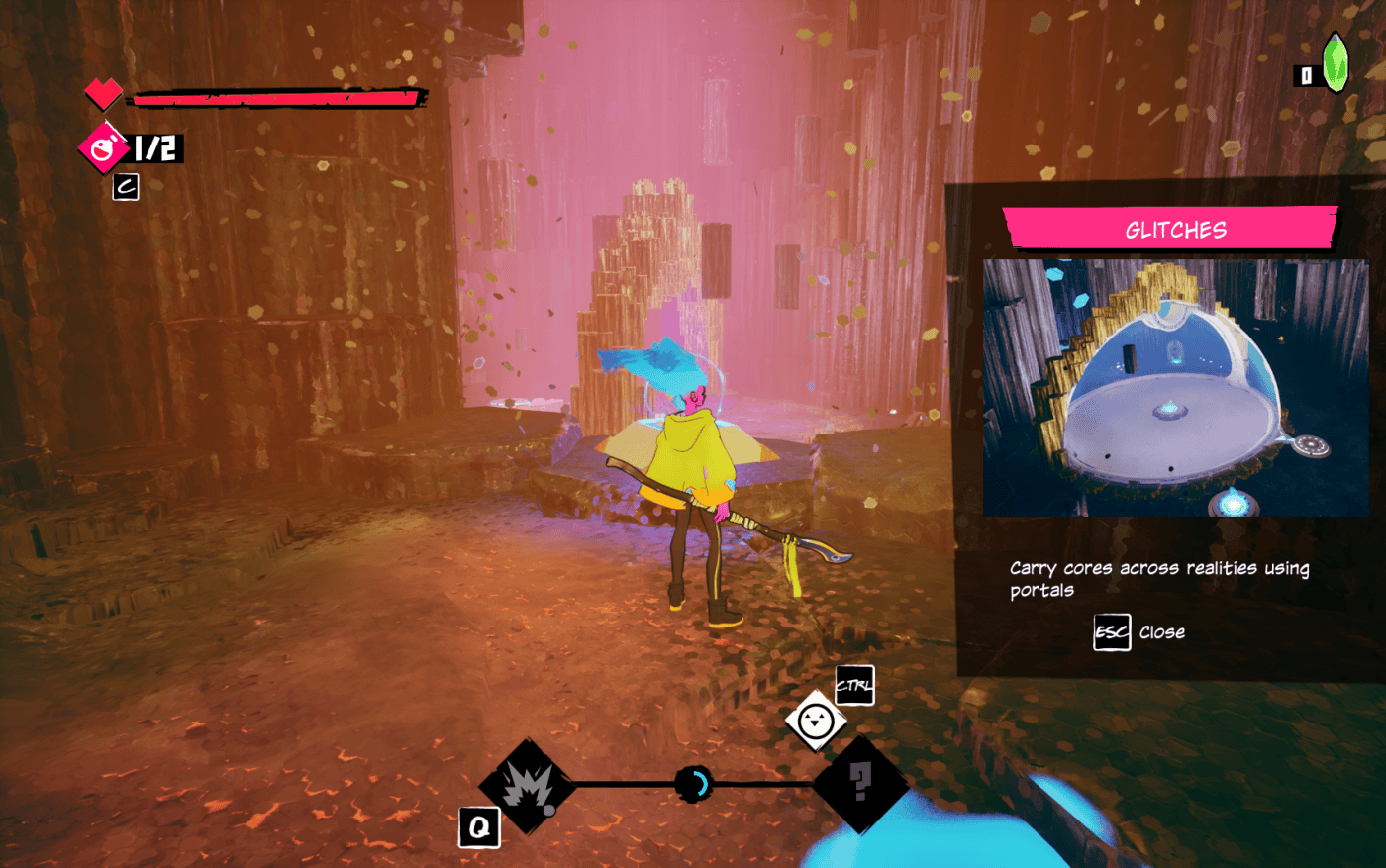
Her water-sphere form is the foundation of Fading Echo’s traversal mechanics, but its role extends well beyond slipping through narrow passages or reaching otherwise inaccessible locations. The properties of the surrounding environment, and the substances One encounters along the way, can alter how she moves and what she is capable of doing. By building on a single, clearly defined mechanic, Emeteria gradually broadens the range of problems players can solve without losing sight of what makes the system distinctive in the first place.
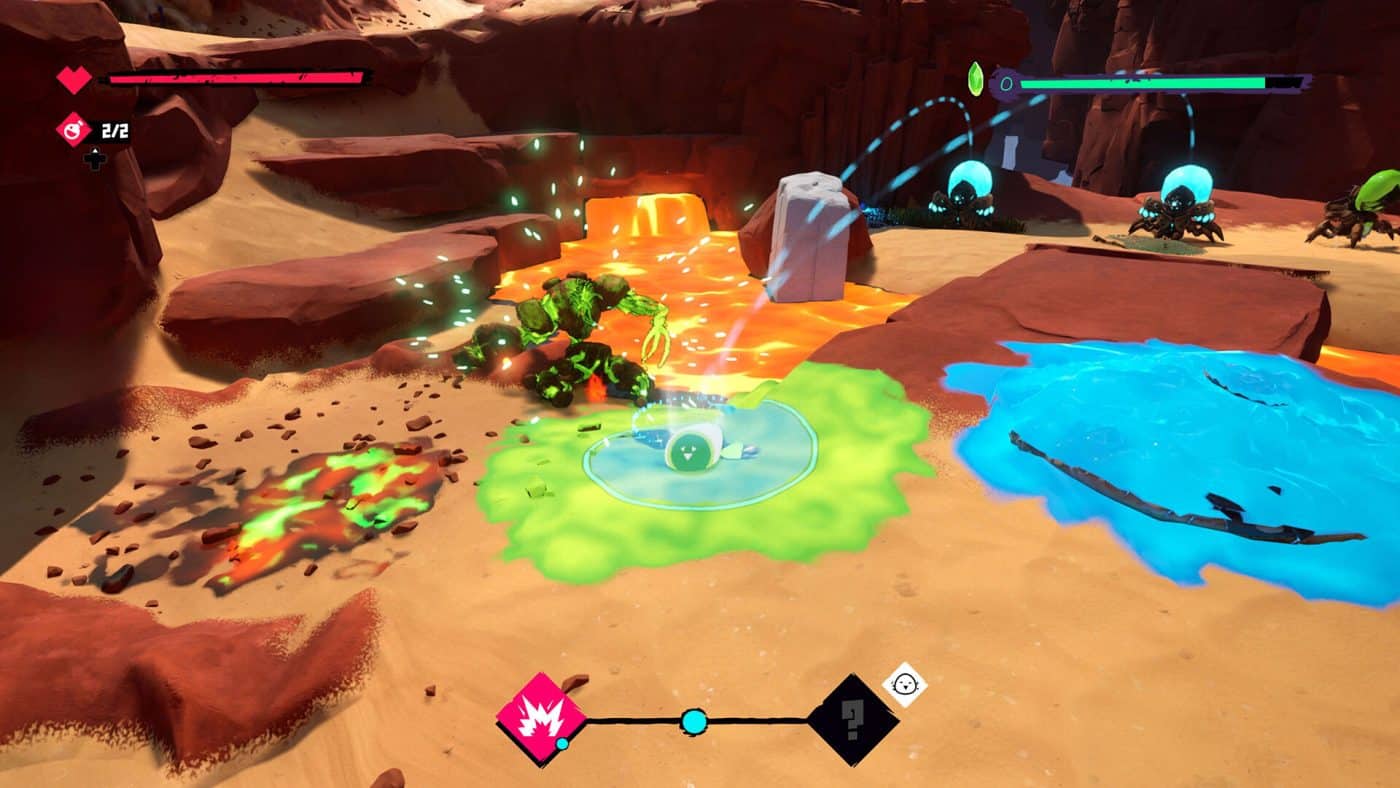
The results are particularly satisfying when environmental hazards become tools for progression. Contact with certain poisonous surfaces, for instance, allows One to perform a powerful single jump, propelling her towards platforms that would otherwise be out of reach. Lava, meanwhile, enables her to assume a steam-like form, allowing her to glide through the air and cover considerable distances. These interactions are central to how the game expects players to approach its environments. A dangerous surface can become an opportunity, a seemingly impassable gap can be crossed by exploiting the right property, and a route that initially appears to lead nowhere can reveal a solution once the player recognises which form to use.

The result is an exploration system in which the environment does more than obstruct the player’s progress: it actively informs how that progress can be made. One’s abilities and the world around her are closely intertwined, and moving forward often means recognising that the answer to a problem is already present in the surrounding space. The challenge lies in identifying the right interaction and understanding when to use it.
The system grows more versatile with the introduction of a seed-like object that One can absorb into her water sphere, allowing her to switch between different elemental properties at the press of a button. This adds another layer to environmental problem-solving. Rather than simply identifying the substance required to overcome an obstacle, players must consider which property best suits the situation and when to switch between them. The emphasis shifts towards choosing the right approach, reading the conditions ahead, and adapting to what the environment demands.
What makes the mechanic work is its accessibility. The underlying rules are straightforward enough to grasp without an extensive learning process, yet their applications become more involved as the game asks players to carry what they have learned into unfamiliar situations. Its depth comes not from an ever-expanding catalogue of transformations, but from the possibilities that emerge when a relatively simple system is applied thoughtfully.
This is where Fading Echo demonstrates the greatest confidence in its design. Its exploration does not need a constant stream of new mechanics to remain engaging; it needs well-constructed challenges that encourage players to reconsider familiar abilities and discover new ways to use them. When the level design and transformation system work in tandem, the game turns environmental problem-solving into something more than a means of progression. It becomes the defining strength of the adventure, and the clearest demonstration of what Emeteria’s central idea can achieve.
One World, Many Ways Forward
The quality of Fading Echo’s exploration ultimately rests on the ingenuity of its level design. One’s abilities would quickly lose their appeal if every obstacle called for the same familiar sequence of actions, reducing progression to little more than repeating solutions the player has already mastered. Emeteria’s approach is more considered: rather than constantly introducing new mechanics, it finds fresh ways to build on those already established, combining them with environmental hazards and interactive elements that encourage players to rethink their approach.
As the adventure progresses, players encounter spring-loaded platforms, mechanisms that alter the surrounding environment, and doors that prevent certain relics from passing through. These are familiar ingredients in a genre built around environmental puzzles, and none is particularly remarkable in isolation. Their effectiveness depends on how they are used together. Fading Echo is at its most engaging when it moves beyond the obvious application of an individual mechanic, asking players to recognise how different systems interact and use that understanding to find a way forward.
Gravity-altering devices, for instance, do more than change the physical conditions within a room. They redefine how players can navigate it, prompting them to reconsider the surrounding space and the routes available to reach their destination. Other obstacles demand a different kind of reasoning. Certain doors, for example, prevent One from passing through while carrying specific relics, forcing players to understand the rules governing her interactions with the objects around her and adapt their approach accordingly. In both cases, the interest lies less in the underlying mechanic than in the problems it creates when combined with other elements. The variety comes from the ways these systems intersect, not simply from the number of tools the game introduces.
This gives the puzzles a sense of progression that goes beyond a straightforward increase in difficulty. Later challenges do not necessarily demand greater precision or faster reactions; instead, they ask players to keep more variables in mind and understand how those variables affect one another. Observation and experimentation remain central, but so does the ability to judge when a familiar solution will suffice and when the situation calls for a different approach.
At its best, Fading Echo makes problem-solving feel genuinely rewarding, with the satisfaction coming from working out the logic of a puzzle rather than simply overcoming another obstacle.
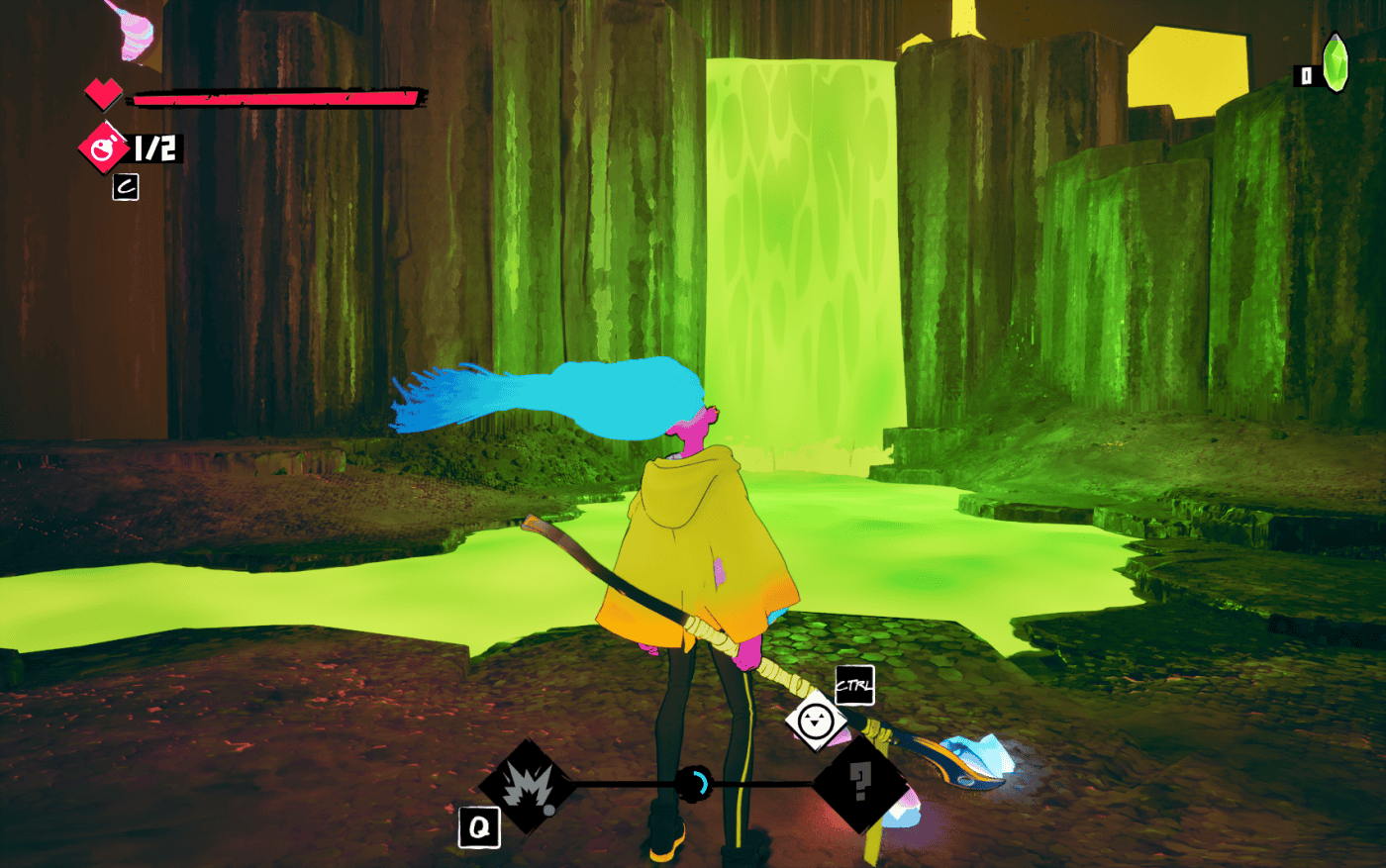
The results are not always equally compelling. Some puzzles leave a stronger impression than others, while certain situations could have made more inventive use of the mechanics at hand. Even so, the overall progression demonstrates a welcome degree of restraint. The game introduces an idea, gives players time to understand its possibilities, and later revisits it in combination with other systems. That gradual layering of mechanics keeps the experience accessible without compromising its depth, allowing newcomers to familiarise themselves with the fundamentals while giving more experienced players increasingly complex problems to work through.
There is also a close connection between this design philosophy and One herself. She has no extensive arsenal or seemingly endless succession of abilities to unlock. Instead, her strength lies in her resourcefulness: the ability to adapt, make use of what she finds, and turn the properties of her surroundings to her advantage. Fading Echo translates that principle into its gameplay, making progression depend as much on the player’s growing understanding as on the protagonist’s abilities. One does not need an ever-expanding set of powers to overcome the world around her; she needs to understand how to use the tools she already has. It is a simple idea, but one that gives the game’s exploration a clear identity and a satisfying sense of coherence.
A Combat System That Never Quite Finds Its Flow
If Fading Echo’s puzzles grow more engaging as familiar mechanics are combined in increasingly inventive ways, its combat struggles to evolve at the same pace. The foundations are promising, particularly in the way One’s abilities can interact with the environment, but the system lacks the variety needed to sustain that initial appeal. As the adventure progresses, encounters become increasingly predictable, exposing one of the more significant weaknesses in Emeteria’s design.
In her human form, One has a fairly limited moveset, built around running, jumping, dodging, and attacking with her staff. Her offensive options consist primarily of a straightforward string of strikes and a powerful kick that knocks enemies backwards. There is nothing inherently wrong with such a stripped-back approach. Combat does not need elaborate combos, demanding parry windows, or layers of complex mechanics to be satisfying; a small set of well-designed actions can go a long way when encounters give players meaningful reasons to use them. The difficulty is that Fading Echo initially struggles to make this limited repertoire feel engaging.
One’s agility gives her considerable freedom to manoeuvre around opponents, while her ability to keep them at a distance makes many encounters feel less threatening than they ought to. This becomes particularly apparent in arenas with cliffs or steep drops, where a well-placed kick can send an enemy over the edge and end the fight with minimal effort. Using the environment to gain the upper hand can be satisfying, especially when players first discover the opportunity. However, when the same tactic proves effective across repeated encounters, ingenuity gives way to routine. What should be one option among several instead becomes an easy answer to too many situations.
The problem is not that the game gives players room to improvise, but that it does not always provide sufficient incentive to explore the alternatives. Mobility and environmental interaction can make combat dynamic only when the encounters are designed to put them to meaningful use.
When a single move can dispatch opponents so reliably, there is little reason to engage with the rest of the system. In its opening hours, Fading Echo does not offer enough variation in enemy behaviour or arena design to offset the limitations of One’s moveset, leaving fights that feel considerably less involving than the exploration surrounding them.

The introduction of One’s water-sphere transformation brings a welcome change of pace. Enemies begin to appear in elemental variants, each with specific vulnerabilities that can be exploited to gain an advantage. Combat now asks for a degree of observation beyond simply tracking an opponent’s movements and landing attacks: players must identify which elements can weaken a particular enemy and determine how the environment can help them exploit that weakness.
Fire-based enemies, for instance, can be weakened by a surge of water or knocked into a pool, while fire can neutralise the poisonous coating that protects other opponents. Creatures composed entirely of liquid, meanwhile, are particularly vulnerable to pollutants. These interactions give combat a more tactical edge, rewarding players who exploit enemy vulnerabilities and turn the environment to their advantage rather than relying on offensive abilities alone.
The elemental system is not especially original, and the relationship between enemy weaknesses and environmental substances is generally intuitive. Its more interesting aspect is how these interactions work within the constraints of One’s abilities. She cannot freely select an element whenever she needs one; she must come into contact with the appropriate substances in the environment to change her properties. This encourages players to move around the arena, assess the available resources, and decide how best to use them against each opponent.
Here, combat and exploration begin to complement one another. The arena becomes more than a space in which to fight, serving instead as an active part of the encounter. A pool of water might provide the means to weaken an enemy, a burning surface might help overcome a particular defence, and a substance that initially appears incidental can become central to the player’s strategy. These moments reveal how naturally One’s transformations could support a combat system built around environmental interaction, carrying the game’s central ideas into a different part of the experience. Fights consequently become a mix of short attack sequences, dodges, kicks, and repositioning, as players look for the most effective way to exploit their surroundings.
Knowing when to close in, when to retreat, and when to use a particular surface can make encounters more engaging, especially when enemy positioning and environmental resources must be considered together. A modest skill tree adds a few more options, allowing players to unlock special abilities that recharge as enemies are defeated. These powers provide some additional flexibility, although they do little to broaden the system in a substantial way.

That is ultimately where Fading Echo falls short. The ideas underpinning its combat are more compelling than the system built around them. One’s basic moveset remains narrow, and the additional abilities do not significantly alter how encounters are approached. Elemental weaknesses introduce useful variations, but rarely force players to rethink their strategy in any meaningful way. Once the rules have been understood, the same solutions tend to work repeatedly, leaving little room for the kind of experimentation that makes the game’s puzzles so rewarding.
The contrast becomes clearer over time. Initially, identifying an elemental weakness or discovering how a particular environmental feature can be used against an opponent offers a genuine sense of satisfaction. These encounters allow players to apply what they have learned through exploration in a new context, turning an understanding of the game’s mechanics into a tangible advantage. Yet the combat system struggles to build on that foundation.
As the adventure unfolds, it introduces too few meaningful variations to keep encounters fresh, and the opportunities to discover new approaches become increasingly scarce.
The result is a combat system that remains functional but never quite fulfils its potential. The connection between One’s transformations, enemy vulnerabilities, and environmental hazards gives Fading Echo a sound foundation, yet these elements are not developed far enough to sustain the same level of engagement as its exploration. Where the puzzles find new ways to use familiar mechanics, combat too often asks players to repeat what they already know.
The Devil Is in the Details
The strengths of Fading Echo extend well beyond its core mechanics. Although its combat never quite lives up to its potential, the same cannot be said of the world Emeteria has built around One’s journey. Corel is a land scarred by destruction, yet one that retains a strong visual identity, thanks to a cohesive art direction, distinctive creature designs, and environmental details that give its ruined landscapes a character of their own.
The environments do more than provide a backdrop for the adventure. Their layouts often suggest possible routes, draw attention to points of interest, and offer clues as to how One’s abilities might help her overcome the obstacles ahead. This is where Fading Echo’s level design proves most effective: in the way it brings the world and its mechanics together.
Rather than serving as little more than the spaces between encounters, the environments actively shape how players approach the challenges before them. The result is an experience in which exploration and problem-solving feel like natural extensions of the world itself.
One also helps give the adventure a more tangible sense of identity. Her design and characterisation fit comfortably within Corel’s visual language, giving players a focal point as they navigate its hostile landscapes. While this does not fundamentally change how the game plays, it lends the journey a greater sense of continuity, helping it feel like more than a succession of puzzles and combat encounters. Yet some of the game’s less polished design decisions stand out precisely because its underlying ideas are so effective. Navigation could be more intuitive, and the game would benefit from a more accessible way to revisit the mechanics introduced along the way.


This becomes particularly important in a puzzle-driven adventure where progression often hinges on understanding how different transformations, substances and environmental properties interact. A mechanic introduced early on may not resurface for several hours, making it surprisingly difficult to recall precisely how it works when it becomes relevant again. When a later puzzle depends on that knowledge, the lack of an accessible reference can shift the challenge away from problem-solving and towards simply remembering information the game has already taught you.
This is a relatively minor omission, but one that could have been addressed without compromising the game’s approach to discovery. A reference guide covering previously acquired abilities and the properties of different substances would make the experience more accessible while leaving the puzzles themselves untouched. Players would still need to study their surroundings, identify connections, and work out the appropriate solution; they would simply have an easier way to recall the knowledge required to do so.
The world’s visual coherence, meanwhile, does not always translate into the same level of variety from one area to the next. Corel has a clear artistic identity, but some environments leave a stronger impression than others, both in their visual presentation and in the challenges they offer.
More pronounced differences in scenery and a broader range of environmental challenges would have given the journey greater variety and momentum. The potential is already there: when the layout of an area is carefully designed around One’s abilities, the environment becomes an active participant in the gameplay. More frequent examples of that interplay would have made the world feel even more rewarding to explore and helped individual locations stand apart.
 7.8/10