A book, an award-winning short film, and a video game to tell the same story: first love according to Ingrid Chabbert and Guridi
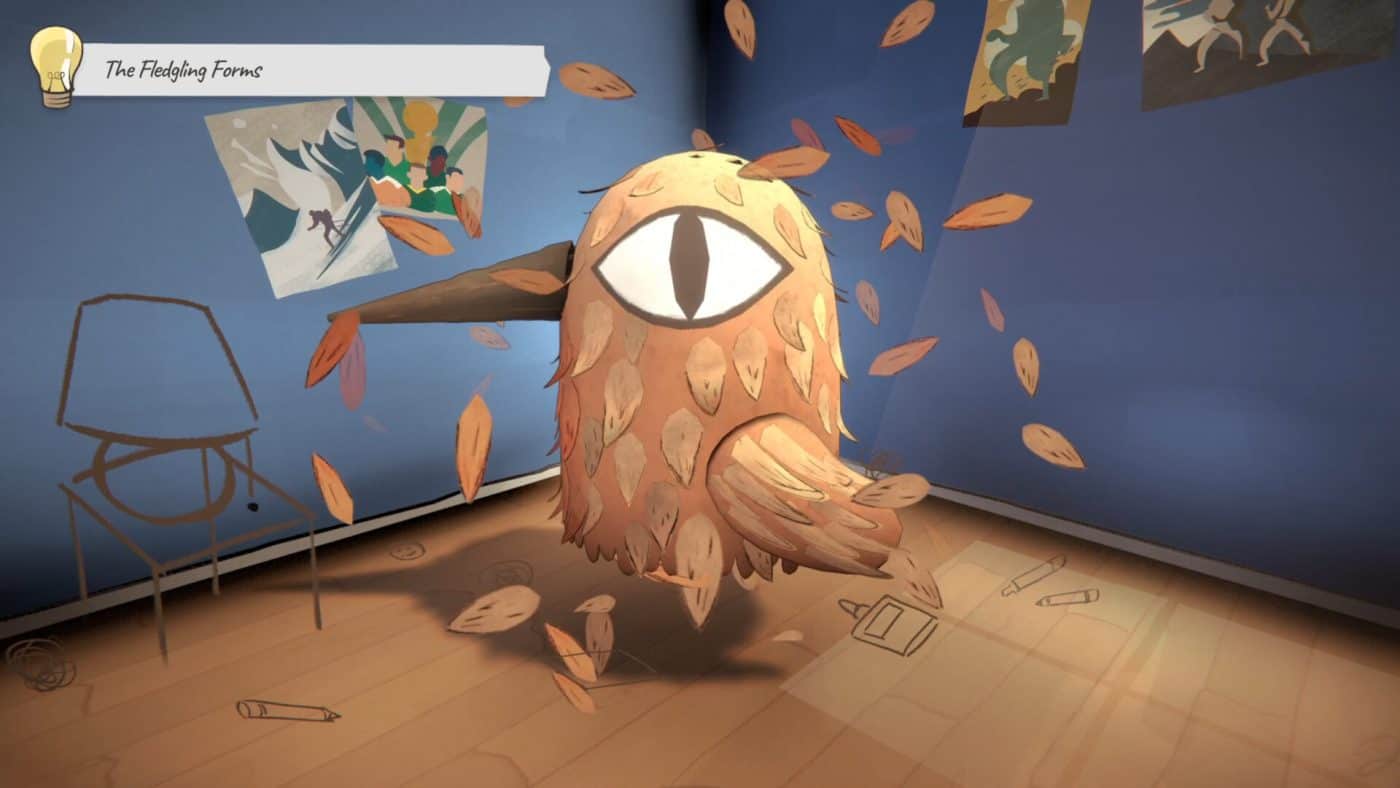
There is a moment, in the park, when Frank stops. His friends are kicking a football around, his bike lies abandoned on the grass, and he collects pieces of the world – feathers, twigs, cardboard – with the silent precision of someone building something important. Not a fortress, not a spaceship: a sparrow costume. Because Sylvia loves birds, and Frank loves Sylvia, and at that age the line between the two is still very thin.
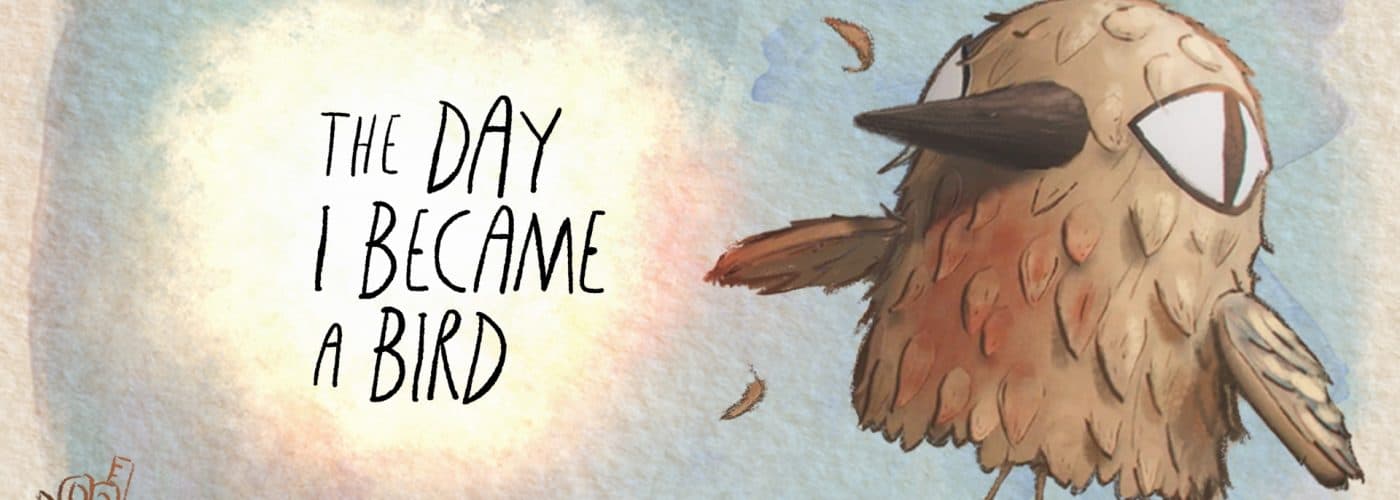
The Day I Became a Bird is a narrative adventure that Hyper Luminal Games developed and Numskull Games brought to market, available from April 15, 2026 on PC (Steam), Nintendo Switch, and PlayStation. It is a game born from a picture book, shaped into an award-winning short film, and finally brought to the screen as an interactive experience. A long and coherent journey, one that deserves attention and a special place in our coverage.

Where It All Begins: The Book
The story originates from a 2016 picture book: French author Ingrid Chabbert wrote it, Spanish artist Guridi (Raúl Nieto Guridi) illustrated it, and Kids Can Press brought it to shelves. The story is as simple as it is striking: on the first day of school, a boy with no name falls in love with Sylvia, the girl sitting in front of him. The problem – or perhaps the wonder – is that Sylvia only has eyes for birds. She draws them in her notebooks, wears them in her hair clips, and when she speaks her voice sounds like birdsong. Faced with this, the boy makes a decision as absurd as it is moving: he goes to school dressed as a bird.

Guridi builds the illustrations with spare, almost tentative pencil strokes, on beige backgrounds that resemble notebook pages. The characters are sketches more than finished drawings – silhouettes that convey emotion through the fewest possible marks. The protagonist does not appear visually in the first spreads: we see only the construction of the costume, and then her. Only then, him. A choice that reflects precisely the point of view of the story: the protagonist does not see himself, he sees only Sylvia. The entire visual grammar of the book – the black and white, the sparseness, the emptiness around the characters – already captures the shyness and obsessive focus of first love better than any caption could.
Among the most memorable pages, a double spread breaks the minimalist register: an explosion of highly detailed ornithological illustrations in a naturalistic style, with the small figure of the boy appearing at their centre. This is Guridi’s way of visualising Sylvia’s world: too vast, too full, for someone who has not yet learned to see it.


The Story Comes to Life: The Passion Pictures Short Film
Before the game, the book took on another form: an animated short film of nearly fifteen minutes, produced by Passion Pictures and directed by Andrew Ruhemann, the studio’s founder and Academy Award winner for Logorama. A credit that speaks for itself in terms of the project’s ambitions.

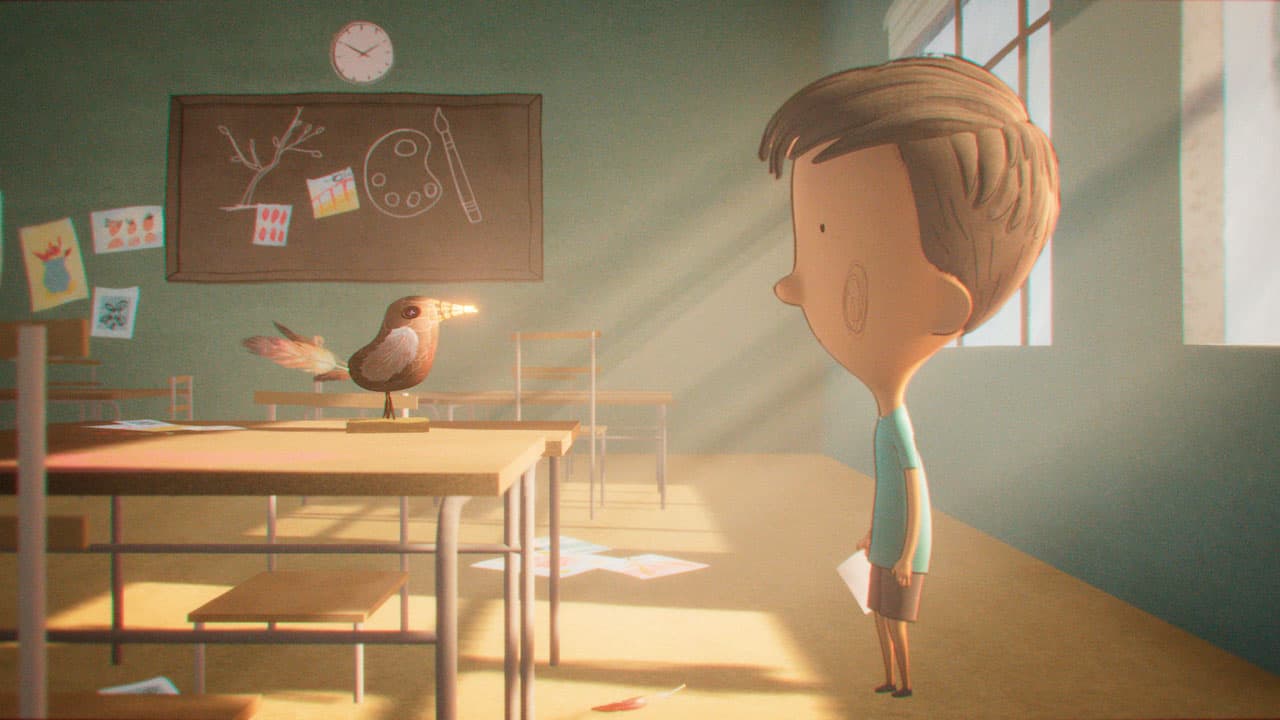
Ruhemann and his team built the short film in Unreal Engine, with a visual approach that blends paper textures, painted light, and three-dimensional animation. The result sits somewhere between an animated book and a film: the characters retain the large round heads from the book, but move through spaces with depth and atmosphere. The art direction comes from Lina Li, who collaborated with Unreal artist Hannah Wahlers to build the visual language and emotional tone of the project.
The style is warm, luminous, often wrapped in golden backlight. The park scenes – Sylvia raising her arms toward the birds in the branches, bathed in an almost sacred light – carry a painterly quality that few animated short films achieve. The secondary characters – the classmates, the cyclists passing by – move through the same world as stylised figures without disturbing its poetry. There is care, too, in the way the short uses silence: some moments carry no dialogue, only music and movement.
It is worth stating clearly: of the three chapters in this project, the short film is the most emotionally complete. The narrative flows without interruption, the music supports every beat with precision, and the ending reaches a genuine sweetness that the interactive format, by its nature, cannot guarantee in the same way. This is not a flaw in the game: it is simply the difference between two languages. The short film comes with the Steam version of the game and a viewing before starting to play is something we strongly recommend – it leaves an emotional imprint that enriches every scene that follows.
One technically relevant note: the short film and the game share the same Unreal Engine foundation, and this was no accident. It is the choice that allowed a deep aesthetic coherence between the two products, carrying not just the visuals but the entire visual language from one format to the other. For those playing the edition that includes the film, the transition between the two experiences feels smooth and almost seamless.
The Game: Spreading Wings, One Puzzle at a Time
The game presents itself as a narrative adventure in isometric perspective that maintains a very precise visual continuity with the short film. The characters carry the same oversized heads, the same proportions of a children’s illustration. The environments – Frank’s bedroom, the bike ride to school, the school courtyard, the park – take shape in three dimensions, but with a treatment of light and texture that constantly recalls paper and hand-drawn work.
One of the most successful visual choices is the coexistence, within the same space, of 3D-rendered objects and pencil drawings overlaid as though sketched in by hand. The tennis racket on the bedroom floor, the toys, the figurines – some are three-dimensional, others are flat sketches, like post-it notes left inside the world. It is a detail that could have felt cluttered and instead works: it tells us we are inside a child’s memory and imagination, not inside a realistic reconstruction.

The gameplay is deliberately accessible. Frank explores environments, collects objects and clues about Sylvia’s interests, solves small puzzles, and completes tasks tied to building the costume. The interface stays clean, with a feather counter that introduces an optional completionist element without ever feeling pressing. The puzzles target a young audience – or adults who want to enjoy the story without obstacles – and rarely present any real challenge. This is a deliberate choice: the challenge is not the point. The atmosphere, the pace, the feeling of being there – that is the point.
On this, some clarity is worth offering: The Day I Became a Bird targets a primarily young audience, and it shows. The mechanics are simple, the runtime is short, and the difficulty curve is nearly flat. An adult looking for ludic depth, gameplay variety, or genuine challenge will find little here. This is not a flaw in the project – it is a precise choice, consistent with the source material and the audience it addresses. Those who approach it with the right expectations, meaning those of an interactive picture book, will find something well-made and sincere. Those expecting a narrative adventure in the fuller sense of the term may come away disappointed.


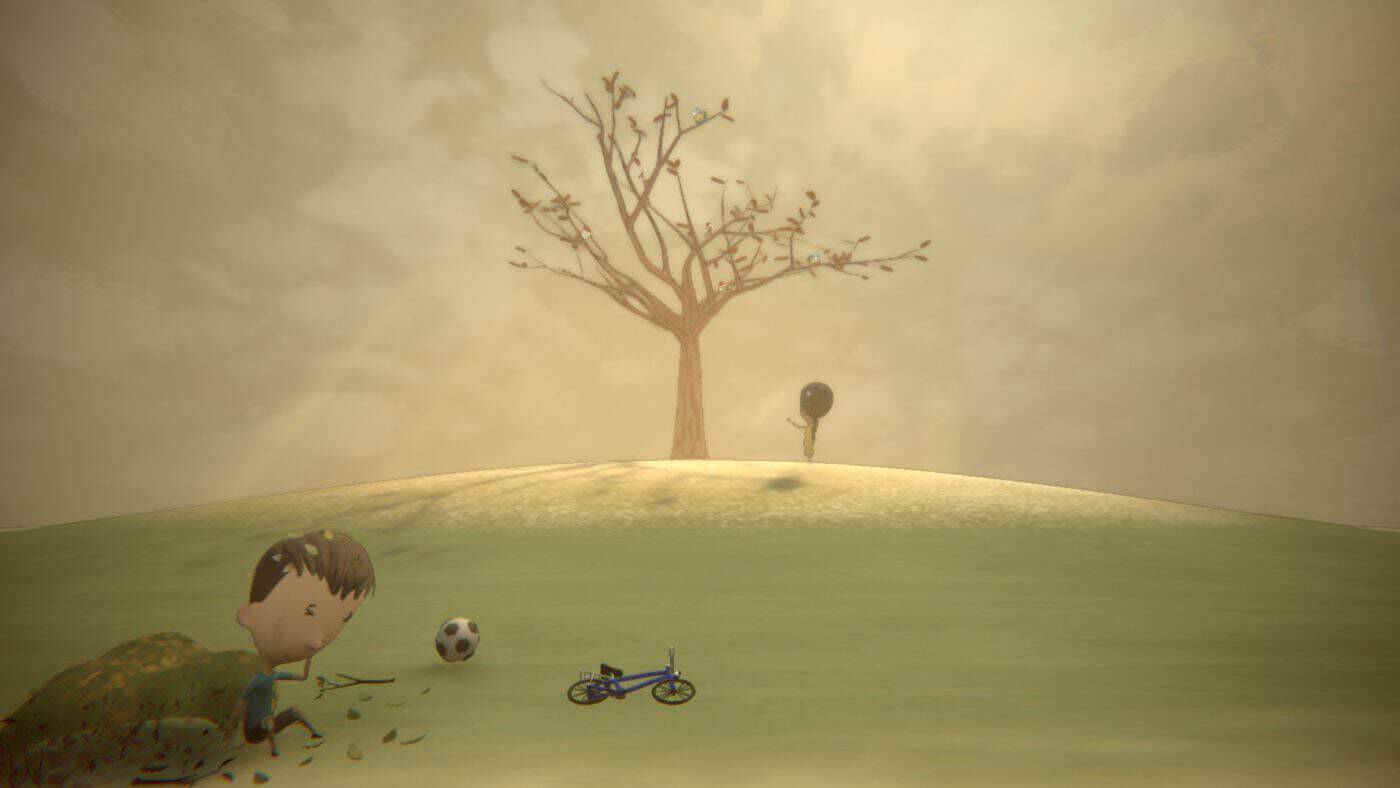
Among the most effective moments is the park sequence: Frank moves through an open, desaturated landscape in ochre and muted green, while in the distance Sylvia’s silhouette stands on a hill. There is quiet melancholy in that spatial distance – she is far away, literally and figuratively – which the game translates into visual terms with great simplicity. No objective marker tells you what to do: just a space to explore, something to find, and that small figure in the background that orients everything.
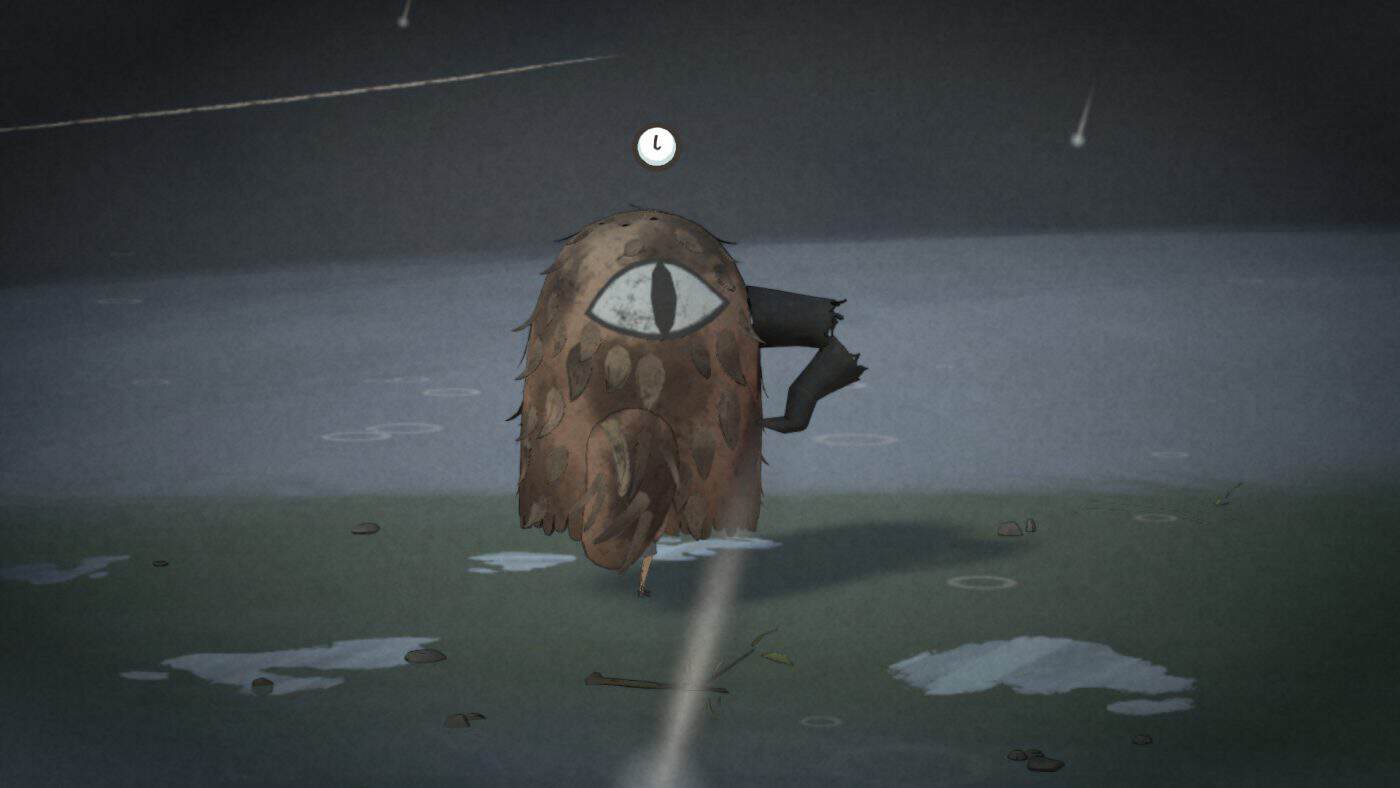
The scenes where Frank in his costume faces the rain, feathers soaking and the costume coming apart, carry a darker tone. Puddles reflect dim light, leaves fall, and the costume – all that work, all that effort – comes undone in the water. This is the emotionally most honest stretch of the experience, where the game pauses being cozy and shows the other side of courage: the vulnerability of someone who has put themselves fully out there and does not yet know how it ends.
The costume-building sequence also deserves a mention: it translates one of the book’s narrative cores into puzzle form. Gathering materials, assembling pieces, watching the costume take shape – it could have been purely mechanical and instead holds emotional weight, because the player knows exactly what they are building and why.

A Small but Deep Narrative Arc
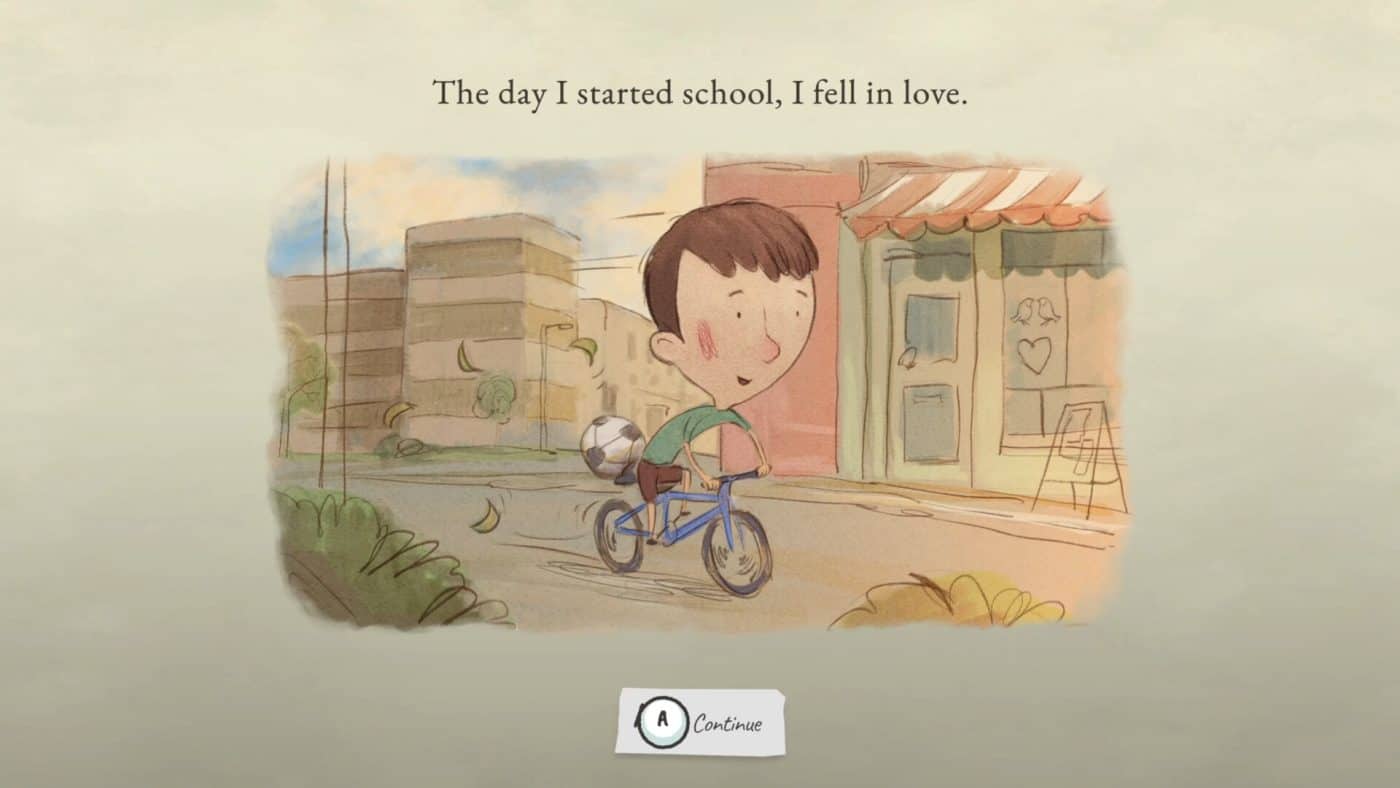
Frank’s story is short but well-structured. The protagonist starts from a routine of games, bicycles, and football – an ordinary childhood, told with affection – and through falling in love arrives at something more complex: respect for nature, contemplation, the ability to look at the world through different eyes. It is a genuine arc of growth, not a predictable one.
The most interesting thing is that the engine driving this transformation is, at its root, a selfish one: Frank learns to love birds because Sylvia loves them. And yet the change is real. He climbs to the top of the tree in his ungainly costume, and there finds something he did not expect – not just Sylvia, but a literally different perspective on the world. The game does not moralise: it lets things happen and leaves the player to make sense of them.
The bold act of putting on the costume – of going to school like that, knowing everyone will stare and laugh – carries the structure of a rite of passage. Frank sets aside his fear of judgment and does something that, in its total ingenuousness, is also an act of genuine courage. The game makes this moment playable without hollowing it out: there is something strange and lovely about controlling a boy in a bird costume walking through the rain, unhurried, as though nothing in the world could be more ordinary.
It is also worth noting how the game handles Sylvia. She is not a character to win over. Sylvia exists in the world with her own autonomy, her own interests, her own light. Frank does not try to change her or persuade her: he tries to understand her, to draw closer to her way of seeing things. It is a small distinction, but not an irrelevant one, especially in a game made with younger players in mind.
The selection for the London Games Festival 2026 – in the Official Selection, with a playable presence at the New Game Plus event – confirms the positioning of this project among independent games with recognisable narrative and artistic ambitions. It is not a game for everyone, in the sense that those looking for mechanical challenge or ludic depth will find little. But it is a game made with care and a clear identity.
Audio and Art Direction
The soundtrack comes from Failpositive (Ethan Duys) and spans twenty tracks across roughly twenty-three minutes. The track titles already tell a small story: A Quiet Morning, Wish to Be Seen, Winged Tears, Warm Embrace, I Became a Bird. The register is that of the most successful cozy games: simple melodies, acoustic instrumentation, nothing that interrupts the narrative flow. The music accompanies without imposing itself, which is exactly what a game like this needs.
The game supports twelve languages, Italian among them. The Italian localisation shows care – the title becomes Il giorno che sono diventato un passerotto, a choice that captures the tone of the original well, diminutive included.

The Privilege of Simplicity
The Day I Became a Bird occupies a space that children’s literature knows well: that of the ideal childhood. Frank has a bedroom full of toys, friends to run around the park with, the free time to build something with his own hands. There is no tension at home, no real loneliness, nothing to disturb that golden bubble except the inner turmoil of first love – which is, in its own way, the most beautiful kind of disturbance there is.
This is a representation that does not claim to be universal, but works precisely because it is not entirely so. Chabbert and Guridi build an emotionally recognisable world – shyness, the desire to be seen, the fear of judgment – and place it in a deliberately neutral, almost archetypal context. Frank has no defined ethnicity, no visible family, no problems that go beyond his own turbulent heart. He is a child-everyman, a figure abstract enough to let anyone project themselves onto him.
This carries a precise value: some emotions need clean space to be told. Idealisation is not always a shortcoming – sometimes it is a poetic choice, a way to bring a feeling into focus without the noise of the world getting in the way. The game does the same: it does not tell one specific childhood, but something that runs through many different childhoods, including those with little of the serene about them. The fact that a child who grew up in difficult circumstances might recognise themselves in Frank’s desire to be seen by Sylvia is, in a sense, the measure of the work’s success.
It is worth naming, at least in passing: that serenity is a choice, not a given. Not every childhood looks like Frank’s, and knowing this makes the game something more than a sweet story – it makes it a space where that serenity is offered, almost as a gift, to those watching it from outside.
Conclusions
The Day I Became a Bird is a project worth knowing in all its forms, and not only for the sake of completeness. Chabbert and Guridi’s book is a small masterpiece of visual and emotional economy. The Passion Pictures short film brings that story into animated form with uncommon quality and sensitivity. The game, finally, offers an interactive version that – while the most accessible and least emotionally intense of the three – earns its place by turning the viewer into a participant.
Those who come looking for a traditional gaming experience may find it too short and too undemanding. Those who want something closer to an animated picture book to explore – something warm, slow, and honest – will find in Frank and his ragged costume an unexpectedly memorable companion.
It is, at its heart, a story about what we are willing to do to be seen by someone we care about. And about how, sometimes, in the attempt to become something else, we discover something of our own.

If you want to know more:
 7.9/10