In short
The Alighieri Circle: Dante’s Bloodline is at its best when it turns Dante’s legacy into something deeply personal. Its atmospheric exploration, striking art direction and transition from Villa Alighieri to the Abyss create a memorable foundation for a mystery built around family and inheritance. Yet for all its promise, the short runtime and limited scope leave the feeling that this fascinating world had considerably more to say.
An atmospheric psychological horror experience that trades combat for exploration, mystery, and a deeply personal interpretation of Dante’s legacy.

The Alighieri Circle: Dante’s Bloodline takes one of the most recognisable works in Italian literature and asks a deceptively simple question: what if Dante’s Divine Comedy were more than a work of fiction? Developed by ONE-O-ONE GAMES, this first-person psychological thriller uses Dante’s imagery as the foundation for a contemporary story of family, memory, and the supernatural.
Released on September 10, 2026, the game follows Gabriele Alighieri, a descendant of Dante whose return to his family’s ancestral villa sets him on the trail of a mystery buried deep within the Alighieri bloodline. This is not an experience built around combat or conventional horror mechanics. There are no weapons to wield, no enemies to fight, and no traditional progression system. Instead, The Alighieri Circle places its emphasis firmly on exploration and investigation, asking the player to examine their surroundings, uncover documents and objects, solve environmental puzzles, and gradually make sense of a story that rarely offers all of its answers at once.
That restraint is central to the way The Alighieri Circle: Dante’s Bloodline builds tension. The villa initially feels grounded and almost reassuring, its rooms filled with the quiet remnants of the family that once called it home. But the longer Gabriele remains there, the more that sense of familiarity begins to erode. Details that first appear mundane gradually take on a different significance, and the space itself starts to feel increasingly hostile. The game rarely needs to place an obvious threat in front of the player. Instead, it turns familiarity into a source of unease, slowly undermining the sense that the villa is a place Gabriele can understand, or trust.
Gabriele’s connection to Dante is what gives that premise its particular identity. For the Alighieri family, the Divine Comedy is not simply an extraordinary piece of literature passed down through generations. It is connected to a ritual intended to keep the gates of Hell sealed.
What the rest of the world understands as Dante’s vision of the afterlife therefore takes on a very different meaning within his bloodline. As Gabriele begins to uncover the secrets left behind by his ancestors, the distinction between literature and reality gradually starts to collapse.
The imagery of the Inferno is no longer confined to the pages of a centuries-old poem. It becomes part of the world Gabriele is forced to navigate, and part of the history he must confront. That idea is reflected in the game’s structure, which revolves around two interconnected realities.
The first is the Villa, a physical space defined by its rooms, corridors, belongings, and the remnants of the Alighieri family. It is a place that feels rooted in the real world, even as its secrets begin to surface. The second is the Abyss, a supernatural dimension that draws on the imagery of Dante’s Hell while pushing it into something considerably more abstract and surreal.
The transition between these two spaces is one of The Alighieri Circle’s most important devices. The Villa provides the context; the Abyss distorts it. Familiar spaces can acquire an entirely different meaning once Gabriele crosses that threshold, while elements of the supernatural gradually become tied to the history he is uncovering. The two realities are not simply different settings.
They are two ways of looking at the same mystery. Exploration is therefore less about reaching the next objective than about learning how to read the world. Gabriele can uncover journal entries, documents, collectibles, and fragments of the Divine Comedy, each providing another piece of information about the Alighieri family and the events surrounding his own life.
None of these discoveries fundamentally changes the way the game is played, but they give the environments greater narrative purpose and reward players willing to look beyond the obvious path. The villa, in particular, gradually becomes more than a location.
It becomes a record of the people who came before Gabriele. The objects left behind, the documents scattered throughout its rooms, and the details hidden within its spaces collectively form a history that the game expects the player to reconstruct rather than simply receive.
The Abyss approaches that same history from a different direction. Here, the grounded spaces of the villa give way to environments shaped by symbolism and the infernal imagery associated with Dante. The contrast is deliberately stark, allowing the game to move between something recognisable and something increasingly difficult to define. That approach also explains why The Alighieri Circle works better as a psychological mystery than as a conventional horror game.
Its tension comes primarily from anticipation and discovery. There is always the possibility that the next room, document, or revelation will change the meaning of what came before. The game is less interested in asking the player to survive an immediate threat than in making them question what they have already seen. The campaign itself is relatively short, generally taking around three to five hours depending on the player’s pace and willingness to explore optional content.
That compact structure suits the game’s linear design and allows its central mystery to remain relatively focused, although it also means that some of its ideas have limited time to develop.
This is particularly noticeable in a story carrying as much thematic weight as The Alighieri Circle. The game touches on inheritance, family history, memory, Dante’s legacy, and the relationship between the human world and the supernatural, all within a comparatively brief campaign.
Its strongest ideas are therefore often the ones closest to its central premise, while some of the broader threads could have benefited from more time to develop. Even so, the concept at the heart of The Alighieri Circle remains its most compelling quality. ONE-O-ONE GAMES does not use Dante simply as visual shorthand for Hell, nor does it attempt to recreate the Divine Comedy in videogame form. Instead, it takes the cultural weight of Dante’s work and places it inside a modern story about a family that has inherited a secret far more dangerous than a literary legacy.
That distinction gives the game a clear identity. Gabriele is not exploring Dante’s Inferno. He is discovering why his family has spent generations trying to keep it from becoming real. And that is where The Alighieri Circle finds the idea capable of carrying its entire adventure: sometimes the most frightening inheritance is the one you were never supposed to know you had.


A Legacy That Crosses Centuries
Behind The Alighieri Circle stands ONE-O-ONE GAMES, the independent Italian studio whose work has increasingly been defined by narrative, atmosphere, and stories built around psychological tension. Based in Rome, the team has previously developed The Suicide of Rachel Foster and Aftermath: different games in both tone and structure, but projects that share an evident interest in character, mystery, and the ability of an environment to become part of the storytelling itself.
With The Alighieri Circle, that sensibility is distilled into a considerably more focused form. The game does not attempt to compete for the player’s attention through combat systems or mechanical complexity. Instead, it builds its identity around looking, listening, and discovering. The Villa is something to be investigated rather than conquered; its rooms, objects, documents, and hidden details gradually reveal the history surrounding Gabriele and the Alighieri family.
It is a creative choice that gives the environment unusual importance. Much of the narrative is deliberately left for the player to assemble, with clues distributed throughout the Villa and the supernatural spaces beyond it. Documents and collectibles provide additional context, while puzzles turn observation into progression. Rather than constantly telling the player what matters, ONE-O-ONE GAMES allows the setting to establish its own hierarchy of information.
That approach is consistent with the studio’s previous work, but The Alighieri Circle takes it in a more deliberately atmospheric direction. Where Aftermath incorporated action, stealth, and survival mechanics into its narrative framework, the new game strips much of that structure away.
What remains is the investigation itself: a first-person journey in which tension is created through uncertainty, discovery, and the gradual realisation that the history surrounding Gabriele is considerably more complicated than it first appears. The result is a project whose scale is relatively contained, but whose premise reaches considerably further. Dante’s Divine Comedy provides the cultural foundation, while the game transforms that literary heritage into something designed for a contemporary videogame audience. That transition, from medieval literature to first-person psychological thriller, is where much of the project’s identity resides.
The journey from development to a global audience, however, extends beyond ONE-O-ONE GAMES itself. Entalto Publishing plays a central role on the publishing side, helping carry the project beyond its Italian roots and into the wider international market. The Spanish publisher provides The Alighieri Circle with an international platform while allowing its distinctly narrative-driven identity, and its unusual reinterpretation of Dante’s legacy, to remain at the heart of the project.
That international reach extends to C&R Creative Studios, the creative and publishing arm of Japan’s CREEK & RIVER. While ONE-O-ONE GAMES remains at the heart of the game’s development, C&R Creative Studios has partnered with Entalto Publishing to bring The Alighieri Circle to the Japanese market, supporting its localisation and helping introduce the project to a new audience.
The distinction matters because The Alighieri Circle is built around a cultural reference point that is unmistakably Italian. Dante is not simply a recognisable name attached to the project; his work provides the game’s mythology, imagery, and central narrative premise.
Taking that material from an Italian development studio to audiences in Spain, Japan, and beyond therefore becomes part of the game’s own journey. An Italian studio supplies the vision. A Spanish publisher helps carry it abroad. A Japanese partner opens another door.
There is no vast multinational structure behind The Alighieri Circle. Its international reach comes from a more focused collaboration between specialised partners, each bringing a distinct role to the project. ONE-O-ONE GAMES remains the creative force behind the game, while Entalto Publishing and C&R Creative Studios help carry that vision beyond its Italian origins and into new markets.
That makes the project an interesting example of the modern independent development landscape. A game does not necessarily need the scale of a major AAA production to travel internationally; sometimes it needs the right creative identity, a publisher capable of understanding that identity, and partners able to carry it into markets with very different audiences.
For The Alighieri Circle, that identity begins in Italy and with Dante. But it does not remain there. The game takes one of Italy’s most enduring literary legacies and sends it through a distinctly modern, international production journey, turning a story born centuries ago into a videogame capable of crossing borders today. Born in Italy. Built for the world.


The Secret of the Alighieri Bloodline
The story begins in 1993, when Gabriele Alighieri, the last descendant of Dante’s family, returns to the old villa of his ancestors. He already knows why he is there. For generations, the Alighieri bloodline has carried a ritual from one heir to the next, and Gabriele has spent his entire life knowing that one day it would become his turn to undertake it. That day has finally arrived.
For Gabriele, the ritual is not simply an obscure family tradition. It is tied directly to the legacy of Dante and to the truth behind the poet’s journey through the afterlife. What generations of readers have understood as literature carries a very different meaning for the Alighieri family: one that has remained hidden for centuries and that Gabriele must now confront for himself.
The old villa is where that inheritance begins to unravel. As he prepares for the ritual, Gabriele searches through the house, gradually piecing together the lives of the Alighieri who came before him. Diaries, documents, personal belongings, and other traces of the family’s past are scattered throughout its rooms, preserving fragments of lives that would otherwise have disappeared.
None provides the complete picture on its own. Together, however, they begin to reveal a history shaped by the same extraordinary responsibility that now rests on Gabriele’s shoulders.
The Villa therefore serves two purposes at once. It is the starting point of Gabriele’s journey and, increasingly, an archive of the family itself. The objects he finds are not merely pieces of environmental storytelling; some also contain the clues needed to solve puzzles and open previously inaccessible areas, tying exploration directly to the process of uncovering the past.
But the ritual’s true purpose lies beyond the walls of the Villa. Hidden within the Abyss, the supernatural realm at the heart of the Alighieri family’s secret, are several original pages of the Divine Comedy. To recover them, Gabriele must uncover a hidden passage within the Villa and cross the portal that leads into the infernal world beyond. The moment he steps through, the nature of his inheritance changes completely. What had existed until then as family history, passed down through generations, becomes a reality he must confront for himself.
Until this point, Dante’s journey has been something Gabriele has understood through family history. Inside the Abyss, it becomes something he must physically endure. The inferno is no longer a story preserved by his ancestors. It is the place where his own inheritance is waiting for him.
The Abyss itself is a vast, distorted realm in which the rules of the world Gabriele knows no longer seem to apply. Spaces bend away from reality, familiar ideas of scale and geography become increasingly unreliable, and progression takes the form of a series of trials that Gabriele must overcome to continue his descent. Yet even here, the Alighieri bloodline remains present.
Gabriele encounters one of his ancestors, a member of the family who has already made the journey into the Abyss. Rather than functioning simply as a guide, this figure becomes another link between Gabriele’s present and the generations that preceded him, offering insight into the realm and the challenges ahead while revealing more about what it meant to carry the Alighieri name.
Their encounters gradually add another dimension to Gabriele’s journey. The more he learns about those who came before him, the more difficult it becomes to separate the ritual from the people it has consumed along the way. Progress through the Abyss is consequently built less around confrontation than observation, exploration, and deduction.
Gabriele must examine his surroundings, recognise connections between scattered clues, and remember information discovered elsewhere. The game repeatedly asks the player to look beyond the immediate path, turning seemingly insignificant details into pieces of a larger puzzle.
And while the Abyss represents the supernatural side of the Alighieri legacy, the Villa never disappears from the story. Gabriele moves repeatedly between the two worlds, with each providing information that can unlock something in the other. The Villa preserves the family’s memories; the Abyss gives those memories physical form. One is grounded in the traces left behind by previous generations, while the other forces Gabriele to confront what those traces actually mean.
That contrast becomes increasingly personal through his relationship with Dalila, his wife, and their daughter, Ginevra, who remain at home while Gabriele undertakes the ritual. Their communications provide a connection to the life waiting for him outside the Villa, grounding the increasingly supernatural journey in something recognisably human.
The further Gabriele travels into the Abyss, the more tangible the possibility becomes that completing his family’s duty may come at a cost to the people he loves. Eventually, the ritual reveals itself to be about more than retrieving the pages and sealing the passage. Every Alighieri who entered the Abyss left something behind. Their documents, memories, and personal traces gradually expose the consequences of the journeys undertaken by previous generations. What Gabriele initially approaches as an obligation inherited from his family becomes an investigation into the people who carried that burden before him, and into the price they paid for doing so.
After enduring the trials and recovering the pages needed to complete the ritual, Gabriele returns to the Villa. By this point, the fragments gathered throughout his journey – the family records, the traces of those who came before him, and the revelations uncovered within the Abyss – begin to fall into place, giving new meaning to everything he has witnessed. What began as an obligation inherited from his ancestors has become a confrontation with the legacy they left behind.
Gabriele is no longer simply carrying out an ancient family ritual. He is finally coming face to face with the history that forced the Alighieri to keep it alive for generations.


The Burden Beneath the Name
At its core, The Alighieri Circle revolves around a deceptively simple question: what happens when a literary legacy stops being something we inherit culturally and becomes something we are forced to carry personally? Few works lend themselves to that idea more naturally than Dante Alighieri’s Divine Comedy. In the game, Dante’s masterpiece is far more than a historical reference or a source of visual inspiration. It is woven into the history of the Alighieri family, tied to an ancient responsibility passed from one generation to the next until it falls upon Gabriele.
What the world remembers as one of literature’s greatest works is, for the Alighieri bloodline, a living inheritance, and one that comes with a burden no descendant can simply choose to leave behind. The game’s most distinctive narrative choice lies precisely in that transformation.
Rather than attempting to recreate the Inferno as Dante imagined it, ONE-O-ONE GAMES takes its mythology and asks what it would mean to live beneath its shadow. That makes inheritance far more than a narrative premise. It becomes the foundation on which Gabriele’s identity is built.
He has inherited a name, certainly, but also a duty, a burden, and a history that began centuries before he was born. There is no clean separation between the life he might have chosen for himself and the life his family has prepared for him. The Alighieri legacy therefore becomes something far more personal than a family tradition: it becomes a question of identity itself. How much of who we are is truly our own, and how much is shaped by the people and expectations that came before us?
The game explores that question through the fragments of the past scattered throughout the Villa. Diaries, documents, personal belongings, and seemingly incidental details gradually form a portrait of the generations that preceded Gabriele. None of them provides the complete story. Instead, the player is left to connect the pieces, fill in the gaps, and understand the significance of events that are often communicated indirectly. It is an approach that gives memory a particularly important role. The past is not presented as a finished account; it has to be reconstructed from what remains.
That design choice also makes exploration meaningful beyond simple progression. Searching a room, examining an object, or discovering another document can reveal something about the people who once inhabited the Villa, while certain details also become essential to solving the puzzles that stand between Gabriele and the next stage of his journey. The environment consequently operates on two levels at once: it is both a physical space to navigate and a fragmented record of a family history that has never been fully laid bare.
The distinction between the Villa and the Abyss takes that idea considerably further. At first, the Villa is tangible and familiar: a place defined by architecture, possessions, and memories. The Abyss belongs to an entirely different order of reality. Its spaces are distorted, its geography is unstable, and the familiar rules of the physical world gradually lose their authority.
The contrast between the two realms is therefore more than a shift in setting; it mirrors Gabriele’s changing understanding of the world around him. The Villa preserves the traces of what came before, holding its history in rooms and memories. The Abyss takes those fragments and gives them shape, turning what was once inherited history into something Gabriele must confront firsthand.
This relationship between the two spaces allows the game to explore reality and perception without reducing either concept to a simple divide between the real and the supernatural. The Abyss externalises ideas that exist within the family’s history, turning memories, consequences, and buried truths into something Gabriele can actually experience. What begins as an inherited story consequently becomes something physical. The supernatural is not merely an intrusion into the narrative; it is the means through which the narrative makes its central ideas tangible.
And then there is Dante himself. The presence of The Divine Comedy gives The Alighieri Circle a mythology that extends well beyond its setting. The poem is not treated as decorative material, nor is the Inferno simply reproduced for the sake of recognisable imagery. Its pages become tangible objects connected to the family’s ritual, while Hell itself exists within the game as something beyond the boundaries of literature. For the world outside the Alighieri bloodline, Dante’s journey is a poem. For his descendants, it is a legacy they have spent generations living with.
That distinction is arguably where the game’s premise becomes most interesting. It takes one of the most familiar literary journeys in Western culture and shifts the perspective away from the traveller. Gabriele is not Dante, nor is he attempting to repeat the poet’s journey. He is someone born centuries later who has inherited its consequences without ever having chosen them.
That naturally brings the narrative towards guilt. The Alighieri family is defined not only by what it has preserved, but by what its members have done and what they have been forced to carry forward. As Gabriele uncovers the traces left by previous generations, his journey into the Abyss becomes increasingly connected to everything they failed to resolve.
His descent is therefore both literal and symbolic: the further he travels into the darkness, the deeper he moves into a history that his family has spent generations keeping hidden.
The idea of sacrifice follows closely behind. The Alighieri responsibility comes at the expense of a life entirely free from inherited obligations. Each generation is asked to accept a burden that existed before it and will, potentially, continue after it. Gabriele is now confronted with the same expectation, creating an understated but persistent tension between duty and personal freedom.
The story never needs to turn that conflict into a philosophical monologue. It is embedded in Gabriele’s circumstances: he has a life waiting for him beyond the Villa, and fulfilling the duty passed down through his family may come at a cost to the people who share it with him. That is where Dalila and Ginevra become particularly significant to the narrative.
Their presence gives Gabriele something beyond the Alighieri legacy to hold on to, grounding his journey in a life that exists outside the rituals and secrets of his bloodline. The supernatural may define the world he enters, but what ultimately gives his journey weight is entirely human. Family is not merely the burden Gabriele has inherited; it is also the reason that burden matters.
In that sense, family and destiny become the two ideas around which everything else ultimately revolves. Gabriele has inherited a past he never chose, yet he must still decide what that inheritance means for the life he wants to lead. The truths he uncovers do not belong solely to the generations that came before him; they force him to consider what he might pass on to those who come after. In The Alighieri Circle, inheritance is therefore never entirely about looking backwards. It is about deciding whether the cycle will continue, or whether one generation can choose what comes next.
From a writing perspective, The Alighieri Circle keeps its storytelling relatively linear and controlled. Its ambition does not come from narrative complexity for its own sake, but from the way it uses exploration, environmental details, documents, and discoveries to gradually broaden the meaning of its central premise. There is a deliberate restraint to the presentation, allowing the player to assemble much of the family’s history rather than receiving every answer immediately.
That restraint also reveals both the strengths and the limitations of the approach. The combination of Dante’s mythology, family history, memory, sacrifice, and destiny gives the project a rich thematic foundation, yet its relatively compact structure leaves some of these ideas less room to breathe than others. Even so, the game is at its most effective when it stays close to its central premise: the idea of inheriting a burden that was never yours to choose, yet becomes impossible to escape.
Ultimately, The Alighieri Circle: Dante’s Bloodline is at its most compelling when it treats Dante not as a backdrop, but as the beginning of a much more personal story. It takes a literary legacy recognised across centuries and asks what happens when that legacy becomes a family obligation, and when the person who inherits it is finally forced to decide what it means for his own life.


A World Designed to Feel Wrong
From a technical standpoint, The Alighieri Circle: Dante’s Bloodline is powered by Unreal Engine 5, but its visual identity goes well beyond the technology behind it. ONE-O-ONE GAMES uses the engine with a deliberate sense of restraint, prioritising the construction of its environments over visual excess or spectacle for its own sake. Detail, materials and, above all, lighting are carefully balanced to shape the mood of each space, creating a world that is less interested in showing off than in making every room feel like somewhere with a story to tell.
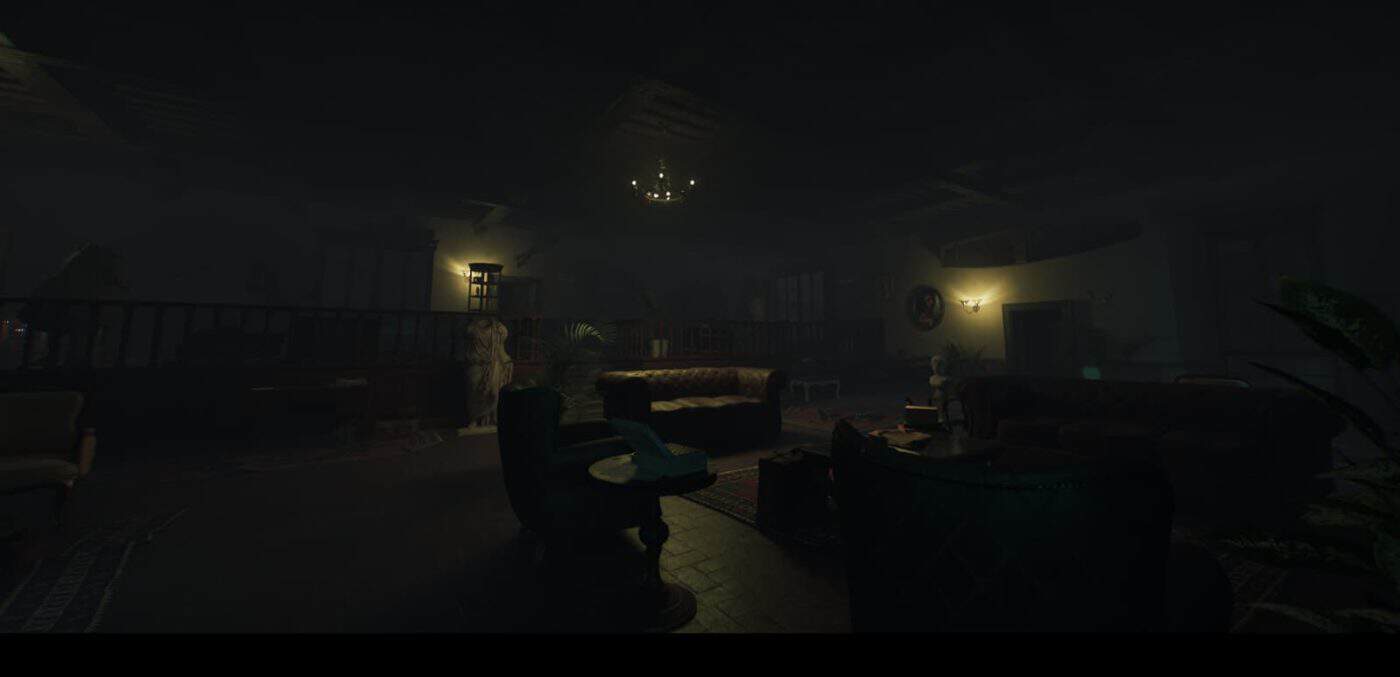
That approach is perhaps most apparent in Villa Alighieri, a residence whose interiors bear the unmistakable traces of generations gone by. Old wood, paintings, statues and countless personal belongings fill its rooms, giving the house a layered, lived-in character and an immediate sense of history. The Villa is far from pristine, and that is precisely the point. Its faded grandeur and understated decay make it feel authentic, as though decades of family life have gradually settled into its walls, leaving behind a space shaped as much by memory as by architecture.
Lighting is central to that illusion. Sunlight enters through the windows in narrow, clearly defined shafts, illuminating sections of the rooms while leaving others in subdued darkness. Details emerge and disappear depending on where the player stands, giving even familiar spaces a degree of uncertainty. For a game built around exploration and observation, that matters. The Villa does not simply give the player somewhere to walk through; it gives them reasons to look.
That sense of authenticity is reinforced by the Villa’s strong visual coherence. Its architecture, furnishings and scattered belongings all feel tied to the same family history, allowing the environment to communicate the Alighieri legacy long before the player has fully pieced it together for themselves. Nothing feels arbitrarily placed; each detail contributes to the impression of a house shaped over generations, where even the smallest object seems to belong to a larger story. Colour plays an equally important role in defining that identity.
The warmer, earthy palette gives the residence a tangible, almost grounded quality, establishing a visual baseline that makes the transition into the Abyss feel all the more dramatic. Because the Abyss is not simply another location. It is where the game’s visual language changes.
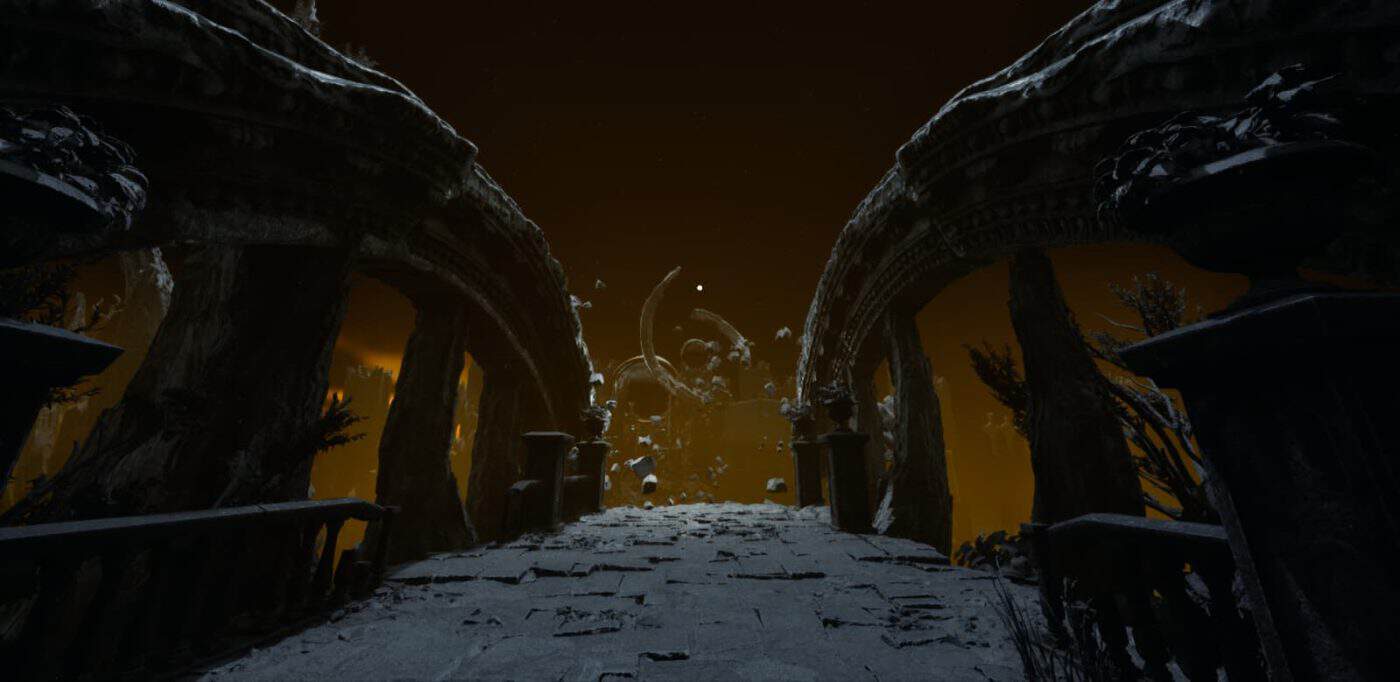
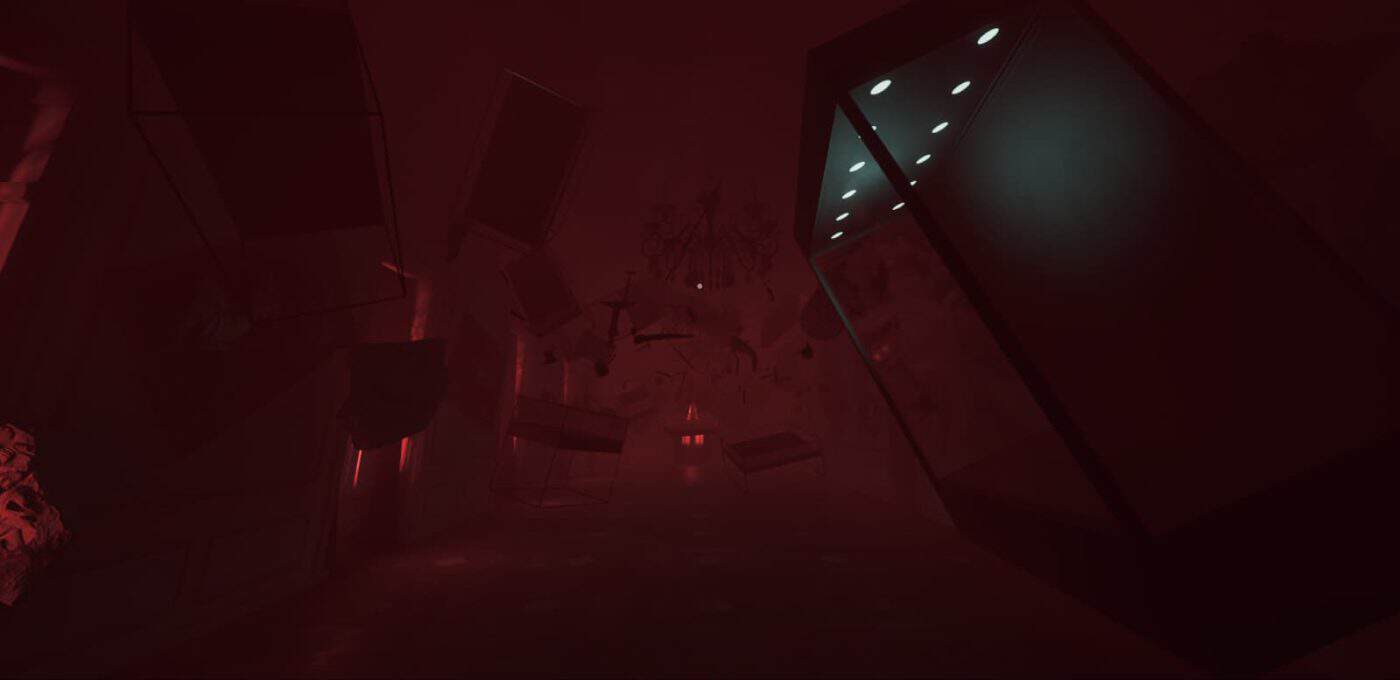
The familiar architecture of the Villa gradually gives way to distorted and surreal landscapes, where natural and architectural forms appear to collapse into one another. The warmer tones disappear, replaced by cold whites and greys punctuated by striking reds. The effect is immediate, but the Abyss is at its most effective when it goes beyond simply looking hostile or supernatural.
There is a genuine sense of dislocation to these environments. Their scale, composition and distorted forms suggest a place operating according to rules that have little connection to the reality Gabriele has left behind. Rather than filling the screen with visual noise, the game often allows these spaces to breathe, giving their stranger shapes enough room to become part of the experience.
Most importantly, this is not Dante’s Inferno simply translated into videogame form. ONE-O-ONE GAMES draws from the imagery, themes and visual language associated with Dante, but never treats them as a blueprint to be reproduced piece by piece. Instead, the Abyss takes those familiar influences and places them alongside far more contemporary and unexpected elements. Petrified and distorted landscapes give way to traces of the modern world, creating a visual language that feels deliberately unpredictable, and all the more distinctive for it.
That tension between the familiar and the alien gives the Abyss much of its personality. The player can recognise fragments of an established cultural image of Hell, only for the game to push them somewhere less comfortable. It is an Inferno filtered through a different imagination, rather than an attempt to reproduce the one Dante already gave us.
The Abyss had already stood out as one of the project’s most intriguing elements during its earlier stages of development, and the finished game largely delivers on that initial impression. This is where the art direction feels at its most assured, using scale, colour and distortion to create some of the experience’s most striking imagery. If Villa Alighieri gives Gabriele a tangible world rooted in family history, the Abyss takes those foundations and twists them into something far more unfamiliar: vast, surreal and governed by a visual logic all its own.
The game’s illustrated sequences add yet another layer to that identity. Instead of presenting every narrative moment through conventional in-engine cinematics, The Alighieri Circle occasionally turns to a more painterly form of storytelling. These illustrations draw on the iconography surrounding Dante and the Divine Comedy, providing a visual bridge between the literary tradition that inspires the game and the interactive world built around it.
The contrast works because it feels intentional rather than ornamental. After spending time inside a fully realised 3D environment, the player is presented with an image that feels closer to a piece of illustrated literature. Gabriele and the other characters consequently take on a different visual quality, while the change in medium gives certain moments a stronger sense of narrative emphasis.
It is also one of the clearest examples of the game understanding what makes its premise distinctive. The Alighieri Circle is built around the meeting point between a centuries-old literary work and a contemporary videogame, and these sequences make that relationship visible. The Villa lets the player explore Dante’s legacy. The illustrations let the game reinterpret it.
The same measured approach can be seen in the 3D models and textures. They are generally solid and detailed enough to withstand the close perspective demanded by first-person exploration, from the materials and furnishings of the Villa to the rocky surfaces and architectural structures scattered throughout the Abyss. They do not possess the sheer complexity of the industry’s most expensive productions, but that comparison is largely beside the point. The game’s relatively controlled environments allow it to concentrate its visual resources where they matter most.
There are some technical imperfections, and certain assets fall short of the consistency achieved by the strongest parts of the presentation. Even so, these issues rarely distract from the overall impression. The technology provides a capable foundation, while the artistic direction does most of the work in turning that foundation into something recognisable.
And that distinction is important. The Alighieri Circle does not need to be the most technically impressive game on screen to be visually memorable. Its strongest moments come from the relationship between light and shadow, warmth and coldness, familiarity and distortion.
Unreal Engine 5 gives ONE-O-ONE GAMES the tools to realise that vision, but the engine itself is not the story. The Villa’s aged interiors give physical form to the weight of the Alighieri family’s history; its warm palette establishes a fragile sense of reality; and the Abyss tears that certainty apart, transforming Dantean imagery into something stranger and distinctly personal.


The Scariest Sound Is Sometimes No Sound at All
The audio design of The Alighieri Circle: Dante’s Bloodline is guided by a simple principle: silence can be just as expressive as music. Rather than leaning on a persistent score to underline every dramatic beat, ONE-O-ONE GAMES gives considerable space to ambient sound, environmental detail and the natural acoustics of its locations. It is an understated approach that fits the game’s emphasis on exploration and psychological tension, allowing the player to spend long stretches simply walking, observing and trying to make sense of what happened inside the Alighieri family home. The music does not always leave a particularly strong impression on its own, but the broader soundscape often gives the environments a convincing sense of life.
Villa Alighieri is the clearest expression of that philosophy. In its quieter moments, the house almost seems to speak for itself. Footsteps move through its corridors, floorboards creak beneath Gabriele, wind filters through the surrounding spaces and distant sounds drift in from outside.
When the weather turns, rain and thunder become particularly effective components of the atmosphere, giving the residence a sense of movement and presence that its architecture alone could not provide. There is something inherently unsettling about moving through such a large, old house with no music constantly reminding you how you are supposed to feel.
That restraint is important because it leaves room for the player’s imagination to complete the picture. Without a continuous musical cue signalling every potential threat, individual sounds carry more weight. A noise from somewhere beyond the player’s immediate view, an unexpected reaction from an object or a subtle change in the surrounding ambience can suddenly become enough to stop the exploration in its tracks. The game consequently finds much of its tension in the spaces between sounds, using absence as deliberately as presence.
Crossing into the Abyss changes the character of that soundscape. The environments become considerably larger and more surreal, and the audio responds by becoming more atmospheric and spatially expansive. Distant sounds help give these vast spaces a sense of depth, preventing them from feeling like little more than spectacular landscapes designed to be crossed.
The smaller details are equally useful. Doors, mechanisms, objects and other interactive elements produce clear sonic feedback, giving physical weight to actions that might otherwise feel purely mechanical. It is not an especially sophisticated interaction system, but it is well suited to the game’s deliberate pace. With no conventional combat loop competing for attention, even these modest sounds help establish rhythm and reinforce the player’s relationship with the environment.
Music, by comparison, knows when to step aside. The score appears primarily when a scene benefits from additional emotional emphasis, rather than attempting to provide a continuous layer of drama. That restraint is largely effective: the game rarely tells the player that a moment is frightening simply by making the music louder. At the same time, the compositions do not always possess enough personality to stand independently from the atmosphere they support. They are appropriate to the tone, but a more distinctive musical identity could have made some of the game’s emotional peaks considerably more memorable.
The voice acting makes a stronger contribution. The performances give the dialogue a sense of character that complements the environmental storytelling, particularly during the moments when Gabriele is forced to confront people beyond the walls of the Villa. The Italian voice track is convincing and well suited to the game’s more important exchanges, while the English voice acting available in the version tested by some outlets similarly provides a solid interpretation of the cast.
That human element matters more than it might initially appear. Gabriele spends much of the experience alone, surrounded by objects, documents and remnants of people who are no longer there. Voices become one of his few direct connections to the world outside the Villa. Conversations and communications consequently serve not only to advance the narrative, but also to remind the player that there is still a life waiting beyond the world Gabriele has entered.
The most effective aspect of the audio design is ultimately the way these elements are allowed to coexist. Voice, environmental ambience and silence rarely compete with one another. Instead, they create a layered soundscape in which the smallest details can carry surprising weight.
Rain against the windows, wind moving through the Villa, the sound of footsteps across different surfaces, the creak of old architecture and the response of an object being manipulated gradually establish a feeling of unease without demanding the player’s attention.
That is perhaps the right approach for a game so concerned with psychological tension. The Alighieri Circle is less interested in startling the player than in making them question what they are hearing. Its most effective audio moments are therefore often the quietest ones: the stretches in which nothing obvious happens, the music disappears, and the environment is left to fill the silence.
The overall result is a solid and thoughtfully restrained audio presentation. Environmental sound and voice acting are its most convincing components, while the score performs its supporting role effectively without always developing a strong identity of its own. More than anything, however, the soundscape understands the importance of atmosphere. It gives Villa Alighieri a sense of age and isolation, allows the Abyss to feel distant from ordinary reality, and turns otherwise unremarkable environmental noises into part of the game’s psychological texture.


A World of Clues, Contrasts and Secrets
There are two places at the heart of The Alighieri Circle: Dante’s Bloodline, and almost everything the game does is shaped by the distance between them. Villa Alighieri and the Abyss represent two radically different expressions of the same inheritance: one grounded in the physical remnants of a family’s past, the other in a reality where that past has taken on a surreal and often unsettling form. The constant movement between these spaces is therefore more than a structural device.
It is the foundation of the game’s world building, gradually shifting the player’s understanding of both the Alighieri legacy and the journey Gabriele has been forced to undertake.
The Villa is where that journey begins, and its role is fundamentally investigative. This is a place to search rather than conquer. Rooms are examined piece by piece, objects are inspected, documents are uncovered and fragments of information are gradually assembled into a broader picture of the family’s history. The diaries left behind by Gabriele’s ancestors are particularly valuable in this regard, revealing details that the main narrative does not always spell out.
There is an appealing simplicity to that approach. The Villa asks the player to pay attention, and its most important discoveries are often small: a document tucked away somewhere, an object whose relevance only becomes apparent later, or a detail that quietly adds another layer to the history surrounding the ritual. But the same restraint also places fairly clear boundaries around what the player can actually do. Interaction remains deliberately limited, with no elaborate inventory system, few optional activities and little incentive to stray from the intended route.
That becomes increasingly noticeable as the adventure progresses. Villa Alighieri initially feels like the kind of setting that should contain far more secrets than the game could possibly reveal in a single sitting. Its history, its inhabitants and the generations of Alighieris connected to the ritual create the impression of an enormous narrative archaeology waiting to be uncovered. In practice, however, the structure is tightly controlled. The game generally tells us where the next piece of the puzzle lies, even if it expects us to work out how the individual pieces fit together.
The Villa is a place of discovery, but rarely of freedom. That distinction becomes much less important once Gabriele crosses into the Abyss. Here, ONE-O-ONE GAMES has considerably more room to let its imagination breathe. The visual language changes almost completely. Familiar architecture gives way to distorted spaces, surreal landscapes and structures that appear to have been assembled from fragments of different places and periods. The result feels less like a traditional game environment and more like a physical manifestation of something that should never have been given a concrete shape. Crucially, the Abyss is not built around combat.
There are no weapons, no offensive abilities and no stat-based progression systems waiting to turn Gabriele into a more capable fighter. There is no conventional stealth system, either. Vulnerability is not something the game expects the player to overcome through character progression; it is the condition in which Gabriele experiences the entire journey.
That choice gives the gameplay a remarkably clear identity. Rather than asking how the player can defeat whatever stands in their way, The Alighieri Circle asks a different question: can you understand your surroundings well enough to find a way through them?
It is a philosophy that fits the game’s psychological-thriller foundations. The official description places atmosphere, exploration and story at the heart of the experience, leaving combat out of the equation. Here, that absence feels less like a missing feature than a deliberate statement of intent.
The resulting gameplay loop is therefore uncomplicated: explore, observe, connect the clues and solve the puzzle. Most of the puzzles are embedded directly into their environments. Symbols, objects, and pieces of information encountered earlier can become relevant later, encouraging the player to remember what they have seen rather than simply searching for a conveniently highlighted solution. None of these challenges is demanding, and the game rarely asks for extended experimentation. Once the right clues have been identified, the answer is usually close at hand.
That accessibility serves the narrative well, but it comes at a cost. The Alighieri Circle rarely delivers the kind of puzzle that forces you to stop, reconsider everything and experience that satisfying flash of recognition when the solution finally clicks. The challenge is generally in noticing rather than solving. When the game gets this balance right, however, the results are considerably stronger.
Some of its best puzzles are those in which the environment itself provides the answer. A particular arrangement, a detail found in another room or a piece of information buried in a document can suddenly become meaningful. The player is not merely solving a puzzle placed inside the world; they are reading the world as a puzzle. Those moments reveal what the game’s design could have achieved with a broader scope. The deliberately slow pace is another part of that equation.
Gabriele moves through these spaces at a measured rhythm, which suits the contemplative nature of the experience and gives environmental details time to register. But the same pace becomes less convincing when the player is simply travelling back through an area they have already understood. What initially feels deliberate can eventually feel restrictive.
The linear structure produces a similar contradiction. It ensures that progression remains clear and prevents the adventure from becoming frustratingly opaque, but it also limits the possibility of stumbling across something the game did not explicitly intend you to find. There is little room for getting lost and, consequently, little room for getting wonderfully lost.
This is particularly evident in the Abyss. Its scale and visual variety suggest a world that is considerably larger than the game ultimately allows us to experience. There are striking environments and intriguing ideas, but comparatively few characters, events or interactive situations capable of transforming our understanding of the space. The Abyss often feels like a glimpse into a much larger world rather than a world fully realised in its own right.
That is one of the project’s more frustrating missed opportunities. The concept of a personal Hell shaped by perception, filtered through Dante’s mythology and tied to the history of the Alighieri family, could have supported far more varied encounters. The Abyss could have become a constantly shifting reflection of Gabriele’s fears, memories and inherited burden. Instead, its strongest qualities remain primarily visual and atmospheric.
The game’s relatively short runtime inevitably contributes to that feeling. A complete playthrough takes approximately three to four hours, depending on how quickly the player progresses and how thoroughly they investigate the environments. There is nothing inherently wrong with that length – narrative games can be remarkably effective when they know exactly how much time they need – but here the limited runtime places a ceiling on the game’s mechanical ambitions.
By the time the player has become fully accustomed to the Villa’s rhythm, the logic of its puzzles and the structure of the Abyss, the adventure is already approaching its conclusion. New mechanics are scarce, the fundamental puzzle language remains familiar and the world rarely has the opportunity to evolve alongside the player’s understanding of it. That leaves The Alighieri Circle in an interesting position. Its gameplay is restrained by design, but sometimes also by scope.
The distinction matters. The game should not be criticised for refusing to become an action-horror title when its entire identity is built around something else. There is a clear coherence in its decision to strip away combat, character statistics and elaborate progression systems and instead place the emphasis on exploration, environmental storytelling, documents, puzzles and atmosphere.
The limitation is that these systems are rarely pushed far enough to reveal all the possibilities suggested by the setting. Villa Alighieri and the Abyss nevertheless complement each other effectively. One preserves the evidence of the past; the other turns that evidence into something tangible, distorted and supernatural. One asks the player to look closely; the other asks them to make sense of what they are seeing. That contrast ultimately gives The Alighieri Circle its clearest gameplay identity. It is not an adventure about becoming stronger. It is not about mastering a combat system or building the perfect character. It is about paying attention.
And while the journey is sometimes too linear, its puzzles too forgiving and its world too compact for the scale of its ideas, the underlying philosophy remains remarkably consistent.


An Ambitious Vision Constrained by Its Scope
The most interesting thing about The Alighieri Circle: Dante’s Bloodline may ultimately be what it leaves behind. Not simply the memory of a short psychological thriller built around exploration and puzzles, but the feeling that there is a considerably larger idea underneath the game we have actually been given. ONE-O-ONE GAMES has established a clear identity here, one built around atmosphere, literary heritage and a distinctly Italian sense of place. What makes the experience so intriguing is that its ambitions often appear to extend beyond its relatively modest scope.
The premise is undoubtedly one of its greatest assets. Taking Dante Alighieri and The Divine Comedy and using their legacy as the foundation for a first-person horror adventure is an unusual proposition, particularly because the game does not simply reproduce Dante’s imagery for recognisable effect. Instead, it turns that cultural inheritance into the history of a family, making Gabriele the latest person forced to confront something that began centuries before his birth.
That gives The Alighieri Circle an identity that feels distinctly its own from the very beginning, and it extends naturally to the world ONE-O-ONE GAMES has built around it. Villa Alighieri feels like a place that existed long before the game begins, and one whose history continues beyond what the player is ever allowed to see. The Abyss takes that sense of scale and pushes it into something altogether more surreal. Its distorted landscapes, impossible structures and shifting visual language suggest a realm that stretches well beyond the boundaries of Gabriele’s journey.
Both spaces are remarkably effective at creating the feeling of something larger just beyond reach. What the player encounters, in both cases, often feels less like a complete picture than a collection of fragments: carefully selected glimpses of a much bigger history, and a world whose full shape remains out of sight. That is where the game’s central limitation begins to emerge: it introduces ideas faster than it can fully develop them. The family history is a good example.
The diaries left behind by previous generations provide useful context and gradually reveal more about the Alighieri legacy, but they also make it clear how much more could have been done with those stories. Some of these figures feel as though they could have supported entire chapters of their own. Experiencing more of their journeys directly, rather than primarily discovering them through written records, could have given the family’s history a much stronger emotional presence.
The same applies to Gabriele. His position is inherently compelling: he has inherited a responsibility he did not create, and fulfilling it inevitably forces him to confront the relationship between family, duty and the life he might otherwise have chosen. There is a strong character arc hidden inside that premise, but the game does not always have enough room to fully realise it.
This is where the three-to-four-hour runtime becomes more than a simple matter of length. A short game is not automatically an incomplete one. Quite the opposite: a tightly scoped experience can be more effective because it knows when to stop. The difficulty here is that The Alighieri Circle reaches its conclusion at almost exactly the point where its world begins to feel truly expansive.
By then, we have been introduced to the Alighieri family, its ritual, the legacy of Dante and the existence of the Abyss. We have begun to understand how these pieces connect, yet the adventure is already preparing to close. The issue is not that the journey is short; it is that the ideas seem to ask for a longer journey. At times, the game consequently feels less like a complete exploration of its mythology and more like the opening chapter of something considerably larger.
That same sense of restraint carries over into the gameplay. The decision to remove combat and conventional progression is perfectly defensible and, in many respects, appropriate. Gabriele does not need a weapon, a skill tree or a collection of statistics to make his journey meaningful. Keeping him vulnerable reinforces the game’s psychological-thriller identity and places the emphasis where it belongs: on exploration, environmental storytelling, and puzzles. The problem is that once those are the game’s primary tools, each of them needs enough depth to carry the experience.
The puzzle design occasionally achieves that. The better challenges are integrated into their surroundings, asking the player to connect documents, symbols, objects and details discovered earlier. These are the moments in which the environment becomes more than scenery and the act of observation becomes genuine gameplay. The strongest puzzles make you feel as though you have understood the world rather than simply solved something the developers placed inside it.
Not every puzzle reaches that standard. Some are straightforward enough to be solved almost immediately, while others can feel insufficiently explained, turning deduction into trial and elimination. The accessibility will certainly make the experience approachable, but it also limits the sense of accomplishment that comes from overcoming a particularly demanding challenge.
What matters, however, is that the stronger examples prove the potential is there. The moments in which Dantean references, environmental clues and previously collected information converge naturally suggest a more ambitious puzzle structure, one capable of evolving alongside the story rather than simply accompanying it. Pacing presents a similar contradiction.
The deliberate movement and slow exploration are fundamentally appropriate for a game that wants its spaces to be observed rather than rushed through. Villa Alighieri benefits from that patience. The problem arises when the same rhythm is applied to backtracking, long transitions between objectives or revisiting areas that no longer contain anything new to discover. At those points, the deliberate pace can begin to feel like friction.
The linear structure reinforces the effect. It keeps the narrative focused and ensures that progression rarely becomes confusing, but it also limits the possibility of wandering into something unexpected. There are few genuine deviations from the intended route and little opportunity for the player to create their own path through the world. The game knows where it wants you to go. It is less interested in seeing where you might go on your own.
That restraint is particularly noticeable in the Abyss, because the Abyss itself feels anything but restrained. Its environments are among the most visually ambitious parts of the experience, and their scale suggests possibilities that the gameplay does not always have the opportunity to explore. There are striking spaces, unusual combinations of imagery and a clear sense that this is not simply Dante’s Inferno recreated in videogame form. Yet there are comparatively few encounters or events capable of transforming our understanding of the dimension.
As a result, the Abyss can sometimes feel more like a window into a larger world than a fully inhabited world itself. That distinction matters because the premise could have supported so much more. A supernatural dimension shaped by perception, connected to Dante’s mythology and filtered through generations of family history is an unusually fertile foundation. More encounters, more environmental transformations, more elaborate trials or simply more time spent there could have turned the Abyss into the defining element of the experience.
Instead, the game often gives us just enough to understand the idea, and then moves on. Visually, however, there is little doubt that ONE-O-ONE GAMES has found a distinctive voice. Villa Alighieri and the Abyss complement one another beautifully, with the former grounding the experience in history, memory and physical reality, and the latter breaking that certainty apart through scale, distortion and surrealism. Lighting, environmental detail, sound and voice acting reinforce that identity, creating an atmosphere that remains one of the project’s most convincing achievements.
The game’s Italian character is equally important. The Divine Comedy is not being used merely as a collection of familiar references. Its presence is fundamental to the premise, and the decision to connect Dante’s legacy to a contemporary family narrative gives the project a cultural identity that feels unusually personal. There is genuine value in seeing Italian history and literary heritage treated as the foundation of an original videogame world rather than as decorative background.
And that brings us back to the game’s greatest strength, and its greatest frustration. There is talent here. There are ideas here. Most importantly, there is a world here. What The Alighieri Circle sometimes lacks is the time and scope required to give all three the space they deserve.
Gabriele could have been developed further. The Alighieri family could have revealed more of its history. The Abyss could have offered more encounters and greater variety. The puzzles could have evolved into a more sophisticated system. The narrative could have lingered longer on the consequences of inheritance, sacrifice, family and destiny. None of those possibilities requires the game to become something fundamentally different. They simply require more room to breathe.
That is why the limitations of The Alighieri Circle: Dante’s Bloodline are difficult to separate from its appeal. Its shortcomings are not the result of a lack of ideas. They stem, more often than not, from the feeling that the project has more to say than its compact structure allows it to say.
As it stands, The Alighieri Circle is a distinctive and compelling experience, at its strongest when atmosphere, art direction and Dantean mythology converge to create something that feels genuinely its own. Its linear structure, relatively forgiving puzzles and compact runtime ultimately keep it from fully realising the scale of the ideas at its core, but they never undermine the strength of the premise itself. What remains is a game with a clear artistic voice and the unmistakable sense that its best ideas extend beyond the boundaries of what it has been able to show.
There is something genuinely exciting about the possibility of ONE-O-ONE GAMES returning to this universe, or carrying what it has learned here into a future project with greater scope. Gabriele’s story could go further. The Alighieri legacy could reach deeper. The Abyss could become something far more unpredictable. For now, The Alighieri Circle remains a promising first step into a world that feels larger than the game itself. And perhaps that is the most appropriate final note for a story built around inheritance. Dante’s journey may have ended centuries ago, but ONE-O-ONE GAMES has shown that his legacy can still open a door to somewhere new.


 7.8/10