An early analysis of an ambitious visual and atmospheric project
With Sub-Species, Irish studio Howling Hamster Entertainment engages with a complex, layered imaginary: the ocean depths as a narrative, technical, and symbolic space. This environment naturally imposes limits on visibility, movement freedom, and threat perception, making it particularly suited to a game experience built around tension, spatial awareness, and control.
The demo, available on Steam starting today, January 21, does not attempt to summarise the entire project or offer a comprehensive overview of its systems. Instead, it works as an initial point of contact—a vertical slice designed to convey atmosphere, identity, and intent, allowing space and movement to dictate the experience’s rhythm.

A visual identity that already feels solid
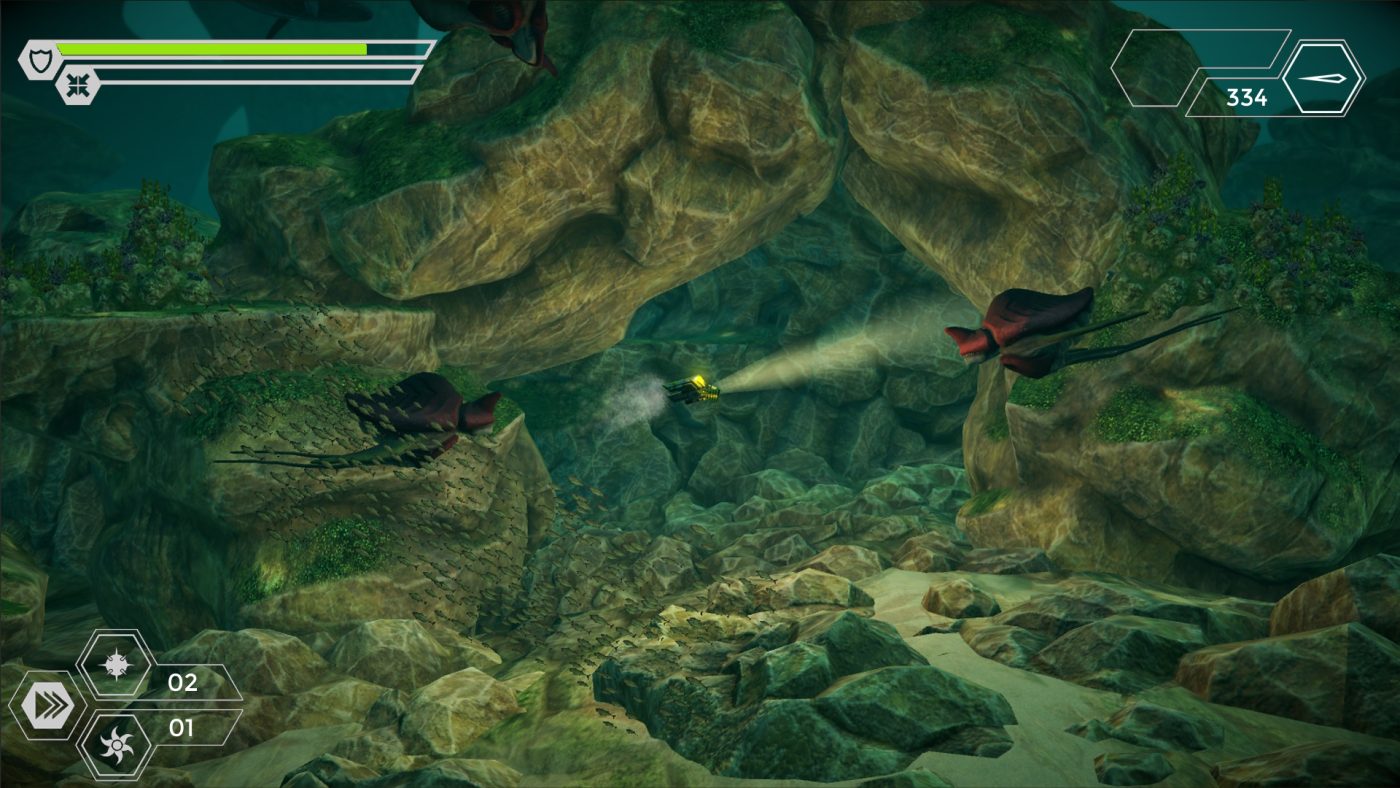
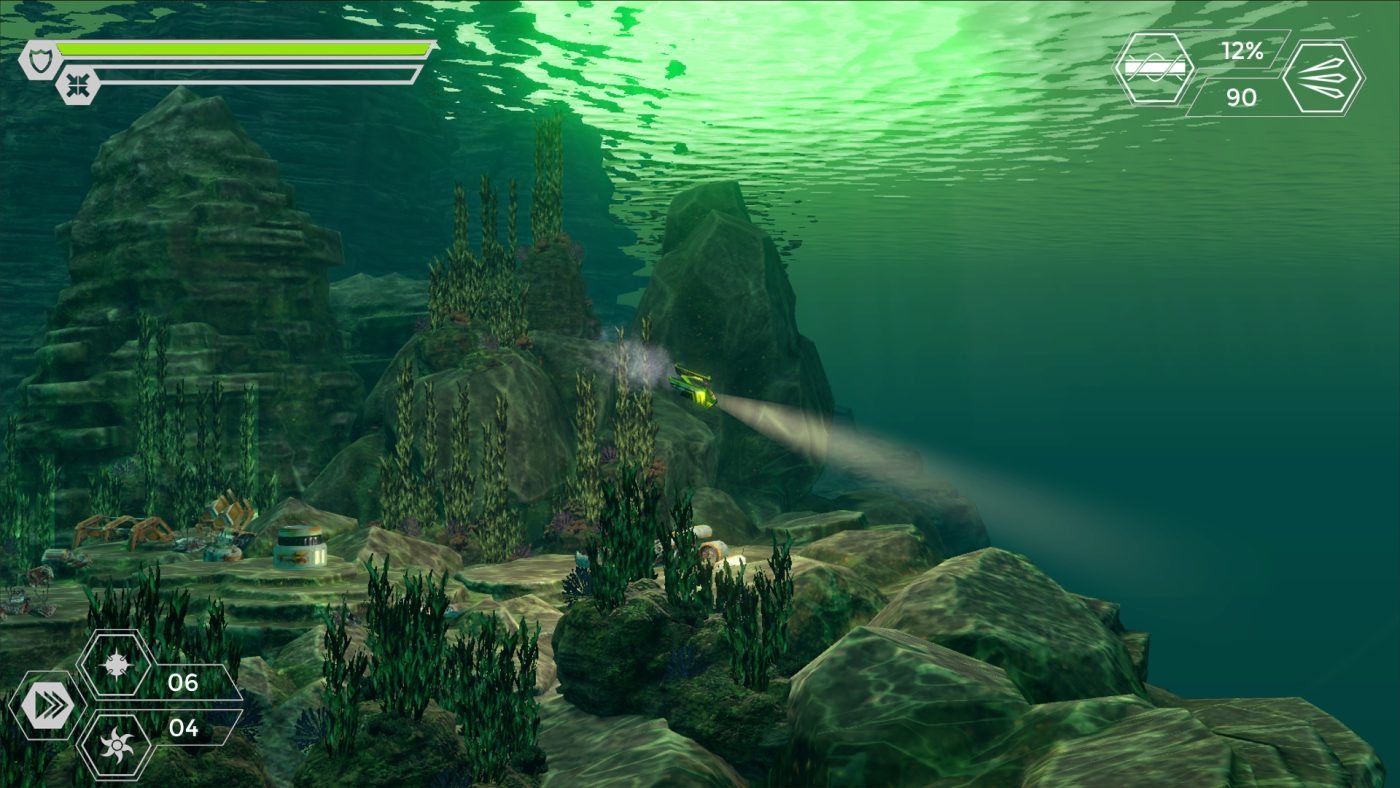
The artistic direction stands out as the most immediately striking element. Sub-Species presents underwater environments that feel cohesive, readable, and carefully constructed, consistently conveying depth and isolation. Artificial structures, wreckage, and alien presences share spaces that support gameplay needs while carrying strong atmospheric weight, without relying on excessive visual noise or decorative flourishes.
The art direction relies on measured visual choices: controlled colour palettes, lighting that supports spatial readability, and sharp contrasts that guide the eye without undermining the atmosphere. This visual framework defines the game’s identity from the outset and supports the experience over time, extending beyond initial impact.
Sound design also plays a central role in shaping the atmosphere. The soundtrack accompanies exploration without overwhelming it, reinforcing isolation and tension, while sound effects effectively convey the submarine’s weight, spatial movement, and the constant presence of the surrounding environment. Together, these elements suggest a technical and artistic foundation that already feels cohesive and well integrated.

Movement and control at the core of the experience
From a gameplay perspective, the demo introduces the submarine’s 360-degree movement system, which serves as the experience’s central pillar. Sub-Species builds its pacing around inertia, spatial orientation, and positional awareness rather than immediacy or simplified action.
This approach demands attention, adaptation, and a willingness to slow down, reading the environment before acting. The design aligns well with the underwater setting and the concept of subaquatic exploration, but it also places significant pressure on the clarity and responsiveness of the control scheme, particularly during the early stages.

Interface and input: friction that needs refinement
Several issues emerge precisely on this front. During the demo session, using a DualShock 4 controller via Steam revealed a concrete problem with input handling: although the mapping assigns the primary fire action to the RB button, the input did not respond correctly, forcing a switch to mouse controls to fire weapons.
The game also relies exclusively on Xbox-style button prompts, which complicates input recognition for players using PlayStation controllers. In a title that treats precision and spatial orientation as core pillars, this friction noticeably affects the initial approach, disrupting flow and pushing players toward unintended hybrid control solutions.
These aspects likely reflect the demo’s current state, but their impact remains significant, as they directly affect the control system’s foundation. Clearer interface communication and more robust input handling will play a crucial role in fully supporting the game’s underlying design intentions.
Atmosphere and narrative intent
Despite these technical frictions, the demo communicates its intended experience effectively. Tension does not stem from constant action or enemy saturation, but from the relationship between player and environment: confined spaces, limited visibility, and threats that approach from any direction.
The narrative approach appears to rely more on atmosphere and spatial composition than on direct exposition, hinting at a broader structure centred on exploration, survival, and environmental storytelling. This choice strengthens the project’s identity and, with a more refined interface, could emerge as one of its defining strengths.
Final considerations
Sub-Species presents itself as a project with a clear vision and a well-defined visual and sonic identity. The technical and artistic components stand out as some of the demo’s strongest elements, supporting the experience and shaping its underwater imaginary from the very first moments.
Input handling and interface design still show room for improvement, especially given the central role that precise control and spatial awareness play within the game’s systems. Further refinement in this area will prove essential to deliver a smoother and more coherent experience aligned with the project’s ambitions.
Overall, these early impressions outline a demanding experience built around movement, space, and threat perception. On an artistic and conceptual level, Sub-Species already shows a solid and recognisable direction, capable of supporting an intriguing potential as development continues.