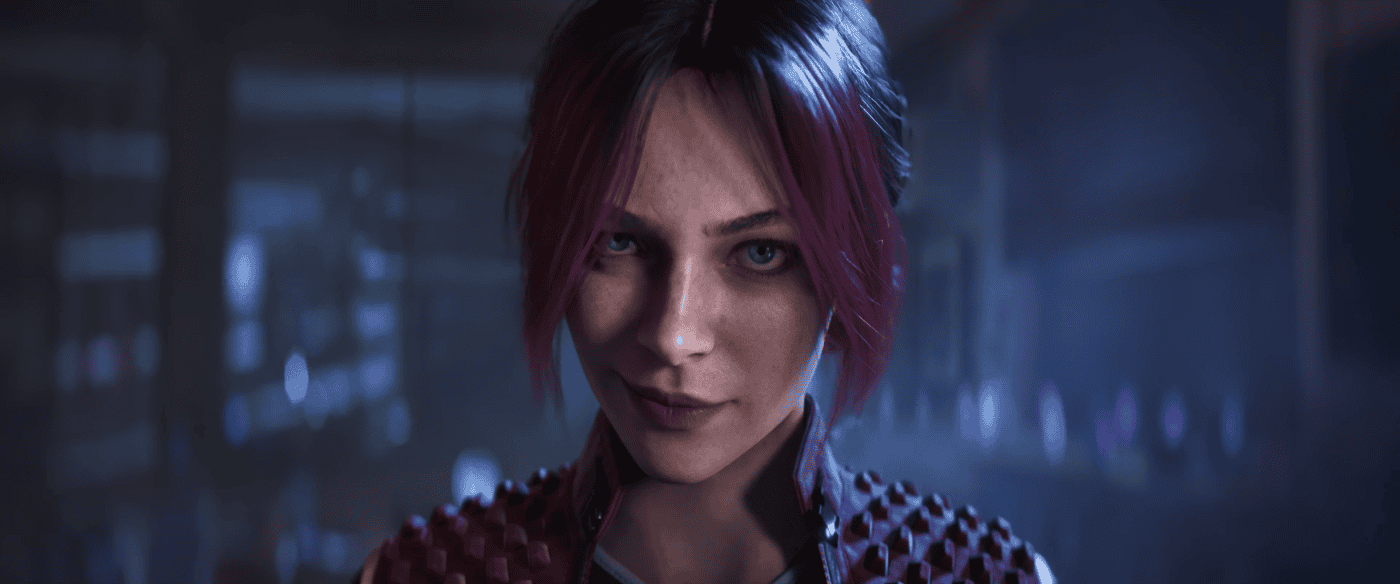

The lights of Tensor City are back on. Redline is back in the fight. And this time, she is coming for the truth.

For months, SPINE has been one of those games we have been waiting to see again. We have followed its development from afar, watching Nekki reveal just enough to keep our curiosity alive while leaving plenty of questions unanswered. Every new glimpse raised the same thought: how much longer would we have to wait before SPINE was finally ready to step back into the spotlight?
That wait has now come to an end: or, at the very least, we finally have a much clearer idea of where it is leading. Since its first appearances, SPINE has stood out for its striking visual identity, futuristic setting, and distinctive take on action combat, combining martial arts and firearms into the stylish Gun Fu system that has become one of the game’s defining features.
Yet for all the spectacular footage we had seen, there was still a great deal we did not know. What kind of world was Nekki actually building? What was driving Redline beyond the fights themselves? And how would all that stylish action fit into the larger story of Tensor City?
Those questions became increasingly difficult to ignore as SPINE spent more time away from the spotlight. The game never disappeared completely from our radar, but its long periods of silence inevitably left us wondering what was happening behind the scenes. There was clearly something ambitious taking shape, but we were still waiting for Nekki to pull back the curtain and show us how all the pieces were coming together. Now, we finally have something substantial to look at.
After months away from the spotlight, Nekki brought SPINE back to the Future Games Show, unveiling a brand-new trailer that gives us a much closer look at the project and the direction it has taken. The new footage does more than put Redline back in motion: it takes us deeper into Tensor City, introduces new characters and threats, sheds further light on the increasingly intriguing relationship between Redline and her Spine implant, and showcases several new environments and combat encounters. Most importantly, however, the trailer answers the question that has been hanging over SPINE for so long. We now know when the wait will finally be over.
So, let’s head back into the neon-lit streets of Tensor City and take a closer look at everything Nekki has revealed. From the city’s unsettling social hierarchy and the forces controlling it to Redline’s increasingly personal journey, from the mysterious role of Spine to the brutal Gun Fu combat at the heart of the experience, there is considerably more to unpack in this latest trailer than a simple return to the action. And after months of speculation, we can finally address the question that matters most: when will SPINE finally be in our hands, and where will we be able to play it?
Know Your Worth. Know Your Place. Welcome to Tensor City
There is something noticeably different about SPINE’s latest trailer. For once, Nekki does not seem particularly interested in rushing from one spectacular sequence to the next. After months of footage built around speed, precision, and the raw impact of its combat, the studio takes a step back and lets the world around Redline breathe. The fights are still here. They remain as kinetic and brutal as ever, and when the action kicks in, SPINE wastes little time reminding us why its Gun Fu combat has become such a defining part of its identity. But the new footage is interested in something else, too. For the first time, it feels as though Nekki is looking beyond the spectacle.
The camera turns toward Tensor City itself: toward the people who live beneath its neon skyline, the institutions that govern them, and the invisible rules that determine where they stand within society. It is a subtle change in emphasis, but an important one. Because behind the acrobatics, gunfire, and perfectly choreographed violence lies a world built around a much darker question: what kind of society has Redline chosen to fight? Until now, SPINE has given us a very good idea of how Redline fights. This trailer finally begins to explain why.
That distinction could prove crucial for Nekki’s game. Combat has always been its most immediate selling point. Redline’s fluid movement, the combination of firearms and martial arts, and the sheer physicality of every encounter have given SPINE an identity that is difficult to mistake for anything else. It is the kind of game that can sell itself in seconds: one fight, one sequence of perfectly timed movements, and you immediately understand what Nekki is trying to achieve.
But a memorable combat system can only take a world so far. For SPINE to truly leave an impression, Tensor City needs to be more than a backdrop for Redline’s next fight. It needs to feel like a place with its own logic, contradictions, and consequences: a society that existed before she decided to tear through it and will continue to exist around her. The latest trailer suggests Nekki is finally ready to pull back the curtain on that side of the game.
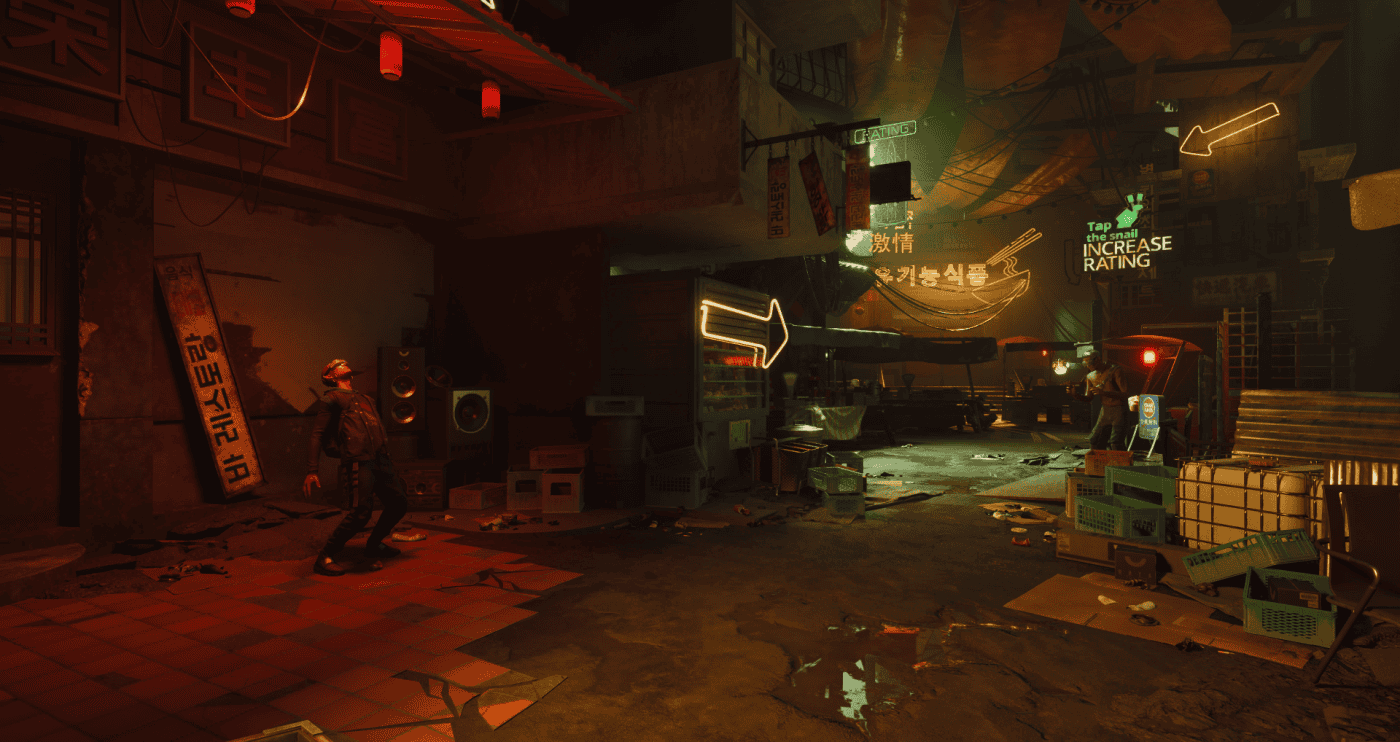
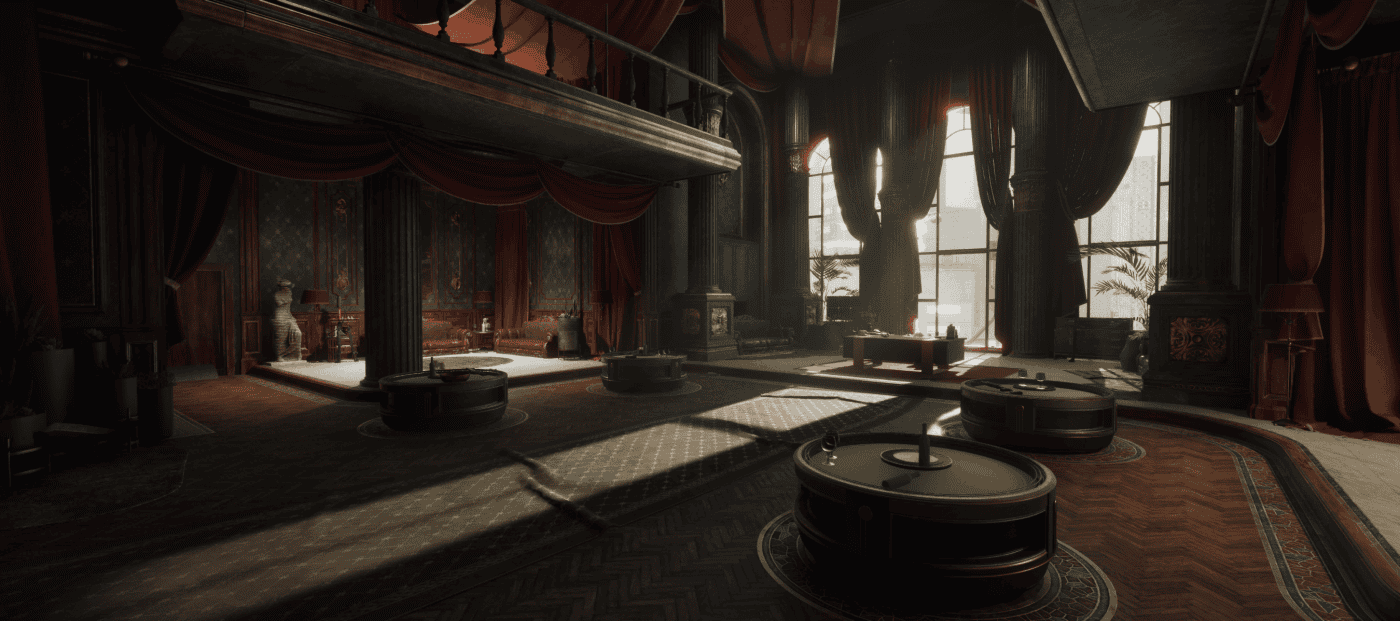
Tensor City was built on a promise. Following an ecological collapse, technology became humanity’s answer to a world that could no longer sustain itself. The city represents the logical conclusion of that idea: a highly controlled, technologically advanced society where security, stability, and efficiency have been elevated to the highest possible virtues. And, at least from the outside, it works.
That is precisely what makes it so unsettling. Beneath the immaculate architecture lies a social system designed to measure its citizens, assign them a value, and determine their place within the hierarchy. The Social Rating is perhaps the clearest expression of that philosophy. It is not simply another futuristic mechanism designed to give Tensor City its dystopian edge; it reflects something far more fundamental to the world Nekki is building: the idea that a human being can be reduced to a numberand ultimately judged by how useful they are to the society around them.
Suddenly, Tensor City looks very different. The city is no longer simply the spectacular playground through which Redline moves. It becomes the product of a system: one that has its own rules, its own hierarchy, and its own definition of what a person is worth. And Redline’s rebellion begins to take on a different meaning when placed against that backdrop. This is what makes the new trailer particularly promising. Nekki is not abandoning the spectacle that made SPINE stand out in the first place. It is giving that spectacle something to push against. The Gun Fu may be what makes Redline look dangerous. Tensor City is beginning to show us why she has to be.
The Redline We Haven’t Seen Before
Nekki does not try to unpack all of this through exposition. The trailer never pauses to explain the inner workings of Tensor, nor does it attempt to cram every detail of its world-building into a few minutes of footage. Instead, the context emerges organically, through fragments of dialogue, carefully chosen environments, and brief encounters that give the world around Redline greater definition. It is a subtle change in approach, but an important one. SPINE remains unapologetically focused on action, yet the new footage spends considerably more time allowing us to see the person at its heart. And some of the most telling glimpses come when the fighting stops.
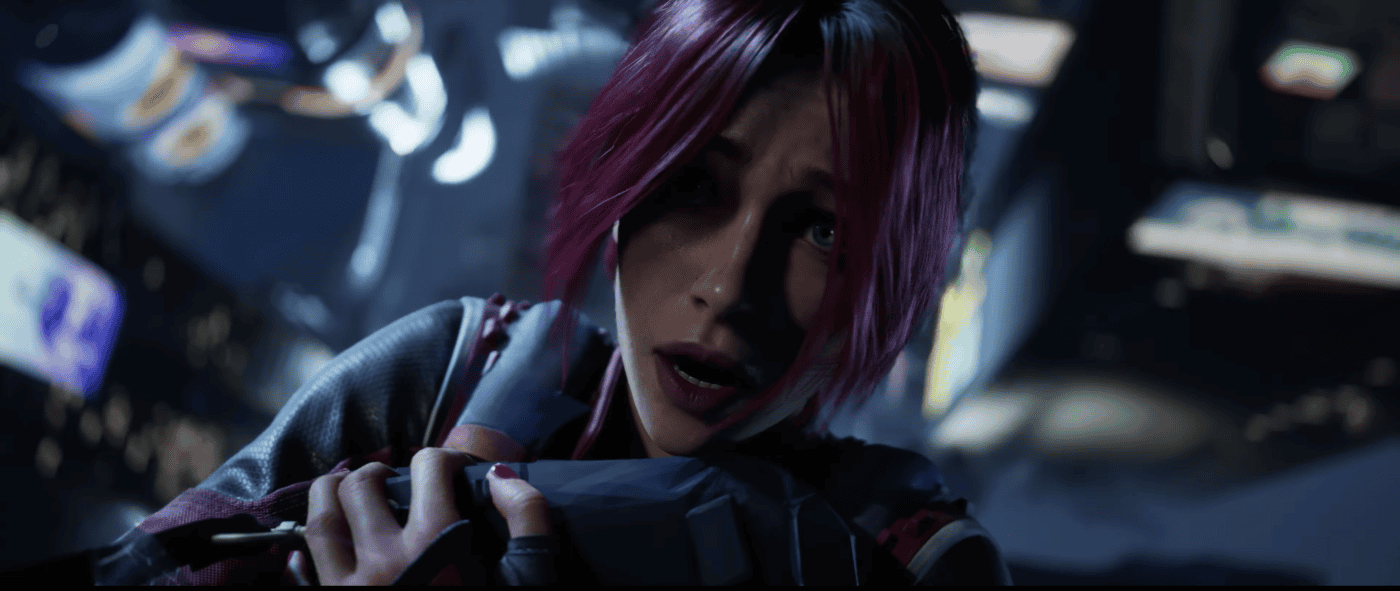
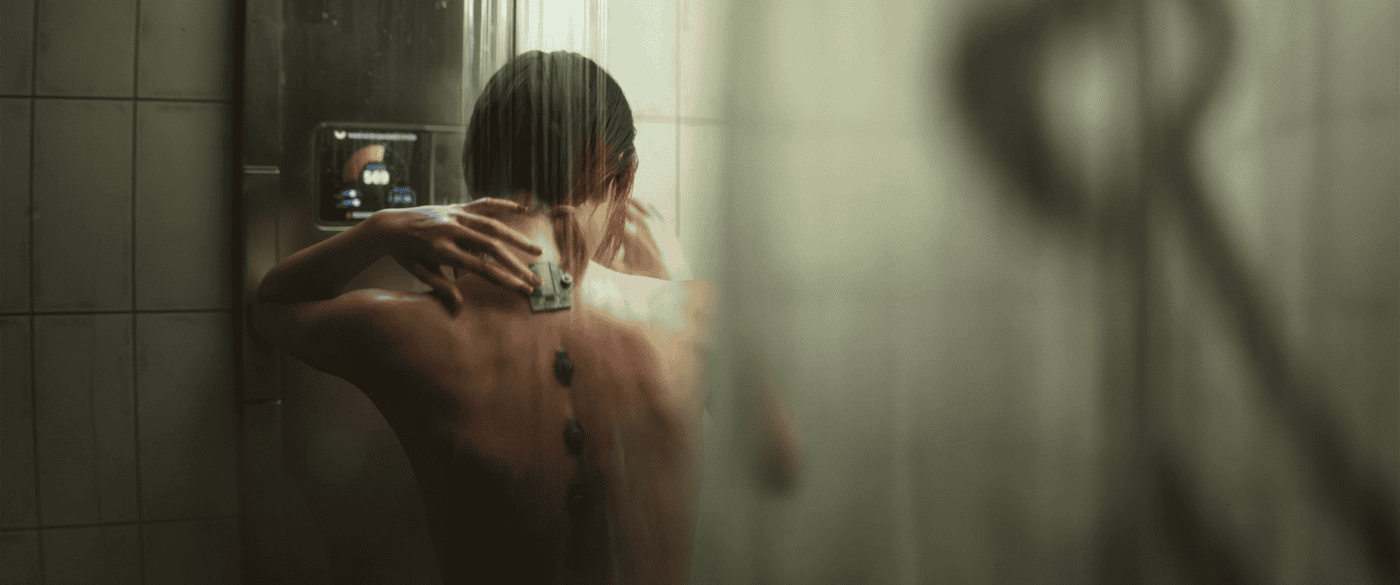
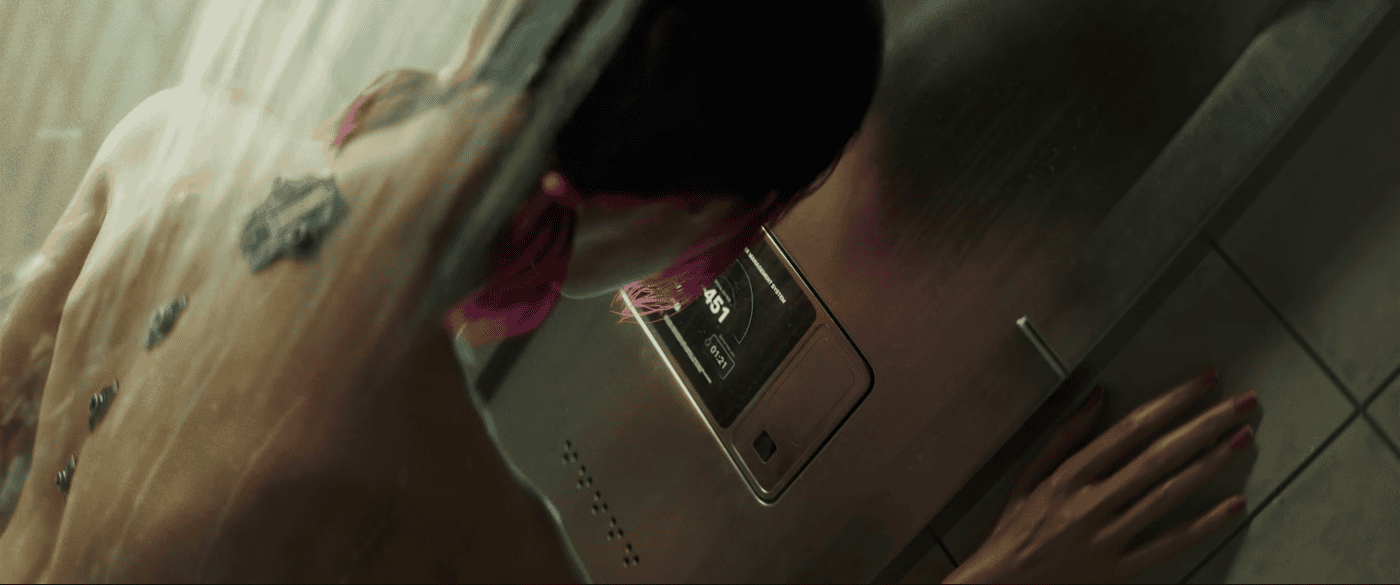
One of them arrives almost unexpectedly, as Redline stands beneath a shower. There are no enemies, no weapons, no gunfire, and none of the elaborate choreography that has become synonymous with the game. For a few seconds, the momentum of SPINE simply gives way to silence.
On its own, it is an unremarkable moment. Within the context of everything we have seen from Redline so far, however, it carries a surprising amount of weight. Until now, she has been defined largely through action: by the speed of her movements, the precision of her attacks, and the control she displays in combat. Here, all of that falls away. What remains is Redline herself.
It is a small distinction, but one that could prove important for the story Nekki is trying to tell. Redline is not merely the vehicle through which we experience Tensor City or an extension of the game’s combat system. She is a young woman navigating a society that has already determined where its citizens belong, and, through systems such as the Social Rating, what they are worth.
For a brief moment, the trailer allows us to see her outside that hierarchy and beyond the violence that surrounds her. There is vulnerability in the scene, but also something more fundamental: a reminder that the fighter we have spent so much time watching is, first and foremost, a person.
And even here, away from the battlefield, Spine remains with her.
Redline and Spine: An Unlikely Partnership
The relationship between Redline and Spine remains one of the most intriguing threads running through SPINE. The implant is not simply another weapon in her arsenal, nor is it a conventional upgrade designed to make her faster, stronger, or more capable in combat.
Spine is an advanced combat implant governed by an artificial intelligence: a piece of technology Redline stole from the very forces she is now fighting. The latest trailer suggests, however, that its importance extends well beyond what it can do in a fight.
Spine feels less like equipment and more like a character in its own right. Its exchanges with Redline hint at a relationship that goes beyond the usual dynamic between a protagonist and the tools at her disposal. There is conversation, disagreement, and a sense that Spine occupies a position of its own within Redline’s journey. We still know very little about what that relationship will ultimately become, and Nekki is clearly keeping some of those answers close.
For now, that restraint only makes Spine more intriguing. The less Nekki tells us about the implant, the more significant its presence begins to feel. It is no longer merely the technology that enables Redline’s extraordinary abilities in combat; it is a presence she can communicate with, question, and perhaps even learn to trust. As she moves deeper into Tensor, that relationship could become increasingly important, with Spine serving as both companion and counterpoint: a voice through which Redline may begin to understand the system she has spent so much of her life resisting.
That dynamic is particularly compelling because Redline and Spine come from opposite sides of the same world. Redline exists on its margins, a survivor who has learned to operate outside the rules imposed by Tensor. Spine is a product of those rules: an advanced creation born from the same technological infrastructure that gives the city its power. One is fighting to tear the system down. The other was built by it. That contradiction gives their partnership an unusual tension.
Redline is using one of Tensor’s own creations against it, turning a piece of the system’s technological power into an instrument of resistance. What was designed to serve authority has ended up alongside someone determined to challenge it. And that idea becomes even more significant when placed against the broader philosophy of Tensor City. Technology was supposed to be humanity’s answer to ecological collapse, the means by which civilization could rebuild itself around stability, security, and control. Yet that same technology has become inseparable from the mechanisms used to monitor citizens, classify them, and determine their place within society.
Spine sits directly at the heat of that contradiction. For Tensor, it may be an advanced piece of technology. For Redline, it is becoming something far more personal. As she searches for her missing brother and follows the trail deeper into the heart of Tensor City, Spine could offer something she cannot find anywhere else: an understanding of the system from the inside.
That may prove to be its most important function. Redline stole Spine because she needed a weapon. She may discover that what she really needed was a way to understand the enemy.

What Redline Is Really Fighting For
For all the political turmoil surrounding Tensor, Redline’s journey is driven by something far more personal: the disappearance of her brother. It is a crucial piece of her story, giving a deeply human motivation to a character who soon finds herself caught up in a conflict far greater than she could ever have anticipated. Redline is not fighting simply because she believes Tensor City is unjust. Her rebellion does not begin with an ideological rejection of the rules imposed upon its citizens.
She is looking for someone she loves. That single objective gives everything she does a different weight, transforming her struggle against Tensor from a straightforward fight against an oppressive system into something much more intimate. Beneath the rebellion, the violence, and the relentless forward momentum, there is a sister searching for her brother.
That search is what keeps Redline moving. Every confrontation, every pursuit, and every step deeper into Tensor brings her closer to the truth surrounding his disappearance, while simultaneously drawing her further into the very system she is trying to understand. What begins as a deeply personal mission could eventually take her far beyond the path she thought she was following, carrying her from the outer edges of Tensor City toward the very heart of the power that governs it.
And this is perhaps where SPINE has the most interesting story to tell. Redline is looking for her brother, but the deeper she goes, the harder it becomes to separate that search from the larger struggle against Tensor. Finding him may mean uncovering the forces responsible for his disappearance, confronting the people who sit at the top of the city’s hierarchy, and ultimately challenging a system powerful enough to reduce an individual life to little more than a statistic.
In other words, a deeply personal mission could become the beginning of something much larger. Redline may have entered this fight looking for one person, but the answers she finds along the way could force her to question the entire world around her. And the latest trailer finally begins to put faces to the forces standing between Redline and those answers.
The Power Brokers of Tensor City
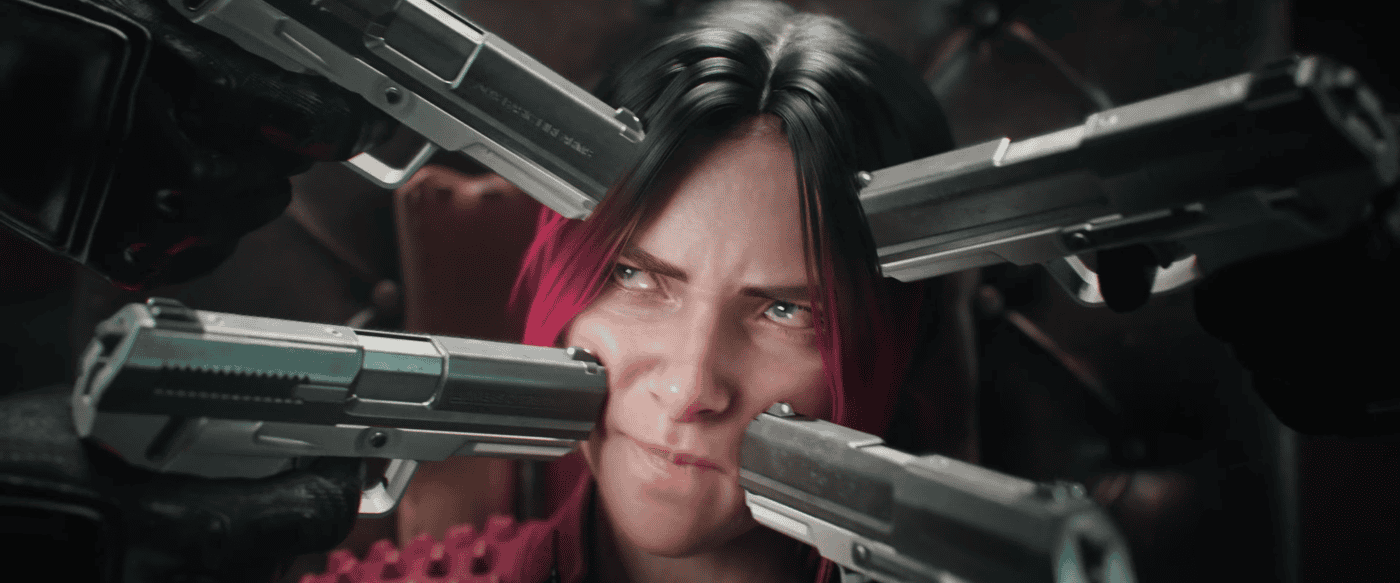
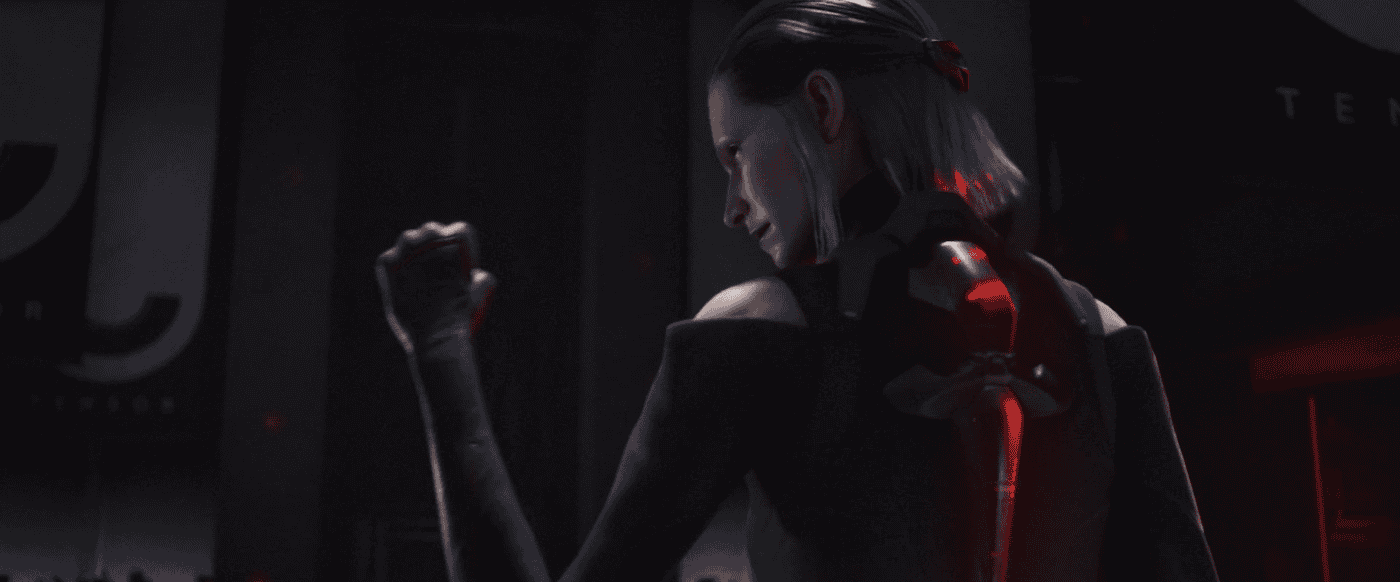
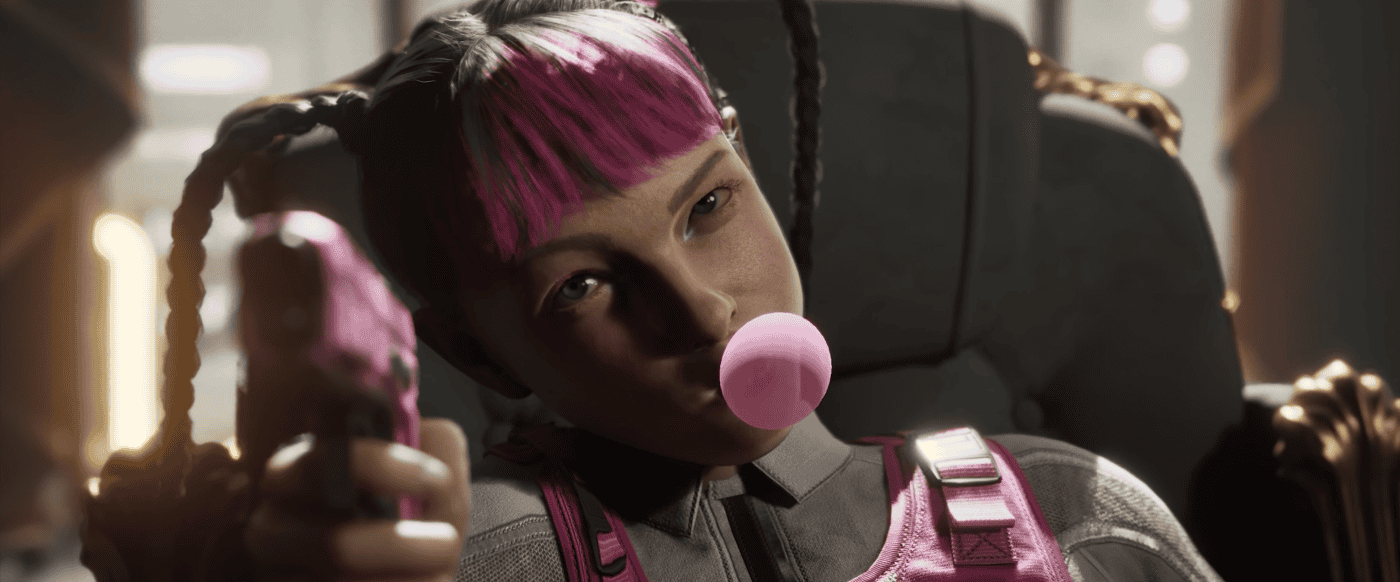
Then Judge, Edda Kopp, and Malady enter the picture, and with them, Tensor City finally puts a face to its power. Judge stands at the very top of the city’s hierarchy, its supreme leader and ultimate authority. Edda Kopp and Malady, meanwhile, are the Daughters of Tensor, two characters whose presence seems to embody the strength and authority of the system itself.
Until now, Tensor has largely been presented as something vast and almost intangible: a society governed by surveillance, social rankings, and rules designed to keep every citizen in their place.

These three figures give an otherwise abstract system of power a distinctly human face. There is a person behind the authority, a will behind the rules, and, perhaps most importantly, someone willing to protect the world Tensor has built. That gives Redline’s struggle a sharper edge. Her enemy is no longer simply the faceless machinery of an oppressive society, but the individuals who occupy its highest ranks and have a direct stake in preserving it. The deeper Redline ventures into Tensor, the closer she comes to the people who embody the very order she has chosen to defy.
Yet the most intriguing revelation may have little to do with their position within that hierarchy. It is what they carry. Both Edda Kopp and Malady possess a Spine, the same advanced technology that Redline stole from the forces she is now fighting. On the surface, it may seem like another detail meant to reinforce their status as formidable opponents. Look a little closer, however, and it raises a much more interesting question: what exactly is Spine within Tensor’s society?
If Redline’s implant is not unique, who is allowed to have one? Is access to Spine reserved for those at the top of Tensor’s hierarchy? Does possessing one signify power, privilege, or something else entirely? And if the Daughters of Tensor are equipped with the same technology as Redline, could there be a connection between the implant, the people who control Tensor, and Redline’s own place within that world that we have yet to understand? The trailer leaves those questions unanswered.
And that may be its smartest decision. Not every mystery needs an immediate explanation. In fact, some of the most effective reveals are the ones that give us just enough information to understand that something matters, while withholding enough to keep us looking for the pieces that are still missing. That is precisely where SPINE seems to be right now.
Judge, Edda, and Malady finally give Tensor’s power a human presence, but their arrival only makes the larger picture more intriguing. We can now see the people standing at the top of the system. What we still cannot see is everything that connects them to Redline, and to the Spine she carries.
Gun Fu Takes Center Stage
There was never going to be a new SPINE trailer without Gun Fu. After pulling the camera back to explore Tensor City, its hierarchy, and the people who sit at the heart of it, Nekki eventually returns to the feature that has made its action game so immediately recognisable: the combat.
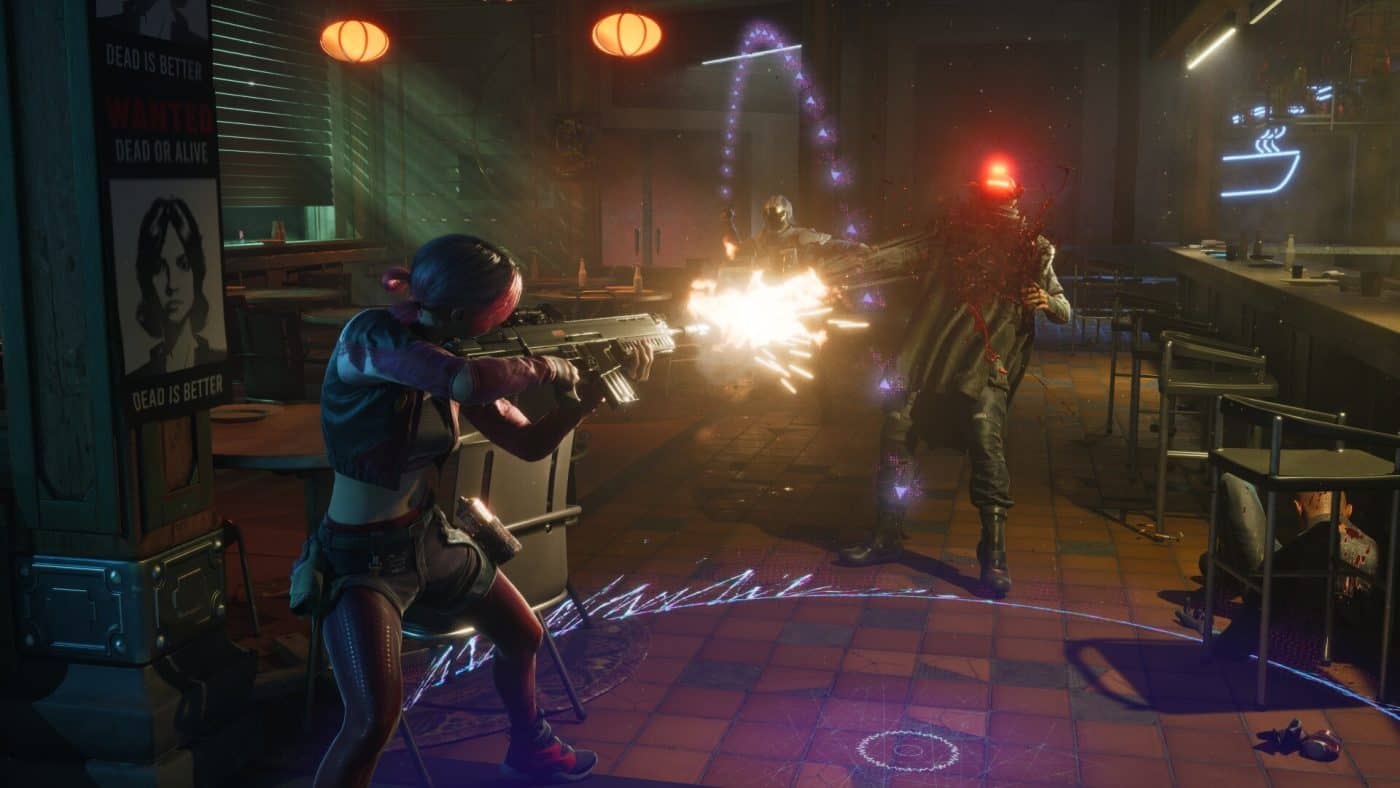
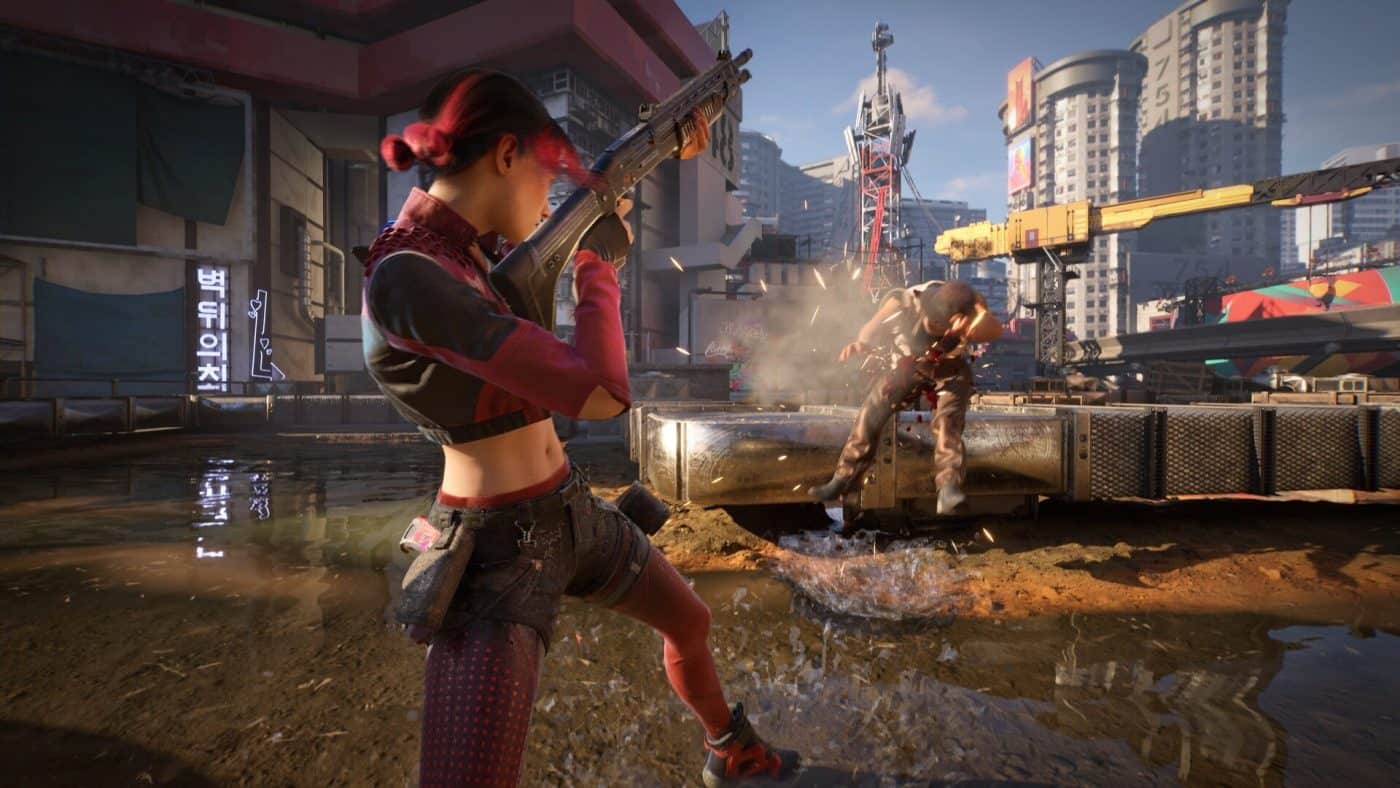
The new footage gives us perhaps our clearest look yet at how Redline is meant to move through a fight. Directional attacks, parries, dodges, counters, and environmental interactions all feed into the same kinetic flow, with the world around her serving as far more than a backdrop. Enemies, objects, and the environment itself can become part of the choreography, creating opportunities to extend an attack, shift position, or turn a defensive manoeuvre into the opening for another strike.
That is what makes Gun Fu particularly intriguing. In SPINE, movement is not separate from combat. It is combat. Every action appears designed to lead naturally into another. A dodge can become a parry; a parry can create the opening for a counter; a counter can carry Redline straight into her next attack. The environment then adds another variable to the equation, giving players yet more ways to maintain momentum and turn the flow of a fight in their favour.
On paper, it is an elegant approach. Rather than dividing combat into clearly defined phases of attack, defence, and repositioning, SPINE appears intent on blurring those boundaries altogether. The result Nekki is chasing is not a collection of flashy moves, but a combat system built around reaction, timing, and momentum, one in which the most effective decision may change from one second to the next. That distinction will matter enormously once the controller is in our hands.
There is an obvious difference between watching a character perform an impeccably choreographed sequence and actually having the freedom to create one yourself. SPINE has already demonstrated that it can look like an action movie. The real test will be whether its systems can give players the same sense of control and precision that Nekki’s footage so effortlessly conveys.
The latest trailer also gives us a glimpse at new boss encounters, suggesting that Redline’s Gun Fu will be tested against opponents capable of pushing the system beyond its more familiar rhythms. Their choreography is certainly impressive, but what matters now is how much depth lies beneath it: how differently these encounters can be approached, how much room there is for experimentation, and whether the combat remains as fluid when every decision is ours to make.
The latest trailer also gives us a glimpse at several new boss encounters, suggesting that Redline’s Gun Fu will be pushed to its limits against opponents designed to challenge everything we have seen so far. Their choreography is certainly impressive, but the real question lies beneath the spectacle: how much depth will these encounters offer once we are the ones in control? The answer will depend on how much room the combat leaves for experimentation, how differently each confrontation can be approached, and whether SPINE can maintain the same sense of fluidity when every decision, and every mistake, belongs to us.
That is something we will only be able to judge once SPINE is finally in our hands. For now, though, Nekki is making its intentions increasingly clear. Gun Fu is not simply SPINE’s greatest visual attraction. It is the foundation of how Redline moves, fights, survives, and experiences Tensor City.
And just as the trailer brings us back to the heart of its action, Nekki gives us another reason to look beyond the fights, because Tensor City itself still has plenty more to show us.
The City Beneath the City
The new trailer also takes us deeper into Tensor City itself, revealing just how much lies beneath the immaculate surface of Nekki’s futuristic metropolis. For all its towering architecture, neon-lit streets, and technological sophistication, Tensor City is not as pristine as it wants its citizens to believe. The trailer takes us beneath its polished exterior and into underground laboratories, hidden spaces where Tensor’s technology takes on a considerably darker and more unsettling character. Far removed from the order and security promised to those living above, these locations hint at a side of the city that its citizens were never meant to see, and suggest that Tensor’s vision of progress may have a far darker cost than its immaculate surface would have us believe.
That contrast is becoming increasingly central to SPINE’s world. Tensor City is built on the promise of technological progress, a society shaped by order, efficiency, and control.
Yet the deeper Redline ventures into its heart, the more that carefully maintained image begins to give way, revealing the machinery and structures that keep it standing. There is the city Tensor wants its citizens to see, and the reality it would rather keep out of sight.
The trailer expands that picture even further with a glimpse of the vast cliffs surrounding the city, opening up the world beyond its dense urban core. It is another indication that SPINE’s setting may have considerably more geographical variety than previous footage had suggested, with Tensor City extending far beyond the streets and skyscrapers that have defined its visual identity so far.
Then comes one of the trailer’s most striking sequences: Redline fighting on the roof of a high-speed train, with the landscape rushing past at extraordinary speed. It is a scene that distils much of what makes SPINE immediately recognisable: velocity, technology, movement, danger, and the kind of kinetic spectacle Nekki has been showcasing since the game was first unveiled.
Yet the sequence lingers for reasons that go beyond its visual spectacle. By this point, the environments in SPINE are beginning to feel like an extension of the story rather than mere backdrops for it. The underground laboratories, the cliffs surrounding the city, and even the speeding train all add to a broader portrait of Tensor as a world defined by stark contrasts. Its technological perfection exists alongside deep inequality; its promise of order depends on control; and beneath its immaculate surface lies a reality that Redline is only beginning to uncover. These places are not simply where Redline fights. They are part of what she is fighting against.
And perhaps that is the most important thing the new trailer tells us about SPINE. Tensor City is not merely the backdrop to Redline’s rebellion. It is the reason that rebellion had to happen.
When and Where Will SPINE Be Released?
After months of waiting, we finally have an answer.
SPINE is scheduled to launch in summer 2027 for PC, PlayStation 5, and Xbox Series X|S, as confirmed by Nekki in its latest trailer. The studio has yet to provide any further details on the Nintendo Switch 2 version, leaving its release plans for the platform unconfirmed for now.
There is still plenty we have yet to see from SPINE, but this latest showcase feels like an important step forward. Nekki has offered a broader glimpse into Tensor City, shed more light on Redline’s personal journey, and given us another look at the Gun Fu combat that remains at the core of the experience. With the game now targeting summer 2027, there is still time for the studio to pull back the curtain further and show us what lies beyond what we have seen so far.
For now, though, one of the biggest questions surrounding SPINE has finally been answered. We know when Redline’s journey will begin, and where we will be able to join her. Summer 2027 may still be some way off. But after such a long wait, at least the countdown has finally begun.