
In short
REANIMAL is not a perfect nightmare. But it is a beautifully crafted one, and sometimes the most memorable horrors are not the ones that give us the most to do. They are the ones we cannot quite shake once they are over.
Tarsier Studios knows exactly how to make a nightmare feel real. REANIMAL is proof of that. The real question is whether there is enough beneath the surface to make us truly afraid of waking up.

There are few studios that understand the language of nightmares quite like Tarsier Studios. Since Little Nightmares, the Swedish developer has carved out a distinctive identity with a particular kind of horror—one that rarely relies on gore, constant combat, or predictable jump scares to get under our skin. Instead, Tarsier finds unease in distorted childhood imagery, oppressive environments, grotesque silhouettes, and the lingering, deeply unsettling feeling that something is terribly wrong.
REANIMAL is the studio’s latest attempt to push that philosophy even further, leaving the familiar behind while carrying its most recognizable ideas into a darker and more personal world.
At the heart of this new nightmare are a brother and sister, two orphaned children who return to an island that has become almost impossible to recognize. Their journey begins with a straightforward purpose: find their missing friends and escape. What follows is anything but simple. As the siblings move deeper into the island, they encounter ruined settlements, abandoned structures, flooded passages, dense forests, and creatures that seem to have emerged from some deeply corrupted version of childhood. REANIMAL rarely explains its world outright.
Instead, it asks us to read between the lines, to understand what happened through its environments, its imagery, its symbolism, and the unsettling details scattered across the journey.
That restraint is fundamental to the way REANIMAL approaches horror. The world itself is the threat. Tarsier takes places and objects that should feel familiar and twists them into something alien, creating an environment where even an apparently harmless stretch of woodland can feel unsafe. Its creature design follows the same principle. These are not simply monsters placed in the player’s path; they are grotesque, exaggerated figures that feel as though they belong to the same distorted logic as the world around them. The result is an adventure in which anticipation often matters more than confrontation. The fear comes from wondering what is ahead, and from knowing that whatever it is, we probably do not want to meet it.
Mechanically, REANIMAL keeps things deliberately focused. Its campaign moves through exploration, environmental puzzles, platforming, stealth, chases, and occasional combat, with each element designed to support the pacing and atmosphere rather than develop into a complex system of its own. The puzzles rarely demand extensive thought, combat remains deliberately lightweight, and stealth is built around simple but effective encounters. Rather than pursuing mechanical depth, REANIMAL uses these elements as part of a tightly directed, cinematic experience, constantly guiding us toward the next location, discovery, or carefully staged encounter.
Perhaps the most significant addition to Tarsier’s formula is the role of co-op. The relationship between the two protagonists is not merely a narrative detail; it shapes the way the entire adventure is experienced. In single-player, we control one sibling while the other accompanies us, while local and online co-op allow two players to share their journey. Obstacles, environmental interactions, and certain encounters are designed around cooperation, making the bond between the characters something we actively experience rather than simply observe.
The shared camera is perhaps the most distinctive part of this design. By keeping both siblings within the same frame, REANIMAL turns proximity into a fundamental part of the experience: you move together, solve problems together, and face the island’s dangers without ever fully escaping the other character’s presence. It can occasionally work against the player, particularly in tighter environments or during sequences that demand quick movement, but it also reinforces something essential to the game’s identity: vulnerability is more powerful when it is shared. In a world this hostile, having someone beside you is not merely a mechanical requirement: it becomes a source of reassurance, companionship, and, at times, the only thing making the darkness feel bearable.
And this is where REANIMAL is at its most compelling. On an audiovisual level, Tarsier Studios is operating at the height of its craft. Its environments are meticulously composed, its creatures are grotesque without ever feeling arbitrary, and its lighting transforms even familiar spaces into places that seem fundamentally unsafe. The sound design is just as effective, understanding that silence can be every bit as unsettling as a sudden noise. A distant sound, a barely visible shape, an open doorway, or a room that appears completely empty can all become sources of tension. REANIMAL rarely needs to tell us that something is wrong. It simply creates the conditions for us to feel it.
But the further we look beneath that polished surface, the more apparent REANIMAL’s limitations become. For all the ambition of its presentation, it is a more restrained game than its audiovisual identity might suggest. Its mechanics rarely evolve beyond their basic foundations, its puzzles seldom demand much more than careful observation, and its combat never develops into a particularly substantial part of the experience. None of this feels entirely out of place within Tarsier’s tightly controlled approach, but it does reveal a noticeable gap between the richness of the world we are exploring and the depth of the systems through which we interact with it.
The narrative presents a similar contradiction. REANIMAL is often at its best when it communicates through symbolism, environmental storytelling, and deliberate ambiguity, allowing its imagery to speak where exposition might otherwise take over. Yet ambiguity can only carry a story so far. Some of the questions it raises are compelling precisely because they are left open to interpretation, while others feel as though they deserved more room to breathe and develop. By keeping so much beneath the surface, REANIMAL occasionally turns its greatest narrative strength into a limitation, leaving us intrigued by ideas that the game never quite explores as deeply as they deserve.
That tension defines much of the experience. REANIMAL is a game that looks, sounds, and feels richer than it sometimes plays. Tarsier has once again demonstrated an exceptional ability to create a world that can unsettle us without constantly explaining why, and there is genuine emotional weight in the relationship between its two protagonists. Yet the nightmare occasionally feels more complete as an audiovisual experience than as a game. Still, there is something difficult to dismiss about the world Tarsier has created. REANIMAL may not always dig as deeply as its imagery suggests, but it understands something fundamental about horror: sometimes the most effective monster is the one we are still trying to understand after we have stopped playing.


A New IP, a New Partnership, a New Nightmare
REANIMAL is the latest work from Tarsier Studios, the Malmö-based Swedish developer founded in 2004 that has spent much of its history refining a distinctive language of horror. The studio became widely recognized through the first two Little Nightmares games, where it established a visual identity rooted in distorted childhood imagery, oppressive spaces, grotesque creatures, and storytelling that trusts players to find meaning in what is left unsaid. That creative DNA is unmistakable in REANIMAL, but the game marks a significant departure from Tarsier’s previous work. It is not another entry in Bandai Namco’s series, but the studio’s first major step into an entirely original universe following Embracer Group’s acquisition of Tarsier in 2019, with Little Nightmares III continuing independently under a different development team.
The influence of Little Nightmares is unmistakable, but REANIMAL is far from a simple continuation of what came before. Tarsier carries forward many of the creative signatures that have defined its work: oppressive environments, child protagonists, grotesque creatures, and a form of storytelling rooted as much in symbolism and suggestion as in explicit answers. Yet beneath those familiar elements, the studio introduces a meaningful shift: REANIMAL takes the foundations of Tarsier’s established horror and reshapes them around a very different kind of experience.
By placing two protagonists at the heart of the experience and building the entire journey around cooperation, Tarsier fundamentally changes the way REANIMAL’s horror unfolds. The shared dynamic camera, which keeps both characters within the same frame, is more than an unusual design choice; it becomes a crucial part of how the game creates tension and vulnerability.
REANIMAL feels less like a return to an established formula than an attempt to evolve it. Tarsier is drawing on the experience that shaped Little Nightmares, but it is also using that foundation to explore what its particular brand of horror can become when the focus shifts from a solitary journey to one built around two characters moving through the darkness together. The studio has described the project as a spiritual successor to its earlier work, with the intention of pushing its horror further and creating an even more unsettling experience. That ambition is reflected throughout the game: the artistic philosophy remains recognizably Tarsier, while its cooperative structure opens up a different relationship between the player, the world, and the characters inhabiting it.
The project also marks a new chapter for Tarsier on the publishing side, with THQ Nordic taking REANIMAL to market. The game launched on February 13, 2026, for PC, PlayStation 5, Xbox Series X|S, and Nintendo Switch 2, giving the studio’s new universe a broad multiplatform reach from day one. That distinction is important for a studio whose identity has long been tied to Little Nightmares. With REANIMAL, Tarsier is no longer building within an established franchise: it is creating a world of its own, with the freedom to define a new identity on its own terms.
THQ Nordic’s commitment also extends beyond the initial release, with additional content planned around the REANIMAL universe. That post-launch strategy points toward a partnership interested in building the foundations of a new property rather than treating the game as a one-off experiment. Whether that universe ultimately grows into something larger remains to be seen, but the intention is clear: REANIMAL is being positioned as the beginning of a new chapter for Tarsier, not merely a footnote to its past.
And that is ultimately what makes the game so significant for the studio. REANIMAL carries the unmistakable fingerprints of the team behind Little Nightmares, yet it is no longer defined by that series. Tarsier has taken the artistic instincts, lessons, and sensibilities accumulated over years of creating unsettling worlds and turned them toward something it can finally claim as its own. The nightmares may feel familiar, but the world belongs to Tarsier.


A Childhood Lost Beneath the Waves
REANIMAL begins with five children gathered around an old well, silently looking into its depths. It is a deceptively simple image, but one that gradually assumes greater significance as the story unfolds. Soon after, control shifts to the Boy, one of the game’s two protagonists, who awakens and crosses the sea in a small boat. Along the way, he finds his Sister floating in the water, apparently unconscious. He pulls her aboard, and the two eventually make their way back to the island they once called home, searching for the three friends who have disappeared.
What awaits them is anything but familiar. The island has been ravaged by some unexplained catastrophe, with large portions submerged beneath the water and the remnants of its former life scattered across ruined buildings and overgrown wilderness. The sense of returning home quickly gives way to something far more unsettling: the children are moving through a place that feels as though it has survived whatever happened to it only in the most literal sense.
Their search leads them first to an abandoned industrial complex, where they encounter Hood, one of their missing friends. The reunion, however, is painfully brief. The facility is overrun by strange creatures, and in the chaos, a tall figure known as Sniffer captures Hood and carries her away in a van. The Boy and the Sister give chase, following Sniffer through the surrounding forest and into a succession of increasingly hostile environments until they finally reach its hideout. After rescuing Hood, the three attempt to escape the island in the vehicle, but their getaway ends in an accident, leaving them stranded and forcing them to continue their search on foot and across the water.
The same uneasy rhythm defines what follows. The children move through flooded areas, ruined structures, forests, and abandoned facilities in search of Bandage and Bucket, gradually encountering creatures that appear to be tied to the island and whatever happened to it. When Bandage is finally found, another reunion turns into another separation: a gigantic pelican snatches the child and carries him away, sending the others after it toward a distant lighthouse. Every reunion in REANIMAL seems to contain the possibility of another loss, keeping its protagonists in a constant state of movement and preventing their growing group from ever feeling entirely safe.
Running alongside this search is a much more intimate mystery surrounding the Sister. She begins to suffer from strange disturbances and increasingly frequent visions, with a lamb repeatedly appearing at the center of them.The animal first appears at the bottom of the well in the opening scene, seemingly just another unexplained detail in a world already filled with them. Yet as the story unfolds, the image becomes increasingly difficult to dismiss.
The lamb grows larger and more threatening with each vision, eventually emerging from the well as a gigantic and terrifying beast. What initially seems like nothing more than a disturbing presence within the Sister’s mind gradually takes on a life of its own, becoming a tangible threat that continues to haunt the children as they struggle to find a way off the island.
Tarsier deliberately keeps much of this story at a distance. Rather than stopping to explain its world, REANIMAL communicates through visual motifs, environmental details, brief sequences, and carefully staged encounters. The player is expected to notice connections, interpret recurring imagery, and draw conclusions from what the game chooses to show rather than what it chooses to explain. It is a storytelling philosophy Tarsier has become particularly adept at, and REANIMAL pushes it even further by allowing its most important ideas to remain buried beneath the surface.
Once the five children are finally reunited, they turn their attention toward the only goal that matters: escaping the island. Their attempt, however, coincides with the creature from the well finally breaking free. The beast rapidly grows and begins hunting the children, consuming them one by one as the group desperately attempts to survive. Even a tank is brought into the confrontation, seemingly causing devastating damage, yet the creature refuses to die. The pursuit continues until the Sister is ultimately swallowed and finds herself inside the beast, where a surreal succession of environments and visions leads her back toward the story’s central structure, eventually bringing her face to face with the other children once again.
Once the five children are finally reunited, their objective is clear: escape the island for good. But their attempt to flee coincides with the creature from the well finally breaking free. The beast rapidly grows into an enormous, relentless force, hunting the children down and devouring them one by one as they desperately fight to survive. Even a tank is brought into the confrontation, seemingly inflicting devastating damage upon it, yet the creature survives and resumes its pursuit.
Eventually, the Sister is swallowed by the beast and awakens deep inside its body, where a surreal succession of environments and visions draws her further into the nightmare. Her path leads her back to the mysterious structure at the heart of the story, where she comes face to face with the other children once again. It is here that REANIMAL embraces its ambiguity most completely.
The game’s ending deliberately leaves several pieces of the story without a definitive explanation, refusing to neatly reconstruct the events that brought the island to ruin or provide clear answers to every question raised along the way. Instead, meaning remains scattered across the world itself: in its creatures, locations, recurring imagery, and the symbols Tarsier places along the way. The result is a story that trusts its imagery more than its exposition, inviting interpretation rather than demanding a single answer. It is often an effective choice, although there are moments when the questions REANIMAL raises prove more compelling than the answers it ultimately provides.


The Things Children Should Never Have to See
REANIMAL takes a deliberately different approach to horror. Rather than building its narrative around lengthy cutscenes, extensive dialogue, or explicit exposition, Tarsier Studios allows the world itself to do most of the talking. Its environments, character animations, visual motifs, recurring imagery, and carefully placed symbols carry much of the story, often communicating ideas that the game never puts into words. It is a method that demands attention from the player.
REANIMAL rarely stops to explain the meaning behind what we see, instead leaving fragments for us to connect and details for us to interpret. Its story is not so much told as suggested, gradually taking shape through the relationship between its imagery, characters, and environments.
This philosophy is recognizably Tarsier, but REANIMAL applies it to considerably heavier material. The more overt fairy-tale quality associated with the studio’s previous work gives way to something darker and more confronting, allowing themes of violence, trauma, loss, and vulnerability to sit much closer to the surface. As narrative director David Mervik has explained, the project was conceived around the desire to tackle harsher themes, including a more explicit depiction of violence that is less sheltered by fantasy. Violence is consequently one of the game’s defining themes, but it extends far beyond the physical brutality of its creatures and encounters.
REANIMAL presents violence as something transformative: a force capable of changing people, corrupting environments, and altering the way children understand the world around them. The island feels like the physical consequence of such a reality, while many of its creatures appear as grotesque distortions of something that was once recognizable. The distinction between victim and perpetrator is unstable, making the game’s monsters disturbing not simply because they are monstrous, but because the boundary between the human and the inhuman is never entirely clear.
This idea feeds directly into REANIMAL’s treatment of innocence and its loss. Placing children at the heart of the story is not simply a way of making them more vulnerable; it fundamentally changes the way the nightmare is perceived. The Boy and the Sister are forced to confront a reality shaped by violence, fear, and cruelty, yet they experience it through the limited understanding of childhood.
They encounter things they are too young to fully comprehend, but are given no choice but to move through them. The horror lies not only in what they witness, but in the fact that they are being forced to understand a world they should never have had to know.
Tarsier uses that vulnerability to explore the brutal process of growing up before one is ready. The children encounter experiences that should have no place in childhood, and survival gradually demands that they adapt to them. Their innocence therefore becomes more than a character trait: it becomes one of the things the world around them is constantly threatening to take away.
At the heart of that experience is the bond between the Boy and the Sister. Their relationship is communicated with remarkable restraint. There are no lengthy conversations explaining what they mean to one another; instead, their connection emerges through movement, gestures, reactions, and the instinctive way they remain close when everything around them becomes hostile.
This is where REANIMAL’s cooperative design becomes particularly meaningful. Cooperation is not simply a gameplay mechanic; it is part of the narrative language. Helping each other, waiting for one another, pulling the other through danger, or simply refusing to move forward alone communicates their relationship more effectively than exposition ever could. Their bond feels earned because the game allows us to observe it rather than constantly insisting upon it.
The idea of family expands further through the other children. They are not merely objectives scattered throughout the adventure, but part of a fragile community attempting to survive after being stripped of almost every source of security. Their shared status as orphans reinforces the importance of belonging, protection, and mutual dependence.
Finding one another, then, becomes about far more than bringing a scattered group back together. It is an attempt to rebuild a sense of family in a world where almost every source of safety and belonging has been torn away. Here, family is not defined solely by blood, but by trust, dependence, and the instinct to protect one another when there is nothing else left to hold on to.
Having been separated from the lives they once knew, the children are not simply searching for those who are missing. They are searching for a place where they can feel safe again, and, perhaps more importantly, for people who can make that place feel like home.
All of these themes converge around fear, loss, trauma, and survival. Horror in REANIMAL is not something that simply appears during a chase or disappears once an encounter ends. It becomes the condition in which the protagonists exist. Fear follows them from one environment to the next, shaping their decisions and reinforcing their dependence on one another.
Survival consequently carries a weight beyond simply reaching the next checkpoint: it becomes a matter of enduring without completely losing what remains of their humanity and innocence.
Yet the game’s reliance on ambiguity is also where its narrative becomes most divisive. Leaving elements unexplained gives its symbolism room to breathe and encourages us to search for meaning beyond the surface of what we see. At its best, REANIMAL understands that uncertainty can be more powerful than exposition, allowing certain images to remain with us precisely because they are never fully resolved. At other times, however, the distinction between deliberate ambiguity and underdevelopment becomes less convincing, with some of the questions raised throughout the adventure feeling more intriguing than the material ultimately provided to answer them.
That tension ultimately defines REANIMAL’s storytelling. It is a narrative built on suggestion rather than explanation, on images rather than exposition, and on emotional impressions rather than definitive answers. Violence, the loss of innocence, trauma, belonging, family, and the relationship between its protagonists give the adventure a thematic depth that extends well beyond its surface as a horror story about children trying to escape a ruined island.
For some players, that openness will be part of the appeal; for others, it may leave the narrative feeling frustratingly incomplete. But there is confidence in Tarsier’s restraint. REANIMAL does not always tell us what its images mean, and it does not always give us the answers we might want. Instead, it leaves us with something arguably more appropriate to its vision of horror: questions that continue to linger long after the nightmare itself has ended.


A World Designed to Make You Uncomfortable
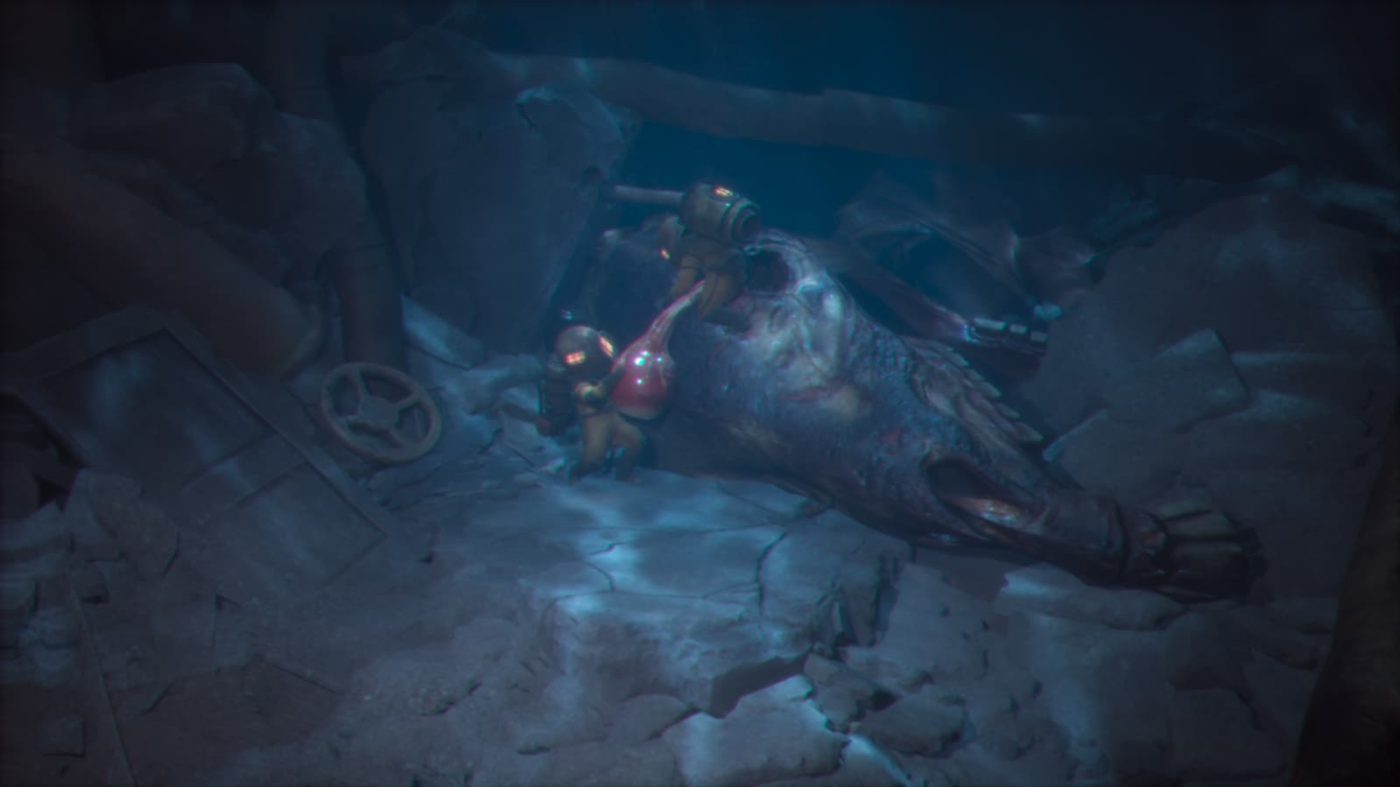
From a technical and artistic standpoint, REANIMAL is a compelling demonstration of Tarsier Studios’ ability to make visual design an essential part of its horror.
Developed in Unreal Engine 5, the game benefits from detailed environments, convincing materials, and a sophisticated use of light and shadow. Yet its greatest achievement is not technical fidelity in itself. Tarsier understands that technology is most effective when it disappears behind the artistic intent, and here every visual element, from the way a room is framed to the surfaces that catch the light, is carefully considered as part of the atmosphere.
Few aspects of the game are as immediately distinctive as its art direction. Tarsier takes familiar places and makes them feel fundamentally unfamiliar, manipulating proportions, shapes, textures, and materials until even ordinary objects acquire an unsettling quality.
The island is not simply a collection of ruined locations; it feels like a place whose reality has been distorted by whatever happened to it. Abandoned industrial facilities, crumbling buildings, flooded areas, and decaying interiors each carry a distinct visual identity, giving the journey a welcome sense of progression while preserving a coherent aesthetic. Just as importantly, the game knows when to compress that space into claustrophobic corridors and when to open it up, allowing the scale of the island, and the loneliness of the characters within it, to become part of the experience.
Lighting is arguably the most important tool in that visual vocabulary. It does not merely illuminate the environments; it determines what we are permitted to see and what remains beyond our certainty. A narrow beam can isolate a single object while leaving an entire room concealed in darkness. Reflections shimmer across flooded surfaces, artificial lights cut through abandoned structures, and distant shapes emerge only briefly before disappearing back into shadow.
These choices give the environments a strong cinematic quality without ever feeling purely decorative. The darkness is not an absence of information. It is information in itself, constantly suggesting that there may be something just outside the frame.
The same attention to physical detail extends to the creature design. Tarsier has never needed conventional monsters to create an impression, and REANIMAL is no exception. Its creatures are defined by distorted anatomy and physical incongruity: familiar animal characteristics are exaggerated, proportions are pushed beyond what feels natural, and bodies move in ways that immediately register as wrong. Their effectiveness consequently comes from more than their role as enemies. Some of them are disturbing before they become threatening, because their very presence seems to violate the logic of the environment around them.
A good horror creature should make us want to look away while simultaneously making it impossible not to look, and Tarsier repeatedly understands that instinct.
Animation plays an equally important role in achieving that effect. The Boy and the Sister have a grounded, convincing physicality, while the creatures move with a deliberately uncomfortable combination of weight, awkwardness, and unpredictability. REANIMAL often finds its most effective moments not in what appears on screen, but in how something moves through it. A creature that advances almost imperceptibly, a body bending at an unnatural angle, or a sudden change in speed can be considerably more unnerving than an overt visual shock. Movement becomes part of the language of the game, allowing Tarsier to create tension without constantly resorting to spectacle.
The presentation is not entirely free of technical shortcomings, with occasional inconsistencies in fluidity tempering an otherwise polished experience. They are relatively minor compared with the strength of the overall visual work, however, because the individual components rarely feel disconnected from the larger artistic vision. Unreal Engine 5 provides an impressive technical foundation, but the engine is not what gives REANIMAL its identity. That comes from the decisions made on top of it: the composition of each environment, the grotesque physicality of its creatures, and the way animation turns movement itself into a source of unease.
This is ultimately where Tarsier remains so effective. REANIMAL does not pursue realism for its own sake, nor does it attempt to overwhelm the player with visual excess. Instead, it understands something much more fundamental about horror: the familiar becomes frightening when it is altered just enough to feel wrong. A room, a forest, an animal, a human body, even a simple pool of light, can become unsettling when Tarsier places it slightly outside the boundaries we expect.


Silence, Anticipation, and Dread
Sound is among REANIMAL’s greatest strengths, precisely because Tarsier Studios understands how little it actually needs. With combat and action kept firmly in the background, tension is built through the smallest disturbances: water dripping somewhere in the dark, footsteps on a damp floor, the creak of a structure settling, a distant movement, the faint sound of breathing. These details rarely call attention to themselves, yet they gradually change the way we inhabit the island. Every noise begins to feel like a warning, even when there is nothing immediately there to justify it.
That restraint is perhaps most evident in the game’s use of silence. REANIMAL is not afraid of empty soundscapes. It allows entire stretches of its journey to breathe, stripping away music and obvious horror cues until we are left with little more than the environment and our own anticipation. A pipe leaking somewhere out of sight can become strangely unsettling. Footsteps can suddenly feel too loud. A noise from somewhere beyond the frame can make an otherwise empty room feel occupied. Tarsier understands that silence is not the absence of atmosphere; it can be one of its most powerful ingredients. The same principle extends to the creatures.
Their sounds are as carefully considered as their grotesque appearances, giving each encounter an unsettling presence before the threat is fully revealed. We may hear something moving long before we understand what it is, and that uncertainty becomes part of the fear. There is something inherently disturbing about being able to hear a creature approaching without knowing where it is or how close it might be. By the time it finally enters the frame, much of the work has already been done. Sound has allowed our imagination to construct a threat before the game ever shows it to us.
The soundtrack follows a similarly measured philosophy. Music is used selectively rather than continuously, appearing when a particular moment needs additional weight before giving way once again to the surrounding environment. There is no constant orchestral insistence telling us when to be afraid, nor does every encounter attempt to overwhelm us with sound. Instead, the score becomes most effective precisely because it knows when to step back. REANIMAL understands that horror does not need to be loud to be felt. Sometimes a scene becomes more uncomfortable when the music disappears and we are left alone with whatever the environment is trying to tell us.
The protagonists’ voices are handled with the same restraint. The Boy and the Sister rarely need words to communicate what they are feeling, with their expressions, movements, and reactions carrying much of the emotional weight. Dialogue remains deliberately sparse, allowing the game’s visual language to take precedence and preserving the sense of mystery that surrounds their journey. It is a particularly fitting choice for a story told from the perspective of children who are themselves struggling to make sense of what they are witnessing.
The result is an audio design that gives the island an almost tangible presence. Even when nothing appears to be happening, it never feels completely still. Something is always dripping, shifting, creaking, breathing, or moving somewhere beyond our immediate field of view. The environment does not merely surround the characters; it constantly reminds us that they are vulnerable within it.
And that is ultimately where REANIMAL’s sound design proves so effective. It does not rely on noise to frighten us. It relies on anticipation. It teaches us to listen, then makes us question what we have heard. It turns silence into suspense, distant noises into threats, and the smallest sounds into reasons to hesitate before taking another step. Alongside its art direction, this is perhaps the clearest expression of Tarsier’s understanding of horror: the most frightening things are not always the ones we can see, but the ones we can hear coming.


Two Players, One Shared Nightmare
REANIMAL’s island is not merely the place where the story happens. It is the game’s central character: a vast, damaged landscape whose every corner seems to carry the remnants of whatever happened here. Flooded passages give way to abandoned industrial facilities, dense forests, ruined buildings, and stretches of open water, constantly changing the scale and texture of the journey without ever allowing the feeling of isolation to disappear.
We move through this world both on foot and by boat, following a largely directed path that nevertheless leaves enough room for curiosity. Hidden routes, optional areas, and small deviations reward those willing to look beyond the obvious, making exploration feel less like a means of getting from one set piece to another and more like an invitation to understand the island itself.
That distinction matters because exploration is where REANIMAL’s environmental storytelling becomes most effective. The game rarely asks us to stop and admire a particular detail; instead, it encourages us to notice things for ourselves. A passage that appears inaccessible may conceal another route. An object left behind may suggest something about the place we are standing in.
A seemingly insignificant detail can acquire meaning several minutes later. Platforming remains deliberately uncomplicated – jumping, climbing, squeezing through narrow spaces, and negotiating environmental obstacles – but the move into larger three-dimensional environments gives these familiar actions a greater sense of physicality. Tarsier has expanded the scale of its world without abandoning the carefully choreographed progression that has always been central to its games.
The same philosophy extends to the puzzles. REANIMAL does not want us to spend ten minutes staring at a combination lock or wrestling with an elaborate logic problem. Its environmental challenges are generally straightforward, asking us to find an object, clear a path, or understand how different elements of the surrounding space fit together. On their own, these puzzles are rarely memorable. Their value lies instead in how naturally they belong to the environments around them.
The best solutions are not presented as isolated problems but discovered almost incidentally, as though the world itself has quietly given us everything we need to proceed. It is a modest approach, but one that preserves the game’s momentum and, more importantly, prevents its atmosphere from being repeatedly interrupted by mechanics demanding our attention for their own sake.
Stealth works in much the same way. When the island’s creatures begin hunting the protagonists, REANIMAL asks us to become more observant rather than more powerful. We read the environment, identify places to hide, listen for approaching threats, and wait for the right moment to move. There is little here that will redefine stealth as a genre, and Tarsier makes no attempt to suggest otherwise. What matters is the tension created by uncertainty.
We might hear a creature before we see it, catch only a glimpse of something moving beyond the frame, or have to cross an exposed area while knowing that something is nearby. The mechanics themselves are simple; the situations in which they are used are not. Once stealth gives way to a chase, that quiet tension erupts into frantic movement, turning the same environments we were cautiously exploring moments earlier into obstacles we simply have to survive.
Combat is perhaps the most surprising element of the formula. The protagonists are capable of using weapons and tools against certain creatures, particularly smaller threats, introducing moments of direct confrontation into an experience otherwise built around vulnerability and avoidance. Yet Tarsier wisely refuses to let combat become the centre of the game.
Encounters remain limited and contextual, functioning primarily as punctuation within the broader rhythm rather than as a system we are expected to master. One moment we are hiding; the next we are running; occasionally, we are given the means to fight back. That constant movement between vulnerability and resistance helps REANIMAL maintain its pace without diluting the helplessness that remains so fundamental to its horror.
But the most meaningful change to Tarsier’s formula comes from the way REANIMAL approaches cooperation. The entire adventure can be played solo, with the second protagonist controlled by AI, or experienced through local and online co-op. Whichever option we choose, the two characters share a single camera and therefore a single space. Neither player can simply wander off and pursue their own route. They have to move together, remain aware of one another, and negotiate the environment as a pair.
What initially looks like a limitation consequently becomes one of REANIMAL’s most interesting ideas. Cooperation is not simply something layered on top of the campaign; it is embedded into its design. Certain situations require both characters to act together, while others demand constant awareness of where your partner is positioned. The shared camera can make movement more awkward than it would be in a conventional co-op game, but that friction also reinforces the underlying concept: these characters are not two independent players occupying the same world. They are two people trying to survive the same nightmare.
That has an unexpectedly powerful effect on the horror itself. In single-player, the AI companion provides a constant physical presence; in co-op, another human being shares every discovery, every chase, and every moment of uncertainty. You point out what your partner has missed. You wait when they fall behind. You instinctively move toward them when something goes wrong. REANIMAL rarely needs to explain the relationship between its protagonists because its gameplay repeatedly makes that relationship tangible. Cooperation becomes another form of storytelling.
There are, inevitably, moments when the shared-camera philosophy works against the game. Fast sequences and more complicated environments can make positioning awkward, particularly when both characters need to move in different directions at once. It is a genuine limitation, and one that can occasionally turn a tense moment into a frustrating one. But it is also difficult to separate that flaw from the very idea that makes REANIMAL’s co-op distinctive. Tarsier has chosen togetherness over independence, and the game is at its most interesting when that choice becomes part of the experience rather than simply a technical constraint.
This is also where REANIMAL’s broader approach to gameplay becomes clear. None of its individual mechanics is especially deep. Its puzzles are rarely demanding, its stealth is fairly rudimentary, its platforming is uncomplicated, and its combat never develops into a substantial system of its own.
On paper, that can sound like a weakness, and in some respects, it is. There are moments when the richness of the world makes us wish the mechanics had been given the same level of attention.
Yet REANIMAL is not really designed around mechanical mastery. It is designed around momentum. Exploration allows us to absorb the world; puzzles make us interact with it; stealth makes us fear it; combat gives us brief opportunities to resist it; and chases force us to surrender control and simply survive. Each element has a specific function within the larger experience, and Tarsier rarely allows one to overstay its welcome. The result is a game whose mechanical simplicity is both its greatest limitation and, to a certain extent, part of its identity.
REANIMAL does not offer systems deep enough to keep us playing for their own sake. What keeps us moving is the island itself: what might be waiting beyond the next doorway, what the next stretch of water might reveal, or what Tarsier might show us if we are willing to keep going.
It is ultimately a deliberate trade-off. REANIMAL sacrifices complexity for control, depth for rhythm, and mechanical freedom for a tightly authored journey. Whether that balance works will depend largely on what we expect from it. As a pure gameplay experience, there is undeniably room for more. As an interactive horror story in which every mechanic exists to carry us deeper into Tarsier’s nightmare, however, the approach makes considerably more sense.
The island remains the constant throughout it all: something to explore, something to fear, and something we gradually learn to read. And perhaps that is the most important thing REANIMAL gets right. It understands that not every game needs to give us a world to conquer. Sometimes, it is enough to give us somewhere we desperately want to understand, and even more desperately want to escape.


A World Worth Getting Lost In
REANIMAL is at its best when it trusts Tarsier Studios’ instincts. Few developers have such a recognisable understanding of horror, and that identity is evident in almost every aspect of the game. The island is oppressive without constantly demanding our attention, its creatures are grotesque without becoming merely grotesque for the sake of it, and its lighting and sound design work together to maintain an almost perpetual sense of unease.
Tarsier knows how to make a place feel wrong. More importantly, it knows how to make that feeling linger. A distant silhouette, an empty corridor, a sudden movement in the darkness: REANIMAL repeatedly finds ways to turn otherwise familiar spaces into something quietly disturbing.
Its approach to co-op is similarly assured. Rather than treating multiplayer as an optional layer placed alongside the main campaign, Tarsier builds the adventure around the idea of two characters moving through the nightmare together. The Boy and the Sister share the same camera, rely on one another during exploration, and occasionally need to coordinate their actions to overcome environmental obstacles. It is a design decision that reinforces both the gameplay and the story: their physical dependence on one another becomes an extension of their emotional bond.
There is an unavoidable trade-off, however. The shared camera can become awkward when the pace picks up, particularly during chases or in spaces where the two characters need to manoeuvre quickly. What makes the co-op distinctive can therefore also make it cumbersome. Still, the idea itself is remarkably well integrated, and playing with another person gives REANIMAL a different emotional quality. Fear becomes something shared rather than solitary; discoveries become conversations, and moments of danger become situations in which both players have to react together. Even when the camera gets in the way, the underlying philosophy remains compelling.
The adventure also benefits from a strong sense of pacing. Exploration, environmental puzzles, stealth, combat, and chase sequences are constantly shifting places, allowing Tarsier to maintain momentum without letting any one element become excessively repetitive.
The campaign’s relatively contained length helps considerably here. REANIMAL rarely feels as though it is stretching an idea beyond its natural lifespan, and its progression remains focused on the atmosphere, environments, and encounters that matter most.
Yet this same economy exposes one of the game’s most significant shortcomings: its mechanics are rarely given enough depth to become genuinely engaging systems in their own right. The puzzles are mostly straightforward exercises in observation and spatial awareness.
Stealth provides tension, but little mechanical sophistication. Combat introduces some welcome variation, yet remains too limited to become a meaningful pillar of the experience. There is variety, certainly, but relatively little progression within those individual components.
That distinction becomes increasingly difficult to ignore precisely because everything around the gameplay is so accomplished. REANIMAL can look and sound like a far more mechanically ambitious game than it actually is. Its environments invite us to linger and investigate, its creatures suggest complex encounters, and its increasingly elaborate set pieces create the expectation that the systems beneath them will evolve accordingly. More often than not, they do not. Tarsier introduces an idea, establishes what it is meant to do, and then moves on.
Whether that is a weakness depends largely on what we expect from the game. If REANIMAL is approached as a traditional gameplay-driven horror title, the simplicity can feel limiting. There is little here to master, and few mechanics that become substantially more interesting the longer we engage with them. But if its systems are viewed as instruments in a larger piece of horror storytelling, the design begins to make considerably more sense.
The game does not want us thinking about the mechanics; it wants us thinking about where we are, what we have just seen, and what might be waiting around the next corner.
The narrative follows the same philosophy, with similarly mixed results. Tarsier continues to favour imagery, symbolism, and implication over direct exposition, and some of REANIMAL’s strongest moments emerge precisely because the game refuses to explain them. Its recurring motifs invite interpretation, while its environments often communicate more effectively than dialogue ever could. There is genuine pleasure in piecing together what happened to the island and deciding for ourselves what certain images might mean.
But mystery is not automatically the same thing as depth. Some of REANIMAL’s unanswered questions feel deliberately open, giving its themes room to breathe; others feel as though they needed another scene, another conversation, or simply more time to develop. The result is a narrative that can be fascinating to interpret without always being equally satisfying to follow. For players comfortable with ambiguity, that restraint will be part of the appeal. Those looking for a more clearly articulated story may instead find that some of its most interesting ideas are left frustratingly underdeveloped.
The technical presentation is similarly impressive without being beyond criticism. Visually, REANIMAL is one of Tarsier’s strongest achievements, with detailed environments, striking lighting, grotesque creature work, and a cohesive aesthetic that rarely loses its sense of purpose. There are occasional technical inconsistencies and moments when the camera struggles to accommodate the action, but they remain relatively minor blemishes on an otherwise exceptionally controlled presentation.
And that ultimately brings us to the central contradiction at the heart of REANIMAL. Tarsier has created an experience that is remarkably sophisticated in presentation, atmosphere, and emotional language, yet considerably more restrained in the mechanics that support them. The game knows exactly how it wants its nightmare to look, sound, and feel. It is less interested in asking how deeply we can engage with the systems beneath that nightmare.
That is not necessarily a failure. In many respects, it is a deliberate creative choice. REANIMAL prioritises momentum over mastery, atmosphere over complexity, and spectacle over freedom. The result is a game that rarely loses control of its tone and almost never forgets what kind of horror it wants to deliver. But it also means that there are moments when we can see the outline of a more ambitious game hiding beneath the one Tarsier ultimately chose to make.
Even so, what is here is difficult to dismiss. REANIMAL has an identity that many horror games would struggle to establish, let alone sustain for an entire campaign. Its world is memorable, its creatures are genuinely unsettling, its audiovisual direction is exceptional, and its approach to co-op gives the relationship between its protagonists a tangible presence that extends beyond the story.
The imperfections are real. The gameplay is simpler than its presentation suggests, some mechanics never evolve beyond their basic functions, and its narrative occasionally mistakes withholding information for developing mystery. But none of those shortcomings erase what Tarsier gets remarkably right.
REANIMAL is not a horror game that stays with us because it gives us endless systems to master or every answer we could ask for. It stays with us because of an image, a sound, a place, a creature moving somewhere it should not be, or the memory of standing beside another character in the middle of a world that feels fundamentally broken.
It is a beautiful nightmare, and while the game beneath that nightmare is sometimes simpler than we might have hoped, Tarsier has nevertheless created something difficult to forget.


 8/10
8/10