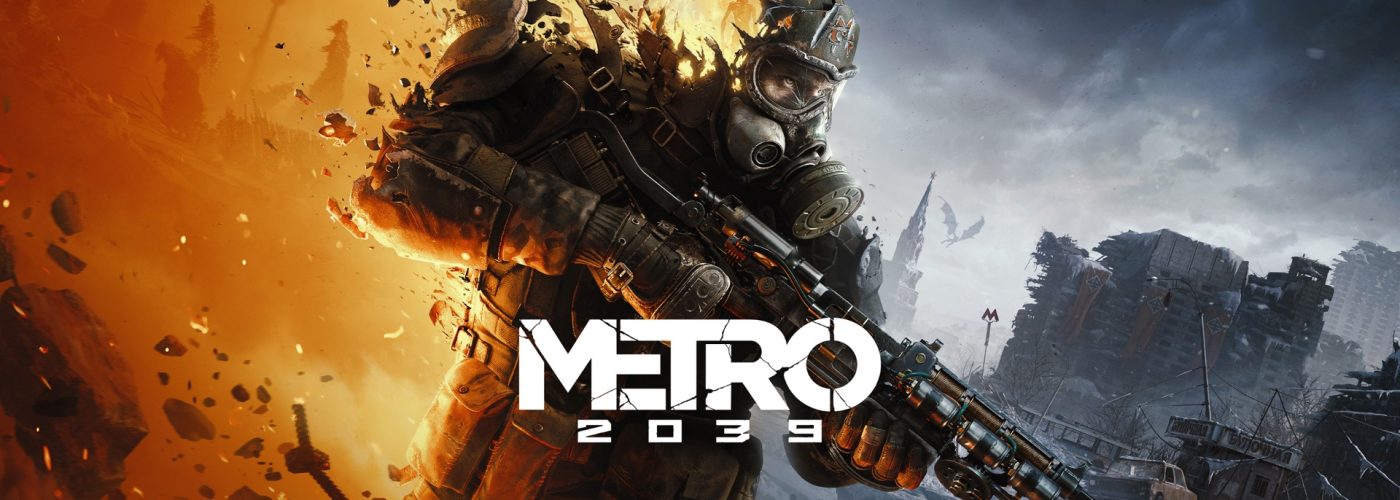
METRO is back: darker, harsher and more psychologically disturbing than ever before.

Moscow has never stopped calling.
A faint, almost imperceptible signal lingers beneath the city’s surface, resonating through its ruins and deeper still into what remains below. With METRO 2039, that voice returns once again – colder, harsher, and more inescapable than ever.
Seven years after METRO Exodus, which expanded the series into more open environments and a broader narrative scope, 4A Games makes a deliberate shift in direction. This is not a nostalgic return, but a conscious creative repositioning. The series returns underground – into compressed tunnels, suffocating corridors, and rusted shelters saturated with memory, where time no longer moves forward but instead settles, layer upon layer. Here, survival is no longer merely physical. It becomes psychological endurance – a constant, exhausting negotiation with what remains of humanity in a world that has long since lost its stability.
Set four years after the events of Exodus, METRO 2039 does not merely continue the story – it pushes further into it, stripping it down to something more essential, more oppressive, and more intimate. The future is no longer a horizon to reach, but a distant echo that has almost entirely faded. What remains is a static present – compressed and slowly drained of its humanity.
Deep within the Metro, beneath flickering lights and silence thick with tension, fear, ideology, and fragments of fading hope accumulate and distort until they lose all clear form. In METRO 2039, descent is no longer just physical. It is existential – a journey not merely underground, but into what humanity has become.

The New Protagonist: From Observer to Survivor
The most evident – and arguably most significant – addition in METRO 2039 is the introduction of a new protagonist: the Stranger. A figure shrouded in mystery, yet already central to the project’s tone. It marks a clear shift for the series, as for the first time in a mainline entry the player character is no longer a silent observer, but a fully realised individual – capable of speech, reaction, suffering, and resistance against the world around him.
This shift fundamentally redefines the relationship between player and narrative. For years, Artyom served as an almost transparent presence: a lens through which devastation was observed, a body moving through collapse, but rarely a clearly defined voice of his own. The Stranger, by contrast, emerges as a far more forceful and fractured narrative presence – conflicted, volatile, and shaped by persistent internal strain.
From the sequences shown so far, the Stranger appears defined by anger, fear, despair, and an undercurrent of vengeance. Together, these elements suggest a central emotional arc running through the experience. The protagonist is not simply a survivor, but an individual forced to piece himself back together as the world continues to fracture around him.
Within this framework, the recurring chain motif seen in the trailer carries weight beyond symbolism. It is not a decorative flourish, but a narrative statement: the past is not merely referenced, but imposed as a persistent condition – one that binds, constrains, and effectively imprisons the present. The overall impression is that METRO 2039 is pushing further into psychological storytelling, framing the protagonist’s journey as a slow descent defined by confrontation and possible unraveling. The focus is not only on what unfolds, but on what remains within those who endure it.


Hunter and the New Reich: The Order of Terror
If the Stranger appears to embody internal conflict, Hunter represents its systemic expression. His return is one of the most significant – and unsettling – developments in the project. A legacy figure in the series, Hunter re-emerges profoundly changed and takes centre stage within a new faction: the so-called “New Reich”. A decision that goes beyond simply bringing back an iconic character, instead giving him clear political and symbolic weight within the narrative.
The New Reich is presented as a system built on repression, propaganda, and psychological control. The sequences shown in the trailer suggest a tightly organised apparatus of oppression, one that appears almost ritualised in its use of violence. The individual is gradually stripped away, reduced to a cog within the machine and shaped through fear, discipline, and submission.
This direction aligns closely with the core identity of the METRO series, long defined by its focus on authoritarianism, dogma, and the slow corruption of power – here pushed into a more explicit and uncompromising form.
Hunter’s role appears deliberate. He has long been associated with extreme brutality and a worldview rooted in moral absolutism, often bordering on the inhuman. His past encounters with the Dark Ones left a deep psychological imprint, turning him into an ambiguous, almost tragic figure – not a conventional antagonist, but a man who stared into the abyss and answered horror with an even more radical form of violence.
The confrontation between Hunter and the Stranger is therefore set to become one of the narrative’s key pillars: not a traditional struggle between good and evil, but a collision between two fractured responses to trauma, loss, and collapse. It is within this moral grey zone that METRO 2039 appears to find its most compelling strength.

The Dark Ones: The Shadow of Humanity
Among the most compelling elements of the game is the return of the Dark Ones, entities that have long occupied a central place in the METRO universe. What is most striking here, however, is the way their role appears to have been reimagined. The Stranger appears to be connected to the Dark Ones in a far deeper way than Artyom ever was. This is not framed as simple communication, but rather as a more unstable, ambiguous, and potentially dangerous link.
The suggestion that the protagonist may be able to influence – or even disrupt – their control adds another layer of complexity, further blurring the line between human and non-human agency.
The Dark Ones are no longer framed simply as a threat or an enigmatic presence. Instead, they emerge as a projection of humanity’s internal fractures – a distorted reflection of what lies beyond full comprehension. Their role extends beyond mystery, serving instead to amplify the pervasive sense of instability that defines the game’s world.
It is here that one of METRO 2039’s most compelling narrative ambitions takes shape: a storytelling approach grounded in ambiguity, uncertainty, and an increasingly blurred threshold where the line between truth and perception, memory and guilt, humanity and otherness becomes progressively harder to define.

A More Focused Approach to Game Progression
METRO 2039 marks a return to a more linear and tightly controlled framework. Following the broader, more open design of Exodus, 4A Games appears to be moving back towards a more compact structure, with a renewed emphasis on carefully staged, deliberately orchestrated environments. A direction that feels consistent with the series’ established identity.
The strength of METRO has always come from its ability to turn space into narrative. Every room, corridor, abandoned shelter, and lifeless body in the dark contributes fragments of story – consequences, aftershocks, and tragedies unfolding off-screen. Nothing is purely decorative; the environment itself functions as a narrative language.
Within this framework, the so-called “frozen stories” return as a defining feature of the experience, reinforcing the series’ long-standing reliance on implicit storytelling. Players are not simply moving through detailed environments, but reading them as remnants of a collapsed world – silent traces of events that have already taken place. It is an indirect form of storytelling, yet one that remains highly effective, requiring attention and active interpretation.
This structure also allows 4A Games to refine its control of tension. In METRO, fear is driven not only by the presence of threats, but by their anticipation: the absence of safety, and the constant uncertainty of what may come next. Linearity is not a limitation, but a design tool – one that sharpens narrative focus and heightens atmospheric pressure.


Technology and Lighting as the Core of Immersion
From a strictly technical standpoint, METRO 2039 marks another step forward in the series’ long-standing pursuit of immersion. The proprietary 4A Games engine appears to have been pushed further still, with the aim of delivering a world that is not only more believable, but also more tangible, layered, and, above all, oppressive in tone.
At the heart of this evolution is lighting, which once again emerges as both a narrative and aesthetic device. Dynamic light sources, deep shadows, wet reflections, airborne particles, and a finely tuned handling of low-light environments combine to produce a constant, almost physical sense of tension. Spaces are no longer designed simply to be observed, but to be experienced in their material weight. Light does not merely reveal – it selects, conceals, separates, and threatens.
Particular emphasis is placed on interior environments, rendered with an almost obsessive attention to detail. Displaced objects, rubble, corpses, abandoned equipment, and the remnants of interrupted lives all contribute to a form of environmental staging that is far from decorative. Every element carries intent, every composition suggests narrative, every detail echoes a story left unresolved. The result is a world that does not rely solely on technical fidelity, but instead embeds itself under the player’s skin.


Combat and Threats: Precision, Pressure, and Consequence
The combat system continues to evolve toward maximum immersion. Gunplay retains the weighty, grounded, and deliberately abrasive identity that has long defined METRO, while also feeling more responsive, more precise, and more immediate in its moment-to-moment feedback. In METRO, every shot is meant to carry weight. Every mistake has consequences. Every encounter is not simply a test of aim, but a sustained moment of pressure, where resources are limited and survival depends on composure, precision, and the ability to read threats with clarity.
The return of the Nosalis, reimagined with a more aggressive design, further reinforces this impression. Animations appear smoother, movement more convincing, and their presence more immediate and threatening. They are not simply enemies to be eliminated, but manifestations of a world in decline – creatures shaped by years of violence, survival, and contamination.
The action sequences also reflect a more confident sense of direction, with combat more naturally integrated into the overall rhythm of the experience. There is little sense of spectacle for its own sake; everything is anchored in sustained pressure and the constant, underlying tension that defines each moment of play.
For a series like METRO, this consistency is as important as any technical refinement.
Back Where It All Began
METRO 2039 is more than a conventional sequel; it is, above all, a statement of intent. A deliberate return to the series’ deepest foundations, where its language finds its most authentic expression – in darkness, moral ambiguity, and a form of survival defined by relentless compromise. If 4A Games succeeds in striking the right balance between narrative intensity and gameplay cohesion, METRO 2039 could stand as one of the most significant releases the medium has seen in recent years.
METRO is back. And this time more than ever, it offers no certainty.