
In short
Denshattack! is the kind of game that dares us to question our own definition of a good idea. Why shouldn’t a train drift around corners? Why shouldn’t it grind along rails, launch into the air and chain skateboard tricks across Japan? Undercoders embraces every one of those questions with remarkable confidence, building a fast, colourful and surprisingly deep arcade experience around them. The result is a game where the absurdity gets us through the door, but the movement, spectacle and sheer joy of discovery are what make us stay.
A train is supposed to stay on the tracks. Denshattack! has other plans, turning that gloriously absurd premise into a high-speed arcade adventure packed with tricks, chaos, and the kind of infectious fun that makes you forget the rails were ever meant to matter.

Unhinged. Unpredictable. Completely unwilling to play by anyone else’s rules. That was Denshattack! to us the first time we set foot on its tracks. We had no idea what we were getting into, and perhaps that was part of the appeal. Before we had any understanding of what lay beneath its surface, before we had learned its systems or grasped the scale of the journey ahead, there was simply the feeling that we were playing something unlike anything we had encountered before.
Some games win us over with polish. Others impress through sheer ambition or the complexity of their systems. And then there are games that take a completely different approach: they put one gloriously outrageous idea in front of us and trust it to do the talking.
Denshattack! is exactly that kind of game. Its premise is almost impossible to describe without making it sound like a joke. At the heart of the experience is an anti-gravity train racing across Japan, leaping over obstacles, grinding along rails, battling enemies and transforming an entire railway network into a sprawling playground. It is part train, part skateboard, part combat vehicle, and part open invitation to see just how much chaos can be wrung out of a set of tracks. On paper, it sounds absurd. In motion, it makes remarkable sense.
Denshattack! is exactly that kind of game. Its premise is almost impossible to describe without making it sound like a joke: an anti-gravity train hurtling across Japan, leaping over obstacles, grinding along rails, battling enemies and turning an entire railway network into a vast playground for speed, tricks and controlled chaos. It is part train, part skateboard, part combat machine, and part invitation to find out just how much freedom can be squeezed out of a set of tracks. On paper, the concept sounds ridiculous. In motion, however, it makes an almost immediate kind of sense.
That is because Denshattack! never treats its premise as a throwaway gimmick. Undercoders takes the idea seriously enough to build an entire game around it, giving speed, movement, tricks, combat and exploration a shared identity. The result can look chaotic at first glance, but once we are in control, its design quickly reveals a much clearer sense of purpose.
The game does not spend hours explaining what it wants to be. It simply puts us on the tracks. And then it accelerates. The scenery starts moving. The music kicks in. The railway curves ahead. Obstacles appear, but so do opportunities. We jump, grind, accelerate, miss a landing, recover and start wondering what else the game will allow us to do. That sense of possibility is crucial, because Denshattack! understands that curiosity can be every bit as powerful as momentum.
We wanted to know what was waiting around the next bend, whether we could catch the rail just ahead of us, and what might happen if we committed to a trick simply because we thought we could pull it off. Soon enough, we were choosing the riskier route over the obvious one, not because the game asked us to, but because we genuinely wanted to see where it would lead. And every now and then, we found ourselves forgetting about the review entirely and simply enjoying the ride.
That matters. There is a particular pleasure in discovering a game that can make you forget, even for a moment, that you are supposed to be analysing it. Denshattack! created plenty of those moments for us. We smiled when a manoeuvre came together, laughed when it went spectacularly wrong, and found ourselves experimenting simply because the possibility looked fun.
For a while, that was enough. But sooner or later, every ambitious idea has to answer the same question: what lies underneath it? A great concept can grab our attention, make an unforgettable first impression, and even carry an experience for a few hours on the strength of sheer novelty. But novelty has a way of wearing off. As our first few hours with Denshattack! stretched into a much longer journey, we found ourselves asking increasingly demanding questions – not about how strange the concept was, but about whether the game beneath it could sustain that initial spark.

Could a game about a skateboarding train remain compelling once the initial surprise had worn off? Could the speed continue to feel exciting? Could the absurdity sustain itself? Could its mechanics turn an outrageous premise into something genuinely satisfying rather than simply memorable?
The more we played, the more interesting those questions became. Because the madness of Denshattack! is not simply there to entertain us. It is the foundation on which the game is built.
A railway line is not merely a means of getting from one destination to another. It can become a ramp, a grind surface, a launch point, a shortcut or an obstacle. Speed is not just about going faster; it is something we learn to manage. Movement is not simply traversal; it gradually becomes a form of expression. That is where Denshattack! starts to reveal its real character.
It is absurd, certainly. But it is not arbitrary. It is colourful, without feeling hollow. It is playful, while still expecting us to learn its rules. The first few hours are largely about reacting to what is in front of us. Then we begin to anticipate. Eventually, we begin to understand. At first, we simply followed the tracks. Then we started reading them. We learned when to jump, when to commit to a risk and when another line might be more rewarding. Routes that had been invisible to us at the beginning gradually became obvious. Opportunities started appearing before the game even presented them.
And somewhere along the way, we stopped merely playing Denshattack! and started learning how to speak its language. That transition is one of the game’s most satisfying achievements.
There is no single moment when everything suddenly falls into place. No dramatic revelation. No one level that changes the way we see the entire experience. It happens organically. One missed jump. One clean grind. One more attempt. Then another. Until, almost without noticing, the reason we were playing had changed. We were no longer simply curious about what came next.
We wanted to get better. And that distinction matters. Curiosity may be what draws us into a game, but mastery is what gives us a reason to keep coming back. Denshattack! gradually bridges that gap, turning the simple desire to see what comes next into a genuine desire to improve.
We began taking risks because we understood what they could lead to. We experimented with routes instead of simply following them. We chased higher scores and started linking movements that had once felt disconnected, discovering how much control the game was willing to put in our hands. Most importantly, the railway stopped feeling like something we were meant to follow.
It became something we could play with. That is the point where the central premise stops feeling like a gimmick and starts feeling like a genuine design philosophy. Anyone can imagine a train that skateboards. The real challenge is making that idea interesting over the long term. Undercoders does this by making movement the connective tissue between the different parts of the experience.


Traversal, exploration, combat and challenges all come back to the same fundamental question: what can we do with the space in front of us? That question follows us across the entire journey.
From Kyushu to Hokkaido, passing through Shikoku along the way, Denshattack! turns Japan into one enormous playground shaped by its railway network. Cities gradually give way to quiet countryside, which in turn opens onto volcanic landscapes and stretches of open sea.
Each region brings its own visual identity and subtly shifts the pace of the journey, but the philosophy at its core never changes: the tracks are not simply there to be followed: they are there to be explored, mastered and played with. Move. Build momentum. Experiment. Take the risk. Learn from the mistake. Try again. That final step becomes more important the longer we play.
Because Denshattack! is not simply about making it to the end of a track. It is about learning to recognise what the track allows us to do. A grind can set up the next manoeuvre. A route that looks dangerous can become the fastest option once we understand its timing. The railway is no longer a limitation. It becomes a playground whose rules we gradually learn to bend.
And perhaps that is what Denshattack! gets right above all else. Its freedom works because it is built on structure. Its chaos works because there is control beneath it. And its absurdity works because the game understands exactly how that absurdity should feel in our hands.
That is also why our relationship with it changed. Our first reaction was simple: “This is insane.” Much later, the reaction was even simpler: “Let’s do that again.” Those are very different responses. The first comes from novelty. The second comes from engagement. And that distinction matters because the games that stay with us are rarely remembered for their concepts alone.
We remember what it felt like to play them. The satisfaction of finally landing a move we had failed ten times before. The frustration of missing by mere inches. The brief rush of discovering a route that suddenly clicks into place. And, perhaps most satisfying of all, the quiet realisation that something that once felt awkward and unfamiliar has gradually become second nature.
Denshattack! lives in that space between chaos and control: between instinct and precision, between the urge to push faster and the understanding that speed means little without the control to match it. And the further we travelled, the less we found ourselves asking whether Denshattack! could justify its own madness. By that point, we understood something much more straightforward.
It did not need to justify it. The madness was never a problem waiting to be solved. It was the game’s identity. The real question was how much the developers could build around it.
How far can a game take such a strange premise? How much depth can exist beneath something that looks like a gloriously ridiculous joke? And perhaps most importantly: What remains once the novelty wears off? Those are the questions we carried throughout our time with Denshattack!.
Not because we wanted to pick it apart simply for the sake of criticism, but because the game gave us enough reason to look beyond the obvious. Beyond the spectacle, there is a genuine attempt to build an experience around movement. Beyond the chaos, there is a system. And beneath the ridiculous premise is a surprisingly sincere desire to make the player feel free.
That is what ultimately makes Denshattack! more compelling than its elevator pitch would suggest. It is not simply a game about a train that can skateboard. It is a game about learning to move through a world differently. About turning a railway into a playground. About discovering that a route does not have to be treated as a fixed line simply because it has been laid out in front of us.
And perhaps that is why, after all the colour, noise and impossible speed, what stayed with us was not one particular trick or set piece. It was the gradual shift from unfamiliarity to control. At first, we were trying to keep up with the game. Eventually, the game had to keep up with us.
That is a subtle change, but it was the moment when Denshattack! stopped feeling like something we were simply reviewing and started feeling like something we were playing on our own terms.
And that may be the most telling thing about the experience. A game can impress us. It can surprise us. But when it makes us want to keep playing after the novelty has already been established, it has crossed an important line. We are no longer simply looking at the game. We are invested in it.
So, before we begin, forget what you think a game about trains is supposed to be. Forget the conventional route. Forget the destination. Forget the idea that there is only one right way to approach a track. Ahead of us are cities to cross, landscapes to discover, enemies to fight, tricks to master and railway lines waiting to become something entirely different.
For now, everything is still. The engine is running. The rails stretch ahead. We still do not know exactly where they will take us. But we already know one thing. We want to find out.
All aboard. Hit the gas. Because our journey through Denshattack! has only just begun – and after everything we have seen so far, we have no intention of slowing down.

From Spain to Japan, Riding the Rails of Denshattack!
Before we jump aboard Denshattack!, before we talk about rails, tricks, derailments, combat and the almost reckless speed with which the game throws us from one corner of Japan to the next, there is something worth doing first. We should stop. For a moment, at least. We should step away from the noise, let the train rush past, and look at Denshattack! from a little further back.
Because beneath all that relentless motion, vibrant colour and absurdity lies something far more compelling: a creative vision worth understanding before we let ourselves get swept away by it.
At first glance, Denshattack! looks almost incapable of moderation. It accelerates, jumps, grinds, crashes and gets moving again before we have even had time to process what just happened. It is loud, colourful and unapologetically strange, throwing together ideas that, on paper, have very little reason to coexist. Trains. Skateboarding. Arcade design. Japanese culture. Dystopia. Rebellion. Folklore. And, naturally, a considerable amount of madness.
At first glance, Denshattack! seems almost allergic to restraint. It leaps, grinds, crashes and picks up speed again before we have even had time to make sense of what just happened. It is loud and completely unapologetic about its own strangeness, bringing together a collection of ideas that, on paper, seem to have no obvious reason to share the same game. Trains. Skateboarding. Japanese culture. Dystopia. Rebellion. Folklore. And, naturally, a healthy dose of madness.
Yet the more time we spent with it, the harder it became to see those elements as a random collection of influences. There is a surprisingly clear idea holding them together. More importantly, there is a creative voice behind that idea. And that voice comes from Undercoders.
There is no mistaking Japan’s influence on Denshattack!. It is everywhere: in the architecture, the railway network, the landscapes, the cities, the cultural references and even in the rhythm of the journey itself. The game constantly moves between crowded urban environments and open countryside, between technological excess and traditional imagery, between familiar places and deliberately surreal ones. It is an unmistakably Japanese world.
And yet, perhaps the most interesting thing about it is that it was not created by a Japanese studio. Undercoders was founded in Barcelona, Spain, in 2005, when three university students decided to turn their shared passion for games into something more ambitious. Since then, the studio has lived through several very different eras of the industry, adapting its work as technology, platforms and the business of making games continued to change around it.
Its early projects were developed for J2ME mobile devices, before the arrival of the iPhone and the App Store transformed the mobile landscape. Like many studios of the period, Undercoders evolved alongside that transformation, eventually moving its attention towards PC and console development and placing greater emphasis on creating games with a strong identity of their own.

That journey would eventually lead to projects such as Battle of the Elements and, in 2016, Conga Master, which went on to launch across multiple platforms and earned the Best Game Design award at the Tokyo Game Show’s Sense of Wonder Night.
There is something fitting about that history when we look at Denshattack! today. Because the game feels like the work of a studio that has spent years learning not to play things safe.
Undercoders has always had an apparent willingness to take an idea and see just how far it can be pushed. With Denshattack!, that instinct has been taken to its most extravagant extreme. A train becomes a skateboard. A railway becomes a playground. A journey across Japan becomes the backdrop for a rebellion. And somehow, rather than collapsing under the weight of all those ideas, Denshattack! finds a way to make them feel as though they were always meant to exist together.
That is particularly evident in the world itself. Our journey begins in the countryside of Kyushu, before taking us through places such as Osaka and Tokyo and eventually towards the snowy expanses of Hokkaido. Along the way, the protected cities of the Miraido Corporation stand in sharp contrast to the communities living beyond their domes: a society divided between those who have access to safety and those who have been left to survive without it.
There is a dystopian story unfolding beneath it all, but Denshattack! never allows its world-building to overshadow what matters most: the act of playing. The game is not asking us to simply admire its version of Japan. It is asking us to learn how to move through it. Jump. Grind. Build momentum. Chain tricks together. Read the track ahead. Find a better line. Take the risk. Miss it. Try again.
That constant process of movement and experimentation becomes the game’s real language. The railway is not merely a route connecting one destination to the next; it is the foundation on which almost every part of Denshattack! is built. Every bend, obstacle, rail and open stretch of track presents another opportunity to experiment, refine our timing and discover a new way forward.
The world is something we do not simply travel through, but something we learn to play with. Eventually, something changes. We stop seeing the railway as a route. We start seeing it as a playground. And that distinction is fundamental. The train itself stops feeling like a vehicle and becomes something much closer to an extension of the player. It is our skateboard, our means of attack, and, increasingly, a reflection of how confidently we understand the game’s systems.
The better we become, the more expressive that movement feels. And once a game has decided that an anti-gravity train should also function as a skateboard, it is probably not going to settle for ordinary boss fights. It doesn’t. Denshattack! gives us giant magical robots, moving castles, mechanical worms and entire armies of Denshattacker. The game seems to operate according to a single creative principle: If this is already ridiculous, why not make it even more ridiculous?
It is a question that keeps returning throughout the journey. And somehow, every time we think the game has reached its limit, it finds another way to move the boundary. But this is where Denshattack! becomes more interesting than its premise suggests. Because underneath all that colour and chaos, there is something remarkably sincere about the game.
It is not embarrassed by its own weirdness. It does not try to make itself more respectable by hiding the things that make it unusual. It does not constantly justify its stranger ideas or attempt to smooth every rough edge into something immediately familiar. It simply commits. To the train. To the absurdity. To the speed. To the music, the colours, the humour, the rebellion and the sheer joy of seeing what happens when all of these things are allowed to exist in the same place.
That commitment gives Denshattack! something that cannot easily be manufactured: personality. And personality matters enormously here, because a game built around such an outrageous premise could very easily have become a novelty. Something we play for an hour, laugh at, show to a friend and then move on from. But Denshattack! does not feel like a joke stretched into a full game. It feels like a team genuinely believed this was a world worth building.
That distinction became increasingly apparent the longer we played. We stopped being fascinated simply by the idea of riding a train across Japan. We started caring about how well we could ride it. We stopped wondering what the next strange thing would be. We started wondering whether we could reach it faster. We stopped looking at the railway as something the game had designed for us. We started looking at it as something we could make our own.

And perhaps that is the real heart of Denshattack!. Yes, it is a game about speed. Yes, it is a game about rebellion. Yes, it is a game about trains doing things trains absolutely should not be doing. But beneath all of that, it is a game about freedom of movement: about taking something as rigid and predetermined as a railway line and turning it into a space for expression.
There is also something quietly fascinating about the cultural perspective behind it. Denshattack! is deeply rooted in Japanese imagery and mythology, yet it is ultimately a Japanese-inspired world interpreted through the eyes of a Spanish independent studio. That distance does not dilute its identity. If anything, it gives the game room to approach its influences with a sense of curiosity, affection and creative freedom. Perhaps that is why its world feels so deliberately heightened.
It is not trying to reproduce Japan. It is imagining what Japan might look like through the lens of a game that refuses to obey conventional rules. And perhaps that is the best way to understand Denshattack! itself. Not as a collection of strange ideas. Not as a novelty built around the question of whether a train can skateboard. But as the result of a studio deciding that, sometimes, the most interesting thing we can do with a familiar idea is to refuse to leave it where we found it.
Undercoders took the railway and turned it into a playground. It took a train and turned it into a character. It took a journey across Japan and turned it into a rebellion.
And somewhere between the rails, the tricks, the ridiculous boss fights and the moments when everything finally clicks into place, Denshattack! reveals what was perhaps there from the beginning: the freedom to stop following the track and start deciding what we want to do with it.
The Chosen One Who Never Asked to Be One
The story of Denshattack! starts from a premise that may sound familiar, at least at first. It draws, in part, from one of the most enduring archetypes in storytelling, and video games in particular: the chosen one, an ordinary person who discovers, almost by accident, that they possess an extraordinary talent. But Denshattack! is quick to put its own spin on the formula, because its unlikely hero is about as far removed from the traditional image of a savior as you could imagine.
Emi is not a warrior. She has no grand destiny, no mysterious origins, and certainly no desire to save the world when the story begins. She is simply a young woman delivering ramen aboard her train, living an ordinary life without any particular ambitions beyond the routine she has built for herself. Adventure is nowhere on her radar. That is exactly where Denshattack! begins to find its identity.
Rather than introducing Emi as someone destined for greatness, the game starts with her ordinary life and lets the extraordinary emerge from it. One routine delivery becomes the catalyst for a journey that will fundamentally change the way she sees both herself and the world around her.
Before that journey can truly begin, however, Denshattack! takes us somewhere even more important: the world Emi calls home. The game is set in a not-too-distant future devastated by the consequences of an environmental crisis that has spiraled beyond control.
Japan has been reshaped by dramatic climate and environmental changes, making life outside increasingly dangerous and forcing its population to rethink how, and where, it can survive. With the world beyond their doors becoming more hostile, society has responded by retreating behind them.
The wealthiest and most privileged have found refuge inside vast cities sealed beneath enormous domes and protected by advanced air-purification systems, all developed and operated by the Miraido Corporation. Within these artificial environments, life can continue with an approximation of normality. People have shelter, clean air, infrastructure, and the illusion that the world outside no longer concerns them. But that security comes at a considerable price.
The domes are not simply a technological answer to an environmental catastrophe. They are also the clearest expression of a society built around control, separation, and privilege. Everything inside is regulated and carefully maintained. Everything outside represents the parts of society that this artificial order has either failed, or chosen, not to protect.
Beyond the domes lies an entirely different reality, home to outcasts, the underprivileged, and those denied access to the safety reserved for the privileged.
Life is harsher here, the environment far less forgiving, and survival depends on both adaptability and mutual support. These communities have been pushed to the other side of a divide that is not merely physical, but deeply social. It is within this fractured world that Denshattack! introduces the idea at the very heart of its story. Because when a society is built around control and separation, people will inevitably find their own ways to reclaim a sense of freedom.

Denshattack! is an underground sport, born on the fringes of society and evolving into something far greater than a mere competition. Racing along railway tracks, grinding across surfaces, and going head-to-head with other riders may provide the foundation for the game’s wonderfully chaotic gameplay, but within the world of Denshattack!, the sport carries a much deeper meaning.
It is a way to escape. A way to meet people. A way to express yourself. And, above all, a way to feel free in a world that has become determined to control where people can go and how they can live.
Emi encounters this world almost by chance, during what should have been another routine delivery. What begins as an ordinary day quickly becomes the turning point of her life. She is immediately drawn to Denshattack!, but she also discovers that she has something else: a natural aptitude for the sport. Fernando, a photographer and devoted Denshattack! enthusiast, is the first to recognize it. Their meeting becomes the catalyst for everything that follows.
Fernando acts as both a guide and a gateway into a world Emi has never experienced before, helping her understand that Denshattack! is more than an eccentric pastime. Behind the races and the sheer absurdity of it all lies a community – and, eventually, a reason to keep moving forward.
From there, Denshattack! takes us on a journey from the southern reaches of Japan to the far north, carrying Emi across regions, landscapes, and communities that can feel worlds apart.
Yet the physical journey is only one part of the story. More importantly, it becomes a journey of growth for Emi and for the people she encounters along the way. This is one of the aspects of the narrative that stood out to us most. Emi does not simply become a more capable Denshattacker.
She changes as a person. Every new place, every encounter, and every challenge gradually reshapes her understanding of the world around her. At the same time, the journey gives us a closer look at people living on the fringes of the society created by the Miraido Corporation.
As a result, the trip never feels like a simple sequence of locations connected by railway tracks. It becomes a story about reconnecting what has been separated.
The tracks physically link one region to another, but the journey gradually begins to rebuild connections between people as well. Communities that have been isolated begin to interact. Strangers find common ground. People who have spent years living on opposite sides of an artificial divide begin to realize that they may have more in common than they thought.
And Denshattack! becomes the catalyst. It is a meeting place. A means of expression. And eventually, a form of resistance. That progression is important because the game’s rebellion does not simply appear when the plot demands it. It grows organically out of the relationships Emi forms along the way. When a system builds walls, divides its population, and attempts to regulate every aspect of life, even something as unconventional as an underground train sport can become a symbol of freedom. That is ultimately what Denshattack! comes to represent.
The sport becomes a vehicle for renewal and rebellion, giving people from radically different backgrounds a shared language. The train gradually takes on a meaning beyond its obvious role as the centerpiece of the game’s arcade mechanics. It becomes the means through which Emi explores the country, meets its people, and crosses the boundaries that have divided them.
And as Emi grows more confident, meets more people, and takes on increasingly outrageous challenges, her journey inevitably begins to intersect with something much larger than herself.
The young woman who once spent her days delivering ramen without any particular ambition is suddenly confronted with a reality she never knew existed. More importantly, she begins to question the system that created it. Her transformation, however, is not simply the result of some predetermined destiny or innate “chosen one” status. It is the people she meets – and the connections she forms with them – that ultimately push her forward.
That may be the most human element of Emi’s story. She does not become important because she was destined to be. She becomes important because she chooses to keep going. She races because she wants to improve, because she wants to challenge herself, and because Denshattack! has given her the opportunity to see a world she had previously known only from a distance.
With every journey, that decision begins to carry greater weight. The trip from south to north therefore becomes more than the route required to complete the adventure. It becomes the means through which Denshattack! gradually rebuilds the connections between people and places that its world has spent years tearing apart. What begins as an underground sport consequently evolves into a form of freedom, then a community, and eventually a means of resistance. And once people begin coming together again, challenging the system becomes possible.
That is what ultimately draws Emi and those around her into conflict with the Miraido Corporation, turning what initially seemed like a bizarre pastime into something much more consequential: a collective rejection of a system built on control and exclusion.
There is something fittingly paradoxical about the way this rebellion takes shape. It does not begin with an army. It does not require a grand revolution or a carefully organized uprising. It begins with a handful of people, a train, and the simple desire to be free. And perhaps that is where Denshattack! finds its most interesting idea. Its story is every bit as unconventional as its gameplay, but beneath all the chaos and absurdity lies something remarkably straightforward: people can be separated and forced behind walls, but the desire to connect cannot be so easily contained.

As long as someone is willing to climb aboard a train and race alongside someone else, there remains a way to cross the barriers designed to keep people apart.
In that sense, Emi’s journey gradually becomes something larger than her own story. It becomes the story of a country attempting to reconnect with itself.
One girl. One train. One underground sport. A journey from southern Japan to the north. And, waiting on the other side of the tracks, a corporation that believes it can control everything.
Denshattack! takes these seemingly disparate elements and turns them into a story about growth, freedom, connection, and rebellion: one that, much like Emi herself, begins with something small before carrying us somewhere far more unexpected.
A Shōnen on Rails
At its core, Denshattack! brings together two very different storytelling traditions: the shōnen and the road movie. One is defined by rivalry, progression and the relationships forged through shared challenges; the other by movement, discovery and the people encountered along the way.
Denshattack! finds a natural middle ground between the two, using a journey that takes Emi from Kyūshū to Osaka, through Tokyo and ultimately all the way to Hokkaidō as both a physical route across Japan and the backbone of her personal growth.
The country she travels through is as varied as the journey itself. Rural landscapes give way to sprawling cities, recognisable locations sit beside increasingly surreal encounters, and environments that initially feel grounded can suddenly veer into the wonderfully absurd. Yet for all its eccentricity, Denshattack! never loses sight of the cultural identity beneath it. Its version of Japan is exaggerated, but never disconnected from the world that inspired it.
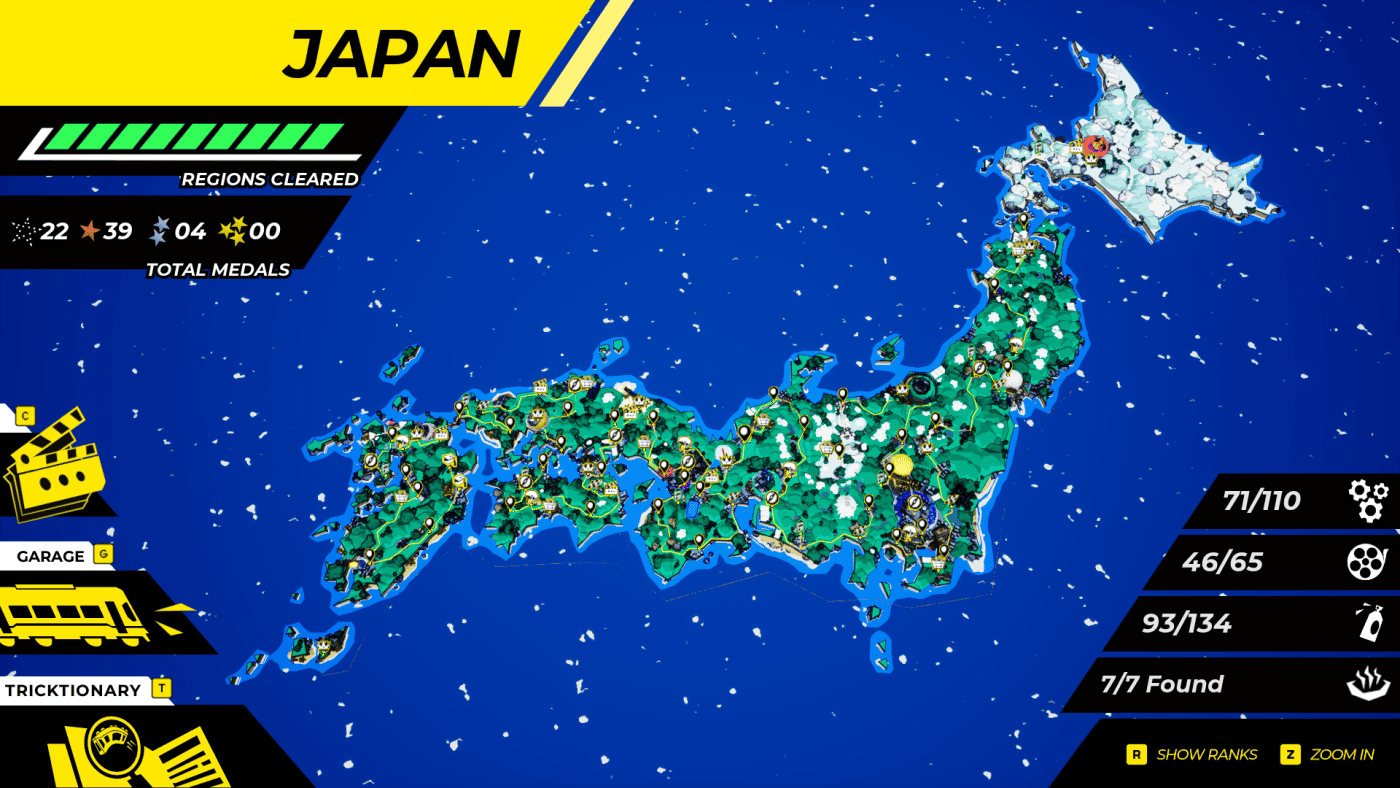
That is because Undercoders never treats Japan as little more than scenery. Instead, the studio takes its visual language, cultural references and folklore and reinterprets them through a distinctly playful and irreverent lens, blending pop culture with traditional imagery and reshaping familiar ideas into something uniquely Denshattack!. The exaggeration serves a purpose: it gives the world a consistent identity, allowing the game to move freely between the recognisable and the ridiculous without ever feeling entirely random. Familiar elements are stretched, distorted and reassembled until they become part of a world that feels unmistakably its own.
That same approach extends to the game’s progression. Each region is controlled by a Denshattack! Gang, and reaching its leader means first making ourselves known within their territory. We cannot simply arrive, issue a challenge and move on. We have to earn our shot.
That means completing routes, taking on challenges and causing enough chaos to attract the attention of the gang and, eventually, its leader. Each region consequently becomes its own chapter in Emi’s adventure, complete with a new territory, a new rival and another obstacle standing between her and the road ahead. The structure is unmistakably shōnen in spirit, but it also gives the journey a clear sense of escalation: every new destination asks Emi to prove herself again, while gradually raising the stakes of the adventure.
More importantly, however, Denshattack! understands that rivalry is rarely the end of the story. The people who challenge Emi are not necessarily the people who will stand against her forever. In a dynamic deeply familiar to the shōnen tradition, competition can gradually give way to respect, friendship and cooperation. Characters who initially appear as obstacles are eventually drawn into Emi’s orbit, transforming from rivals into valuable allies.
That shift is what allows the narrative to expand beyond its initial premise. What begins with Emi and Fernando gradually grows to include the various gangs, their leaders and the many characters scattered across Japan’s railway network. The further we travel, the clearer it becomes that Denshattack! is not simply interested in charting the rise of a single protagonist. It is building a wider story around the people she meets along the way.
Every encounter adds another perspective. Every region reveals another side of this fractured Japan. And every new ally makes Emi’s path feel less like a solitary adventure and more like a journey shared with an ever-growing group of people. Her development is therefore measured not only by how much better she becomes on the rails, but also by the relationships she forms beyond them.

That is what gives the route from Kyūshū to Hokkaidō its importance beyond geography. These regions are not merely stages to clear before reaching the next part of the map. They mark different points in Emi’s development while gradually revealing how far Denshattack! has evolved from the underground sport at the centre of its premise. Rivals become allies. Strangers become companions. And a journey that begins with one girl slowly grows into something shared.
In that sense, Denshattack! takes the familiar shape of the hero’s journey and gives it a distinctly communal heart. Emi may be the one at the controls, but she is never truly travelling alone. Every challenge she overcomes, every rival she meets and every friendship she forms becomes part of the larger story, until the journey from south to north feels like more than a route across Japan.
It becomes the story of a girl discovering who she is, finding her place in a changing world, and learning that the further she travels, the more people she finds waiting to ride alongside her.
Someone Should Probably Stop This Train
For all the spectacle surrounding it, Denshattack! does not truly reveal what makes it special until we get our hands on the controls. Its visual identity is striking, its soundtrack gives every run a distinctive sense of energy, and the sheer audacity of Undercoders’ concept is enough to make the game stand out. But none of that would matter for long if the game underneath it were little more than a novelty.
Thankfully, it is not. What initially appears to be an outrageous premise built around the simple question of what if a train could skateboard? gradually reveals a remarkably coherent arcade system. Denshattack! is immediately approachable, but there is considerably more depth to its movement than its chaotic presentation suggests. The longer we play, the more we begin to understand how its different mechanics feed into one another and, more importantly, how much freedom the game is willing to give us once we learn how to use them.
The easiest way to understand that freedom is to forget that we are driving a train. We are riding a skateboard. It just happens to weigh several tons. That shift in perspective is essential.
Denshattack! borrows heavily from the language of skateboarding, and the comparison to Tony Hawk’s Pro Skater becomes increasingly difficult to avoid once tricks and combos enter the picture. The difference, of course, is that our board is a train, and the skatepark is an entire railway network stretching across Japan. That distinction is more than a joke. It defines how the game is played.
Our train can jump, change direction, drift, leave the rails and use the environment as part of its route. Deviations can take us away from the main line and into tunnels; walls become surfaces to drift across; pipes, structures and other pieces of the environment can be used as improvised rails. The track is less of a fixed path than a framework for experimentation. We are looking ahead, spotting opportunities and deciding whether the obvious route is actually the one we want to take.
It is an important distinction because Denshattack! can look almost uncontrollably chaotic from the outside. In our hands, however, there is considerably more control than the spectacle initially suggests. Braking is a perfect example. It is easy to assume that a game built around speed would simply reward us for holding the accelerator down, but Denshattack! quickly teaches us otherwise.
Tight corners demand careful management of momentum, particularly when we are carrying enough speed to make even a small mistake costly. Brake too early and we throw away momentum. Brake too late and the train can slide beyond the line we intended to take. The solution is not to slow down. It is to learn when to brake, when to release and when to let momentum do the work.
Eventually, those decisions become almost instinctive. We approach a corner, make a small adjustment, release the brakes, carry the train through the turn and immediately start preparing for the next jump. What once felt like a sequence of individual inputs becomes a single, fluid motion.
That progression, from consciously controlling the train to simply riding it, is one of the most satisfying parts of the experience. Even the horn has a place within this design philosophy. It is not merely a cosmetic flourish or a bit of railway flavour; it can trigger specific events and, in certain situations, clear the way ahead. It is a small mechanic, but an effective example of how Denshattack! takes something we would normally consider incidental and gives it a reason to exist within the gameplay. The real depth, however, emerges once we start combining drifting, manuals and tricks.
After launching into the air, the right analogue stick allows us to perform different manoeuvres, each with its own level of difficulty. The result is a system that gradually shifts our focus from simply surviving a run to thinking about what we can build within it.
A jump is no longer just a way to clear an obstacle. It is an opportunity to start a sequence. One trick leads into another. A landing becomes a setup. A manual keeps the chain alive.
This is where the Tony Hawk’s Pro Skater influence feels most meaningful. Denshattack! is not trying to replicate a skateboarding game, but it understands the same fundamental pleasure: the satisfaction of turning movement into a continuous sequence of decisions, with every successful connection creating another opportunity to keep going.
The manual sits at the heart of that loop. Chaining tricks increases our combo score while also filling a dedicated meter. Once charged, it activates rainbow zones along the route, opening access to alternative paths through the level. That is a particularly clever piece of design because these zones are not simply another reward for playing well. They can change the way we approach a level.
An alternative route may offer a different line through a section, create new opportunities for movement or give us a practical advantage during a particular encounter. In some boss fights, choosing the right route can become especially important, turning what initially looks like an optional reward into a meaningful strategic consideration.


It also gives the combo system a purpose beyond chasing a high score. We can play conservatively, stick to the safest route and simply make it to the finish. There is nothing wrong with that. But Denshattack! is constantly tempting us to do more. Take the bigger jump. Try the harder trick. Hold the manual a little longer. Look for another opportunity to extend the combo. The important part is that the game never removes the choice. The risk is ours to take, and so is the consequence.
That makes the best runs particularly satisfying. When several tricks connect, the manual holds, the train stays under control and the combo continues to climb, the reward is not simply the score flashing on screen. It is the feeling that we have finally understood the system well enough to push it further than before. And once we experience that, playing it safe becomes considerably harder.
The same applies to perfect starts and last-second route changes. A well-timed launch gives us an immediate burst of speed, while a sudden change of direction can allow us to preserve momentum and maintain the rhythm of a run. These mechanics may seem small individually, but together they reinforce one of Denshattack!‘s most important ideas: the best runs are built on anticipation, not reaction. At higher speeds, simply responding to what is directly in front of us is rarely enough.
We need to read the track ahead, understand where the next turn is coming from, know when to start braking and recognise when an apparently safe route is actually slowing us down. We are constantly making decisions about momentum, positioning and risk, often within seconds.
That is why reducing Denshattack! to a game about speed would be missing what makes its movement so enjoyable. Speed is the reward. Control is the skill.
The faster we go, the more precise we need to become. The more ambitious the trick, the greater the potential payoff, and the greater the punishment for getting it wrong. Every mechanic feeds into that relationship, creating a gameplay loop in which improvement feels tangible because we can actually feel ourselves becoming more confident with the train.
The progression is almost deceptively simple. At first, we are wondering how a train is supposed to perform a trick. Then we learn to jump. We learn to drift. We discover manuals. We begin chaining tricks together. We start searching for rainbow zones. We learn which corners demand the brakes and which ones reward us for maintaining momentum. Eventually, we stop thinking about each mechanic individually and start combining them instinctively. And that is when Denshattack! clicks.
The train stops feeling like a train. It becomes a skateboard with an entire railway network as its playground. The tracks stop feeling like restrictions and start feeling like possibilities. The chaos stops being something we simply watch and becomes something we can control. That is the real strength of Denshattack!‘s gameplay. It takes an idea that should, by all reasonable logic, be completely ridiculous and gives it enough structure, precision and depth to make it work.
The madness is the hook. The control is what keeps us playing. Every run gives us another chance to go faster, take a bigger risk, find a better line, recover from a mistake and try again. And beneath all the noise, spectacle and sheer absurdity is a game that understands exactly what it wants us to do: learn the rules, bend them as far as we can, and then get back on the train for another run.

The Best Rewards Are Off the Beaten Track
There is more to Denshattack! than simply learning how to ride its trains. As we travel across Japan, we also meet a mechanic who becomes our main point of contact for customisation, allowing us to spend the resources collected during our runs on stickers and new carriages.
The sticker system is straightforward. Designs are tied primarily to the gangs we encounter and the regions we visit, giving us a purely cosmetic way to personalise the train. There is no deeper mechanical layer to them, but that is hardly the point. As the adventure progresses, the stickers become a visual record of where we have been, gradually turning our train into something that feels connected to the road behind us rather than just another vehicle we happen to control.
The carriages, meanwhile, introduce a little more variety. New ones become available throughout the adventure, each bringing its own visual identity alongside a combination of bonuses and drawbacks linked to specific actions and elements of our movement system.
Choosing a particular carriage can therefore favour certain approaches to tricking, movement or combo building while making others slightly less effective. It is a good idea in principle, particularly within a game so heavily built around speed, timing and control. In practice, though, the differences are rarely substantial enough to transform the way we approach a run. The modifiers are clearly explained and easy to understand, but their impact tends to remain on the margins. We noticed the differences, but seldom felt compelled to rethink our entire approach because of them.
That makes the carriage system feel more like a light layer of experimentation than a genuine build system. It adds another choice without competing too heavily with the movement mechanics that remain the real heart of Denshattack!. The more interesting choices come from what we find scattered across the tracks.
Stickers and carriages are purchased with two separate currencies, both of which can be collected during our runs. Rather than placing these resources conveniently along the safest route, Denshattack! often positions them just far enough away to make us think twice. A slight change of trajectory might be enough to reach one. Others demand a full detour, a risky jump or a last-second adjustment that could easily disrupt the rhythm of an otherwise perfect run.
It is a small but effective way of reinforcing one of the game’s central ideas: there is usually something waiting for us if we are willing to take the risk to reach it.
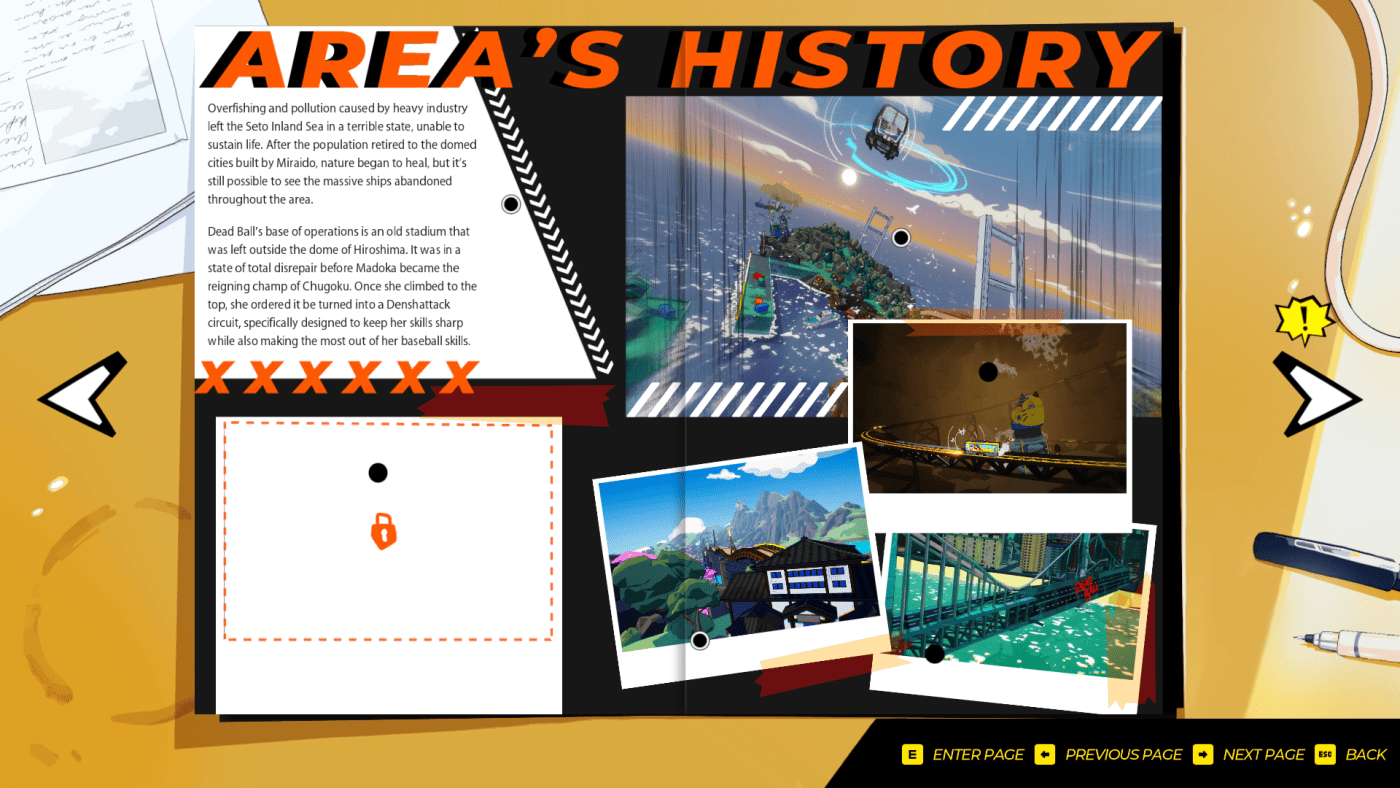
The same philosophy extends to the region-specific collectibles scattered throughout Japan. Finding them allows us to complete a dedicated magazine for each area, gradually filling it with additional information, trivia and details about its locations, characters and the many cultural touches that shape Undercoders’ exaggerated interpretation of Japan. These collectibles are aimed at a very particular kind of player: the one willing to occasionally slow down and look around.
That might sound strange in a game whose entire identity revolves around speed, but it works precisely because Denshattack! understands that movement is not always about going faster. Sometimes the most interesting thing we can do is notice what we would have missed by simply following the main line.
The game is generally good at drawing our attention towards these rewards. Signs, environmental details and visual cues make it clear when something is nearby without necessarily revealing exactly how we are supposed to reach it. The distinction is important.

Denshattack! tells us that there is something worth finding; it leaves the final step to us. And that final step can be surprisingly demanding. A currency might be sitting just beyond a corner. A sticker might be positioned along a line that requires an awkward jump. A collectible might be hidden behind a section of track that we barely noticed on our first attempt.
Suddenly, the route we were following no longer feels like the route we actually want to take. We stop. We calculate the line. And then comes that familiar thought: we can get that.
It is one of the simplest impulses a game can create, but Denshattack! gets considerable mileage out of it. What begins as a passing curiosity can quickly turn into a small challenge against ourselves. We change direction, adjust our speed, attempt the jump and hope that the train lands exactly where we need it to. Sometimes it does. Sometimes it absolutely does not. But even a failed attempt can be valuable, because it teaches us something about the route and, more importantly, reminds us that the railway is not a fixed path. It is a space we are constantly learning to manipulate.
That is why the collectibles work better than a conventional completionist checklist. They give the movement system another purpose. A difficult jump is no longer difficult simply because the game wants to test us; there is a reason to attempt it. A detour is no longer wasted momentum; it might lead to something we cannot get anywhere else. Of course, there is always a cost.
Leaving the main route can mean sacrificing speed, momentum or a carefully built combo. A detour can interrupt the rhythm we have spent the last few seconds establishing, and a failed attempt can send us scrambling to recover. The game therefore creates a small but meaningful tension between maintaining a clean run and chasing something that may not be necessary at all.
That choice is what makes the rewards feel satisfying. We are not collecting them because Denshattack! demands that we do. We are collecting them because we decided the risk was worth taking. And that distinction matters. A reward handed to us along the main route is simply another item. A reward that forces us to abandon our line, challenge our timing and put our run at risk feels like something we actually earned.
It also captures something fundamental about the game’s broader design philosophy. Denshattack! is constantly asking us to look beyond the obvious solution: to push a little further, take a slightly stranger route and see whether our understanding of the movement system is good enough to get us there. By the time we start chasing the last few rewards, the question is no longer “where does the track take us?” It becomes: “where can we make it go?” And for a game built around turning a train into a skateboard, that may be the most appropriate question of all.

The Many Faces of Japan
The longer we spend with Denshattack!, the clearer it becomes that Undercoders has approached its world with the same lack of restraint that defines its gameplay.
References, easter eggs and cultural influences are scattered throughout the experience, drawing from Japanese folklore, pop culture and the country’s enormous entertainment legacy. Traditional imagery sits alongside the visual language of anime and videogames, while familiar ideas are constantly reshaped into something louder, stranger and unmistakably Denshattack!.
It is a world that rewards attention. Something as simple as a character, an environment or a passing detail can carry a reference, a joke or a deliberate reinterpretation of something we have seen before. None of it feels particularly desperate for recognition, either. The game simply assumes that its audience will notice some of these details, smile at others and occasionally stop to wonder just how many influences have been folded into the same screen.
This is also where Denshattack!‘s understanding of shōnen becomes impossible to miss. Rivalries, larger-than-life personalities, escalating challenges and, above all, boss fights are woven into the structure of the adventure. Some of these encounters are among the game’s most memorable set pieces, not least because they capture its willingness to take an already ridiculous premise and ask what would happen if we pushed it even further. We are deliberately avoiding the details here.
Not because there is nothing to say about these encounters, but because the surprise is part of the experience. Denshattack! is at its best when it catches us off guard, when something appears on screen that makes us briefly stop playing and simply process what we are looking at. Explaining those moments beforehand would rob them of exactly the quality that makes them work. What we can say is that Undercoders has made excess a fundamental part of the game’s creative language.
Denshattack! is unapologetically over-the-top, but its greatest strength is that it never treats exaggeration as an excuse to abandon coherence. There is a difference between being deliberately absurd and being random, and the game understands that distinction remarkably well. It keeps pushing the boundaries of what we are willing to accept, but it also gives us enough context to make those increasingly outrageous ideas feel like natural extensions of the world.
The more Denshattack! escalates, the less we question it. That is not because the game gradually lowers our expectations. Quite the opposite. It establishes its own rules so confidently that we eventually stop comparing them with reality. A train can jump. A train can drift. A train can launch itself through the air. And, eventually, none of those things feel particularly strange anymore.
That transformation is especially apparent during ordinary traversal. What begins as a sequence of railway sections gradually takes on the rhythm of a continuous action scene, with our train functioning almost like an extension of Emi herself. We jump between tracks, grind across structures, drift through corners, change direction at the last possible moment and launch ourselves through sequences that feel closer to an anime set piece than anything we would normally associate with a railway journey. The remarkable part is how quickly our brain accepts it.

For a few seconds, we stop seeing a train and start seeing a vehicle built purely for movement. The railway becomes a stage, the environment becomes part of the route and every piece of scenery becomes a potential opportunity for another trick. That same philosophy extends far beyond traversal, shaping the game’s biggest encounters just as naturally as it shapes the smallest moments on the track. Every new region, character and encounter has the potential to escalate the spectacle because Denshattack! is constantly searching for another way to surprise us.
It rarely settles for repeating an established idea when it can twist it into something new. A familiar concept might return in a different form, a seemingly straightforward encounter can suddenly become something much larger, and a boss fight can evolve into a full-scale spectacle before we have had time to ask how we got there. Yet it never feels completely arbitrary.
The reason is world-building. Denshattack! has created a setting in which these contradictions can coexist naturally. Japanese folklore sits beside contemporary pop culture. Dystopian technology shares the same space as underground communities. Railway networks become skateparks. Gangs control territories. Trains perform impossible manoeuvres. Bosses turn encounters into spectacles.
None of these ideas should necessarily belong together. Here, they do. The world does not ask us to decide where reality ends and fantasy begins. It simply establishes its own logic and invites us to follow it. That is also why the game’s references work so well. They are not merely there to demonstrate how much Undercoders knows about Japanese culture or videogame history. They contribute to the texture of the world itself. Some are obvious. Others are subtle. Some will immediately trigger recognition; others may pass unnoticed entirely. And that is perfectly fine.
We will not spoil the best examples, because discovering them is part of the pleasure. There is something genuinely satisfying about recognising a familiar piece of imagery in the middle of all this chaos, especially when Denshattack! has transformed it enough to make us wonder whether we are remembering it correctly.
The result is not an attempt to present a definitive version of Japan, nor is it simply a collection of references assembled for the sake of novelty. Undercoders takes the cultural imagery that inspires it, filters it through its own sense of humour and exaggeration, and then pushes it somewhere entirely its own. That is what ultimately gives Denshattack! its identity.
The game is loud, strange and occasionally ridiculous. But it is never without purpose. Its excess is not decoration; it is part of the way the world communicates with us. Its references are not there merely to be recognised; they help establish its tone. And its escalating spectacle is not random escalation for its own sake: it is the natural consequence of a game that refuses to stop at the first idea that works. Which is why Denshattack! is so difficult to describe without giving something away.
Some of its best moments are the ones we cannot prepare you for. They arrive without warning, leaving us staring at the screen for a second longer than we should, trying to work out whether what we just saw actually happened. “Did they really just do that?” Yes. Of course they did. Because by this point, we have learned the only rule that truly matters: If Denshattack! can go further, it will.

A World With a Voice of Its Own
One of the first things Denshattack! gets right is the strength of its identity. Its audiovisual presentation is colourful, energetic and immediately recognisable, giving the game a visual and sonic language that feels entirely consistent with everything else Undercoders is trying to achieve. This is not a technically flawless production, and there are moments when its limitations are apparent, but Denshattack! has little interest in competing on technological spectacle alone.
Instead, it succeeds through cohesion. Every element of its presentation feels guided by the same clear creative vision: bold colours, increasingly eccentric environments, expressive visual effects and character designs built to stand out rather than blend into their surroundings.
Realism is never the goal. What matters is that the game establishes a distinct visual identity almost instantly, and then commits to it without hesitation. Within moments of seeing Denshattack! in motion, there is little doubt about the kind of experience Undercoders is creating. That kind of consistency is difficult to achieve, and it gives the game a personality of its own.
The landscapes Emi crosses are vibrant and varied, shifting between recognisable Japanese environments and increasingly surreal interpretations of them. Traditional architecture and cultural imagery can sit alongside designs that appear to have escaped from an entirely different genre, yet the contrast rarely feels accidental. There is a clear artistic direction holding everything together, allowing the game to move between the familiar and the ridiculous without losing its visual identity. It does not try to make its excess look reasonable. It makes the excess part of the aesthetic.
The same philosophy extends to the character design. While the cast is not always given the kind of psychological depth we might expect from a more character-driven adventure, each personality is shaped around a clear and recognisable identity. Several characters lean into familiar archetypes, and some of the supporting cast would undoubtedly benefit from more nuanced writing or a greater sense of development as the journey progresses.
Yet there is an immediacy to the way these characters are presented that works remarkably well. Their silhouettes, clothing, animations, expressions and mannerisms often communicate as much as the dialogue itself. They are designed to be recognisable at a glance, and that visual clarity gives even some of the less developed characters a distinct presence. They may not always reveal particularly complex inner lives, but they rarely feel interchangeable. For a game that places so much emphasis on spectacle, that distinction matters.

The soundtrack is arguably the most consistently accomplished part of Denshattack!‘s audiovisual presentation. It never feels like music simply placed beneath the action; instead, it becomes part of the game’s momentum, evolving naturally as the pace, intensity and atmosphere shift.
There is room for quieter moments, but Denshattack! is at its best when everything starts moving faster, and the soundtrack understands exactly how to accompany that acceleration. Its tracks add urgency without becoming intrusive, helping individual sections develop their own sense of momentum while reinforcing the feeling that we are always moving towards whatever comes next.
The further we travel, the more that relationship between music and movement becomes apparent. The soundtrack does not merely accompany the ride; it becomes part of its momentum, rising and falling with the action and instinctively responding to every shift in pace. When Denshattack! accelerates, the music pushes forward with it; when a sequence reaches its most spectacular peak, the soundtrack feels as though it has been building towards that moment all along. It is presentation doing more than setting the mood: it is actively shaping how the journey feels.
The story, by comparison, takes a far more straightforward approach. Its structure is largely linear, its progression deliberately uncomplicated, and some of its later developments can be anticipated well before they arrive. Denshattack! has little interest in elaborate twists or constantly subverting our expectations; instead, it keeps its narrative focused on a clear sense of direction, following Emi’s journey without adding unnecessary complications along the way.
That simplicity, however, feels largely intentional. This is a game whose strongest ideas live in movement, discovery and interaction, rather than in intricate plotting. The story provides the framework around which those ideas can exist: it gives Emi a reason to travel, introduces the communities and characters she encounters, connects the different regions and gradually gives greater meaning to what initially appears to be an underground sport.
The narrative is there to give the journey purpose, not to compete with it. For most of the adventure, that balance proves effective. The story provides enough context to give weight to the people we meet, the places we visit and the changes Emi undergoes, while remaining unobtrusive enough to preserve the momentum that drives the game forward. It does not ask to become something it was never designed to be, and there is a certain confidence in that restraint.
Our disappointment comes later, when the narrative reaches its pivotal turning point. Without spoiling what follows, this is where Denshattack! has a genuine opportunity to give its themes greater weight and carry its story somewhere more unexpected. Instead, we were left with the sense that Undercoders stops just short of making the bolder choice. The groundwork is already in place, and after seeing how confidently the game embraces ambitious ideas everywhere else, we wanted the narrative to show that same willingness to take a creative risk when it mattered most.
That hesitation never becomes a serious flaw. It does not undo the journey that comes before it, nor does it weaken the story as a whole. What lingers is simply the feeling that something more was within reach. And perhaps that is why the moment stays with us.
Denshattack! spends so much of its time teaching us to look beyond the obvious route: to take the harder jump, put a carefully built combo at risk and follow a line simply because it might lead somewhere more interesting. When the narrative approaches its final stretch, we found ourselves wishing it had shown the same willingness to leave the expected path behind.

 8.8/10