In short
What happens when a visual novel starts thinking like an RPG? Celestial Return has an intriguing answer, combining dialogue-driven storytelling, personality, dice and investigation into a distinctive – if occasionally uneven – experience.
Celestial Return reimagines the visual novel as a choice-driven RPG, combining sharp writing, personality systems, dice-based mechanics, and exploration into an ambitious cyberpunk adventure that doesn’t always know how to balance its many moving parts.

Imagine having the perfect answer to a problem, only to realise that finding it comes at a cost. You know exactly what you want to do. Your character has the attributes required to pull it off. The opportunity is there, but taking it means spending one of the few dice at your disposal.
The gamble could pay off, opening a possibility that would otherwise remain inaccessible. Or it could fail, leaving you without a resource that may become crucial much later. It is a deceptively simple mechanic, but one that captures the philosophy at the heart of Celestial Return. This is a game built around choices, consequences, and the uncertainty that lies between them: a constant negotiation between what you stand to gain and what you are willing to risk.
At first glance, Celestial Return looks like a visual novel, and its narrative certainly draws heavily from the genre. Spend a little more time with it, however, and a much broader design emerges. Statistics, implants, inventory management and progression systems give it a distinctly RPG-oriented framework, while investigation and exploration add another layer to an experience set against a richly imagined cyberpunk world. Rather than committing to any one of these identities, Celestial Return attempts something considerably more difficult: it tries to make them work together.
Conversation, exploration, investigation, character development and chance are all designed to feed into the same loop. The result is an experience where the way you interact with the world is inseparable from the way you shape its protagonist, and that is where the game’s most interesting ideas begin to emerge. Most importantly, Celestial Return understands that narrative can itself be a gameplay system. Dialogue is not simply there to deliver exposition or move the plot from one scene to the next. Your attributes can determine which options are available, while the personality system influences how other characters perceive and respond to you.
Then there are the dice: a deliberately limited resource that introduces uncertainty into situations that might otherwise be entirely deterministic. Suddenly, a conversation is not just a conversation. A decision is not simply a branch in a script. It becomes a risk worth considering.
That approach gives Celestial Return one of its clearest strengths. It treats role-playing as something broader than combat statistics and character builds. Here, playing a role is also about understanding what your character can do, what they are willing to risk and which opportunities are worth pursuing when failure has a tangible cost.
The world built around these systems is equally central to the experience. Celestial Return creates a decaying cyberpunk setting populated by enigmatic characters, unresolved conflicts and mysteries that deliberately resist immediate explanation. Rather than revealing everything at once, the game gradually layers new information onto what initially appears to be a relatively contained story, expanding its scope through investigations, unusual encounters and secrets buried beneath the surface. It is a world that rewards curiosity more than haste.
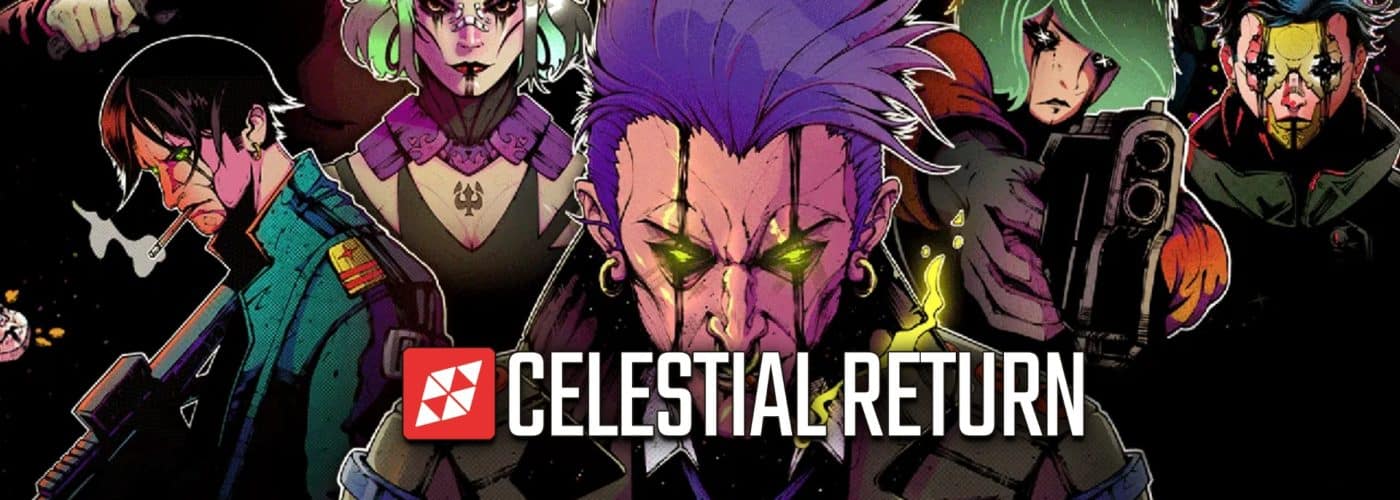
The art direction does much of the heavy lifting in making that world feel distinctive. Illustrated sequences give Celestial Return a strong visual identity, while the environments and character designs reinforce the atmosphere of decay, isolation and uncertainty that runs through its narrative.
The artwork is not simply there to make the game look distinctive; it helps establish the tone through which its story is experienced. Then there is the music. If the artwork gives Celestial Return its visual character, the soundtrack provides much of its emotional texture.
Melancholy, tension and mystery are woven into the musical identity of the game, with the score consistently supporting the atmosphere rather than competing with it. It is one of those elements that can be easy to overlook precisely because it works so naturally in the background.
But there is an unavoidable tension at the centre of Celestial Return. The more ideas a game tries to accommodate, the harder it becomes to give each of them room to breathe.
When the experience follows its carefully controlled narrative structure, Celestial Return is at its most assured. The objectives are clear, the pacing is deliberate and its various systems feel meaningfully connected to the story being told. The balance becomes less consistent once the game asks the player to take greater responsibility for exploration.
There are moments when determining where to go next or how to progress feels less intuitive than it should. The issue is not a lack of content, but the transition between systems: Celestial Return knows what it wants the player to experience, yet it does not always provide the clearest bridge between one part of that experience and the next. The resulting pauses can interrupt a rhythm that is otherwise carefully constructed. This is perhaps the central contradiction of Celestial Return. Its ambition is rarely its problem. Its ambition is the reason its problems exist.
There is simply a lot happening here. Some ideas complement one another remarkably well. Others feel as though they needed more refinement, more development or simply more time to settle into the larger design. Yet even when a system does not completely succeed, it tends to reveal something worthwhile about what the developers were attempting to achieve.
That makes Celestial Return unusually interesting to evaluate. Its imperfections are rarely empty spaces; they are often the visible seams between genuinely ambitious ideas.
What emerges, then, is an ambitious and imperfect narrative RPG with considerably more depth than its individual systems might initially suggest. It does not always achieve the balance between its many influences, but it demonstrates why that balance is worth pursuing.


A Visual Novel That Plays by RPG Rules
The first thing Celestial Return gets right is understanding that a visual novel does not have to remain a visual novel in the traditional sense. Its foundation is familiar, but its ambitions extend well beyond it. Dialogue, descriptive passages and illustrated characters still form the backbone of the experience, yet they are surrounded by a collection of systems that gradually push the game into distinctly RPG territory. Statistics, quests, items, implants and abilities are all integrated into a broader progression system, with the inventory itself divided into dedicated categories.
On paper, this could easily sound like a collection of familiar RPG conventions added for the sake of variety. In practice, however, Celestial Return gives these systems a meaningful role in determining how its story unfolds. Your character sheet is, in effect, another part of the narrative.
Statistics can determine which options become available during conversations and specific situations, creating a direct relationship between character development and narrative possibility. It is a small but significant departure from the way choices typically function in a traditional visual novel. Usually, the question is simple: what would you like your character to say or do?
Celestial Return adds another layer: is your character capable of doing it? A dialogue option may be locked behind a particular ability threshold. Elsewhere, attempting an action can require the expenditure of a specific resource to improve the likelihood of success. The result is a system in which narrative decisions are no longer entirely separate from character progression.
What you choose depends, at least in part, on what you have built. That connection gives Celestial Return a particularly interesting relationship between storytelling and mechanics. Character development is not merely about becoming stronger; it gradually defines the boundaries of what the protagonist can attempt, how they can approach certain situations and which possibilities remain available. The game therefore turns its RPG mechanics into something more than a secondary layer. They become part of the language through which the story is told.
It is an approach that does not always reach its full potential, but when the different systems align, Celestial Return demonstrates exactly why stepping outside the traditional visual-novel framework can be so rewarding.
A Dialogue System Built Around Character Progression
Some of Celestial Return’s most interesting encounters are the ones that turn conversation into an RPG-style skill check. At pivotal moments, a seemingly simple exchange can open into four or more possible approaches, each governed by a different attribute or ability.
Dialogue, in other words, is not always about choosing the response you prefer. Sometimes, it is about whether your character has actually earned the right to give it. That distinction gives the game’s progression system a meaningful place within its storytelling.
Certain options remain locked until a particular ability has been developed far enough, while some checks may also require one of the limited dice available to the player. The result is a system in which character development can directly influence the shape of an encounter.
Improving an attribute does not merely make the protagonist stronger; it can change the range of possibilities available to them. This is where Celestial Return makes one of its more convincing arguments for treating progression as part of the narrative itself.
The character sheet is not simply a collection of numbers sitting behind the story. It gradually establishes what the protagonist can understand, attempt or accomplish, giving mechanical progression a direct relationship with narrative agency. The way you build the character can, at least in certain situations, determine the story you are able to experience.
There is a natural replayability to that idea, too. A protagonist developed around one set of abilities may encounter routes, responses or solutions that another build simply cannot access. Returning to the same situation with a different character configuration can therefore reveal another side of an encounter, even if the game does not always exploit these differences to their fullest potential.
And that is perhaps where Celestial Return leaves some of its most interesting opportunities on the table. The framework is stronger than the extent to which it is ultimately used. Not every variation carries significant narrative consequences, and some alternative options amount to different ways of reaching broadly similar outcomes. Yet the design philosophy remains sound.
Because when your character’s abilities determine not only how you can respond, but which responses are available to you in the first place, the line between progression and storytelling begins to disappear. The character sheet stops describing the story. It starts shaping it.

A Surprisingly Tense Game of Risk and Reward
One of Celestial Return’s most distinctive ideas is its dice system, which gives chance a tangible cost. The dice are a limited resource, and that simple restriction fundamentally changes how they function. They are not merely there to determine whether an action succeeds or fails; they become something the player has to manage. Whenever a choice calls for a die, there is a decision to be made before the roll itself. Is this moment worth spending one?
That question adds a surprisingly effective layer of strategy to the game’s conversations. A choice can be appealing from a purely narrative perspective and still be difficult to justify if taking it means giving up a resource that may be more valuable later. Conversely, holding on to a die means accepting that some opportunities may have to be left unexplored.
The mechanic is deliberately modest, but its scarcity gives even relatively ordinary exchanges a degree of tension that a traditional dialogue system would rarely create.
It also ensures that Celestial Return’s visual-novel structure never becomes entirely passive. Even when the player is primarily reading and listening, there is still something to consider beneath the dialogue itself. You are not simply deciding what your character should say; you are deciding what you are willing to spend to make that choice possible.
That is where the system becomes particularly effective. The dice create a connection between narrative agency and resource management, turning conversations into moments of consideration rather than simply branching points in a script.
They are perhaps the clearest example of the developers’ broader desire to push the visual-novel format towards something more mechanically involved. The problem is not the idea itself, but the way Celestial Return introduces it alongside everything else.
The game brings a considerable number of mechanics into play within a relatively short period, and its enthusiasm for adding systems occasionally works against its ability to teach them naturally. Attributes, abilities, dice and other elements of progression are introduced before the overall structure has always had enough time to settle, making the opening hours feel denser and less immediately intuitive than they might otherwise be.
It is a recurring tension throughout Celestial Return: the game is at its most interesting when its many systems intersect, but it sometimes moves too quickly to give those systems the space they need to breathe. The dice are a strong example of the potential behind that philosophy: an understated mechanic that can make a simple conversation feel like a genuine decision, provided the player has enough time to understand what is at stake.
Personality as a Tool for Player Expression
More distinctive still is Celestial Return’s personality system, which gives the protagonist an identity beyond the numbers on their character sheet. Stats and abilities determine what the character can do, but personality helps shape how they choose to do it. Traits such as anger, impulsiveness and curiosity can influence certain conversations and encounters, allowing the player to establish a sense of character without pushing the game into the conventions of a traditional RPG.
What makes the system work is its understanding that role-playing does not necessarily require the player to construct an entirely new identity from scratch. Instead, Celestial Return gives them a set of tendencies through which that identity can emerge. An argument can be met with aggression or reason. An investigation can be pursued out of genuine curiosity or approached with a more pragmatic sense of purpose. These choices may not send the narrative down radically different paths, but they gradually give the protagonist a different voice and way of engaging with the world.
That makes personality feel less like another progression track and more like a layer of interpretation. The player is not simply deciding what happens; they are helping define the person through whom those events are experienced. It is a subtle distinction, but an important one, particularly in a game so heavily built around dialogue and character interaction.
It also highlights one of the more interesting ideas behind Celestial Return’s approach to interactive storytelling: personalisation does not have to mean rewriting the narrative. A game can tell broadly the same story while giving players different ways of inhabiting it. The events may remain familiar, but their meaning can shift depending on the character the player has gradually shaped.
Celestial Return does not always extract the full potential from this idea, and the influence of personality can feel more pronounced in some situations than others.
Even so, the system adds a valuable layer to the experience. It turns characterisation into something the player participates in rather than something they simply observe. The protagonist is not just the character you control. They are the character you gradually define.

The Voice Behind the World
For all the systems built around its narrative, it is ultimately the writing that holds Celestial Return together. Its dialogue is carefully crafted, but the real strength lies in the way it gives the cast a distinct sense of identity. Supporting characters never feel like little more than vehicles for exposition or convenient tools for moving the story from one beat to the next.
They have their own personalities and motivations, allowing even seemingly minor conversations to carry a sense of purpose.That matters because Celestial Return understands that a convincing world is built as much through the people who inhabit it as through the lore surrounding them.
Characters can reveal something about themselves while, almost incidentally, exposing another fragment of the society they live in. A seemingly inconsequential conversation can establish a relationship, hint at a larger conflict or quietly introduce a piece of information that becomes more meaningful later. The game’s world-building consequently feels less like a database being opened one entry at a time and more like something the player gradually pieces together.
Information is distributed throughout conversations and encounters rather than delivered through long explanatory passages, allowing the setting to retain a degree of ambiguity. The game introduces a society where advanced technology, scientific experimentation, mystery and unexplained phenomena exist side by side, without immediately explaining how every piece fits together. That restraint is particularly valuable for a narrative built around unanswered questions.
The game does not feel compelled to stop and explain its world whenever something unfamiliar appears. Instead, it allows details to accumulate, giving the player enough information to recognise patterns while leaving room for uncertainty and interpretation.
It is a quieter form of world-building, but an effective one. The setting feels larger than the information the game explicitly provides, precisely because its characters suggest histories, tensions and realities that extend beyond the immediate conversation.
And that may be the writing’s greatest achievement: Celestial Return does not make its world feel alive by telling you everything about it. It makes you want to keep listening.
A Detective Story With No Interest in Staying Grounded
Celestial Return begins with an image that immediately tells you this is not a world governed by familiar rules. Inside a secret facility, sentient creatures resembling roses are discovered, an unsettling premise that establishes the game’s reality as something fluid and difficult to define. From there, the story begins to connect several of its central characters, including one of these creatures and the detective who gradually becomes the focal point of the investigation.
Their relationship provides an unusually effective introduction to the game’s world. Rather than front-loading its lore, the game allows its setting to reveal itself through the people caught up in it, giving the player just enough information to recognise that something is fundamentally unusual without immediately explaining why. The mystery takes a considerably darker direction when the detective is called back into service to investigate a series of apparently unrelated suicides.
The cases initially seem disconnected, but the further the investigation progresses, the more they begin to point towards something larger: cults operating in the shadows, secrets deliberately kept from view and events that become increasingly difficult to explain through conventional means.
What follows is a narrative that refuses to remain in a single register. Investigation and character-driven dialogue form its foundation, but they are repeatedly interrupted, and sometimes reshaped, by encounters that move into much stranger territory. The ability to converse with the dead is perhaps the clearest expression of this approach, taking an already unusual investigation and pushing it beyond the boundaries of conventional detective fiction.
Crucially, these elements are not presented simply for the sake of surprise. They become pieces of the same larger puzzle, gradually expanding the scope of the story and complicating the player’s understanding of what is actually happening. The more the detective uncovers, the less useful ordinary assumptions become That gives Celestial Return an appealing sense of narrative instability.
The mystery does not simply ask you to discover what happened; it repeatedly asks you to reconsider what kind of world could allow it to happen at all.
Not every revelation lands with equal force, and the story occasionally struggles to balance its more grounded investigative elements with its increasingly unconventional ideas. Even so, that willingness to keep moving beyond the expected is one of its defining qualities.

A Cyberpunk World Full of Contradictions
One of Celestial Return’s greatest strengths is the world it creates around its narrative. Its cyberpunk setting is far more than an aesthetic choice. Technology, decay and social unease are woven into the fabric of the world, shaping a future that feels less like a vision of progress and more like the aftermath of it. There is nothing particularly utopian about this version of tomorrow.
Advanced technology exists alongside deterioration, secrecy and uncertainty, creating a setting defined by the tension between what humanity has achieved and what it has failed to leave behind. The result is a world that can feel technologically sophisticated without ever feeling truly optimistic: a place where progress has not necessarily brought clarity, stability or even comfort.
That contradiction gives Celestial Return’s setting much of its character. Technology is everywhere, but so is everything that has accumulated in its wake: decay, unanswered questions, the consequences of past decisions and the persistent sense that forces beyond the player’s immediate understanding are shaping this world. That same tension allows the game’s visual identity to extend well beyond simply establishing its genre. Its art direction works as part of the world-building, with environments, character design and visual details reinforcing the atmosphere and quietly communicating the history and instability that lie beneath the surface. The result is a setting whose appearance often reveals as much about its underlying tensions as the narrative itself.
This is where Celestial Return arguably shows its strongest creative instinct: it understands that its world should feel lived-in, complicated and slightly unsettled rather than merely futuristic.
A Visual Identity You Don’t Easily Forget
The artwork is where Celestial Return finds its strongest and most immediate voice. Its illustrations are polished, expressive and carefully composed, capable of establishing the mood of a scene before a single line of dialogue has been read. The characters, in particular, benefit from distinctive designs and a strong sense of visual presence, while the environments are detailed enough to feel like extensions of the world rather than decorative backgrounds.
For a visual novel, that distinction is crucial. Still images are not merely presentation here; they are part of the game’s dramatic language. A change in expression, the way a character occupies the frame or a subtle shift in composition can completely alter the meaning of an exchange. Celestial Return understands this particularly well, using its artwork to reinforce the writing and give its characters an expressive range that dialogue alone could not provide.
The game’s direction occasionally goes a step further, introducing restrained animation during some of its more important sequences. These moments add movement and emphasis without undermining the visual-novel format, allowing key scenes to breathe without requiring a level of technical spectacle the game was never designed around.
That is ultimately where Celestial Return makes the right choice. Its visual ambition is not about graphical fidelity; it is about artistic coherence. Illustration, composition, character acting and atmosphere work together to create a style that remains recognisable throughout the experience.
The result is a game that does not need cutting-edge rendering or elaborate visual effects to make an impression. Its strongest images are effective precisely because they understand what they need to communicate, and when to let the image speak for itself.


A World Heard as Much as It Is Seen
If the art direction is the game’s most immediately striking achievement, the soundtrack is its more understated triumph. Music is woven into almost every part of Celestial Return, but it rarely feels like mere accompaniment. The score is carefully tailored to the mood of each situation, moving between tension, melancholy, mystery and unease while giving scenes an emotional texture that the writing and artwork alone could not always provide.
That level of attention is apparent even outside the main narrative. The music that plays across the main menu already establishes a clear sense of intent, reinforcing the idea that the soundtrack was treated as part of the game’s overall identity rather than as something added simply to occupy the background.
More importantly, Celestial Return understands when music should take the lead. There are moments in which the score becomes the defining element of a scene, quietly shaping the player’s response without drawing attention to the technique behind it. A conversation can feel more intimate, an investigation more uncertain, or an otherwise understated moment more emotionally charged simply because of what is playing underneath it.
That is particularly effective in a game whose rhythm is so heavily determined by reading and conversation. With relatively little conventional action to dictate momentum, music becomes one of the key tools through which the game controls pace and atmosphere. It fills the spaces between words without overwhelming them, and gives quieter moments room to resonate.
Perhaps the clearest sign of its success is what remains after the screen goes dark. The strongest musical moments are not necessarily the ones you remember as melodies, but the ones you remember as feelings. For a narrative-driven game, that is a considerable achievement, and one of the clearest indications that Celestial Return understands atmosphere as something that has to be built, not simply displayed.
Getting Lost Isn’t Always Fun
Not every part of Celestial Return feels equally assured. Its most noticeable weakness emerges in the shift from the tightly structured flow of its visual-novel sequences to the greater freedom of its map-based exploration. The contrast is hard to miss. When the game is driven by dialogue, choices and carefully paced progression, its pacing is confident and its direction rarely in doubt.
Once the player is given control of where to go next, however, that sense of direction can occasionally disappear. Most objectives are communicated clearly enough, but some investigations leave too much of the progression logic for the player to reconstruct without providing quite enough information to do so confidently. That distinction matters because there is a fundamental difference between figuring something out and simply trying things until something works. The former is precisely what an investigative game should encourage: paying attention, connecting seemingly unrelated details and arriving at a conclusion that feels earned.
The latter can produce the opposite effect, turning what should be an engaging process of discovery into a matter of retracing locations, testing interactions or waiting for the right progression trigger.
Celestial Return is at its best when it trusts the player to make connections without taking away the context needed to make those connections. Some of its investigations therefore reveal a small but meaningful imbalance in the game’s approach to player agency. Freedom is valuable only when the information surrounding it is strong enough to make that freedom meaningful.
A slightly more deliberate approach to signposting could have preserved the investigative challenge while reducing the moments in which progression feels uncertain for reasons unrelated to the mystery itself. The issue is not that Celestial Return asks too much of the player; it is that, occasionally, it asks the player to guess where deduction should begin.

Technical Restraint in Service of the Experience
On the technical side, Celestial Return proves considerably more convincing in its current form. The present build is largely free of issues significant enough to interfere with the experience, while its visual-novel framework keeps the technical demands relatively restrained. That leaves the game free to place its emphasis where it matters most: on its artwork, atmosphere and narrative design.
The distinction between the current version and the game’s earlier iterations is nevertheless worth making. The initial release was affected by a number of technical shortcomings, some of which could disrupt the otherwise carefully paced flow of the experience. Continued post-launch support has gradually addressed those issues, with successive updates bringing greater stability to the game as a whole. There is never any real attempt to make technology itself a selling point.
Celestial Return is not built around graphical complexity, nor does its presentation need to be. Its technical framework serves a far more practical purpose: to support the game’s visual language, atmosphere and narrative ambitions without ever drawing attention away from them.
That may sound like a modest achievement, but it is an important one. In a game so dependent on atmosphere, dialogue and visual storytelling, technical friction can be disproportionately disruptive. Celestial Return largely avoids that problem in its current state.
A Vision Worth Pursuing
By the end of Celestial Return, the quality that gives the game much of its character also exposes its greatest limitation. This is not a game lacking ideas; it is a game that occasionally struggles to make so many ideas feel like parts of the same whole. Its RPG systems give progression greater weight, the personality mechanics add a meaningful layer to characterisation, and the dice turn otherwise straightforward decisions into moments of risk and consideration.
The map introduces an investigative layer, while the writing, artwork and soundtrack provide the narrative and atmospheric foundation around which everything else is built.
There is genuine value in each of these components. The problem emerges in the spaces between them. When too many systems demand the player’s attention at the same time, complexity can begin to feel like density rather than depth. This is particularly evident during the opening hours, when Celestial Return introduces much of its mechanical vocabulary before the player has had sufficient time to understand how those individual parts fit into the larger design.
The early experience therefore asks for considerable attention on several fronts at once. You are learning the rules of its world, following its narrative, managing statistics and resources, discovering how personality affects your character, understanding the role of the dice and learning to navigate the map, all while the story itself is still establishing its foundations.
None of these systems is especially difficult in isolation. What makes them demanding is the speed and proximity with which they are introduced. A more measured introduction could have changed that dynamic considerably. Giving each mechanic time to establish its purpose before adding another layer would not have reduced the game’s complexity; it would have made that complexity easier to appreciate. The player would have been able to understand not only what each system does, but how it contributes to the experience as a whole.
That distinction ultimately defines Celestial Return. Its problem is not that it tries to do too much, but that it does not always give its ideas enough room to breathe. Beneath that density is a game with a surprisingly rich collection of concepts, many of which work remarkably well on their own. What is missing, at times, is the space and pacing required to let them become a coherent whole.

 7/10
7/10