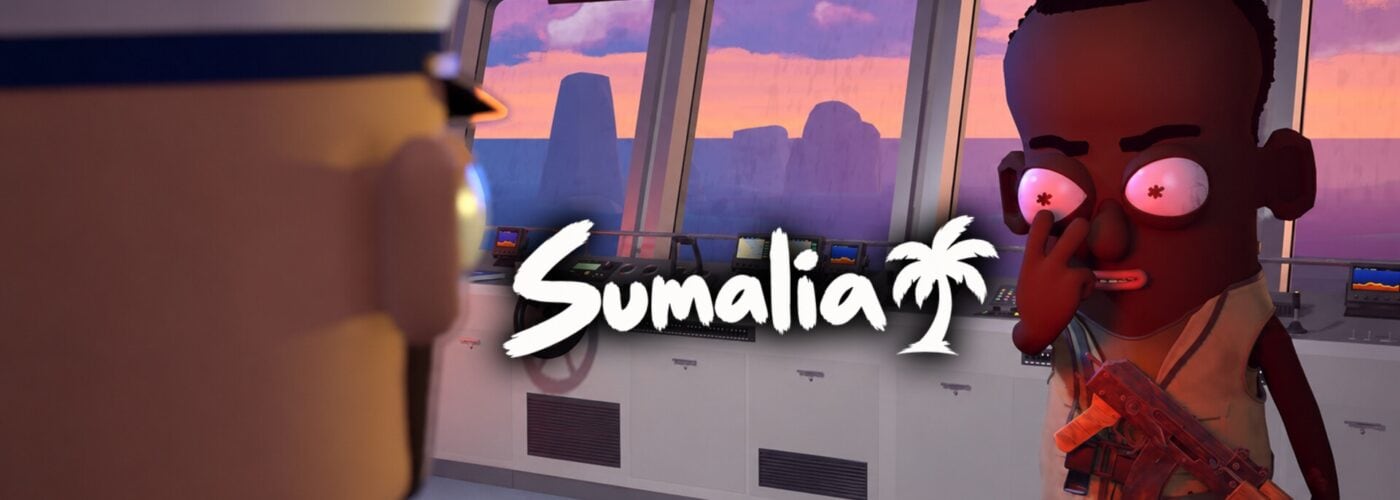
In this upcoming co-op simulator, players will work together to capture vessels, secure their cargo and use the proceeds to improve their boats and village.

Pirate games have long drawn from a familiar romantic vision of life at sea: towering galleons, buried treasure, and fierce clashes between crews armed with cutlasses.
Few titles have embodied that fantasy as memorably as Assassin’s Creed IV: Black Flag, whose swashbuckling adventures helped define the genre’s enduring appeal. Sumalia, however, sets its sights on a very different kind of pirate story. Developed by independent studio halfbrain, this upcoming co-op simulator leaves the Caribbean’s Golden Age behind to explore the far more contemporary world of maritime piracy off the coast of Somalia.
At its heart, Sumalia is a co-op simulator built around the idea of modern-day piracy, blending a deliberately satirical premise with ship raids, resource management, vessel upgrades, and village development. The aim goes beyond boarding ships and claiming their cargo: players must build an operation from the ground up, starting with limited resources and a modest boat before gradually expanding their reach. Every successful raid offers the chance to strengthen the crew’s position, invest in better equipment, and lay the foundations for a more ambitious enterprise.
In that respect, the game’s underlying structure brings to mind independent titles such as Schedule I, which turn illicit activities into elaborate gameplay loops driven by progression, management, and increasingly absurd situations. Sumalia applies a similar framework to a very different setting. Here, city streets are replaced by open waters, while the pursuit of profit revolves around boarding vessels, securing their cargo, and reinvesting the proceeds.
Its appeal lies in the interplay between these activities, as the action of each raid feeds into the broader process of building and maintaining the player’s operation. The premise is rooted in a conflict over the exploitation of local resources. Foreign vessels, particularly large industrial fishing boats, encroach on the waters surrounding the players’ village in search of its marine wealth, leaving waste and environmental damage behind. With their community under threat, the villagers decide to take matters into their own hands, and turn to piracy as a means of fighting back.
Players will be tasked with organizing this response alongside their companions, forming a crew and transforming a small, improvised operation into something considerably more substantial. Raids, captured cargo, and subsequent investments are expected to drive that progression, allowing the group to improve its vessel, expand its resources, and gradually develop the village.
What sets Sumalia apart, at least on paper, is its decision to draw inspiration from a contemporary and recognizable setting rather than the familiar mythology of Caribbean piracy. The result is an unusual premise for a cooperative game, one that could give halfbrain’s project a distinctive identity within a genre often defined by historical adventure and romanticized depictions of life at sea.
That choice also comes with a delicate balancing act. How will Sumalia reconcile its satirical tone with an setting inspired by a complex real-world issue? Its caricatured approach may provide room for irreverent humor, but the effectiveness of that humor will depend on how thoughtfully the game handles its subject matter. Avoiding a portrayal that simply reduces the Somali coast and its communities to a collection of stereotypes will be crucial to making the premise work.
For now, Sumalia stands out for taking the pirate fantasy in an unexpected direction. Rather than chasing the legends of the past, halfbrain is looking to the present, trading treasure maps and legendary ships for cargo raids, resource management, and the uneasy business of building a pirate operation on the Somali coast.

Smooth Sailing Takes Some Serious Planning
At the core of Sumalia is the ambition to build and expand a pirate operation from the ground up. Rather than moving from one standalone mission to the next, players appear to progress through an interconnected loop of raids, resource gathering, and village development, with each activity contributing to the growth of their enterprise. The journey begins on a modest scale, with a small boat, basic equipment, and a dwindling supply of fuel. From there, success will depend on identifying suitable targets, making the most of each expedition, and securing the money and materials needed to transform a fledgling crew into a more established operation.
What gives this progression its potential depth is the relationship between the spoils of piracy and the development of the player’s village. Cargo seized during raids is not simply a reward to be stockpiled; it can be put towards improving the settlement, constructing buildings, restoring infrastructure, and supporting future expeditions. In this sense, each voyage serves a purpose beyond the immediate thrill of an attack, feeding into a wider system of investment and expansion. The challenge will be to balance short-term gains against the resources required to keep the operation running and ensure that the next expedition is better equipped than the last.
That broader management layer extends to the community’s everyday needs. Food, water, and materials must be accounted for, while fishing offers a way to secure some of the resources required to sustain the village and its crew. Eight different fish species have already been featured in the game’s development materials, pointing to a system that gives players reasons to spend time away from the more action-driven side of the experience.
These activities may not carry the same immediate appeal as boarding a vessel, but they appear to be part of the infrastructure that makes each raid possible. The boat itself is another key consideration, serving as both the player’s primary means of reaching targets and an important investment in the operation’s future. Upgrades are expected to allow players to tailor their vessels to different roles, with trade-offs between speed, durability, cargo space, and fuel consumption. A nimble craft could prove invaluable when pursuing or escaping another ship, but its limited capacity may leave less room for valuable cargo. A larger vessel, meanwhile, might offer greater resilience and storage space at the cost of increased fuel requirements.
Fuel could prove to be one of the most consequential resources to manage while out at sea. A shortage during an expedition has the potential to turn a promising raid into a costly setback, particularly when the crew is far from shore or already engaged in a pursuit. Players will need to keep track of their reserves, plan their routes, and consider how much distance they can cover before committing to an operation. It’s a straightforward mechanic on paper, but one that could lend a greater sense of risk to voyages and make preparation an integral part of the experience.
Character customization offers a welcome dose of levity alongside Sumalia‘s more demanding management systems. Players will be able to shape their own pirate through a range of options, including some rather unconventional tweaks, right down to the shape of their character’s forehead. Such details capture the game’s irreverent spirit, hinting at halfbrain’s intention to complement its resource-driven gameplay with a distinctly absurd sense of humor. How consistently that tone will carry across the full experience remains to be seen, but the customization system already suggests a project that isn’t afraid to poke fun at its own pirate premise.

Every Ship Is a Different Kind of Fight
No pirate adventure would be complete without the occasional boarding party, and ship raids are central to Sumalia‘s gameplay. The development updates released by halfbrain suggest that the combat system has been evolving alongside the rest of the experience, with new mechanics gradually broadening the possibilities available during encounters at sea.
One of the more interesting additions is the ability to engage in close-quarters combat, with weapons such as the machete giving players an alternative to firearms when boarding an enemy vessel. This should help bring some variety to these encounters, particularly when fighting unfolds across the confined spaces of a ship’s deck. Firearms are also part of the equation, including the AK-47, further underlining Sumalia‘s departure from the swashbuckling conventions of historical pirate games.
Not every raid is expected to pose the same level of danger. The size of the vessel and the security measures in place aboard it should have a direct bearing on the difficulty of an attack. A small fishing boat will naturally present a different challenge from a heavily guarded cargo ship, with the number of defenders and the risks involved likely increasing alongside the value of the potential haul. This distinction could prove particularly important to the game’s progression, giving players a reason to consider their capabilities before choosing their next target.
For a fledgling crew, smaller vessels should provide a relatively manageable way to accumulate resources and upgrade its equipment. As the operation expands, however, larger ships and more valuable cargo will inevitably become tempting targets. These increasingly ambitious raids are also likely to carry greater risks, with better-armed defenders and more demanding boarding encounters raising the stakes of every expedition.
There is still room for the combat system to develop further, particularly when it comes to the defensive capabilities of the ships players set out to capture. A more varied range of onboard security measures could give each vessel its own character and make the approach to a raid feel less predictable. High-pressure water cannons, armed positions, or other close-range defenses, for instance, could put smaller pirate boats at a considerable disadvantage, forcing players to rethink their tactics before attempting to board.
These are possibilities rather than confirmed features, but they would fit naturally within Sumalia‘s existing framework. Giving different vessels distinct defensive profiles could make the choice of target just as important as the raid itself, adding another layer of strategy to the game’s cooperative encounters. It would also help ensure that success at sea depends on more than simply having the better weapons, turning each boarding operation into a challenge that calls for preparation, coordination, and a degree of improvisation.


Your Ship, Your Rules, Your Ransom
One of the more distinctive features revealed for Sumalia is the choice players face once they have taken control of an enemy vessel. With the ship’s security neutralized, a successful boarding is only the beginning: players must decide how to turn their prize into a profit. The most straightforward option is to salvage the cargo, return it to the village, and sell it to finance further expeditions.
This creates a clear link between each raid and the broader progression loop, allowing players to reinvest their earnings in boat upgrades, new infrastructure, and the development of their community. In this way, every successful operation can help lay the groundwork for the next.
There is, however, a more questionable alternative. Rather than taking the cargo, players can capture members of the crew and hold them for ransom. The prospect of securing a larger payout makes this an enticing option, but one that comes with additional risks and demands. According to the game’s presentation, hostages can prove more valuable than the goods aboard a ship, although managing them requires a different approach from simply loading cargo onto a boat.
This system could add a compelling strategic layer to Sumalia‘s boarding encounters, making the capture of a vessel only the first of several decisions players must face. Choosing between securing the cargo and taking the crew hostage could shape the course of each expedition, as players weigh the potential rewards against the risks and resources required to see their plan through. In co-op, the mechanic could also encourage more deliberate teamwork, with crews having to agree on their priorities and adapt their approach as an operation unfolds.
This is where Sumalia‘s co-op structure could really come into its own. A boarding operation might quickly turn into a frantic exercise in teamwork, with players splitting up to secure the deck, collect the cargo, keep the crew under control, and prepare the spoils for the journey back to shore. By making the aftermath of a raid a task in its own right, the game could turn each successful capture into a more involved and memorable cooperative undertaking.

The Pirate Life Is Better with a Crew
Cooperative play is central to Sumalia‘s design, with the game allowing up to four players to join forces as a single pirate crew. Those who prefer to sail alone will also have access to a single-player mode, while online and local network support provide different ways to share the adventure. Among the features designed to strengthen this sense of teamwork is proximity voice chat, which limits communication according to the distance between players in the game world.
During a boarding, for example, crew members will have to remain close enough to one another to exchange instructions and coordinate their movements. Straying too far from the group could leave a player cut off at precisely the wrong moment. The mechanic could make Sumalia‘s cooperative encounters feel more immediate and unpredictable. Operating a vessel, taking control of enemy ships, and securing the spoils all involve tasks that can benefit from a well-organized crew.
Proximity chat may also give rise to some memorable mishaps, particularly when a player finds themselves in trouble beyond the reach of their companions’ voices. Whether the result is a tense rescue or an unintentionally comic situation, the system has the potential to make teamwork feel like a natural part of life at sea rather than an optional extra.
Progression, meanwhile, appears to extend well beyond improving the modest boat players begin with. As their operation grows and their resources increase, crews will be able to acquire larger vessels, some of which can serve as floating bases. This could have a substantial impact on the scale and organization of expeditions, allowing players to venture further afield while providing more room to manage their activities offshore.
Ultimately, Sumalia‘s appeal will depend on how well its cooperative systems, resource management, and progression come together to form a cohesive experience. Its most engaging moments could emerge when these mechanics intersect: a carefully coordinated raid, the acquisition of a larger vessel, or an unexpected setback that forces the crew to rethink its plans. For halfbrain, the key will be to build on this foundation with a satisfying sense of progression and enough variety in its activities to keep each expedition compelling well beyond the early stages.


When Will Sumalia Set Sail?
Sumalia is currently scheduled to launch in Q4 2026, according to halfbrain’s official website. Although an exact release date has yet to be confirmed, the game is already available to wishlist on Steam, where players can follow its development and keep up with the latest announcements ahead of launch.
We’ll keep following Sumalia‘s development and bring you the latest news as halfbrain reveals more about the game, including any updates on its release date.