In short
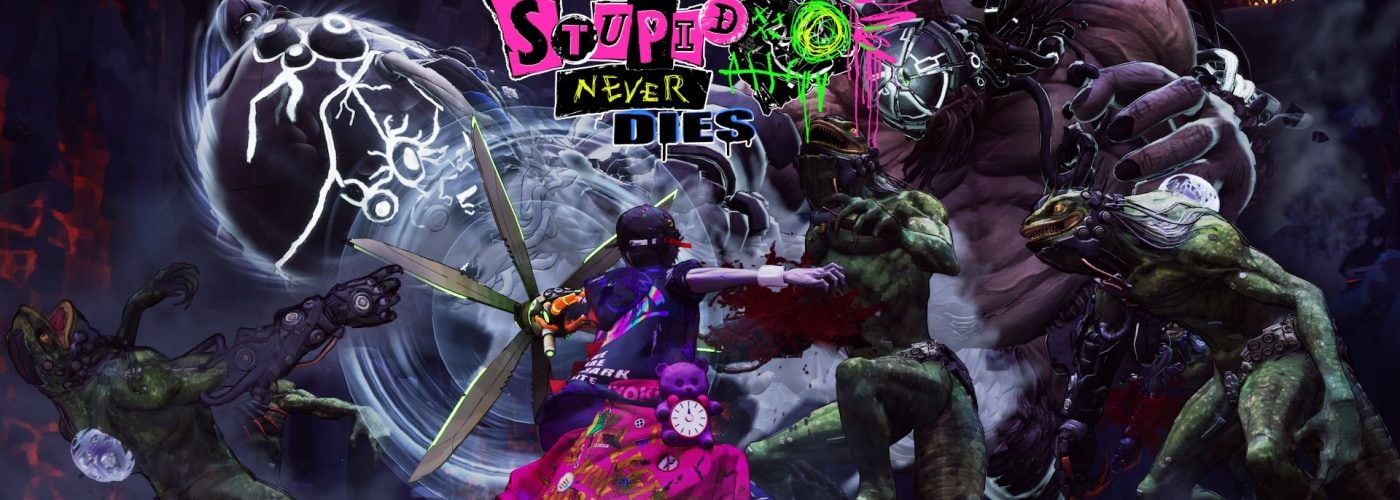
The soundtrack of Stupid Never Dies, released by T’s MUSIC SOUND DESIGN with 80 tracks, is a load-bearing element of GPTRACK50’s roguelite: the analysis goes through the nineteen tracks of the in-game Turntable, the four composers led by Rei Kondoh, the remixes credited to Davy and the Neo Pop Punk formula described by Hiroyuki Kobayashi, which blends pop-punk, metal, electronics and traditional Japanese instruments such as shakuhachi, biwa and shinobue.
An analysis of the soundtrack that sets the tone for the entire experience, with a look at the tracks, who composed them, and how pop-punk meets metal, electronic music, and traditional instruments.
One of the main reasons Stupid Never Dies makes you want to keep playing is the music. It was also one of the main reasons this GPTRACK50 title struck me so deeply from the teaser onward.
That may be a personal point of view; art and the interest in art always start from an instinct or a natural inclination, that much is certain. But in this case it is equally certain that there is quality. Quality in how GPTRACK50 presented the project, first of all, nearly a year ago now, and quality in every one of the aspects that make up such an original and striking title.
In Stupid Never Dies, music and aesthetics are dominant elements, and it shows, on top of gameplay that is enjoyable in its own right.

Would Stupid Never Dies be the same game without graphics and music like these?
With no critical intent, I believe the answer is no.
Stupid Never Dies without its exceptional look, and above all without its music, would not be what it is, and playing it would not be as much fun.
Music is a foundational part of the experience, and we will look in more detail at why.
A DJ table in the middle of the action figures
In the game, someone who belongs to the fictional world signs every track: Davy, the bosses, or the shop where it plays.The Turntable collects nineteen of them, all with invented names.
The player finds the track list, which unlocks gradually, at Kitsch Monster, the shop that sells action figures and gadgets: in the middle of the merchandise there is a DJ table with two turntables, a mixer, and speakers covered in stickers, beneath a neon sign with smiling ghosts and a screen hanging from the ceiling showing a band in green and blue like a distorted signal.
The Battle Tracks are three: Climb or Die, signed by Davy, and the remixes of Inferno Titan and Headless Highway, signed by Davy together with the original authors, Surtr R.S. and Bob Dullahan. The Boss Anthems are four: The Keeper’s Oath and Nothing Gets Through, signed by The Gatekeepers and The Boss Syndicate, listed as Various Artists, plus the original versions of these two tracks.
The B-Sides are twelve under the Other label. There is the Stupid Never Dies theme by Davy & Julia and Davy Burst, which the menu classifies as a Battle Track even though it sits among the B-Sides, then the Mall Grooves named after the mall’s venues: Marilynbill Mall by The Food Court Crew, Jupiter Target by Dr. Frank Steiner, Ink on the Brain by Acelino de la Luna, and so on, one piece per shop, signed by whoever runs it. Frank Steiner is Doc, Acelino de la Luna the tattoo artist at Ink on the Brain.
Some tracks have their own cover art: Climb or Die shows a purple teddy bear shattering against a blue background, Inferno Titan a gaping mouth, Headless Highway a yellow background with the title in crooked letters. The main theme has two faces under caps, and the other tracks a black record with the game’s logo. From the menu you can play a track, add it to the playlist, repeat it, or shuffle the list.

The idea is consistent with the rest of the art direction, where collecting is part of the character: the card alongside catalogs the TickTock Teddies in six series, Animal, Sports, Monster, Glitzy, Musician, and Freaky, and describes the standard specimen as a gift Doc gave. Music and plush toys end up in the same menu, because both are objects the player finds and displays. The same teddy bear, with its pink alarm clock belly, is the timer for the descents: it appears in the top right corner next to the level number. The remaining time is extended by three minutes when you clear the tenth or the twentieth level.
The eighty tracks of the album
T’s MUSIC SOUND DESIGN released Stupid Never Dies Original Soundtrack on October 22, 2026, around launch, with copyright by GPTRACK50: eighty tracks on three digital discs, 3 hours, 18 minutes, and 49 seconds, available on the major streaming platforms under the Various Artists label.
The composers are four, and all come from T’s MUSIC: Rei Kondoh, Varon Chase Bantug, Yuta Yamaguchi, and Haruno Ito. On Kondoh’s website, the game’s page lists him as Lead Composer and Music Director, with the closing theme among his credits; among his tracks are also the final suite The Rebirth Beyond the End and the four movements of Legion of the Moon.
On the first two discs, Kondoh signs nearly half the tracks, thirty-four of seventy; Ito, Yamaguchi, and Bantug split the rest between them.On the third, his name appears in the credits of nine of the ten tracks: the only one left out is the remake of Inferno Titan.
Restless, Reckless, Never Die, Fearless closes the third disc after eight remixes of six or seven minutes, so anyone who listens to the whole album ends on a sung track.As for the credits, the four Boss Anthems tracks have four different authors, and all of them divide the Mall Grooves among themselves: none of the four kept a category to themselves.

The Davy signature
The third disc is almost entirely remixes. At the bottom of the tracklist, right before the end-credits track, the album credits Davy with eight remakes: from Headless Highway (Davy Remix) to The Rebirth Beyond the End (Davy Remix).
On the album the credits change: four remixes are by Yuta Yamaguchi, two by Rei Kondoh, one by Varon Chase Bantug, and Yamaguchi signs Crimson Requiem with Bantug. “Davy” is a collective name that covers three people. The remixes run from 5:54 to 7:32 and generally exceed the originals, since on the first two discs the only track over five minutes is the final suite. Headless Highway goes from 4:15 to 6:15, Inferno Titan from 4:43 to 6:41; The Rebirth Beyond the End drops from 8:01 to 6:06.
The same gap between billing and credits applies to the sung tracks. The two themes are the only ones with vocal parts, plus a rap by Davidgocray that the tracklist does not place. Stupid Never Dies, 2:52, is by Yuta Yamaguchi with lyrics by Shang Aquinde, Restless, Reckless, Never Die, Fearless, 3:42, by Rei Kondoh with lyrics by Genseki Tanaka. The album lists both tracks as duets by Francis Rey Gatmaitan and Brigette “Loise” Quirante, while in the Turntable the opening theme credits Davy & Julia. In the game, those credits tell the story of the characters; elsewhere, on the album, you can read who composed and who sings.
Even the titles do not match: the Turntable calls the track Marilynbill Mall, on the album it is Marilynville Mall.

Neo Pop Punk
Hiroyuki Kobayashi, producer and founder of GPTRACK50 after leaving Capcom in 2022, described the method in the Deep Bite video dedicated to the game’s sound. Composition started from Davy’s theme, from which the team derived the game’s tone. The team chose Pop-punk for the love story between Davy and Julia, and because it was the genre the developers listened to in their youth.
From there the team did something unusual: it did not stop at the protagonist’s theme, but wrote a piece for every inhabitant, one for Davy, one for each boss, one for every shop in the mall. The result brought metal, rock, electronic music, and traditional Japanese instrumentation into the mix, in a formula the studio calls Neo Pop Punk. The tracks change depending on what Davy is doing, and the mall’s background music uses lo-fi beats.
In the game, that idea has an exact counterpart: Surtr R.S., the name the Turntable credits Inferno Titan to, is one of Drugoya’s four generals. Doc’s database describes him as someone constantly seeking a clash capable of making his nerves sizzle, and who despises zombies for sitting halfway between humans and monsters. The track was written for a fire giant and remixed by the one who defeated him, that is, by a zombie.
The catalog also includes tracks of about ten seconds named after an era or a place: Molten Rome, Medieval Europe, Ancient Andes, Edo Zipangu. Read in sequence they sound like miniatures, interludes to register which world you have just entered, and the first two echo the Molten Rome Layer and the Medieval European Layer that the Frank’s Database lists alongside the Northern Viking Layer. If that is the criterion, the album also becomes a compressed atlas of the dungeon’s layers, with the lengthy stops reserved for monsters.
Kinya Sogawa plays shakuhachi and shinobue, Akiko Sakurai the biwa, and Bantug also handles drums and bass. Behind the two wind instruments stands a single person, and in the mix the biwa shares space with a distorted guitar.
A roguelite repeats the same descent dozens of times, and a single theme restarting identically on every attempt grows tiring quickly. A different signature for each boss, with remixes that rework the piece, changes the listening from one attempt to the next: after a third fight against the same opponent, the difference becomes audible. And that is why the DJ table matters: in the same places, after a few descents, changing the track changes the mood of the run.

Outside the fiction
The nineteen entries on the Turntable unlock one at a time, and the player lets you replay a track without repeating the descent in which you first heard it: the DJ table thus also becomes a log of defeated opponents and visited shops. Even fully unlocked, however, they cover less than a quarter of the album: the suites, the ambient pieces, and the four movements of Legion of the Moon live only on the disc.
Putting the tracks in the characters’ hands works: the soundtrack becomes an object of the world, like the shops’ lit-up signs.
Anyone who listens to the album without having played finds a single sequence of eighty tracks with no scene indications, while anyone who has played recognizes the names of the bosses and the shops among the titles and can reconstruct on their own the path taken through the dungeon and the mall.
This is why the music of Stupid Never Dies works so well. As Kobayashi recounts, Davy’s theme arrived before the game had a tone, and the boss pieces before the bosses had names.

If you want to get to know Stupid Never Dies better, you can read our review.