In short
With DLSS 5 and its 3D-Guided Neural Rendering, NVIDIA has pushed AI beyond final frame reconstruction, and an experiment with Silent Hill 3 on PCSX2, ReShade and no HD texture pack shows how much the image of a twenty-year-old game can be modernized without touching the original assets. From there, the article speculates on the next step: a progressive remastering that, leveraging emulator texture replacement and ReShade’s add-on architecture, would build a local cache of reconstructed textures and materials in the background, balancing conservative restoration against the risk of artistic reinterpretation.
From frame enhancement to progressive asset remastering: what happens when AI stops limiting itself to the final image
With DLSS 5, NVIDIA has once again moved the boundary of what we consider real-time rendering. I had already described the most evident rupture when commenting on the announcement, in DLSS 5 and the end of deterministic rendering: rendering stops being deterministic, and two identical executions of the same scene may not produce the same image. That reasoning, however, concerned the frame. What matters here is the next step, that is, what happens when the same principle is applied not to the final image but to the assets that compose it.
We are no longer talking only about reconstructing an image at higher resolution or generating intermediate frames: the new 3D-Guided Neural Rendering intervenes on the final appearance of the scene, using the frame produced by the engine as a base and adding visual information related to lighting and materials. NVIDIA describes it as a final neural stage of the pipeline, guided by the rendered content, by motion vectors, and by controls designed to preserve structure and artistic direction. NVIDIA Developer
This is an important difference, because for the first time DLSS is not limited to obtaining more efficiently a result the renderer could have produced with more resources. DLSS 5 directly generates part of the final appearance shown on screen, while remaining anchored to the game’s data. NVIDIA
If we can now reconstruct the frame, the question shifts: what could the next step be?
An old game with a surprisingly modern image
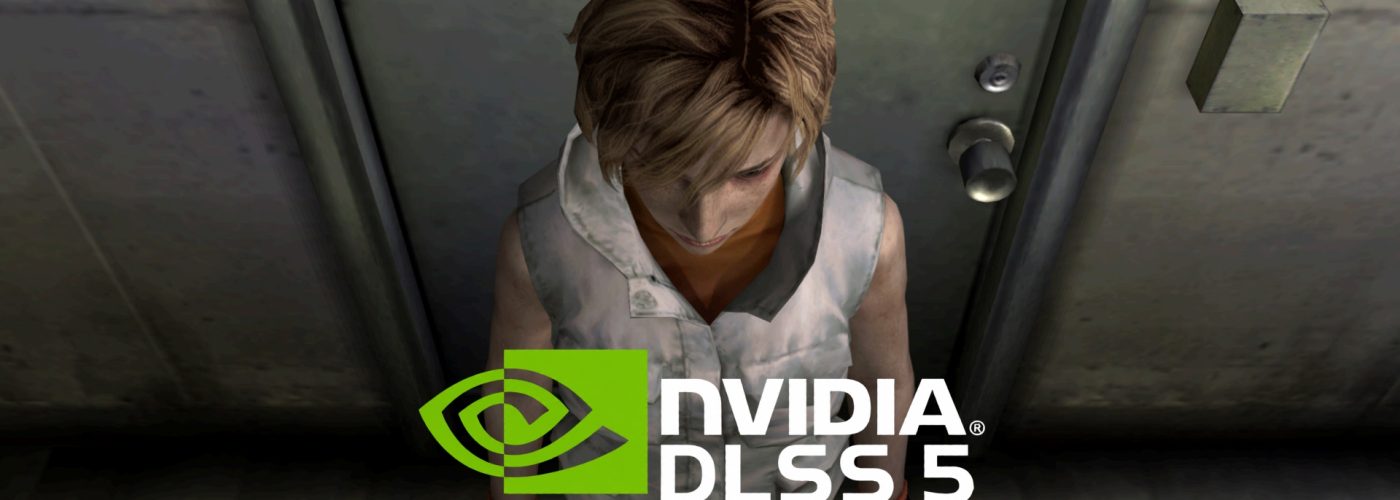
To get a concrete idea, I ran a few tests with Silent Hill 3 on PCSX2, using ReShade and DLSS 5.
The point is that I did not use an HD texture pack.

The textures, the geometry, the models, and most of the technical limitations therefore remain those of the original game. Yet the quality leap is evident. Not because Silent Hill 3 has suddenly become a modern title, but because the final image looks far more coherent and readable than one would expect from assets produced over twenty years ago.
And it is precisely this discrepancy that makes the experiment useful.

Heather’s model remains the original one. The walls remain relatively simple. The materials do not magically become those of a contemporary game. But lighting, skin, hair, surfaces, and microcontrasts are presented in a way that makes it much clearer how much the limitation did not lie in the assets alone.
In some cases, the framebuffer seems to have become more modern than the objects it contains.
This does not mean that DLSS 5 is “remastering” Silent Hill 3. The system was not built for this, and NVIDIA presents it as a technology integrated into games, with information and controls provided directly by the engine. Currently, DLSS 5 uses frames, motion vectors, and specific parameters to keep the result anchored to the original scene. NVIDIA Developer
But the experiment makes a direction visible, and to follow it, it is worth looking at what emulators have been doing for years.

PCSX2 has already solved half the problem
Modern emulators have long offered another kind of enhancement: texture replacement.
PCSX2, for example, allows dumping the original textures, modifying them, and loading alternative versions. This is the principle behind HD texture packs. The PCSX2 project itself, however, points out an evident limitation: increasing the internal resolution of the framebuffer improves edges and image precision, but cannot automatically recover information that does not exist in the source textures. PCSX2
The traditional workflow is therefore relatively simple: someone extracts the textures, modifies them manually or with dedicated tools, builds a pack, and the emulator replaces the original assets during execution.
AI, however, introduces a different possibility, not necessarily better in absolute terms: instead of distributing a pre-prepared texture pack, one could imagine a system that progressively builds its own cache of enhanced assets.
A texture is encountered for the first time. The game keeps using the original one, while an asynchronous process generates a higher-resolution version of it. The result is saved locally and, from the next session or the following load, that texture can be replaced automatically.
There would be no need to run a generative model sixty times per second to enhance a surface that will remain unchanged for the entire duration of the game: the expensive inference would happen only once.
A remaster that builds itself while we play
The conceptual model could be very simple.
The game encounters a texture, computes an identifier for it, and checks whether an enhanced version already exists in cache: only if it does not, it starts the work in the background.
Once the work is complete, the new asset becomes available for subsequent uses.
In this way, the game would progressively build its own cache, without lengthy initial processing phases and without anyone having to prepare the library in advance: after a few hours of play, a substantial portion of the assets actually used might have already been processed, and ReShade would become the part to start from.
ReShade could become something more than a post-processor
ReShade is normally associated with post-processing shaders applied to the final image, but its add-on architecture allows intervening much more deeply in the graphics pipeline.
In the Direct3D case, for example, ReShade’s code already intercepts resource creation and can notify add-ons of events related to textures and other GPU resources. The APIs expose events for resource creation, initialization, and destruction. GitHub
This does not mean that a universal system already exists capable of automatically replacing the textures of any game. That would be a far more complex problem, especially considering differences between APIs, resource management, dynamic textures, render targets, and streaming.
It does mean, however, that the hook exists, and that ReShade is not tied to a single emulator.
An experimental pipeline could therefore be split into two parts: ReShade would handle recognizing resources, while an external process would manage the heavy work: upscaling, reconstruction, compression, mipmap generation, and saving the cache.
The game would keep running normally, with the remastering relegated to the margins of the pipeline.
Not just bigger textures
Limiting oneself to simple upscaling, however, would be almost reductive.
An old texture does not only contain few pixels. It often embeds information that today would be distributed across multiple maps and handled by a physically more complex material.
A surface in a PlayStation 2 game could rely almost entirely on diffuse textures, per-vertex lighting, and a few dedicated effects. A modern renderer works instead with normal maps, roughness, metalness, ambient occlusion, and other separate parameters.
In theory, an enhancement process could therefore try to reconstruct not only a higher-resolution diffuse, but also derived information.
From an original texture, a cleaned-up albedo, a plausible normal map, a roughness map, or a height map could emerge.
We would no longer simply be increasing definition, but interpreting the asset: the question is broader than simple “AI upscaling”.
Where does restoration end and reinterpretation begin?
Silent Hill 3 is an excellent example precisely because its visual identity also depends on its own limitations.
It is a dirty, dark, grainy game, often deliberately unpleasant. Surfaces do not necessarily have to look clean or realistic. Faces do not have to look like contemporary cinematic renders. Part of the atmosphere comes precisely from the combination of art direction and the technology of the time.
An overly aggressive generative model could produce a result that is technically richer but artistically worse.
An undefined wall could become perfectly readable concrete. A stain could turn into a semantically plausible texture completely different from the original. A stylized face could receive pores, reflections, or details that no artist ever envisioned.
Enhancement would become reinterpretation, and it is not a theoretical problem: modern systems already deal with it. DLSS 5 introduces controls for intensity, tonality, and masking precisely because the stated goal is to keep the intervention coherent with the game’s artistic direction. NVIDIA Developer
In a system designed for automatic remastering, this control would become even more important.
It would probably make sense to distinguish a conservative, reconstruction-oriented approach from a much freer generative one.
In the first case, the system could limit itself to super resolution, artifact reduction, edge reconstruction, and recovery of plausible structures without significantly altering the image; in the second, it would instead try to reinterpret materials, surfaces, and details. Both approaches are feasible, but they lead to different results: one stays close to the original, the other moves away from it.
The frame is only the last layer
What makes DLSS 5 particularly interesting, therefore, is not only the result achievable today.
It is a paradigm shift: for years we have thought of assets as the “real” part of the game and rendering as the process needed to display them.
Neural technologies are introducing an increasingly important intermediate layer, capable of reconstructing information that is not explicitly contained in the traditional renderer.
Today this happens on the final frame; tomorrow it could happen on the assets as well. A future pipeline could therefore have three layers: the first, asynchronous, would progressively enhance textures and materials, saving them in a persistent cache; the second would remain the classic rendering of the game or emulator; the third would use real-time neural techniques to refine the final frame. The result would not be a remake, and probably not even a remaster in the traditional sense: it would be a form of progressive reconstruction.
The same reasoning works outside video games too
This kind of experimentation does not necessarily concern games only.
In recent months I have also run some tests with DirectX 12 video players, ReShade, and VR environments, applying post-processing and reconstruction techniques to traditional film content displayed inside a virtual space.
The principle is similar: a film remains the same film, the source material does not change, but the pipeline through which it is presented does.
When resolution, local contrast, image reconstruction, and display are handled by modern systems, the distance between the original content and the final experience becomes less and less linear.
In this sense, technologies born for gaming could become part of a much broader problem: how to present legacy content on display systems that belong to completely different generations.
After DLSS 5
The question, therefore, may not simply be what the next version of DLSS will be.
The decisive shift may happen sideways.
Today we use neural models to reconstruct the final frame. Emulators already know how to identify and replace textures. ReShade can insert itself into the graphics pipeline and intercept the resources used by the application. Super resolution and generation models can work offline or in the background instead of being forced into real-time inference: all elements that already exist, but separately.
Putting them together means imagining something different: a system in which an old game is progressively enhanced while being used, building a local cache of reconstructed assets without modifying the original software.
I do not know whether this will really be the direction we take.
But after seeing Silent Hill 3 go through a pipeline like this without even using an HD texture pack, the question becomes hard to ignore.
Perhaps the next step will not simply be rendering more pixels, but deciding which parts of an old game we really want to leave old.