
In short
Afterplay is turning retrogaming into a platform: a browser-based service that manages emulators, libraries, saves and configurations through a user account, letting games move seamlessly between devices. In 2026 it opened a store dedicated to new indie titles for historical hardware like Game Boy and Sega Genesis, with publishers such as Mega Cat Studios and Incube8 Games, a catalog past fifty titles, and a 90/10 revenue split favoring developers. Founder Patrick Corrigan describes it as building a “Steam for retro”. The piece examines what that model means for distribution, ownership and preservation.
Emulating an old video game is relatively simple. Turning decades of hardware, libraries, save files and new retro indie games into an ecosystem usable from any device is a completely different problem.
Retrogaming has never really had a problem of access to technology. Emulators have existed for decades, often with impressive levels of accuracy, and today it is possible to run an enormous amount of historical hardware practically anywhere.
The problem arrives right after that.
Every device comes with its own configurations, emulators, cores, BIOS files, controllers, folders, ROMs and save files. Changing computer or switching from desktop to smartphone often means replicating at least part of that setup. For those who know the tools it is not necessarily complicated, but it remains a process.
Afterplay starts exactly from here and tries to change the paradigm: not simply building another emulator, but turning emulation into a persistent service.
The emulator stops being the center
The first impression can be misleading. Afterplay runs in the browser and lets you upload your own ROMs, so it would be easy to quickly file it away in the category of web emulators.
But emulation is almost the least interesting part of the project.
The platform manages library, configurations and saves through the user’s account, allowing you to start a game on one device and continue it on another. The game runs locally, while the cloud is used to create continuity between sessions.
So this is not the classic cloud gaming model in which the game runs on a remote machine and is streamed to the player. The browser remains the runtime, while the cloud becomes the layer that preserves the experience.
The same architecture also allows offline use of games already present in the device’s cache; if the user deletes the local data, they need to go back online to retrieve the games again.
It is a seemingly subtle difference, but a fundamental one.
The problem was not emulating, but removing friction
Those who regularly use RetroArch, standalone emulators or dedicated frontends can achieve far more customized results. They can choose specific emulator versions, shaders, configurations, paths and practically every detail of the system.
But precisely this freedom inevitably generates complexity.
Afterplay instead tries to move the work from configuration to use. Afterplay adds a ROM to the library, associates it with the correct system, and from that moment on it remains available in the account. The platform handles automatic saves, manual saves and SRAM, while the user can also download and transfer the game’s normal internal saves elsewhere..
This last detail is particularly important.
A service that centralizes a library could easily turn into a cage. The ability to export at least the SRAM saves keeps a connection with the traditional emulator ecosystem and with real hardware.
It does not eliminate lock-in in every form, but it prevents dozens or hundreds of hours of play from necessarily remaining trapped inside the platform.
From frontend to distribution
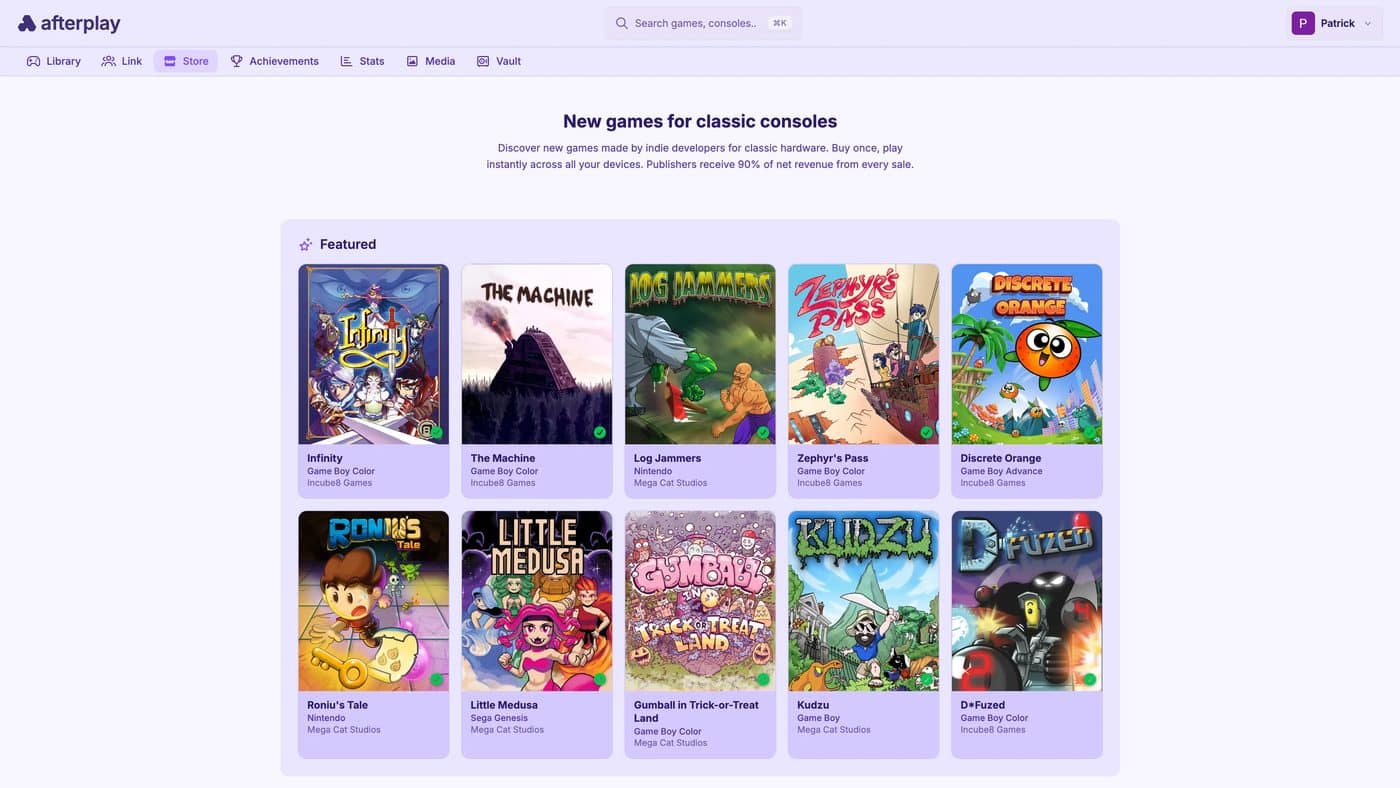
In 2026, however, Afterplay made the move that makes the project far more interesting from IGD’s point of view: it opened a store.
Not a generic video game store, but a catalog dedicated mainly to new titles developed for historical platforms.
At launch there were publishers such as Mega Cat Studios and Incube8 Games; a few months later the catalog had already surpassed fifty titles. Some are developed for Game Boy, Game Boy Color, Game Boy Advance or Sega Genesis, but users purchase and launch them directly through Afterplay’s modern infrastructure.
Here the project changes nature.
It no longer just simplifies the use of an existing collection. It also becomes a possible distribution channel for a very particular category of indie games: those developed today for hardware designed thirty or forty years ago.
New indie games for old consoles
Homebrew and commercial development for historical hardware has never really disappeared.
Games keep coming out for Game Boy, NES, Mega Drive, Dreamcast and many other platforms. Modern tools have also greatly lowered some technical barriers, allowing new developers to work on hardware that for a long time required extremely specialized knowledge.
Digital distribution, however, has remained fragmented.
A developer or publisher can sell a game on itch.io, on their own website, through crowdfunding campaigns, or directly as a physical cartridge.In the case of a digital ROM, after purchase it is still up to the user to decide where and how to run it.
Afterplay tries to shorten that distance.
You buy the game and it goes directly into the library from which it can be run. There is no need to install a compatible emulator, find the right core or manually transfer the file between multiple devices.
From this point of view, the comparison with Steam used by Afterplay’s own developers starts to make sense.
Not because the two platforms have comparable size or characteristics, but because the conceptual model is similar: purchase, library and runtime become part of the same environment. Founder Patrick Corrigan has explicitly described the goal as building a “Steam for retro”.
A model that is interesting for developers too
Then there is an economic detail that is hard to ignore.
On its store, Afterplay currently keeps 10%, leaving 90% to the developer or publisher. According to Corrigan, the store’s main goal is not to generate the largest possible margin directly on sales, but to increase the overall value and audience of the platform.
It is a particularly interesting approach for a niche market.
An indie game developed for historical hardware can rarely count on the volumes of a contemporary PC or console title. Reducing distribution friction while keeping a high share for those who make the game can make even a relatively small audience economically more sustainable.
Above all, Afterplay offers something that is normally missing from the sale of a simple ROM: a context.
The game enters a library, players discover it alongside other compatible titles, and it immediately has the infrastructure players need to play it.
It does not change the game.
It changes what gets built around it.
Ownership remains an interesting question
This is also where one of the most important issues emerges.
In the traditional model, buying a ROM produces a file that can be kept, copied onto compatible hardware and used through different emulators. A centralized ecosystem offers enormously greater convenience, but inevitably shifts part of the relationship with the product toward the service.
Afterplay lets users upload their own ROMs and export their SRAM saves, while it distributes what it sells in the store through agreements with developers and publishers. The founder has also expressed the future ambition of extending the model to historical catalogs officially licensed.
It is probably one of the most interesting aspects to observe over time.
Because retrogaming is born, almost by definition, from the ability to preserve something beyond the commercial life of the original platform. Any service that wants to become an important part of this ecosystem will sooner or later also have to confront the meaning of the word “ownership”.
The browser is powerful, but it remains a browser
The technological choice that makes Afterplay possible is also one of its limits.
The browser allows the same platform to reach computers, smartphones and many other devices without having to maintain a completely different application for each operating system.
But not all browsers are equal.
The team points to Safari on iOS as one of the main technical constraints, especially because of memory limits and the slower adoption of some web standards. The documentation also notes specific cases involving some Nintendo DS games. These can be problematic on mobile devices precisely because of the memory available in the browser.
There are then inevitably bugs, incompatibilities and differences in controller behavior. The official documentation maintains a list of known issues, from rendering to gamepad behavior to specific anomalies on Windows and iOS.
Afterplay does not therefore magically make forty years of hardware uniform.
It does move much of that complexity away from the user.
When old technology finds new infrastructure
The most interesting part of Afterplay is probably not what it lets you do today.
It is the model it suggests.
For years, emulation has brilliantly solved the technical problem of compatibility: taking software designed for a vanished machine and making it run on the current one.
Far less has been done to build a modern infrastructure around that software.
Accounts, persistent libraries, save synchronization, multiplayer, discovery, instant purchase and commercial distribution are all now normal elements of contemporary video gaming, but they remain fragmented when you go back a few generations.
Afterplay tries to overlay these two worlds.
On one hand it preserves software conceived for historical hardware. On the other it builds around it services that belong entirely to the present.
And this is probably the reason why the project deserves attention even outside the emulation community.
The future of retrogaming may not look retro
Personally, this is the aspect I find most interesting.
Perfectly reproducing an old console remains fundamental for preservation, research and personal passion. But not every new experience built around those games necessarily has to imitate the limitations of the era they come from.
An indie game can be written today for a Game Boy and at the same time be purchased in 2026 through a store, sync its saves online and be played a few seconds later on a smartphone.
There is no contradiction.
There is simply a new technological layer built on top of an old one.
Afterplay did not invent emulation and probably does not even intend to compete with the most sophisticated emulators on their own turf.
It is attempting something different: turning retrogaming from a set of tools into a platform.
Whether it will really manage to become the “Steam of retro” will depend above all on the catalog, on the agreements with publishers and on the ability to keep open the delicate balance between convenience, ownership and preservation.
But the question it raises is already interesting.
Perhaps the next step for retrogaming is not to emulate the past better.
It is to finally give it a contemporary infrastructure.