Beyond the Physical-Versus-Digital Debate
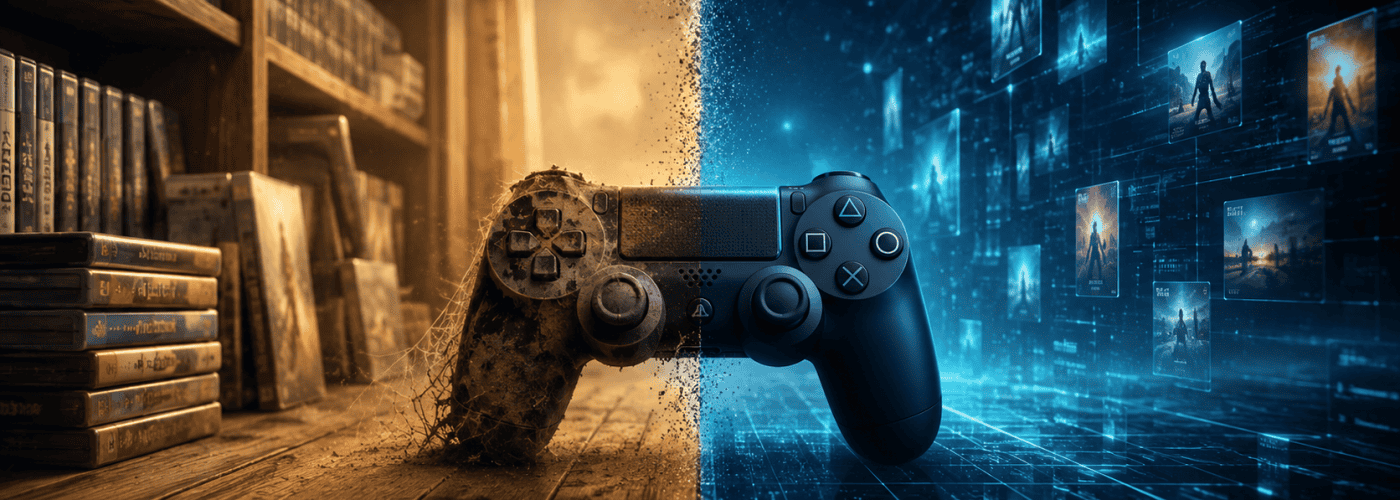
For years, the debate over the disappearance of physical format has divided players, collectors, and the industry. Commentators often reduce the discussion to a contrast between disc and digital download, as if it were a binary choice.
Yet the real problem isn’t the medium. It’s the concept of ownership.
Today, buying a video game usually means acquiring a license tied to a platform. Even when a disc exists, it often serves merely as a conduit: the real content lives elsewhere, distributed through updates, patches, and additional content downloaded from servers.
The result is a paradox: physical format no longer guarantees preservation, while digital doesn’t offer real ownership. Disc copies that still require massive downloads on first launch aren’t rare, nor are titles that become inaccessible once stores remove them from digital shelves or once support servers shut down.
The Problem Isn’t the Disc, but Ownership
In the past, buying a game meant owning it. The physical medium was self-sufficient: inserting the disc or cartridge was enough to access the entire experience.
Today this paradigm has changed. Many titles require additional downloads, online authentication, or mandatory updates. The physical medium has become, in many cases, an access token.
At the same time, digital distribution eliminates the medium entirely, but it introduces a structural dependence on platform servers.
If a service shuts down, a breach compromises an account, or the platform revokes a license, the game can simply disappear.
The critical point, then, isn’t the disappearance of the disc, but the user’s loss of control.
A Third Way: Platform-Generated Personal Media
If digital now dominates, the solution doesn’t necessarily mean going back. It could instead evolve.
Imagine a platform that lets users generate their own physical medium – not mass-distributed but created on demand – giving users direct control and the ability to preserve it.
Not a standard Blu-ray, but a certified USB drive or SSD.
Inside, the platform could include the complete game, every available patch, and any purchased additional content, along with integrity-verification systems, a digital signature, and account-linked encryption.
The result would be a snapshot of the game at a precise state, ready for long-term preservation.
Preservation and Independence
A system like this would let us separate two concepts that today blend into one: access and preservation.
The platform would keep regulating access, through authentication and license management. Preservation, however, would return to the user’s hands.
Users could store a personal medium offline, preserve it over the years, and keep using it even after the original servers disappear, through deferred authentication mechanisms or local keys.
This approach wouldn’t eliminate content protection; it would make it compatible with preservation.
Rethinking the Secondhand Market
One of digital distribution’s most visible side effects is the disappearance of the secondhand market.
In the traditional model, resale let players recover part of their spending and let titles keep circulating.
Digital distribution eliminated this mechanism entirely.
Yet a platform could reintroduce it in controlled form.
A platform could offer an internal marketplace where users transfer licenses among themselves.
At the moment of sale, the platform would remove the license from the seller and invalidate any personal medium generated for it, while the buyer would receive a new, fully valid license. The platform would manage the payment and could split it automatically into a share for the developer, a platform commission, and the remainder for the seller.
This way, developers too would start earning from the secondhand market, turning a long-standing problem into a new revenue stream.
Collecting Without Traditional Media
Physical format isn’t just a means of distribution. It’s also an object.
Special editions, cases, merchandise, and limited versions belong to a culture that pure digital struggles to replicate.
A model based on media generated on demand could preserve this dimension, without the constraints of industrial production.
Companies could offer customized storage devices, themed media, physical editions created on demand – objects that don’t simply contain a file but represent a tangible extension of the experience.
This approach would also reduce waste, unsold stock, and logistics, making collecting more sustainable.
A New Definition of Physical Format
The current debate tends to oversimplify the problem into a choice between two extremes: physical or digital.
But we could move past this opposition.
The future could be a system where digital keeps its efficiency while new tools reintroduce the concept of ownership.
No longer a disc manufactured in millions of copies, but a personal medium, generated when needed.
No longer a static, non-transferable license, but an ecosystem where ownership, preservation, and exchange coexist, moving past the initial physical-versus-digital opposition and bringing the debate back to its central point: the user’s real control and exchange coexist.
More than the end of physical format, this could be the start of its evolution.
Romanticism vs. Self-Interest
Unfortunately, one very concrete fact is hard to ignore: from the industry’s point of view, selling new copies remains more profitable than creating a secondhand market.
Still, a system like this wouldn’t necessarily represent a loss. It could instead foster more dynamic economic circulation, where value doesn’t run out with the first purchase but keeps moving between users and titles.
Users could reinvest credits from digital secondhand sales directly into new games, creating a continuous flow between different experiences. In this scenario, whoever has already sold copies wouldn’t lose anything, while users would gain greater freedom to explore and invest.
The result would be a less static ecosystem, where consumption stops being an isolated act and becomes part of a broader economic cycle.