
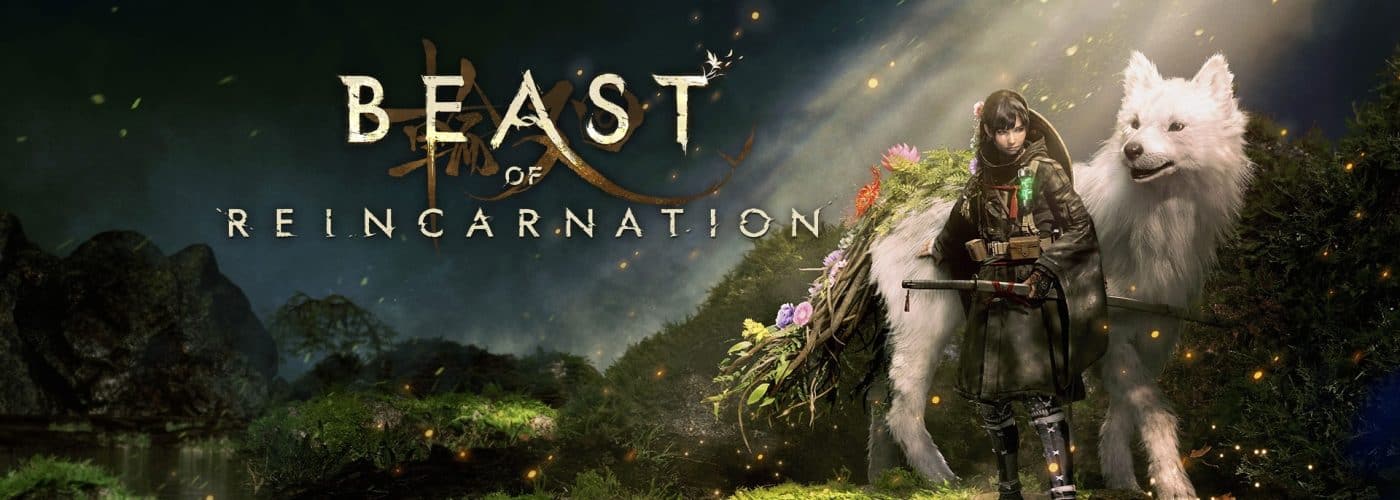
Game Freak steps far outside its comfort zone with a post-apocalyptic action RPG that may not realize all of its ambitions, but finds a remarkably distinctive identity along the way.

With Beast of Reincarnation, Game Freak is stepping into unfamiliar territory. After years spent defining one of the most recognizable identities in the medium through Pokémon, the Japanese studio is turning its attention to a radically different kind of experience: a dark, single-player action RPG set in a distant, post-apocalyptic future where humanity is no longer the dominant force it once was. Set in Japan in the year 4026, the game imagines a civilization struggling to survive in the aftermath of a mysterious plague that has transformed the environment, altered living creatures, and fundamentally disrupted the relationship between mankind and the natural world.
At the heart of this journey are Emma, a young woman living on the fringes of society, and Koo, the plague-infected dog who accompanies her across the remnants of a fallen world.
Their journey provides the foundation for virtually every aspect of the experience, from its narrative themes to the way its combat is designed to function. Rather than treating the relationship between protagonist and companion as a secondary narrative device, Game Freak has built the game around the idea that Emma and Koo should be understood as two halves of the same experience.
That ambition is immediately apparent in the game’s unusual premise. Beast of Reincarnation is not interested in portraying the apocalypse as a world reduced to rubble, where humanity’s technological achievements have disappeared beneath the ashes. Instead, Game Freak presents a future in which nature has reclaimed what civilization left behind. Forests spread across abandoned structures, vegetation consumes the remains of human infrastructure, and ancient technology exists alongside landscapes that have become increasingly wild and unpredictable.
The result is a world defined by contrast. The remnants of human civilization are still visible everywhere, but they no longer feel like the dominant presence. Roads, buildings and technological installations have become fragments of a forgotten age, gradually absorbed into forests, wetlands, mountains and waterways. At times, the landscape feels almost peaceful; at others, the same natural world becomes something hostile and unfamiliar. The plague sits at the heart of this transformation, creating an ecosystem in which the boundary between the natural, the artificial and the corrupted has become increasingly difficult to define.
It is within this world that Emma and Koo’s relationship becomes particularly important. Game Freak describes the project as a “one-person, one-dog action RPG,” and the phrase is more than a memorable way of explaining its premise. It reflects the game’s fundamental design philosophy. Emma and Koo are not simply travelling companions who happen to share the same adventure. They form the core of the gameplay itself. Emma fights with her sword and a variety of abilities, while Koo can be given direct commands and deployed through specific techniques during combat.
The distinction is important because Koo is not designed merely as an AI-controlled companion who occasionally assists the protagonist. His abilities are integrated into the rhythm of encounters, creating opportunities for the player to coordinate attacks, respond to enemy behaviour and approach situations through the strengths of both characters.
This partnership gives Beast of Reincarnation one of its most compelling mechanical ideas. Combat is not exclusively about mastering Emma’s moveset; it is about understanding how two different sets of abilities can interact. The player must learn when to attack, when to defend, when to create an opening and when Koo should become part of the equation. The result is a system that attempts to turn the emotional bond between the two characters into something tangible through play.
The RPG layer reinforces that philosophy. Emma’s development can be shaped through skill trees, equipment and Spirit Stones, allowing players to build around different approaches rather than following a completely predetermined progression path. A more aggressive configuration can favour direct encounters, while other setups can place greater emphasis on ranged attacks or stealth. The system is not designed to overwhelm the player with endless layers of statistical complexity, but it provides enough flexibility to make progression feel connected to personal playstyle.
Exploration, meanwhile, provides the bridge between these systems and the world itself. The journey through 4026 Japan takes Emma and Koo across a variety of environments, from dense forests and waterways to settlements and the remains of technological infrastructure.
These locations are designed not only to provide visual variety, but also to communicate the scale of the transformation that has taken place. Civilization has not vanished entirely; it survives in isolated communities, abandoned structures and fragments of technology, surrounded by a natural world that has grown beyond humanity’s ability to control it.
The game’s major Boss encounters further connect these different layers. Powerful creatures known as Nushi dominate individual regions, turning them into major obstacles in Emma and Koo’s journey. Defeating them is not simply a matter of clearing another combat encounter: their powers can be acquired by the protagonists, expanding the tools available to the player. In this sense, progression becomes tied to conquest. The world’s most dangerous creatures are also the means through which Emma and Koo become stronger, creating a loop between exploration, combat and character development that ultimately leads towards the mysterious Beast of Reincarnation.
This structure is particularly significant because it reveals just how far Game Freak is attempting to move beyond its established identity. Beast of Reincarnation is not simply a change of setting or a different visual direction. It represents an attempt to explore a completely different design language: one built around real-time combat, environmental storytelling, character relationships and a darker interpretation of humanity’s relationship with nature and technology.
There is also a distinctly mature quality to the project. Its world is darker, its themes are more introspective, and its central relationship is designed to carry considerably more emotional weight than the typical action-game partnership. The story’s questions surrounding identity, memory, isolation, humanity and the consequences of technological progress give the adventure a thematic foundation that extends well beyond its post-apocalyptic premise.
That combination is ultimately what makes Beast of Reincarnation so intriguing. There is nothing particularly new about the idea of a ruined future in which nature has reclaimed the world, nor is the action RPG genre short of stories about humanity struggling against forces it can no longer control. What gives Game Freak’s project its personality is the way these familiar ideas are filtered through the relationship between one woman and one dog, and the decision to make that relationship matter mechanically as much as it does narratively.
The result is an action RPG that feels less like Game Freak attempting to imitate the established leaders of the genre and more like a studio searching for its own interpretation of the formula. Its world, combat system, progression and narrative are all built around a relatively simple premise, but one with considerable potential: what happens when survival depends not on standing alone, but on learning to trust another being completely?
That is the question at the heart of Beast of Reincarnation. And while not every element of the experience reaches the same level of ambition, the game’s strongest ideas demonstrate that Game Freak’s creative identity extends far beyond the world that made its name.


The Game Freak You’ve Never Seen Before
Behind Beast of Reincarnation stands Game Freak, a studio whose identity has been defined for decades by one of the most recognizable names in video games. Yet this project represents a striking departure from the creative territory that made the Japanese developer famous. Best known for Pokémon, Game Freak is now attempting something considerably more difficult: building an original action RPG from the ground up, one that leaves behind the series’ familiar visual language and embraces a darker, more intimate vision of a world on the brink of collapse.
That distinction matters. Beast of Reincarnation does not simply feel like Game Freak applying its existing expertise to a different genre. It represents a genuine attempt to step outside the studio’s established identity and discover what that identity might look like without Pokémon at its heart. The result is a considerably more mature experience, shaped by real-time combat, exploration, character progression, and a narrative built around isolation, memory, humanity, and the fragile relationship between people and the world they inhabit.
The project’s origins make that creative departure even more interesting. Beast of Reincarnation began within Game Freak’s Gear Project, an internal initiative designed to give developers the opportunity to pitch original concepts and turn them into working prototypes. Director and writer Kota Furushima initially conceived the project as a personal idea, developing its earliest foundations largely on his own before it evolved into the much larger production it is today.
That humble beginning says a great deal about the game’s character. Beast of Reincarnation was not born simply from a desire to expand Game Freak’s portfolio with a new genre, nor does it feel like a calculated attempt to capitalize on the growing popularity of action RPGs.
Its foundations are considerably more personal. Furushima has spoken about wanting to recreate the particular feeling left behind by a powerful film or novel, the kind of emotional impression that remains long after the experience itself has ended. That idea eventually crystallized around one deceptively simple concept: “one person, one dog.” Everything else grew from there.
Emma and Koo were never conceived as a conventional hero-and-companion pairing, with one character carrying the narrative while the other simply exists to provide support. From the outset, they were designed as two parts of the same experience, with their relationship shaping both the emotional core of the story and the mechanics through which the player engages with the world. Furushima’s stated intention was to explore feelings such as warmth, trust, reliability, and loneliness through their relationship, turning something that could easily have remained a narrative theme into something the player actively experiences. Koo’s role is therefore far more significant than that of a traditional AI companion. He is woven directly into the combat system, allowing players to issue commands and make use of his abilities alongside Emma’s own attacks and techniques.
The distinction may appear straightforward on paper, but it fundamentally changes the rhythm of combat. The player is not simply controlling a lone warrior with an additional ability at their disposal; they are learning to operate as part of a two-character unit.
That philosophy also explains why Game Freak has committed to a single-player-only experience. The decision is not merely a matter of scope or production priorities. It reflects the studio’s desire to keep Emma and Koo at the heart of the experience and allow their relationship to develop without being interrupted or diluted by multiplayer systems. The journey belongs to these two characters, and the player is invited to experience that journey through their partnership.
Creating such a project, however, required Game Freak to confront another challenge: scale. Beast of Reincarnation is considerably more demanding from a technical and production standpoint than the studio’s traditional output. Rather than attempting to build every component internally, Game Freak assembled a network of external development partners, retaining creative direction while bringing in additional expertise to support the technical execution.
That approach became particularly important as the team moved into Unreal Engine 5. For a studio accustomed to a very different technological pipeline, adopting Epic’s engine represented a substantial shift in both workflow and production philosophy. The development process consequently involved a significant amount of research, experimentation, and technical learning as Game Freak adapted to the demands of building a large-scale, visually ambitious action RPG.
It is one of the reasons Beast of Reincarnation feels more significant than simply being “the next game from the creators of Pokémon.” It is a glimpse at what happens when one of Japan’s most established development studios deliberately steps away from the formula that made it famous and gives a different creative voice room to grow.
There are, inevitably, moments when the scale of that ambition exposes the limits of the production. But the important point is that Game Freak is taking the risk in the first place. Beast of Reincarnation is the product of an idea that began with a single developer, expanded through collaboration, and ultimately became an attempt to redefine what the studio can be when it is no longer constrained by the expectations surrounding its most famous franchise.
And perhaps that is the most compelling thing about the game. For the first time in a long while, Game Freak is not looking back at Pokémon. It is looking somewhere entirely new.


A Journey Through the Ruins of Humanity
Beast of Reincarnation is set in Japan in the year 4026, long after a mysterious plague brought human civilisation to the edge of collapse. The world that remains is almost unrecognisable. Humanity has retreated into isolated settlements, while forests, rivers and wild landscapes have reclaimed the ruins of the society that once dominated them.
Yet this is not simply a world abandoned to nature. The plague has fundamentally altered the ecosystem, giving rise to creatures unlike anything that existed before and turning the remnants of civilisation into a constant reminder of everything that has been lost.
It is within this fractured world that Emma, a young woman belonging to the ostracised group known as the Excluded, begins her journey. Her only constant companion is Kuu, a plague-infected dog whose unusual abilities make him an essential part of both her survival and her story. Together, they travel across the remains of Japan aboard the Cleanse Walker, moving between contaminated territories and the scattered communities that have managed to endure. Emma is a Purifier, a role that requires her to confront the creatures born from the plague and absorb their contamination, helping to contain a threat that has become inseparable from the world itself.
The creatures Emma and Kuu encounter are known as the Kegai. Some are little more than obstacles scattered throughout the wilderness, while others have grown powerful enough to dominate entire regions. These formidable beings are known as the Nushi, and confronting them becomes the backbone of Emma’s journey.
Each Nushi effectively defines the territory it inhabits, turning the journey across Japan into a succession of increasingly dangerous encounters. Defeating one is not simply another victory on the way to the finale: Emma absorbs its plague and gains the power required to continue deeper into the world. In this way, the game’s central progression naturally connects its three principal pillars – exploration, combat and character progression – while gradually leading Emma and Kuu toward the capital and the mysterious Beast of Reincarnation itself.
The overarching structure may initially appear familiar, but Beast of Reincarnation is more interested in what happens between those major milestones. As Emma and Kuu cross each region, they encounter remnants of the civilisation that preceded them, isolated communities attempting to survive and creatures that reveal just how profoundly the plague has reshaped the natural world. Each new location adds another fragment to the larger picture, allowing the history of this future Japan to emerge gradually rather than arriving fully formed through exposition.
This is where the game’s approach to storytelling becomes particularly effective. Beast of Reincarnation does not treat its setting as a decorative backdrop for Emma’s adventure. The world itself carries much of the narrative weight. Ruined structures, abandoned technology, settlements and even the creatures inhabiting the landscape all contribute to an understanding of what happened, and of what humanity has become in the aftermath.
The story is delivered through a combination of cutscenes, character interactions and environmental storytelling, with exploration providing much of the connective tissue between them. Rather than explaining every aspect of its mythology outright, the game often leaves enough space for the player to interpret what they encounter and assemble the history of the world.
That sense of discovery is reinforced by the contrast at the heart of the setting. The Japan of 4026 is neither a technological dystopia nor a traditional post-apocalyptic wasteland. It is a place where the remains of human ambition have been swallowed by an increasingly dominant natural world, while that same nature has been fundamentally corrupted by the plague. Ancient structures disappear beneath vegetation, familiar landscapes become hostile territories, and the boundary between the natural and the artificial grows increasingly difficult to define.
For Emma, however, this journey carries a more personal significance. She is moving through a world she does not fully understand while confronting questions about the plague, the people who survived it and, ultimately, her own place within that reality. The journey toward the Beast of Reincarnation therefore functions on two levels: it is both a physical passage across a transformed Japan and a gradual attempt to understand the world, and the self, that remains beneath its ruins.
That duality gives the narrative its strongest quality. The story may be structured around a familiar progression from region to region, with increasingly powerful enemies standing between the protagonist and her final destination, but the world surrounding that journey possesses enough mystery and thematic weight to make the road itself matter.


What Makes Us Human When Everything Else Has Changed?
Beast of Reincarnation begins with a deceptively simple premise: Emma has no memories, little understanding of her own emotions, and only a fragmented sense of the person she once was. Rather than using amnesia merely as a convenient mystery-box device, Game Freak makes it the foundation of her journey. Emma’s story is ultimately less about recovering a forgotten past than about learning, for the first time, how to understand herself, and what it means to feel, trust and connect with another living being. That process is inseparable from Koo.
The relationship between Emma and her plague-infected companion is the emotional heart of Beast of Reincarnation, but what makes it particularly effective is the way Game Freak translates that bond directly into gameplay. Koo is not simply a character who follows Emma from one location to another, nor is he a conventional combat companion whose presence exists primarily to provide additional firepower. He is woven into the very structure of the experience. Emma fights alongside him, commands him and depends on his abilities, turning their bond into something the player actively participates in rather than something the story merely describes.
It is a deceptively effective approach. Koo cannot communicate through conventional dialogue, so Emma has to learn to read his behaviour, his movements and the small ways in which he responds to the world around him. The player does the same. Their relationship develops through repetition and shared experiences rather than constant exposition, and that makes its emotional progression feel considerably more organic. There is something quietly affecting about watching Emma gradually learn to rely on Koo in a world where almost everything else has become uncertain.
This gives the game’s exploration of loneliness an even greater emotional weight. Emma begins her journey disconnected not only from society, but from herself. She has lost the memories that might have anchored her identity and struggles to comprehend emotions that other people take for granted. In a world where humanity survives in isolated pockets, that internal emptiness mirrors the physical desolation surrounding her. Koo becomes the one constant she can depend upon, a presence that does not need to explain itself to remain meaningful. From there, Beast of Reincarnation expands its focus toward a broader question: what exactly makes someone human?
Emma’s circumstances allow Game Freak to approach that question from several directions. Memory, emotion, consciousness and physical identity are brought into conflict, particularly through the game’s depiction of Golems, beings in which human souls have been transferred into mechanical bodies. The distinction between human and machine consequently becomes increasingly difficult to define. If a person’s body can be replaced, if memories can disappear and if consciousness can exist independently of flesh, where exactly does humanity reside?
The game does not always explore these ideas with the same degree of sophistication, but they give its world considerably more thematic substance than its post-apocalyptic premise might initially suggest. Its most interesting moments are those in which these questions are allowed to emerge through the characters rather than being presented as abstract philosophical concepts.
Nature provides another important piece of that equation. The Japan of 4026 is not the familiar post-apocalyptic wasteland of ruined cities and barren landscapes. It is a world in which nature has reclaimed what civilisation left behind. Forests swallow abandoned structures, vegetation grows through forgotten infrastructure and corrupted ecosystems reshape the landscape.
Humanity has not simply disappeared; its remnants have become part of an environment that no longer belongs entirely to it. That tension between civilisation and nature gives the setting much of its identity. Technology remains everywhere, but increasingly as a relic. Machines, ruins and artificial beings are reminders of a civilisation that once believed it could control its environment, while the world surrounding them suggests that nature has ultimately proved far more resilient.
Beast of Reincarnation never reduces this relationship to a simplistic battle between technology and the natural world. Technology is simultaneously a symbol of humanity’s ambition, a means of survival and a reminder of the mistakes that brought the old world to its knees.
Memory ties these themes together. Emma’s missing past is not simply a narrative puzzle waiting to be solved; it is the missing piece of her identity. As fragments of her history gradually come to light, the game encourages us to reconsider not only what happened to Emma, but how recovering those memories might reshape her understanding of herself. The past therefore becomes something more than backstory. It becomes part of the game’s larger meditation on identity: if our memories help define who we are, what remains of us when those memories are gone?
Violet further deepens this exploration of identity and perception. Visible only to Emma, she exists in an intentionally ambiguous space between the external world and the protagonist’s inner reality. Her presence provides another perspective on Emma’s emotional development, giving form to thoughts and feelings that she is often unable, or simply unwilling, to express herself. More than a conventional narrative companion, Violet becomes a reflection of Emma’s evolving perception of both herself and the world around her, reinforcing one of the story’s most compelling ideas: that understanding who we are can be just as difficult as remembering who we once were.
For all its thematic ambition, however, the writing is not without weaknesses. Beast of Reincarnation occasionally reaches for familiar science-fiction and JRPG territory, particularly when it expands its mythology beyond the more intimate story of Emma and Koo.
Some of its ideas feel as though they could have been pushed further, while certain narrative developments are more predictable than the strength of the central premise might suggest. And yet, the story remains at its most compelling when it returns to its simplest idea: two beings moving through a world that has lost almost everything, learning to understand one another along the way.
That is where Beast of Reincarnation finds its emotional identity. Beneath the plague, the machines and the mythology is a much smaller story about companionship, trust and the reconstruction of a self that has been broken apart. Emma’s journey is not simply about discovering who she used to be. It is about discovering who she can become, and Koo is there for every step of it.
The result is a narrative that may not reinvent the themes it explores, but understands where its greatest strength lies. Beast of Reincarnation is most powerful not when it tries to explain its entire world, but when it allows Emma and Koo to simply exist within it. In those moments, Game Freak finds something surprisingly human in a world that has almost forgotten what humanity means.


Life After Civilization
If Beast of Reincarnation marks a genuine creative departure for Game Freak, that ambition is perhaps most immediately visible in its technical and artistic direction. The project stands among the studio’s most ambitious productions to date, not simply because of its scale, but because it asks Game Freak to step beyond the visual language that has defined much of its history.
Gone is the bright, deliberately accessible aesthetic associated with Pokémon. In its place is a darker and more atmospheric interpretation of post-apocalyptic Japan, built around the uneasy coexistence of nature, technology and the remnants of a civilization that has long since collapsed.
The game’s art direction does not pursue photorealism as an end in itself. Instead, Beast of Reincarnation embraces a stylized 3D presentation that combines grounded environmental detail with anime-inspired character design and a Japanese visual sensibility. It is a careful balance, and one that gives the world a stronger identity than a purely realistic approach might have achieved. The result is a setting that can feel beautiful, melancholic and unsettling within the same frame.
That philosophy is reflected in the character designs, beginning with Emma. Her silhouette combines elements reminiscent of traditional Japanese clothing with more futuristic details, grounding her visually in both the cultural identity of the setting and its distant future. Koo takes the opposite approach: his design is comparatively understated, but his importance becomes increasingly apparent as his abilities evolve. His changing appearance is not merely cosmetic; it reinforces the sense that he, like the world around him, is being reshaped by the plague.
Yet it is the environments that provide Beast of Reincarnation with its strongest visual signature. Game Freak does not envision its post-apocalyptic Japan as a lifeless wasteland. Instead, it imagines a world in which nature has survived humanity – and, in many places, has begun to reclaim it. Forests grow through abandoned structures, waterways cut through the remains of civilization, and technological remnants sit uneasily within landscapes that have otherwise returned to the wild.
That contrast is remarkably effective. An industrial facility half-swallowed by vegetation can communicate more about the passage of time than a conventional exposition sequence ever could. A forgotten road disappearing beneath roots and foliage becomes a visual reminder that the infrastructure once considered permanent has become temporary.
The world is not simply showing the aftermath of civilization’s collapse; it is showing what happens when civilization is no longer there to maintain itself. This gives the setting a quality that sets it apart from more conventional post-apocalyptic settings. Beast of Reincarnation is not interested solely in depicting destruction. It is equally interested in what comes after destruction.
Nature is not presented simply as an obstacle or a threat, but as a force capable of adapting, transforming and ultimately occupying the spaces humanity has abandoned.
The Kegai extend this philosophy into the creature design. Rather than functioning as generic enemies, these beings appear to be physical manifestations of a world altered by the plague. Their designs draw from animalistic and organic forms while introducing elements that feel corrupted, unnatural or almost alien. The result is a bestiary that can be genuinely unsettling, particularly when compared with the more approachable creatures for which Game Freak is traditionally known.
The Nushi, meanwhile, represent the fullest expression of that visual philosophy. Eachboss is defined by a distinctive silhouette, imposing scale, and unmistakable physical presence, immediately conveying its place within the world. Their designs go beyond simply making them look formidable; they are intrinsically connected to the encounters themselves.
This is perhaps where the game’s art direction feels most purposeful. The strongest bosses are not merely spectacular to look at – they look as though they belong to the fights they create. Their silhouettes, movements, animations, and visual cues help players read their attacks, anticipate openings, and recognise shifts in the rhythm of a battle.
Technically, Beast of Reincarnation is equally significant because it represents Game Freak’s move to Unreal Engine 5. For a studio with such a long-established internal production history, adopting Epic’s technology represents more than a change of tools. It reflects a broader attempt to expand what the studio can achieve in terms of environmental scale, lighting, animation and visual density.
The transition is not entirely seamless, but its advantages are evident. The environments benefit most from the engine’s capabilities, particularly in the way the game handles large areas filled with vegetation, ruins and environmental detail. Lighting also plays a crucial role in shaping the atmosphere of individual regions, allowing the same underlying world to shift between serene, almost painterly landscapes and far more oppressive spaces.
There are, however, moments when the technical execution falls short of the ambition behind it. Secondary animations can lack the refinement of the main characters, while environmental assets do not always maintain the same level of detail across every location. Certain elements become noticeably less convincing when viewed at close range, revealing the limitations of a production that is attempting to make a considerable technological leap.
What makes those shortcomings particularly apparent, however, is just how strong Beast of Reincarnation can be at its best. When its environmental art, lighting, animation and creature design converge, Beast of Reincarnation can produce some genuinely striking imagery. Its virtual cinematography also deserves recognition: camera placement and environmental composition frequently encourage the player to appreciate the landscape rather than simply pass through it. Some of the game’s most effective storytelling moments are consequently not delivered through dialogue, but through the spaces Emma and Koo inhabit.
For Game Freak, Beast of Reincarnation ultimately represents far more than an experiment outside its established genre. It is an opportunity to establish a new visual vocabulary – one built around decay, renewal and the uneasy relationship between humanity and the natural world. Unreal Engine 5 provides the technical foundation for that ambition, but it is the contrast between reclaimed landscapes, forgotten technology and increasingly unnatural life that gives the game its identity.
It is not a flawless technical achievement, nor does every part of the presentation reach the same standard. But its most successful moments demonstrate that Game Freak is capable of something considerably more interesting than simply stepping outside its comfort zone: it is beginning to discover what its games can look like when that comfort zone is left far behind.


A World Meant to Be Heard
Sound is one of Beast of Reincarnation’s most distinctive achievements, not because it constantly calls attention to itself, but because it understands when not to. Game Freak uses audio as part of the game’s narrative language, shaping atmosphere, establishing place and, at key moments, communicating information that the characters themselves cannot. For a story built around two unusually restrained protagonists, that distinction matters. Emma and Koo may be sparing with words, but the world around them is anything but silent.
The environmental soundscape is where this philosophy becomes most apparent. Beast of Reincarnation rarely allows its landscapes to fall into complete silence. Wind moves through the canopy, vegetation shifts beneath Emma’s footsteps, and subtle layers of ambient noise give each location a sense of life beyond what the player can see. These sounds do not merely decorate the environments; they suggest an ecosystem that continues to exist whether Emma is present or not.
It is an approach that makes even ordinary details surprisingly effective. The cicadas heard throughout certain areas, for example, are rendered with such convincing clarity that they can briefly feel detached from the game itself, as though the sound were coming from somewhere beyond the screen. Moments like these reveal the strength of Game Freak’s approach.
The studio is not attempting to make every sound spectacular. It is attempting to make the world believable enough to listen to. That becomes especially important because nature is never presented as an uncomplicated symbol of renewal. The vegetation that initially evokes life gradually acquires an unsettling quality as Emma moves deeper into plague-ravaged territory. Familiar sounds become ominous; the rustling of leaves or movement within the undergrowth can suggest that something is nearby rather than simply reinforce the beauty of the landscape.
This duality reflects one of the defining tensions of Beast of Reincarnation’s post-apocalyptic world. Nature has reclaimed what humanity left behind, but reclamation is not the same as restoration. Forests, rivers and overgrown ruins may appear serene from a distance, yet beneath that beauty lies an ecosystem reshaped by the plague. The soundscape captures that contradiction with remarkable subtlety, allowing familiar natural sounds to gradually acquire an unsettling quality.
During combat, meanwhile, audio becomes considerably more immediate. Attacks, impacts, parries and defensive actions each carry distinct sonic signatures, giving the player another layer through which to interpret an encounter. Because timing is so important to the combat system, these cues are more than aesthetic flourishes: they reinforce the rhythm of an exchange and help establish whether an action has connected, been deflected or arrived too late.
That relationship between sound and responsiveness is particularly effective when the player is learning an enemy’s patterns. Animations may indicate what an opponent is preparing to do, but sound reinforces the moment itself: the weight of an impact, the sharpness of a successful defence, the change in rhythm that signals an opening. The game therefore uses sound not simply to sell the fantasy of combat, but to make combat more readable.
The soundtrack approaches the world from a different angle, prioritising emotion over physical presence. Game Freak makes striking use of vocals and choral arrangements, giving many of its compositions an almost ethereal quality that resonates with the game’s central themes of isolation, companionship and renewal. For Emma and Koo, music becomes an additional emotional language, expressing feelings that neither of them can easily articulate.
The strongest compositions know when to remain understated. Rather than overwhelming a scene with constant orchestral emphasis, the score often allows individual voices, textures and harmonies to carry its emotional weight. Melancholy, warmth, unease and solitude emerge gradually, changing the way a location or encounter feels without explicitly telling the player how to interpret it.
The Nushi are perhaps the clearest example of how Game Freak uses music to give its creatures an identity beyond their visual design. Their encounters are accompanied by distinctive vocal and Japanese-inspired, almost ritualistic elements that lend them an imposing sense of presence. The music suggests something ancient and unnatural at work, reinforcing the idea that these creatures are not merely powerful enemies but embodiments of the world’s altered ecosystem.
Voice acting completes that picture. Emma’s restrained emotional expression places greater emphasis on the performances surrounding her, making tone, cadence and silence unusually important. Characters do not always need to explain what they feel for the player to understand it; sometimes the way a line is delivered, or the pause before it, is enough.
What makes Beast of Reincarnation’s sound design so effective is its consistency. The environment establishes presence, music gives emotion a voice, and performances fill the spaces between spoken words. None of these elements exists in isolation.
Together, they create a world whose atmosphere is communicated as much through the ears as through the eyes. And that may be the most fitting achievement of all. In a game about a woman trying to rediscover her humanity in a world transformed beyond recognition, Beast of Reincarnation understands that not everything worth communicating needs to be spoken. Sometimes, the most meaningful things are simply heard.


A Bold Vision with Plenty of Potential
Beast of Reincarnation understands that a post-apocalyptic world is defined not only by what has been destroyed, but by what has been allowed to grow in its absence. Set in Japan in the year 4026, the game imagines a civilisation brought to the brink by a mysterious plague, leaving behind scattered human settlements and vast stretches of land where nature has reclaimed the remains of the old world. It is a familiar premise, yet Game Freak gives it a surprisingly distinctive character by shifting its attention away from the apocalypse itself and towards the world that emerged after it.
That idea is at the heart of the game’s world building. The history of this future Japan is rarely delivered as a straightforward lecture; instead, it is embedded in the spaces Emma and Koo travel through. Abandoned structures disappear beneath vegetation, forgotten infrastructure cuts through otherwise untouched landscapes, and surviving settlements reveal fragments of a society that has learned to exist under radically different conditions. Forests, mountains, waterways, coastlines and ruined facilities provide visual variety, but more importantly, they reinforce the sense that humanity is no longer the dominant force shaping this world.
The structure supporting these environments is considerably more restrained than the premise might initially suggest. Beast of Reincarnation is not a traditional open-world RPG, but a more focused adventure built around contained regions and guided progression. Individual areas still provide opportunities to stray from the main route and uncover optional discoveries, yet the game rarely embraces the kind of systemic freedom associated with the genre’s largest productions.
That restraint is both a strength and a limitation. On one hand, it gives the journey a deliberate rhythm and ensures that exploration rarely feels aimless. On the other, there are moments when the world seems to invite curiosity that the underlying systems do not entirely support. The environments often feel larger in imagination than they are in practice, creating an occasional disconnect between the scale of the setting and the freedom given to the player within it.
The surviving settlements nevertheless provide an important counterpoint to the wilderness. They show that the collapse of civilisation was not its complete disappearance. People have adapted and found ways to survive alongside the plague, creating a world that feels inhabited rather than merely abandoned. These encounters also broaden the game’s perspective beyond Emma and Koo, offering glimpses of the many different ways humanity has responded to the same catastrophe.
If exploration establishes the world, combat is where Beast of Reincarnation most clearly defines itself. Emma’s sword provides the foundation, but the surrounding systems allow players to develop her abilities, equipment and Spirit Stones according to their preferred approach. The progression is relatively accessible compared with more systems-heavy RPGs, but it offers enough flexibility to make experimentation worthwhile.
Then there is Koo, whose presence fundamentally changes the equation. Game Freak does not treat him as a passive companion or an additional source of automated damage. Koo is part of the combat language itself. Players can issue commands, exploit his abilities and coordinate his actions with Emma’s attacks, turning their relationship into something tangible rather than merely narrative.
This distinction matters because it gives the game’s central bond a mechanical identity. Emma and Koo are most effective when they operate together, and the player is constantly encouraged to think about how one can create opportunities for the other.
The result is not necessarily a revolutionary combat system, but it is a coherent one: the game’s most important relationship is also its most important gameplay mechanic.
The combat further relies on timing and observation. Enemies are designed to be read rather than simply attacked, with dodges, parries and counters rewarding players who learn their patterns and recognise the brief windows in which they become vulnerable. The system remains approachable, but its better encounters demand patience and adaptation, particularly when the player is confronted with enemies capable of punishing reckless aggression.
This becomes especially apparent in the battles against the Nushi. These encounters function as the game’s clearest mechanical examinations, asking the player to understand an opponent’s rhythm while making effective use of both protagonists. Their significance also extends beyond the fights themselves: defeating them allows Emma to absorb their plague and acquire new abilities, turning each major confrontation into a meaningful step in her progression. It is a simple but effective loop.
Explore a region. Learn its dangers. Face the creature that rules it. Take its power. Become capable of going further. By tying new abilities directly to major victories, Game Freak gives the journey a sense of forward momentum without burying it beneath layers of progression systems.
The broader RPG mechanics follow the same philosophy. Emma and Koo can be developed through abilities and equipment, while Spirit Stones provide another layer of customisation. There is room to experiment, but the game never allows character building to become more important than actually playing it. Progression exists to complement the action, not replace it.
Exploration follows a similarly focused philosophy. Resources, items and optional discoveries reward players who look beyond the critical path, but Beast of Reincarnation avoids turning every region into a catalogue of icons and objectives. Its quieter moments are instead given room to breathe, allowing the landscape, environmental storytelling and relationship between Emma and Koo to carry some of the experience.
That pacing is crucial. The game understands that constant action can make action itself feel insignificant. By moving between traversal, environmental discovery, smaller encounters, narrative moments and major battles, it creates a rhythm that allows its most demanding sequences to carry greater weight.
Yet this is also where the game’s unrealised potential becomes most apparent. The world is compelling enough to make you wish it were more interactive, more open and more willing to let the player become lost within it. Its regions are carefully designed, but rarely feel truly unpredictable. Beast of Reincarnation frequently suggests the possibility of a deeper exploration system without fully committing to one. Even so, the underlying design remains coherent. The world, progression and combat all orbit the same idea: survival through connection.
Emma needs Koo to overcome the physical dangers of this world, while her relationship with him gradually gives meaning to a journey that begins in profound isolation. The mechanics reinforce that bond, the world contextualises it, and the progression system gives it momentum.
That cohesion ultimately matters more than whether Beast of Reincarnation introduces a completely new formula. Game Freak has not reinvented the action RPG here. What it has done is take a familiar framework and build an unusually personal identity around it. The result is an ambitious, occasionally constrained adventure whose strongest ideas emerge precisely when its world, mechanics and characters are working towards the same purpose.


A Risk Worth Taking
The most compelling thing about Beast of Reincarnation is not what it borrows from the action RPG genre, but what it manages to make its own. For Game Freak, this is a conspicuous step into unfamiliar territory: a darker, more mature adventure built around real-time combat, a post-apocalyptic world and a relationship between two protagonists whose bond exists as much in the mechanics as it does in the story. That distinction gives the game a strong identity from the outset.
It is not difficult to see the ambition behind Beast of Reincarnation; what is more difficult is ignoring the distance that sometimes remains between that ambition and its execution. The game has the foundations of something remarkable, but several of its ideas feel as though they stop just short of becoming as ambitious as the world surrounding them. Combat is where those foundations are at their strongest. The partnership between Emma and Koo could have been reduced to a familiar companion system, yet Game Freak makes it one of the defining principles of the experience.
Koo is not an accessory to Emma’s journey, nor merely another source of damage. His abilities are integrated directly into combat, encouraging the player to think about their actions as a coordinated exchange between two characters rather than a sequence of attacks performed by one.
That design choice gives familiar action RPG mechanics a different texture. Emma’s swordplay is built around timing, positioning and awareness, while Koo can create opportunities that would not otherwise exist. Learning when to issue commands, when to commit to an attack and when to wait for an opening gives the combat a satisfying sense of rhythm.
The system is at its best when it demands adaptation. Enemies telegraph their intentions, attacks have distinct rhythms, and defensive mechanics reward players willing to observe rather than simply react. Dodging and parrying are not particularly revolutionary ideas on their own, but their integration with Koo’s abilities gives encounters a degree of tactical character that helps distinguish Beast of Reincarnation from more straightforward action RPGs.
The Nushi encounters provide the clearest expression of that potential. These bosses are not simply larger enemies built around inflated health pools; each is designed around a distinct combat identity, with unique patterns, behaviours and visual cues that demand genuine observation and adaptation. The best battles consequently feel like conversations: the boss makes a move, the player learns to read it, Emma and Koo respond, and the rhythm gradually becomes clearer. This is where Beast of Reincarnation feels most confident: when mastery comes not from becoming overwhelmingly powerful, but from learning to understand the enemy standing in front of you.
The visual direction reinforces that same sense of purpose. Japan in 4026 is not reduced to the familiar imagery of collapsed skyscrapers, abandoned highways and endless urban ruins. Instead, Game Freak envisions a world in which civilisation has not simply vanished, but has been gradually reclaimed by everything that came after it. Trees push through abandoned structures, dense vegetation overtakes forgotten infrastructure, and waterways carve their way through spaces once shaped and controlled by human hands. Technology still survives across the landscape, but increasingly as the remnants of a vanished age rather than the force that defines the world.
That distinction gives the setting an unusual melancholy. The world is not showing the aftermath of civilisation; it is showing what happens when civilisation is no longer there to maintain itself.
It is also where Game Freak’s visual ambitions become most apparent. The contrast between organic growth and forgotten technology produces some genuinely striking environments, particularly when the game allows the player to slow down and simply take in what remains.
Sound plays an equally important role in sustaining that illusion. Environmental audio gives the wilderness a constant sense of activity, while the soundtrack often steps away from conventional orchestral accompaniment in favour of vocals and choral textures. The choice feels deliberate. Emma is a character defined by what she cannot remember and, initially, by what she struggles to express, so music frequently becomes the emotional language the protagonist herself lacks.
The result is a soundscape that can make the world feel simultaneously beautiful and unsettling. Nature sounds alive, but not necessarily safe. The same forests that can feel peaceful in one moment can become threatening when the effects of the plague begin to intrude, creating a subtle connection between atmosphere and world building.
The narrative itself is considerably less consistent. At its heart is a genuinely effective idea: Emma’s journey is not simply about discovering what happened to the world, but about discovering who she is within it. Her missing memories, emotional detachment and relationship with Koo create a natural framework for exploring identity, loneliness and the meaning of human connection.
The game also reaches towards larger questions surrounding consciousness, nature and the boundaries between human and non-human existence. There is substance beneath the surface. But there are also moments when the writing feels less confident than the questions it raises.
Some of the broader revelations occasionally rely on familiar science-fiction and JRPG conventions, and certain ideas that initially appear capable of carrying considerable thematic weight are resolved more conventionally than expected. The problem is not that Beast of Reincarnation lacks things to say. It is that it sometimes has more ideas than it has time to properly develop.
That imbalance also affects the pacing. The journey can move elegantly from quiet traversal to tense encounters and major battles, but narrative interruptions occasionally disrupt that rhythm. Some conversations deepen the characters and provide valuable context; others feel as though they are asking the player to pause precisely when the adventure has found its momentum.
Exploration presents a similar contradiction. There is a fascinating world here, and it constantly invites curiosity. The ruins suggest forgotten stories. The landscape hints at paths beyond the obvious route. Environmental details imply a history that extends well beyond what the main narrative explicitly explains. Yet the actual level design remains comparatively controlled.
There are optional paths, resources and discoveries, but the game rarely allows its environments to become truly unpredictable. Its world feels open in imagination more often than it does in structure. That is perhaps the most significant missed opportunity in the entire experience. The setting has the atmosphere of a world begging to be explored, while the underlying design is more interested in directing the player through it.
Progression is similarly functional rather than transformative. Emma’s abilities, equipment and Spirit Stones provide enough flexibility to accommodate different approaches, and the system complements the combat without becoming unnecessarily complicated. But it never reaches the depth that might satisfy players looking for extensive buildcrafting.
That restraint is not inherently a flaw. In many respects, it keeps the focus where the game is strongest. Yet it also means that some of the RPG elements feel like supporting infrastructure rather than systems with an identity of their own. The side content follows the same pattern.
Some optional encounters contribute meaningful context to the world, while others feel primarily motivated by rewards. The disparity becomes noticeable because the main adventure is at its best when every component seems to reinforce its central ideas.
Technically, Beast of Reincarnation represents a substantial leap for Game Freak. Its adoption of Unreal Engine 5 is more than a technological footnote; it reflects the scale of the studio’s ambitions and its willingness to rethink how it builds its worlds. The engine allows for dense vegetation, expansive environments, atmospheric lighting and increasingly elaborate creature designs.
At its best, the result can be striking. At its weakest, however, the presentation reveals the growing pains of a studio adapting to a different technological foundation. Animation quality is not always consistent, secondary assets can lack refinement, and some environmental details do not withstand close inspection as well as the game’s strongest vistas.
Those imperfections are noticeable, but they are rarely what defines the experience. What defines it is the feeling that Game Freak has discovered a creative space it genuinely wants to explore.
Beast of Reincarnation is at its strongest when its characters and world are all expressing the same idea. Emma and Koo’s relationship works because it is simultaneously emotional and mechanical. The combat works because their partnership gives it a reason to exist. The world works because its reclaimed landscapes mirror the game’s questions about humanity, memory and survival.
Where the experience falters, it is often because that carefully established relationship between its strongest elements begins to lose its balance. Exploration becomes more linear than the world suggests. Narrative ideas become more conventional than their setup promises. Progression becomes more functional than the RPG framework initially implies.
But those shortcomings should not obscure what is perhaps the most important achievement here. Game Freak has made a game that does not need Pokémon to define it.
That may sound like a modest accomplishment, but it is anything but. After decades of association with one of the most recognisable properties in gaming, the studio has stepped into an entirely different creative space and produced something with its own tone, its own visual language and, most importantly, its own reason for existing.
Beast of Reincarnation does not reinvent the action RPG. It does not consistently fulfil the enormous potential of its world, either. But it does something arguably more valuable for Game Freak: it proves that the studio can take risks and emerge with an identity of its own.
There is still room for this formula to grow. Perhaps that is precisely why the game leaves such a lasting impression. Beneath its limitations lies the outline of something considerably bigger: a world, a relationship and a combat system that occasionally glimpse the game Beast of Reincarnation could become. And that potential may ultimately be its most exciting achievement.


 7.3/10