The journey of a small hero in search of a lost home
Within the increasingly crowded landscape of action RPGs inspired by the so-called “soulslike” formula, Another Crab’s Treasure stands out from the very first moment thanks to an idea that is as simple as it is unexpectedly effective: it brings the core mechanics of the genre into a seemingly light and colorful marine setting, turning a small crab into the protagonist of a journey that feels at once ironic, critical, and deeply coherent from a gameplay perspective. What may initially appear as a purely aesthetic choice instead becomes the starting point for a broader reflection on the language of the genre and on the ways it can be reinterpreted without compromising its fundamental principles.

Another Crab’s Treasure
The game introduces players to an underwater world that, at first glance, may resemble an accessible and almost carefree adventure, yet it conceals a far more layered and complex structure. The initial impact remains deliberately ambiguous: vibrant colors, quirky creatures, and marine environments immediately contrast with expectations of difficulty, tension, and rigor typical of the genre. This contrast is intentional and clearly communicates the developers’ vision: even an apparently “light” aesthetic can sustain a demanding experience without sacrificing coherence or depth.
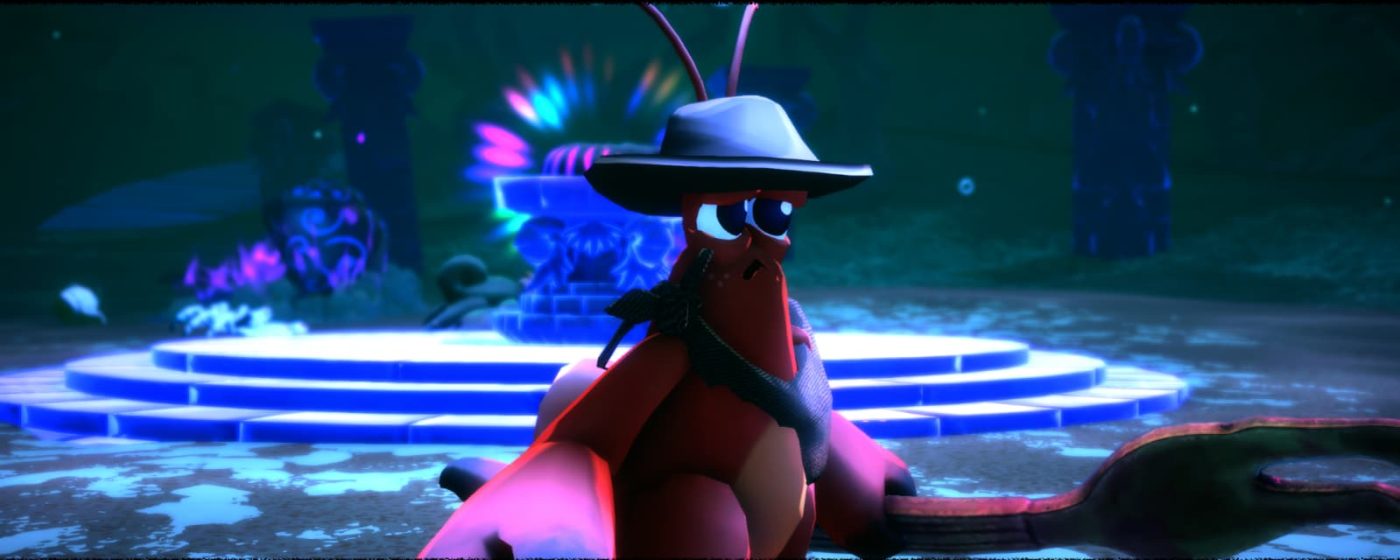
From the very beginning, the game establishes a direct relationship with the player built on exploration, learning, and adaptation. The protagonist, a small crab forced to rely on objects found on the seabed for protection and defense, quickly becomes a symbol of vulnerability and ingenuity. This starting condition not only defines the gameplay mechanics but also introduces one of the most compelling aspects of the experience: the constant need to reinvent oneself in a hostile environment, using whatever is available to survive.
The game world feels credible despite its evident stylization. The ocean floor does not function as a mere decorative backdrop but as a living space, rich in details that suggest a broader reality shaped by ecological dynamics, remnants of human civilization, and creatures adapted to often harsh conditions. This approach fuels curiosity, encouraging players to explore not only to progress but also to better understand the context that surrounds them.
From a gameplay standpoint, the title gradually introduces its systems, avoiding any early overload of complexity. The initial pacing supports progressive learning, leaving room for mistakes and experimentation. This accessibility, however, should not mislead: beneath an apparently simple surface lies a structure that demands attention, precision, and adaptability, fully aligned with the expectations of the genre.
Another significant element lies in the overall tone, which balances irony and seriousness with notable effectiveness. Situations, characters, and even certain design choices convey a lightness that never becomes trivial, coexisting instead with deeper themes and genuine challenge. This balance makes the experience accessible without oversimplifying it, and complex without becoming oppressive.
Another Crab’s Treasure presents itself as a title capable of refreshing a well-established genre through a thoughtful reinterpretation. It shows that originality does not necessarily come from breaking the rules, but can also emerge from reworking them within unexpected contexts. The introduction lays solid groundwork for an experience that promises to engage both on a gameplay level and on a thematic one.
Self-made
Behind Another Crab’s Treasure stands Aggro Crab, an independent studio that has built a distinct creative identity over the past few years, combining a light aesthetic, irony, and a surprisingly deep systemic design. Starting as a relatively small team, the studio has earned its reputation through projects that confidently engage with established conventions, reworking them through a personal and often irreverent lens. In this sense, the game represents a natural evolution of their philosophy: take a highly codified genre and reinterpret it with a fresh perspective, while preserving the rigor that defines it.
The development clearly reflects a leaner production structure compared to large AAA projects, yet this very scale has allowed the team to maintain a cohesive creative vision throughout the entire process. Every choice, from the design of the protagonist to the construction of the underwater world, feels part of a unified plan, free from the inconsistencies that often emerge in more fragmented productions. The strength of the project does not lie in the volume of resources, but in the ability to use them with precision, enhancing each element in service of the overall experience.
The role of the publisher — Aggro Crab itself in this case — further explains the creative freedom evident in the final product. Without external pressures tied to stricter market expectations, the developers were able to experiment with tone, structure, and mechanics without the need to conform to predefined commercial standards. This results in a game that does not aim to replicate its references, but instead uses them as a foundation to build something original.
From an organizational standpoint, the team’s work shows a clear focus on coherence across all departments. Art direction, gameplay, and narrative tone do not develop as separate elements, but as interdependent parts of a single system. This level of integration often emerges more naturally in independent environments, where internal communication remains direct and creative decisions can be made with greater speed and flexibility. The result is a product that feels tight and intentional, without elements included merely to fill gaps.
Another noteworthy aspect lies in the studio’s approach to its relationship with the audience. Over time, Aggro Crab has shown a strong awareness in how it communicates with its community, maintaining an ironic and self-aware tone that also permeates its games. This openness translates into a deeper understanding of player expectations, without ever sacrificing its own identity. Another Crab’s Treasure does not seek to please at all costs, but to express a clear vision — and precisely for this reason, it feels authentic.
The studio’s work and its decision to handle publishing independently ultimately represent one of the project’s key strengths. The combination of creative independence, strong design coherence, and the ability to reinterpret established models allows the game to stand out within a crowded genre, proving that even relatively small teams can deliver meaningful experiences when guided by a clear and well-structured vision.


From Simple to Complex
The story unfolds around a narrative premise that feels as simple as it is emblematic: the protagonist, a small crab named Kril, suddenly loses his shell — an essential element not only for his survival but also for his identity. This initial event, seemingly trivial and almost ironic, becomes the driving force behind a journey that extends far beyond the mere search for a lost object, evolving into a path through a complex, layered, and surprisingly meaningful underwater world.
From the opening moments, the narrative establishes a distinctive balance between lightness and subtext. The starting situation carries a tone that borders on humor, yet it conceals a broader reflection on loss, adaptation, and survival. The shell does not serve merely as a functional object; it represents safety, protection, and a sense of belonging. Its loss forces the protagonist to face an environment that, without that defense, suddenly feels far more threatening.
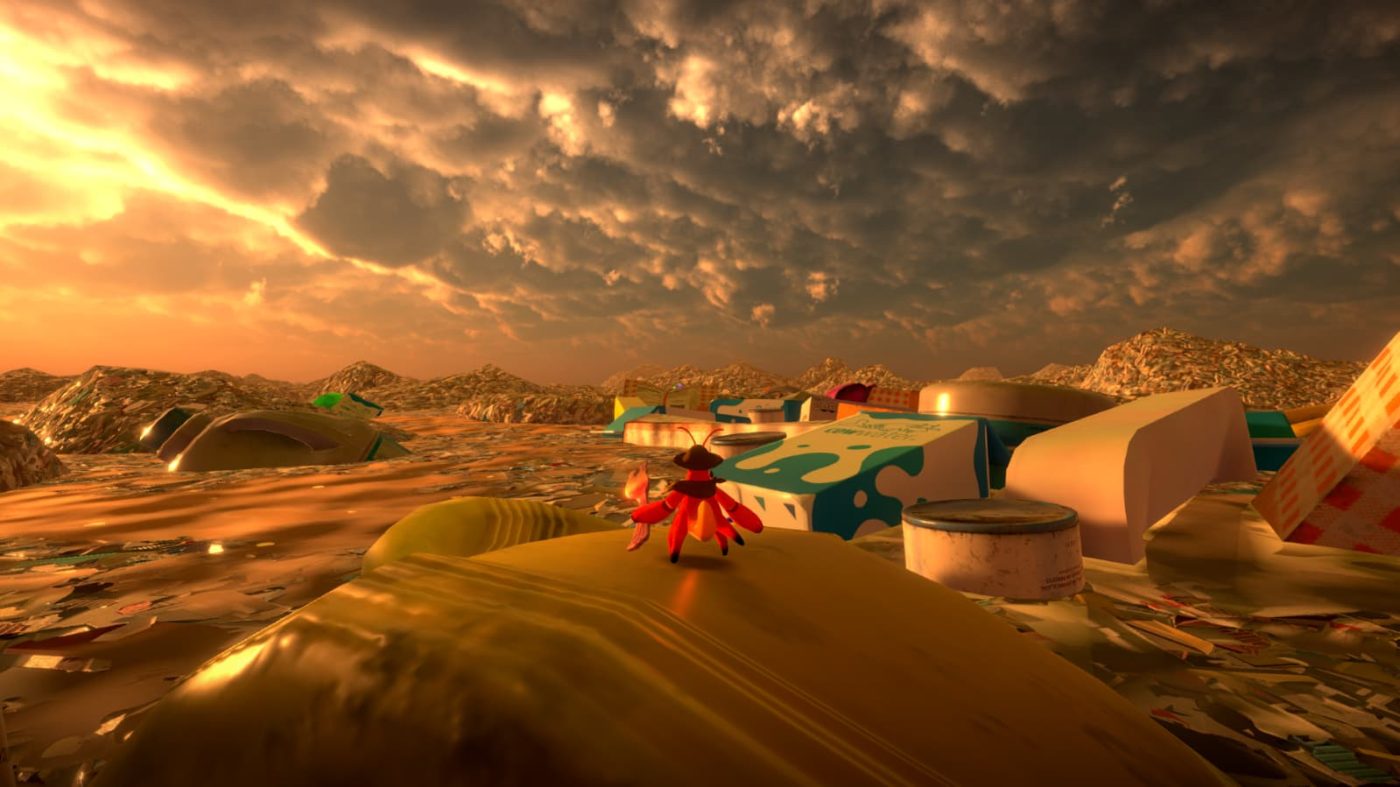
The journey that follows develops through a series of encounters and transitions that allow players to gradually uncover the reality of the marine world around them. This is not a pristine or idyllic setting, but an ecosystem marked by the invasive presence of human waste, which accumulates on the ocean floor and transforms into resources, weapons, and protection — while also acting as symbols of a disrupted balance. This element introduces an additional narrative layer that intertwines with the protagonist’s personal story.
The characters encountered along the way contribute to a broader, ensemble-driven narrative shaped by individuals striving to survive or adapt within a changing world. Each one brings a distinct perspective, often conveyed through dialogue that alternates between irony and reflection. There is no clear-cut division between good and evil: motivations arise from needs, fears, and survival strategies, giving the narrative context a more nuanced quality than traditional structures.
The narrative progression does not follow a strictly linear path, but unfolds organically through exploration and the completion of objectives that often intersect. The search for the lost shell gradually expands, leading the protagonist to confront increasingly complex realities and implications that go beyond his individual situation. The journey thus becomes a metaphor for growth, where the initial loss turns into an opportunity for change.
A particularly compelling aspect lies in how the game uses its environmental context to enrich the narrative. The ocean floor tells silent stories: abandoned objects, submerged structures, and accumulations of waste hint at a human past that continues to shape the present of marine life. This form of environmental storytelling broadens the scope of the narrative, connecting the protagonist’s personal journey to a wider and more universal dimension.
Another Crab’s Treasure builds from a simple idea into a layered narrative that successfully blends irony, critique, and a sense of adventure. It is a story that does more than entertain; it uses the language of videogames to reflect on contemporary themes, maintaining a consistent balance between narrative accessibility and thematic depth.


Complex Themes, Treated with Simplicity
While the plot provides the structural foundation of the journey, Another Crab’s Treasure fully reveals its identity through its narrative approach and the themes it explores. The game adopts a dual storytelling method, alternating between more explicit moments — often conveyed through direct, ironic dialogue — and a subtler construction shaped by environment and context. This duality allows the experience to remain accessible on the surface, while offering deeper layers of interpretation for those willing to look beyond it.
One of the central themes is adaptation. Deprived of his shell, the protagonist must reinvent the way he exists, using discarded objects as protection and tools for survival. This gameplay mechanic quickly becomes a narrative metaphor: living in a hostile world requires the ability to transform what is available, even when it consists of waste or remnants of a larger system. The idea of adaptation never appears in an overtly dramatic form, but instead emerges naturally through the player’s actions.
Alongside this, the game addresses the theme of pollution and human impact on the environment in a surprisingly direct way. The ocean floor is filled with artificial objects — cans, bottles, containers — that integrate into the gameplay itself. These elements do not serve as mere decoration; they form a constant, almost oppressive presence that defines the ecosystem inhabited by marine creatures. Through this, the narrative uses the language of videogames to build an environmental critique that, despite its light tone, remains difficult to ignore.
Another relevant theme concerns value and perception. Within the game world, what humans discard becomes an essential resource for survival among marine life. This inversion of perspective introduces an implicit reflection on what truly holds value, challenging the very notion of usefulness and importance. By relying on waste as protection, the protagonist becomes a symbol of a reality where nothing is inherently meaningless, but everything depends on the context in which it is observed.
The narrative also stands out for its tone, which balances irony and seriousness with precision. Dialogues often present situations and characters with a light, almost caricature-like quality, yet beneath this surface lie more complex themes. This contrast allows the game to address potentially heavy topics without becoming didactic or excessively bleak. Humor becomes a tool that makes reflection more accessible, without diminishing its significance.
The relationship between the individual and the system adds another layer of interpretation. The protagonist moves within a world he does not control, one that often appears indifferent to his presence. The social and environmental structures he encounters are not designed for him, yet he must still adapt and carve out his own space. This theme reflects in the narrative progression, which avoids a strictly guided path and instead leaves room for exploration and discovery.
Finally, the game offers a reflection on resilience. Despite its challenges, the world does not lack vitality: creatures continue to live, adapt, and find new forms of balance. This dimension prevents the experience from becoming purely pessimistic, offering instead a more nuanced vision in which survival remains possible even under adverse conditions.
Another Crab’s Treasure uses its narrative not only to tell a story, but to construct a broader discourse on adaptation, environment, and the perception of value. It demonstrates how a title with an apparently light aesthetic can still engage with complex themes, while maintaining strong accessibility and a clearly defined identity.


Distinctive and Engaging
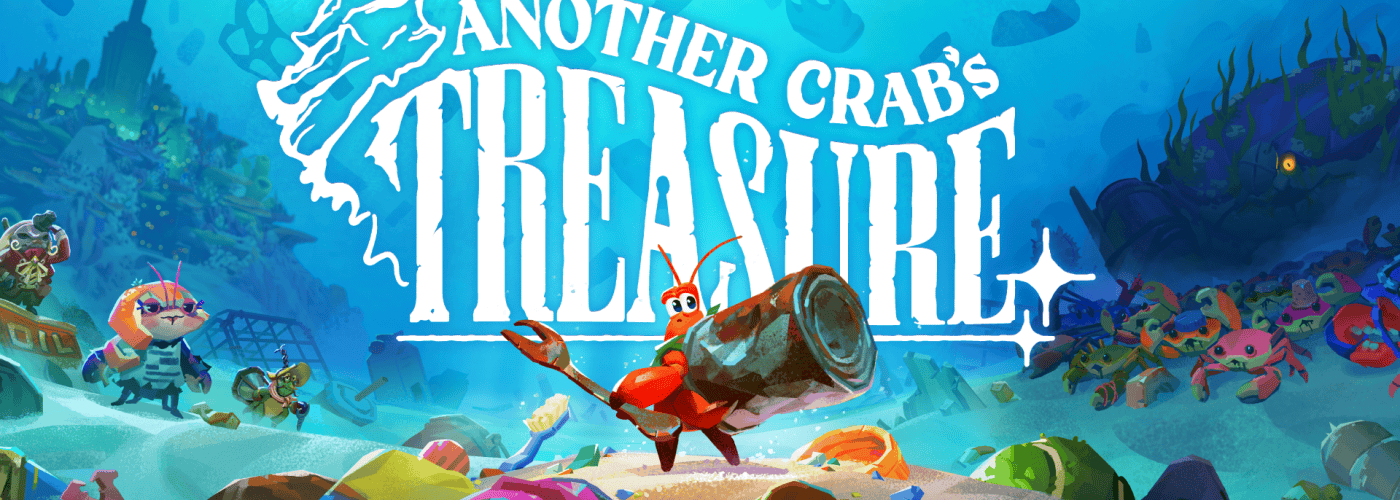
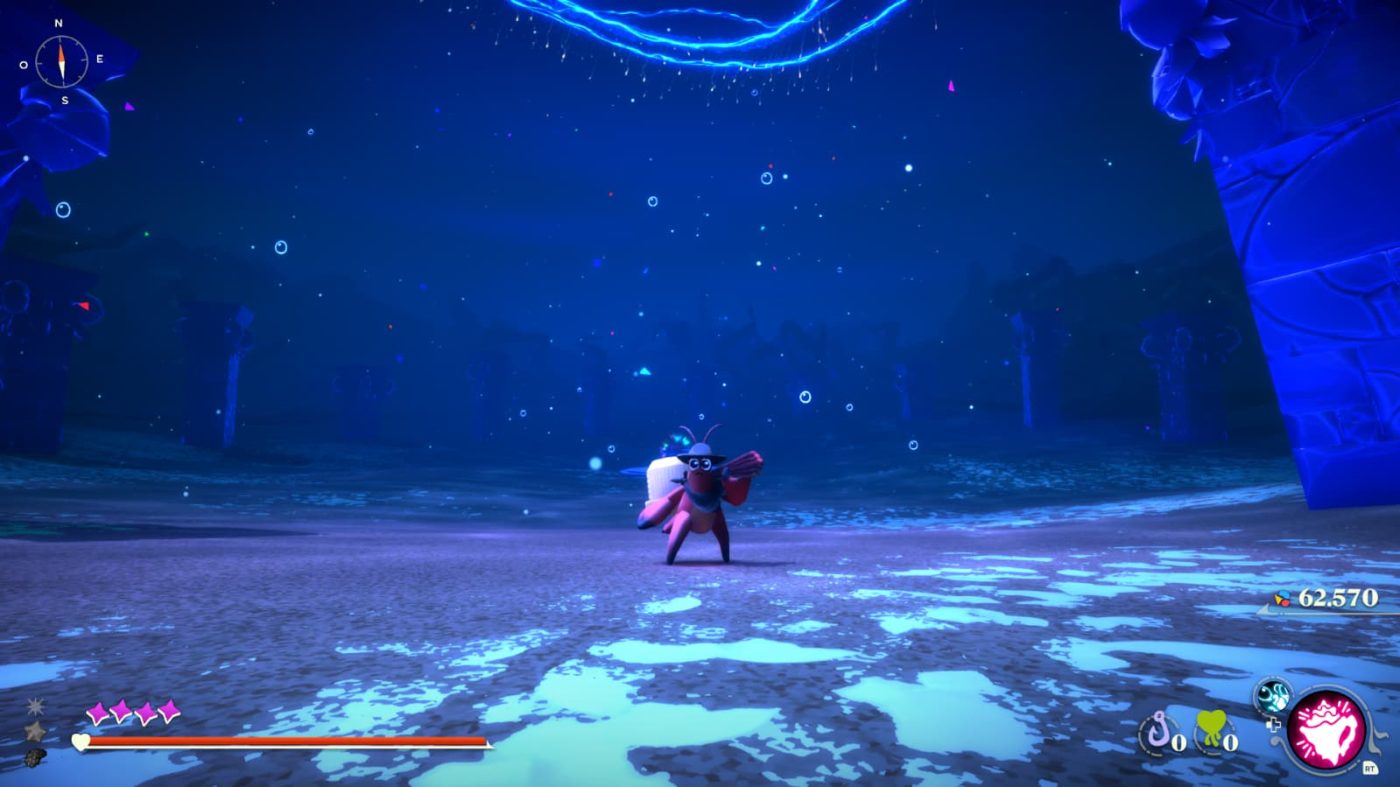
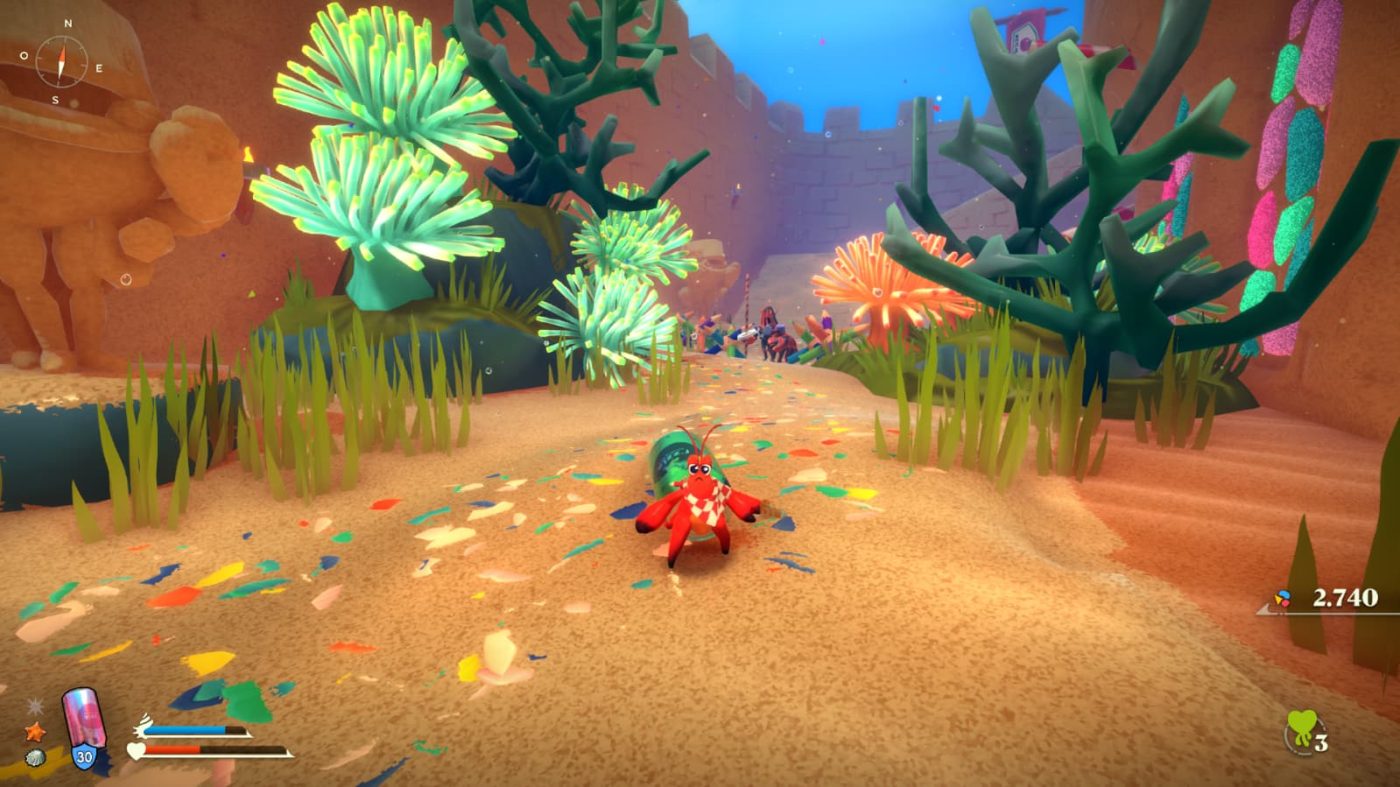
Unlike many titles within the same genre, which tend to favor dark atmospheres and desaturated tones, the art direction here takes a completely different path: a vibrant underwater world filled with color, contrast, and detail that never slips into superficial aesthetics. The use of color palette stands out as one of the most significant elements. The ocean floor features vivid tones, ranging from deep blues to bright corals, alongside shades of green and orange that help shape a visually dynamic ecosystem. This choice serves more than an aesthetic purpose; it directly affects gameplay readability. Interactive elements, hazards, and resources clearly stand out from the background, allowing players to navigate even complex environments with ease.
Character and creature design follows a coherent stylistic direction that combines formal simplicity with strong expressiveness. The protagonist, despite being a small marine creature, benefits from carefully crafted animations that convey emotion and intent through movement and posture rather than detailed facial features. The other creatures populating the world offer notable variety, yet maintain a consistent visual language that avoids stylistic dissonance.
The integration of human-made objects into the environment proves particularly effective. Cans, bottles, containers, and other forms of waste do not appear as foreign elements; instead, they blend naturally into the world, becoming part of both the landscape and the gameplay systems. From a technical standpoint, this requires careful handling of proportions and physical interactions, ensuring that each object feels credible both as a visual component and as a usable tool for the player.
The use of the Unity engine allows for smooth management of environments and animations without aiming for extreme realism, while still ensuring visual stability and coherence. Lighting and particle effects, in particular, reinforce the sense of being underwater: reflections, refractions, and water movement receive careful treatment, never becoming excessive or intrusive. The goal does not lie in showcasing technical complexity, but in supporting immersion through a consistent and believable presentation.
Animations play a crucial role in making the world feel alive and dynamic. Movements of the protagonist, creatures, and environmental elements appear fluid and contextually appropriate, contributing to a tangible sense of physicality. Interactions with objects — especially those used as improvised “shells” — receive equal attention, strengthening the connection between gameplay mechanics and visual representation.
Another key aspect lies in environmental design. The game’s areas offer variety without sacrificing coherence, alternating between open spaces and more confined zones, linear paths and more exploratory sections. The arrangement of elements follows a logic that encourages both discovery and spatial understanding, avoiding any sense of arbitrary disorientation. This balance between complexity and readability stands as one of the design’s main strengths.
The technical execution and art direction demonstrate how a clear stylistic vision can elevate a production that does not aim for photorealism. The use of color, the consistency of forms, and the integration between environment and mechanics all contribute to a visually distinctive experience, capable of supporting and amplifying the game’s themes and systems without ever feeling redundant or artificial.


Acoustically Coherent
The audio design plays a fundamental role in shaping the tone of the experience, contributing decisively to balancing the game’s dual nature: on one side, a light, ironic, almost caricature-like dimension; on the other, a more reflective and immersive layer tied to environmental themes and the structural rigor of the genre. The result is a surprisingly nuanced soundscape, capable of adapting to different situations without ever feeling intrusive or out of place.
The soundtrack stands out for its wide range of tones, alternating between lighter, more dynamic compositions and distinctly atmospheric moments. Tracks that accompany exploration favor softer sound textures, often built around timbres that evoke the fluidity of the aquatic environment. These pieces never attempt to dominate the experience; instead, they create a coherent backdrop that supports the player without distraction. During more intense moments, such as combat encounters, the rhythm becomes more pronounced, yet it never slips into excessive dramatization.
A particularly interesting aspect lies in how the music sustains the balance between irony and seriousness. Some tracks carry playful accents that integrate seamlessly with the visual design and overall tone, while others introduce darker or more melancholic nuances, especially in areas that emphasize environmental decay. This alternation allows the audio to reflect shifts in atmosphere without creating abrupt breaks, maintaining emotional continuity throughout the experience.
Environmental sound design receives equal attention, especially in its depiction of the underwater setting. Muffled sounds, subtle vibrations, and filtered noises contribute to a believable sense of immersion without relying on exaggerated clichés. Water is not only represented visually, but also acoustically, through modulation that conveys density, distance, and depth. This approach strengthens spatial perception and helps players orient themselves more intuitively.
Sound effects tied to the protagonist’s actions are crafted to feel clear and satisfying. The crab’s movements, combat impacts, and the use of collected objects all produce distinct audio feedback, making each interaction more tangible. In particular, the use of improvised “shells” as shields — often human-made objects — comes with sounds that emphasize their material nature, reinforcing the connection between gameplay and narrative context.
Enemies and creatures inhabiting the world also feature well-defined audio identities. Their vocalizations, movements, and interactions help distinguish them, making each encounter recognizable not only visually but also acoustically. This element proves especially important in a game that relies heavily on environmental awareness, allowing players to anticipate situations and react accordingly.
Another noteworthy aspect is the use of spatial audio. Sound directionality is handled effectively, enabling players to perceive the position of enemies, objects, and points of interest even outside their field of view. This enhances immersion and reduces reliance on explicit visual indicators, reinforcing the sense of presence within the game world.
Overall, the audio design aligns perfectly with the game’s vision, supporting both gameplay and narrative components. It does not function as a secondary layer, but as an integral part of the experience — one that amplifies emotion, suggests meaning, and makes the world feel more believable and engaging. Without seeking the spotlight, it plays a decisive role in the overall success of the title.


Classic and Innovative
The most evident strength of Another Crab’s Treasure lies in the remarkably intelligent integration between world building and gameplay — two elements that do not simply coexist, but continuously reinforce each other. The underwater world does not function as a passive backdrop for the action; it acts as a living structure designed to directly influence how players move, fight, and interact with their surroundings. Every environmental design choice carries tangible gameplay consequences, resulting in an experience that feels both coherent and deeply immersive.
The world building develops through a depiction of the ocean floor that blends natural and artificial elements into a deliberately unbalanced ecosystem. Game areas take shape as altered environments where human waste is not a marginal detail, but a structural component. Cans, bottles, plastic, and other debris integrate into the landscape, becoming shelters, obstacles, resources, and landmarks. This approach not only reinforces the environmental theme, but also creates a world that feels recognizable and internally consistent, where every element serves a purpose.
Environmental variety helps maintain player engagement. The game shifts between open, brighter seabeds and denser, more oppressive zones, with pathways that intertwine and overlap in a structure that echoes the interconnected design typical of the genre, while still maintaining its own identity. Exploration is driven not only by progression, but by curiosity: each area conceals hidden paths, shortcuts, and visual cues that reward careful observation and spatial awareness.
From a gameplay perspective, the title adopts a familiar foundation for players experienced with more demanding action RPGs, but introduces a significant variation through its “shell” system. The protagonist, lacking natural protection, must rely on objects found in the environment as defensive tools, each one offering distinct properties. This mechanic forms the core of the gameplay loop: every object differs in durability, weight, and associated abilities, forcing players to make situational choices. The system introduces a meaningful strategic layer, working alongside resource management and combat awareness. There is no single optimal solution; effectiveness depends on the player’s ability to adapt, experiment, and make use of what the world provides. In this sense, gameplay mirrors the theme of adaptation already present in the narrative, creating a rare level of coherence between mechanics and meaning.
The combat system, while accessible, still demands attention and precision. Dodging, parrying, and stamina management remain central elements, yet the design avoids excessive punishment, favoring a structure built around progressive learning. The game maintains a steady level of challenge without becoming overly punitive, making it more approachable than many titles within the same genre.
Character progression supports this philosophy. Upgrades, abilities, and enhancements are introduced gradually, allowing players to become familiar with the systems without feeling overwhelmed. Clarity takes precedence over unnecessary complexity, ensuring that the experience remains accessible without losing depth.
Another important aspect is the overall pacing. The game alternates between more relaxed exploration and more intense combat sequences, creating a rhythm that avoids monotony. Areas are designed to include natural pauses, vantage points, and moments of respite, contributing to a balanced management of tension.
Ultimately, world building and gameplay merge into a cohesive system where every element serves a clear function and contributes to shaping the overall experience. The game demonstrates how innovation within a well-established genre does not require breaking its rules, but rather reinterpreting them intelligently within a new context — giving familiar mechanics renewed meaning.


It Delivers
A critical analysis of Another Crab’s Treasure shows how the game positions itself with originality within a highly codified genre, avoiding both passive imitation and forced disruption of established conventions. Rather than attempting to completely reinvent the soulslike formula, it chooses to reinterpret it through a different lens — more accessible, more ironic, and thematically contemporary. This decision stands as one of its greatest strengths, though it also introduces some inevitable limitations.
One of the most successful aspects is the coherence between form and content. The colorful, seemingly light aesthetic never clashes with the gameplay or the themes explored; instead, it reinforces them. The underwater world, with its blend of nature and waste, becomes an effective example of how design can convey meaning without excessive exposition. At the same time, this very coherence may feel less impactful for players expecting greater visual variety or spectacle, particularly over extended play sessions.
From a gameplay perspective, the shell system represents a genuinely strong idea, capable of setting the title apart from others in the genre. The ability to use different objects as protection introduces a compelling strategic layer that integrates seamlessly into the game world. However, the overall depth of the combat system remains relatively limited. While it works well, it does not reach the complexity or variety found in more ambitious productions, and it may feel repetitive in later stages.
Difficulty balancing also deserves attention. The game maintains a consistent level of challenge without becoming overly punishing, making it more accessible than many similar titles. This approach broadens its potential audience, but may leave more experienced players wanting a higher level of difficulty and a greater demand for technical precision.
From a narrative standpoint, the game stands out for its ability to address meaningful themes — such as pollution and adaptation — without losing its light tone. Irony acts as a mediating tool, making the message more approachable, though at times slightly less impactful. The decision to avoid pushing too far into dramatic territory preserves balance, but can reduce the overall emotional intensity.
Another critical point concerns gameplay variety. Despite strong and coherent world building, certain dynamics tend to repeat, particularly in the later phases. The overall structure remains solid, yet it does not always manage to maintain the same level of surprise throughout the entire experience.
That said, many of these “weaknesses” stem directly from deliberate design choices. The intention to create an experience that remains accessible, coherent, and readable inevitably limits complexity and extreme variation. These are conscious trade-offs rather than actual flaws.
Another Crab’s Treasure ultimately stands as a successful work, distinguished by a clear vision and consistent execution. It does not aim to dominate the genre, but to offer a personal reinterpretation, showing that innovation does not require overturning established foundations. The experience works best when accepted on its own terms: an original, accessible journey that proves surprisingly rich in meaning.


If you want to know more:
Another Crab’s Treasure
PRO
- Original and well-developed core idea
- Distinctive art direction
- Strong integration between gameplay and narrative
- Coherent and meaningful world building
- Well-balanced accessibility
- Clear and readable progression system
- Well-executed ironic tone
- Effective audio design
CON
- Combat system lacks deeper complexity
- Repetitive elements in later stages
- Limited enemy variety
- Not suited for players seeking extreme challenge


7/10