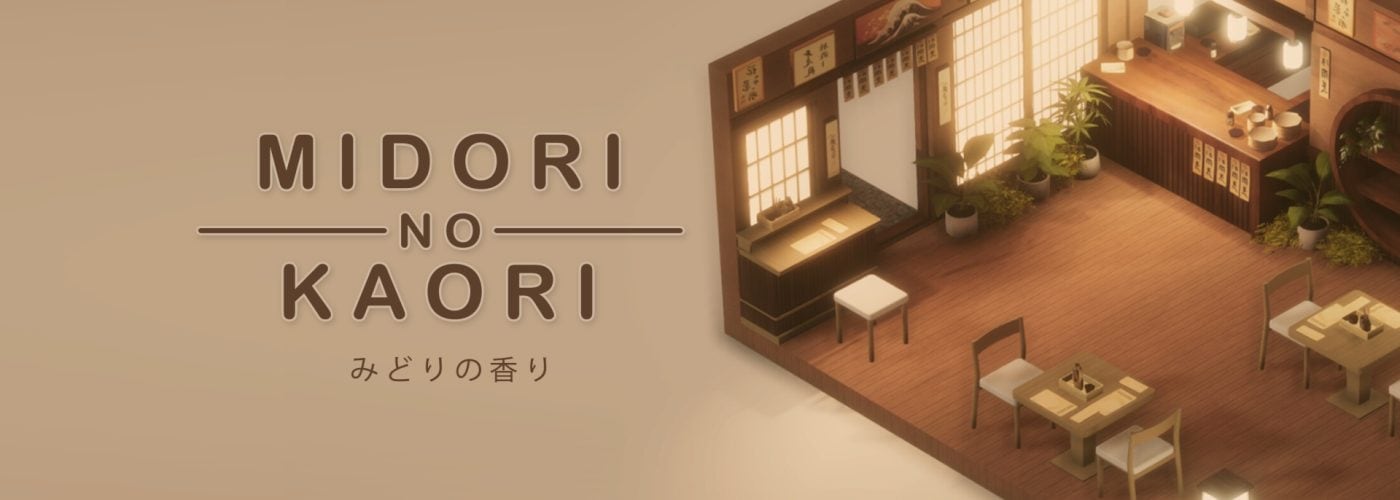
Space management, automation, and atmosphere: Midori no Kaori as a cozy experience built on rhythm and permanence.
Midori no Kaori is an indie cozy game developed and published by TheLaba, available on PC via Steam. After an Early Access period that began on November 27, 2024, the game reached its full release on October 21, 2025, establishing itself as a contemplative and relaxed experience, far removed from traditional ideas of challenge and competition.

The game focuses on building and customizing a restaurant inspired by traditional Japanese aesthetics and atmosphere.
It offers an experience without strict objectives, scores, or failure conditions. From the very first minutes, the design avoids testing the player’s skills. Instead, it provides a space to inhabit, observe, and shape over time.
The design philosophy behind Midori no Kaori remains clear throughout: reduce pressure, slow down the pace, and encourage an intentional form of play, closer to permanence than forced progression.

A cozy game that prioritizes rhythm and permanence
Within the cozy game genre, Midori no Kaori adopts a measured and consistent approach. The gameplay revolves around space management rather than resource management in a strict sense: furnishing, decorating, and organizing the restaurant becomes the core activity, while time flows without imposing urgency.
The game features no timers, penalties, or mandatory objectives. It does not ask the player to “win,” but to find a personal balance within the space they create. This design choice makes the experience especially suitable for players who look for a game to enjoy at a relaxed pace, even in short or intermittent sessions, without the pressure to optimize every action.
Midori no Kaori thus presents itself as a form of soft management, where satisfaction comes from watching the restaurant take shape and come to life, rather than from reaching numerical milestones.

Automation and idle elements: a management system that can turn passive
One of the most distinctive aspects of Midori no Kaori lies in its automation system, which allows the restaurant to operate almost autonomously. Once the player sets the foundations, customers receive service automatically, and the game continues to generate income without requiring constant interaction.
This feature gives the title a light idle-game quality, without fully embracing that structure. Players can leave the game running, return after some time, and use the accumulated currency to expand, improve, or simply beautify the space.
Manual interaction always remains available, but the game never forces it. This flexibility makes Midori no Kaori particularly appealing to players who enjoy semi-passive experiences that adapt to their available time and attention.

Art direction and visual presentation: balance and coherence
From a visual standpoint, Midori no Kaori follows an essential and controlled art direction. The game avoids both hyper-realism and overly stylized exaggeration, opting instead for a color palette built around natural, desaturated tones: greens, browns, and warm, soft lighting.
The attention to detail does not aim for spectacle, but for perceptual coherence. Every decorative element, from architectural structures to the smallest objects, fits naturally into the environment. The restaurant does not function as a purely utilitarian setting, but as a livable space designed to encourage the player to linger.
Lighting, environmental animations, and sound design work together in harmony. Rain, soft lights, and subtle music do not tell an explicit story, but act as emotional regulators that maintain a consistently calm and contemplative tone.

Lore and context building: minimal environmental storytelling
Midori no Kaori abandons traditional narrative structures. The game features no complex dialogue, explicit backstories, or clearly defined narrative arcs. Instead, the context emerges through atmosphere, repeated actions, and careful observation of the environment.
The game conveys its emotional dimension through minimal environmental storytelling, leaving wide interpretative space to the player. Rather than presenting a conventional narrative, the experience works as an experiential container, allowing each player to build a personal relationship with the space they create.
This approach limits immediate narrative impact, but it strengthens the project’s overall coherence and improves accessibility.

The developer and the production journey
TheLaba, the pseudonym of Leonardo, developed Midori no Kaori. Leonardo is a 27-year-old Italian developer from Milan who carried the project forward entirely on his own for over a year.
His background stems from an early passion for video games, particularly large-scale narrative adventures and the interactive storytelling potential of the medium. During middle school, Leonardo began creating his first small 3D projects, later continuing his education at a technical IT high school.
In the following years, he developed several mobile games, gaining hands-on experience both technically and from a production standpoint. At the end of his studies, he presented a historical video game as his final thesis, integrating multiple themes from his academic path.
Before fully committing to independent development, Leonardo worked in Research and Development within a multinational company, focusing on augmented reality and virtual reality. This experience proved especially valuable from an organizational and project management perspective.
The decision to develop Midori no Kaori came from a desire to create something more personal and artistically expressive.
After building two small horror games, Leonardo chose to pursue a more ambitious project developed independently. The response exceeded expectations. Many players connected with the game’s deeper themes, especially those related to death and happiness.
Throughout Early Access, community dialogue played a central role in development. Leonardo gradually expanded the game with new decorative elements and AI improvements. Balance adjustments and a broad localization effort were added over time.
The game eventually supported eight official languages. Strong attention was also given to technical stability. Numerous fixes and refinements were delivered throughout development. A symbolic detail closes this journey. Shortly before the full release in 2025, Leonardo was in Japan, already working on a new project. Midori no Kaori began as a declaration of love for a specific cultural imagery. It completed its cycle while its creator was physically immersed in the place that inspired it.
Leonardo currently works on a second, larger project, which he plans to reveal in the near future.

Conclusion: is Midori no Kaori the cozy experience you’re looking for?
Midori no Kaori does not target players who seek complex challenges or deep management systems. It offers a slow, intentional, and deeply relaxing experience, designed for those who enjoy cozy games, automation, and the act of building spaces meant to be lived in rather than optimized.
Its greatest strength lies in coherence: every design choice works to reduce pressure and support personal engagement. If the idea of building a zen Japanese restaurant, letting it run almost on its own, and returning to it whenever you feel the need appeals to you, this indie title deserves attention.

Discover Midori no Kaori on Steam and decide whether it can become your digital refuge.
Midori no Kaori
PRO
- Relaxing and cohesive atmosphere
- Flexible and accessible gameplay
- Strong authorial identity
CON
- Limited gameplay depth
- Idle-game feel not always appealing
- Minimal narrative


7.2/10