Micro-tales in rhyme, suspended between chance, irony, and branching destinies
In today’s indie landscape, a clear trend keeps emerging: reduce instead of expand. Cut systems, compress mechanics, focus the experience around a strong, recognizable idea. Fate’s Theater, developed by Totally Normal Creature and released on February 17, 2026 on PC, follows this direction with precision and avoids any ambiguity from the start. It does not aim to be a competitive card game, nor a structured roguelike, but a smaller and more focused object: a “micro-tales toy” built around the generation of short rhyming narratives.
The premise works through a simple and effective idea: two fairies, Fortune and Misfortune, compete over mortal lives, bending outcomes toward favorable turns or far more cruel resolutions. The player steps in by combining cards and influencing this balance, generating a series of couplets — over 400 — that compress entire narrative situations into just a few lines.
This approach shifts the focus immediately. The experience does not revolve around building, accumulating, or mastering a system, but on observing what happens when specific elements interact. In this sense, the game does not rely on traditional progression, but on a continuous alternation between curiosity, surprise, and formal consistency.

What Fate’s Theater Actually Is
Calling Fate’s Theater a simple card game misses the point. Cards exist, but they mainly act as combinatory devices, tools that trigger small narrative events. The core experience does not lie in deck-building or resource optimization, but in producing outcomes: short stories, closed in two lines, born from the interaction between archetypes and opposing forces.
The system relies on a clear binary structure. Each situation can unfold in two directions: one guided by Fortune, tied to more favorable or ironically positive outcomes, and one driven by Misfortune, which leans toward the macabre, the absurd, or outright tragedy.
The cast follows the same essential logic. You find archetypal figures: witch, dragon, bard, hermit, peasant, ogre, innkeeper. Each card represents an immediate narrative function, easy to read and ready to interact with others. The game does not build a world in the traditional sense. It builds a field of possibilities — a basic grammar made of roles and situations that the system continuously recombines.
This structure allows immediate access while reinforcing the theatrical nature of the experience. Characters do not evolve or develop. They enter the stage, perform their role, and disappear. The focus stays on the event, not on identity.

Between Control and the Unpredictability of Fate
From a gameplay perspective, Fate’s Theater adopts a deliberately contained structure. Simple rules with secret wagers and quiet mind games describe a system that stays accessible without becoming passive. The mechanics revolve around numerical values and direct card comparisons, with each interaction determining whether Fortune or Misfortune drives the outcome.
The player does not simply watch a random sequence unfold. The system allows intervention, even if in a limited form. Rather than controlling results outright, the player nudges them in a direction.
This middle ground fits the project well. Too much control would flatten surprise; pure randomness would remove any sense of involvement. Fate’s Theater balances both, leaving space for intuition while preserving unpredictability.
At the same time, this lightness introduces a clear limitation. Players who look for systemic depth, long-term build strategies, or strong progression may find the experience too thin. Repetition can surface over time. Still, this limitation aligns with the game’s intent: a short-form experience built for quick sessions, driven more by variation than by mechanical complexity.

The Core of the Experience: Rhyming Couplets
Fate’s Theater places its ambition squarely in its writing. Each outcome takes the form of a couplet — two lines that must contain an entire micro-narrative: setup, development, and resolution. This constraint demands precision and strong control over rhythm.
For example:
A cultist chants dark verses as a bard walks by…
The bard performs it at the inn – none lived to ask him why.
In just a few words, the game constructs a complete sequence. The opening line sets up a readable but ambiguous situation. The second line shifts the tone, turning the event into an unexpected and darker conclusion. The result resembles a micro-fable, where lightness collapses into something unsettling.
The writing does not function as decoration. It acts as the main content. Cards generate text, and the system produces variation. The real collectible element does not lie in the combination itself, but in the narrative outcome. Progress does not come through “wins,” but through discovery.
This shift changes the entire experience. Each couplet stands on its own, complete and self-contained. That immediacy makes every outcome easy to consume. The game succeeds when each micro-story remains engaging enough to justify the next.

A Theater of Silhouettes Between Fairy Tale and the Macabre
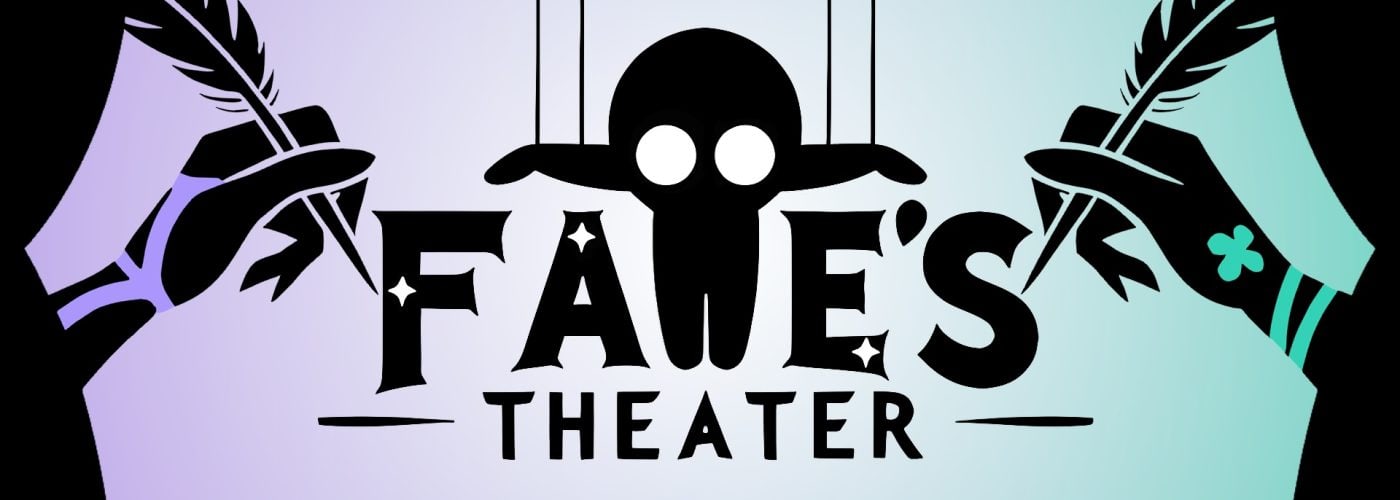
The visual design reinforces the game’s direction with strong coherence. Black silhouettes, suspended characters, vegetal frames, and desaturated backgrounds clearly evoke a shadow theater or a small puppet stage. This choice does more than create a pleasant style. It builds a conceptual frame that aligns perfectly with the core idea.
Characters do not appear as fully realized, three-dimensional figures. They exist as shapes, icons, cut-out forms. This keeps them readable while creating emotional distance. When an event turns grotesque or tragic, the player does not experience it as realistic drama, but as part of a staged performance. Cruelty becomes spectacle, and tragedy fits within a controlled space.
The limited color palette, with green and purple accents, sharpens the game’s identity without overwhelming the screen. It highlights essential elements — characters, values, outcomes — and keeps the focus where it belongs.
Reactive, atmospheric music supports this theatrical dimension, turning each interaction into a brief performance rather than a traditional challenge.


Conclusion
Fate’s Theater stands as a small but highly coherent project. Every element — cards, archetypes, moral bifurcation, rhyming couplets, and shadow-theater aesthetics — moves in the same direction: building a compact machine for micro-narratives.
Its strength rests almost entirely on the variety and quality of its writing. The promised 400+ stories sustain the structure well. The game maintains curiosity through constant variation, keeping the experience fresh despite its deliberately simple mechanics. That mechanical lightness does not weaken the design; it reinforces its purpose.
The direction remains clear and distinctive. Fate’s Theater does not expand the language of card games through complexity. It bends it toward synthesis. A miniature stage where fate unfolds in opposite directions, and where every combination turns into a story.

If you wanto to know more:
Fate’s Theater
PRO
- Strong, well-crafted writing in rhyming couplets
- Clear and cohesive identity across mechanics, tone, and visuals
- Accessible system that leaves room for unpredictability
- Strong sense of discovery through narrative variation
- Distinctive and well-integrated art direction
CON
- Limited mechanical depth
- Repetition may emerge over time
- Not ideal for players seeking structured progression
- Gameplay engagement takes a back seat to the narrative layer


7.5/10