It’s not easy to see a 2D action platformer like Majogami. Speed, style, great glance and above all: an exaggerated amount of fan service.
It’s not easy to create a 2D action game with personality like Majogami is. Different ingredients make up the dish and must be dosed as best as possible. Especially combining both the idea for a story and an aesthetic and the search for original mechanics well integrated into the gameplay. Often this is not enough to make a product good. With the new mechanics, there must be solid old ones that must act as a foundation.
Majogami immerses the player in a visually striking world, complemented by clever and well-crafted level design. A world of paper where the protagonist makes her way through numerous dangers to recover her memory. I almost forgot, we can’t help but talk about the fan service that the game offers, even leading to ecchi.
Let’s take a closer look at what Majogami has to offer.
A “one of a kind” narrative
Let’s start from an assumption, Majogami does not have an unforgettable plot. This doesn’t cause me any problems, also considering the genre, but there are some considerations to make.
The protagonist of the story is Shiroha, awakened without memory in the world of Orchesgra. A distorted and perverse world made of paper and dominated by Craft Witches who dominate the various biomes of this world.
Shiroha will not be alone in this adventure, in fact a paper creature will accompany us: our father Shiori. To recover our memory and escape from this world we must recover the Recarte. These are in the possession of the Craft Witches and we will have to snatch them from them to obtain the lost memories.
As mentioned before, Majogami makes extensive use of fan service. Nothing explicit, but double entendre, skimpy clothes and “unconventional” shots will accompany you throughout the story. So far there would be nothing wrong if it weren’t for the bloody themes that sometimes clash with the dark and bloody mood chosen by the narrative.
Unfortunately the story takes place with still images that alternate together with an incredible amount of lines of dialogue, although spoken in Japanese. Each act and scene we will face will have before and often after, a long sequence of static dialogues. Considering the number of acts plus the new game plus, the quantity of lines of dialogue becomes overwhelming. Everything increases with the optional dialogues to be unlocked in game and then listened to outside the game.


Aesthetic choices
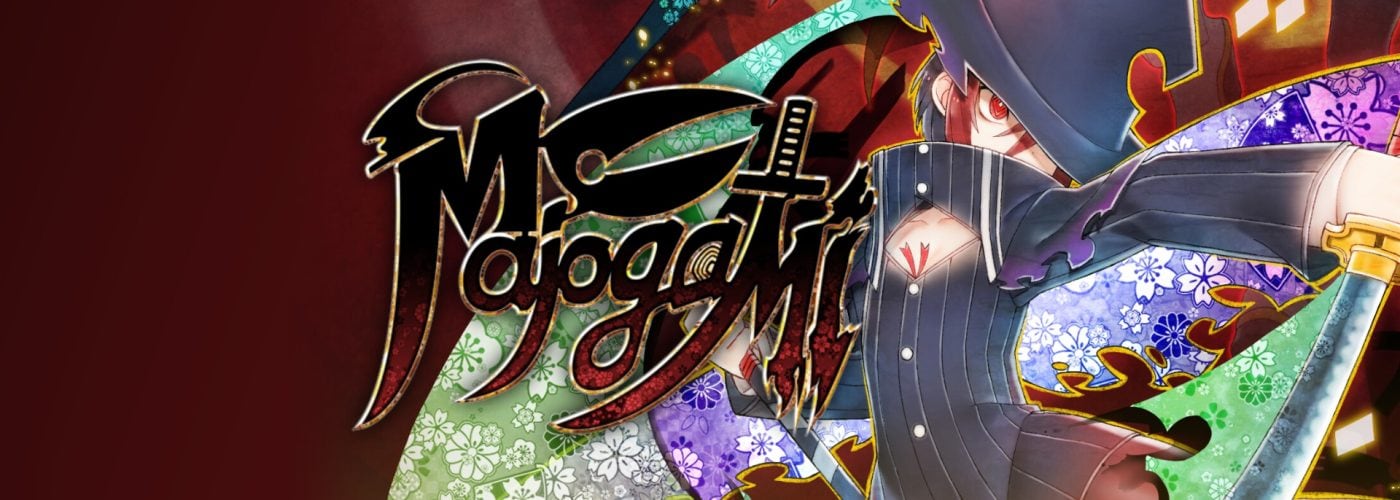
What stands out most about Majogami is undoubtedly its visual style. The characters that move within this paper universe are in perfect manga style. I will not dwell further on the fan service issue, which I have already spoken about, but on the general aesthetics of the title. Majogami‘s adventure is told as if it were a fairy tale and takes place on the pages of a book. In fact, in this world of paper, a dark page represents an act where, for each scene passed, the darkness thins out. Until you get to the boss fight. Once the latter is defeated, all the darkness will be cleared from the pages, so as to move on to the next act.
On an aesthetic level, the acts are very different from each other, with their own gimmick and a very coherent aesthetic. The developers have been able to create biomes with original and well-curated aesthetic and gameplay solutions and opponents. The combat is full of colors, lights and effects that are beautiful to look at. We’ll then talk about how it intersects with gameplay. The boss fights are also spectacular, leaving aside the mechanics, they are beautiful to look at. They too have the same ecchi mood that envelops the entire title.
Talking about music, we have two strands. Solo piano songs: well edited, well played and engaging during the levels and songs sung in Japanese, in Jpop rock style. The latter will arrive during certain in-game actions and at times could be intrusive to the player’s ear.
A gameplay that tries to innovate
Majogami is no different from other 2D action games in the genre. Levels with treasures, secrets and the classic shop where you buy talismans to equip to change our builds. Along with them there are moves for the character to learn. However, Majogami differs in some aspects. We only have one type of basic attack, one jump and one defensive move. By holding down the Y button (PC-XBOX), Shiori defends us by making us immune to all attacks, at the cost of remaining immobile. While strong, this compromises many game design choices, especially against bosses. It is obvious that learning the movesets rewards the player, and then improves him. This technique, accessible from the beginning, breaks precisely this principle and it is a shame, in my opinion.
The boss fights are interesting where we don’t have to remove hit points but increase a bar to the limit which will then take the boss to the next phase. Procedure that will lead to a sort of QTE until defeat.


Setsuna and Astrals
Let’s talk about the positive and interesting sides instead: Setsuna and the Astrals.
The Setsuna is the fulcrum on which both the combat and part of the exploration of the levels are based. Shiroha can target an enemy and hit them with a deadly slash by teleporting towards them. This type of attack can be chained together, making the action frenetic and spectacular. The boss fights themselves will add cutscenes once we use this ability at the right time. Furthermore, the Setsuna can be directed horizontally, vertically and obliquely. An element not to be underestimated because some enemies need to be hit in a specific direction to breach defenses. A very strong move that needs to be charged with standard attacks.
The Astrals, on the other hand, are creatures that we will meet during the adventure. I won’t give any spoilers about the number but I will describe its capabilities. We can, through Power words, found in the levels, increase our affinity with them. This gives passive bonuses and dialogue lines.
With them we get two transformations: the first is ascension where the weapon transforms and we get both new moves and the double jump. Once some requirements are satisfied we can move on to Astralization. A total fusion that transforms us, makes us stronger and allows us remarkable mobility. We can jump endlessly and reach otherwise inaccessible areas.
Obviously transformations have a limited time.
Less is more
A short paragraph to explain the implications between interesting ideas, style and ingenuity in implementation. Let’s start from the aesthetics where the colours, lights and speed sometimes put the player in difficulty. We talk about certain clashes and the difficulty of sometimes finding the protagonist on the screen, due to the speed with which we attack. Paradoxically, aesthetics work against the most interesting mechanics that the game offers.
Although the level design is sufficient, on the contrary, it has some really intelligent ideas, precisely due to a bit of “dirt” on the controls which makes exploration sometimes frustrating.
Plus even good level design ideas are lost during Astralization. Being able to practically jump-fly bypasses both the clash with opponents and the level design created, a shame.
Furthermore, in boss fights, when transformed, some Quick Time Events sometimes do not trigger with the consequence of taking damage unfairly.
However, they are naive in adding good ideas without considering all the consequences.


My Two Cents
INTI CREATES CO. with Majogami definitely did a good job. The video and sound are well inspired and of good quality, the level and game design are interesting and intelligently placed. An unexceptional and predictable narrative but still enjoyable and the use of really fun and interesting combat system ideas. The feel of power that Setsuna gives you is strong, as well as being very fun to watch and play. However, everything is still immature. Majogami seems like a game with good potential but still with numerous microflaws. An experiment that, if cleaned up, can give rise to a good sequel.
There are no glaring flaws, but several small stumbles and moments of naïveté accumulate, undermining the experience over time. For instance, the J-pop rock soundtrack that accompanies the protagonist’s transformations can be intrusive and at odds with the game’s atmosphere. Similarly, the static narrative can feel tiresome, and the decision to reserve the story’s conclusion for a New Game Plus may frustrate some players. Lastly, the inclusion of ecchi elements – sometimes in combination with crude themes and characters who appear underage – may make certain players uncomfortable. It should be emphasized, however, that the game contains no explicit sexual content for adults.
Review code granted by the developers.
Majogami
PRO
- Good graphic and sound
- Original and engaging combat system
- Original stage and level design
- Fan service
CON
- The game seems still “immature” in its mechanics
- Overwhelming static narrative
- No macroscopic defects but many small stumbles and naivety which all together undermine the experience in the long run
- Fan service


7.2/10